
In this article
This week, improve the containers and the organization of your dry storage. The goal is to protect food, retain its information and facilitate rotation. Reconditioning is not an obligation for each product and does not guarantee indefinite storage.
Examine the place before packaging
Choose a space that is clean, dry and protected from large temperature variations. Avoid the vicinity of chemicals, areas exposed to an ingress of water and unstable installations. Check the capacity of the shelves: a dense reserve represents a significant load.
Keep access to products and dates simple. A forgotten food in an opaque container often ends up being replaced unnecessarily. Plan an inventory proportionate to your reserve, with quantities, location and next check.
Check the suitability for food contact
Use containers explicitly intended for the intended food use. The plastic number or the HDPE symbol alone does not demonstrate that the container is suitable for storing a given food. Do not use a container that contains a chemical.
Check the cleaning instructions, seal and closure. The outer bins can organize already closed packaging, but are not automatically adapted to direct contact with food, waterproof or resistant to pests.
Keep the necessary information
If you transfer a product, keep its name, allergens, lot, date and instructions. Add the opening or reconditioning date. Do not mix lots without being able to ensure their traceability and avoid masking the date of origin by an assumed duration.
Adapt the portions to your consumption and the possibility of storing the product after opening. A very large bag is not necessarily economical if its content changes or if a part must be thrown away.
Understand what accessories do
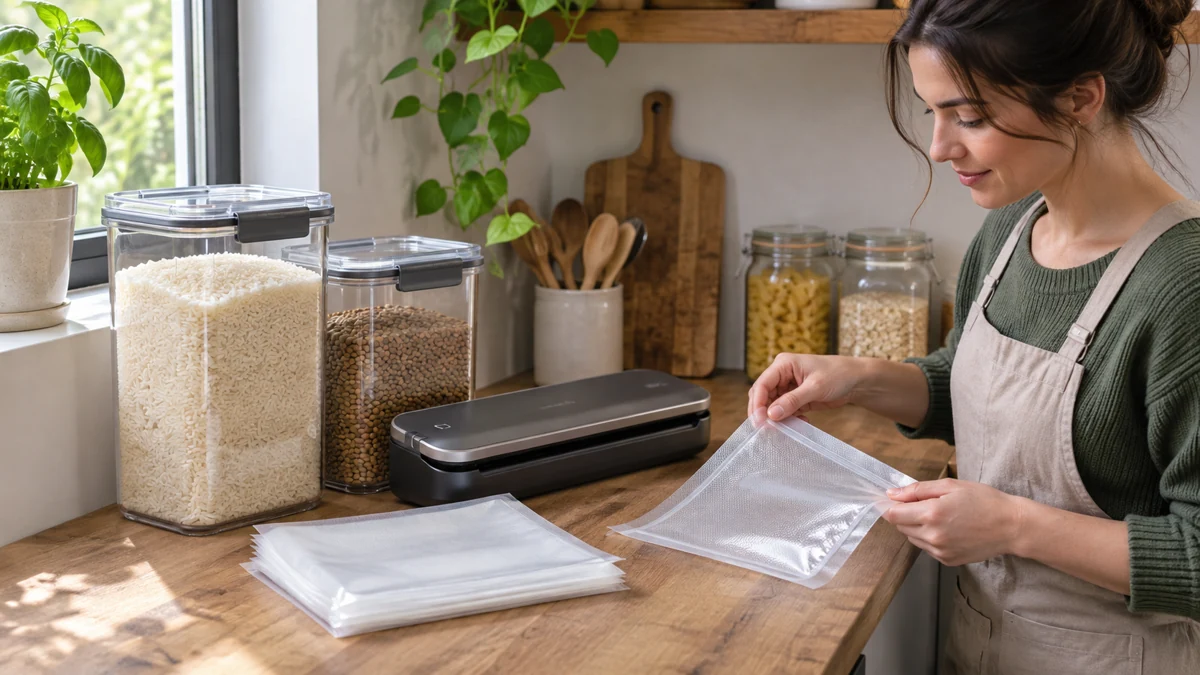
A barrier packaging can limit certain exchanges with the environment, depending on its characteristics and its closure. A vacuum sealer removes some of the air in a suitable packaging; it does not sterilize and does not make any food stable at room temperature.
Oxygen absorbers and desiccants have distinct uses and restrictions. Do not always add them to all foods. Follow validated recommendations for food, its moisture and packaging; low oxygen conditions do not provide universal protection against food risks. Keep non-food bags identified and out of reach of children.
Test before generalizing
Start with a small batch of a regular dry food and an appropriate method. Inspect the closure and note the result. If you do not have a validated method, keeping the product in its commercial packaging according to the instructions is often preferable to an improvised transfer.
The duration depends on the product, process and conditions. Don’t keep a list of supposedly “eternal” foods. Oils, flours, powdered products and other foodstuffs evolve differently; use reliable indications and rotation.
Actions of the week
- Check the place, the shelves and access to the reserve.
- Identify products that actually need another container.
- Confirm the food use of the containers.
- Keep directions and prepare practical portions.
- Test a method before repackaging an entire stock.
Your expected result: better organized and traceable foods, without depending on an invented storage time.
Put this reading into practice
Perform the action as you wish and then check the result. Your follow-up remains specific to this route.
52 weeks to strengthen your preparation; Week 19
Organize the containers
Your action: Check the sizes, closures and intended uses of the containers, then label what needs to be followed.
To check: The food contact and the load are adapted; the containers do not block the exits.
To do