
In this article
This week, supplement your food supply with meals that the household already consumes. After the first base of week 1, the goal is to identify shortages, better distribute purchases and associate food with water and the necessary means of preparation.
Take stock before buying
Write down the meals available with your current reserves. For each, check the actual portions consumed, allergies, texture and special needs. A bag of rice or a jar of condiments alone is not a complete meal. Also note what requires water, cooking or a refrigerator after opening.
Start by filling the incomplete days. If the budget is limited, add one or two regular products during the races rather than buying a specialized set. The interest of the reserve is its availability and rotation; no future price increases or automatic savings are guaranteed.
Combining complementary foods
Provide simple options: canned vegetables, fruits, fish or legumes, grain products, foods suitable for snacks and small amounts of seasoning. Choose formats that the household can finish without keeping a cold rest for a long time. Consider protein needs, variety and dietary constraints.
Do not abruptly change the diet of infants or a person with a medical need. Infant formula meets a specific use; it is not a supplement intended to “boost” the immunity of adults. Check with the professionals concerned the preparation and storage of particular products.
Check the opening and preparation
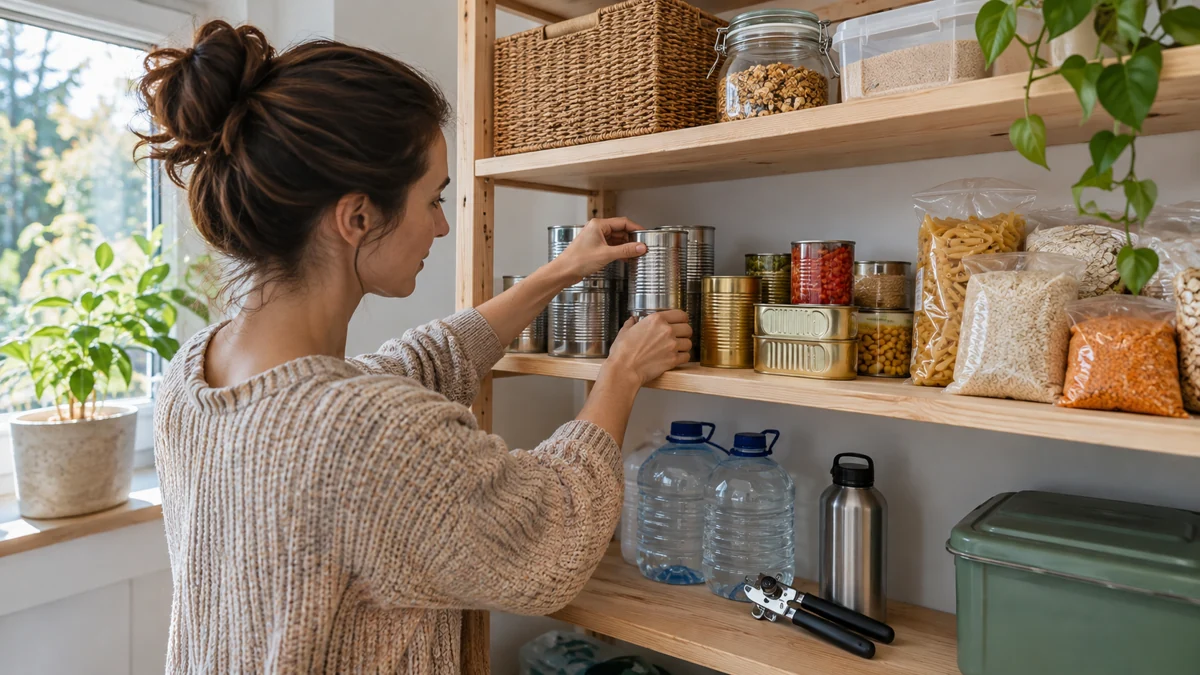
A manual can opener must be present if your reservations require it. Try it on the containers you buy and check that users can handle it.
Organize at least a few consumable meals without cooking. If you plan a stove, its conditions of use must be respected: a device reserved for the outside is not used in the housing. Do not plan a recipe whose only means of cooking would be unavailable or dangerous during the breakdown.
Complete the water without making the reserve inaccessible
Separately calculate the water for drinking, food preparation and hygiene. Check local recommendations and consider people, animals and the climate. Distribute containers to keep them manipulable; a large full canister may be too heavy for some members of the household.
Use containers provided for drinking water and maintained according to their instructions. Do not assume that side stacking is allowed: check for closure, stability and load. A filter does not replace a ready-to-drink supply and does not eliminate all contamination.
Store to consume and renew
Choose a place that is clean, dry, accessible and protected from large temperature variations. Keep food separate from household products and away from possible water ingress. Put the products to be consumed first in front, without hiding the original dates and instructions.
A marker can be used to mark the date of purchase or opening on an appropriate area of the package. Do not apply it on the food and do not replace the manufacturer’s instructions with an assumed duration.
Actions of the week
- Count the available meals and make a short list of shortages.
- Gradually buy foods that are known and adapted to the home.
- Check the opening, the necessary water and the safe means of preparation.
- Store the products according to their rotation and keep their indications.
- Prepare a meal from the reserve to validate your choices.
Your expected result: a more consistent reserve, of which you really know how to prepare and serve meals.
Useful reference
Preparing a suitable kit for the home - Public Safety Canada.
Put this reading into practice
Perform the action as you wish and then check the result. Your follow-up remains specific to this route.
52 weeks to strengthen your preparation; Week 11
Consolidating Reserve Meals
Your action: Compose complete meals from your inventory, with rotation compatible with the usual diet.
To check: Special needs and allergens are taken into account; quantities are verifiable.
To do