
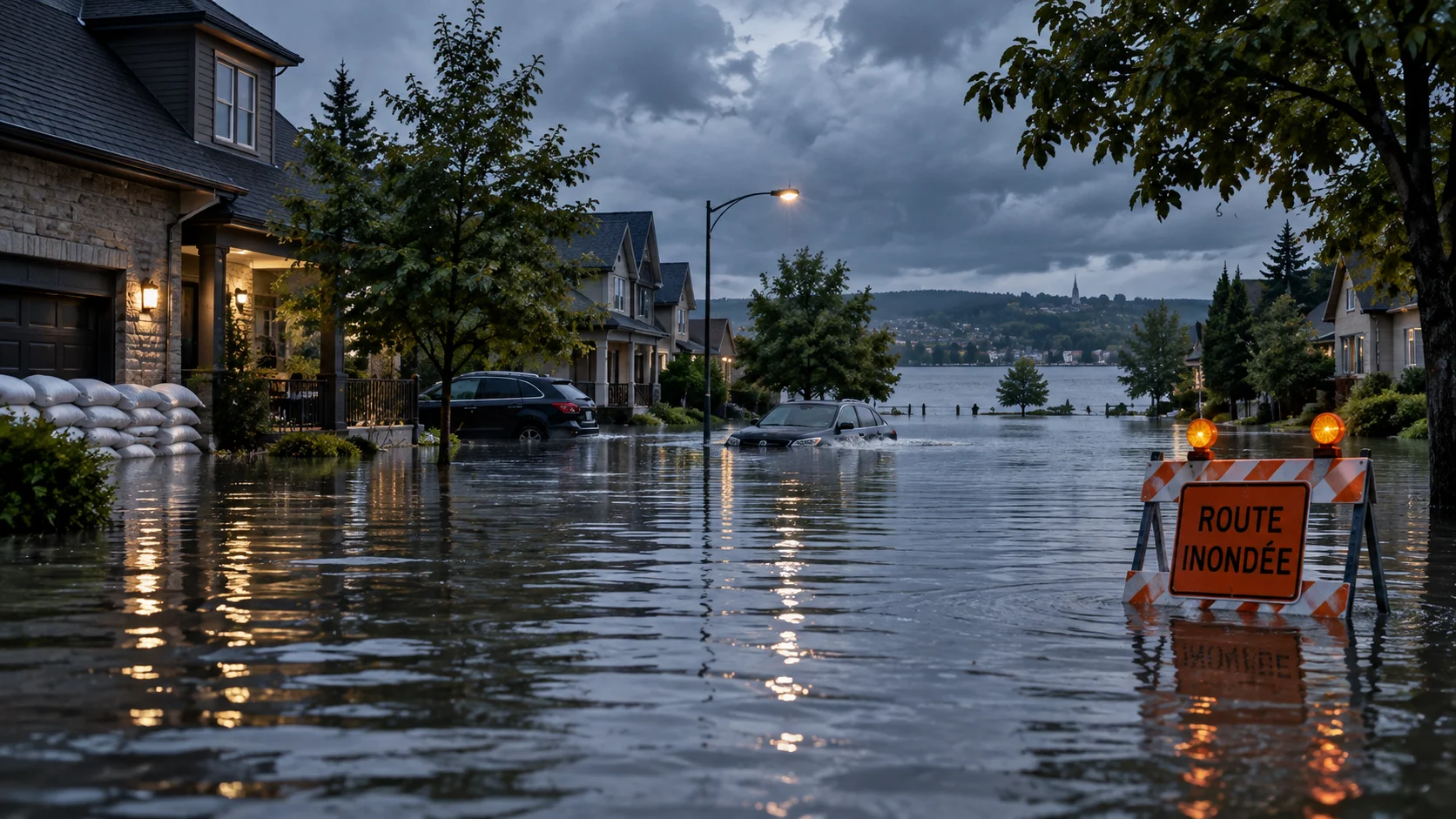
Natural · Risk index 7/9 (Quebec) · 3/9 (France)
Ice jams and break-up
An ice jam is a dam of ice that blocks a river. Water can rise within minutes upstream, then sweep everything downstream when it gives way. In Quebec, it is a risk every late winter.
Quebec / Canada
France
If you only do three things
- 1Find out whether your river is under ice monitoring
- 2Move valuables up and cut basement power at the first warning
- 3Evacuate as soon as ordered, without waiting to see water
Lasting collapse?
Key figures
A river that can overflow overnight.
Understanding the risk
Ice that acts as a dam.
An ice jam forms when pieces of ice pile up in a narrow passage, a bend or under a bridge. The ice cover breaks during a thaw, heavy rain or the spring freshet, then the ice stacks up and holds back the water.
Upstream, the level rises very fast. When the jam gives way (break-up), a wave of water and ice travels down the river. There are also frazil jams, made of ice crystals that form in very cold water in mid-winter.
Severity
Water often arrives at night, freezing and full of ice blocks that can damage homes, bridges and vehicles. Basements flood first.
Flooding can recur several times in one season if the jam re-forms further downstream.
In detail
What to do depending on the moment.
| Moment | What to do | Avoid |
|---|---|---|
| Ice monitoring notice | Move basement items up, prepare the go-bag, park the car on high ground | Waiting to see water |
| Water rising in the street | Cut basement power if access is dry and safe, follow instructions | Going down into a flooded basement |
| Evacuation order | Leave immediately with people and pets | Staying to protect belongings |
| Break-up under way | Stay away from banks and bridges | Getting close to film |
| Returning home | Wait for permission, have the electrical system checked | Switching a wet panel back on yourself |
Assess your exposure
Are you more exposed than average?
Tick what applies to your situation.
Get prepared
Your preparedness checklist
Tick items as you go: your progress is saved on this device.
Suggested kits and plans
Before, during, after
The right actions, before, during and after.
Before
- Flood zone checked
- Municipal alerts on
- Basement items raised
- Go-bag ready
- Fallback lodging arranged
During
- Follow municipal notices
- Stay away from banks and bridges
- Cut basement power if safe
- Evacuate as soon as ordered
- Never drive through a flooded street
After
- Wait for permission to return
- Photograph damage before cleaning
- Have the electrical panel checked
- Throw out food touched by the water
- Apply for disaster financial assistance
In Quebec, Canada and France
What changes depending on where you live.
Quebec / Canada
The Government of Quebec monitors ice on at-risk rivers and publishes flood forecasts in its Vigilance tool. Exposed municipalities often have their own alert system.
- Emergency
- 911
- Floods
- Vigilance (Government of Quebec)
- Disaster aid
- Municipality, then Quebec’s financial assistance program
- Support
- Info-Social 811
France
In France, ice jams are rare and mostly affect rivers in the east during cold spells. Debris jams (branches, trunks) during flash floods are more common. Vigicrues publishes flood alerts.
- Emergency
- 112
- Floods
- Vigicrues, Météo-France vigilance
- Alerts
- FR-Alert
- Support
- France Victimes, 116 006
Domino effect
This risk often triggers others
Frequently asked questions
Frequently asked questions
Can I break up an ice jam myself?
No. It is extremely dangerous. Only specialized teams intervene, sometimes with machinery or explosives.
Why does water rise when it is not raining?
Because the ice blocks the flow: water builds up upstream, even in dry weather.
Does my insurance cover an ice jam?
It depends on your policy and flood coverage. Check with your insurer before winter.
How long does the danger last?
It can return several times in the season, as long as the ice has not left the river.
365 Program
Prepare for this risk, week by week
Data checked on November 23, 2026. Figures come from the organizations cited; consult them for updates.
Sources
Data checked on November 18, 2026. Figures come from the organizations cited; consult them for updates.
- Environment Canada, Floods in Canada: Quebec
- INSPQ, Floods and flood types (in French)
- Government of Quebec, Ice-jam or open-water floods (in French)
- Expert committee on Chaudière River ice jams, final report 2020 (in French)
- Canadian Underwriter, Beauceville April 2019
- CBC News, Beauceville April 2019
This page provides general preparedness information. It does not replace instructions from the authorities: in an emergency, call 911 in Canada or 112 in France.
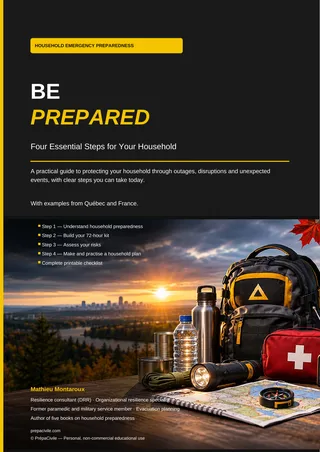
Start with the basics.
Our free “Be Prepared” guide: 72-hour kit, family plan and your own risk assessment.
Ice jams and break-up
Index Quebec/Canada 7/9 · France 3/9
If you only do three things
- Find out whether your river is under ice monitoring
- Move valuables up and cut basement power at the first warning
- Evacuate as soon as ordered, without waiting to see water
During
- Follow municipal notices
- Stay away from banks and bridges
- Cut basement power if safe
- Evacuate as soon as ordered
- Never drive through a flooded street
After
- Wait for permission to return
- Photograph damage before cleaning
- Have the electrical panel checked
- Throw out food touched by the water
- Apply for disaster financial assistance
Emergency numbers: 911 (Canada) · 112 (France)
prepacivile.com/en/risks/ice-jams/