
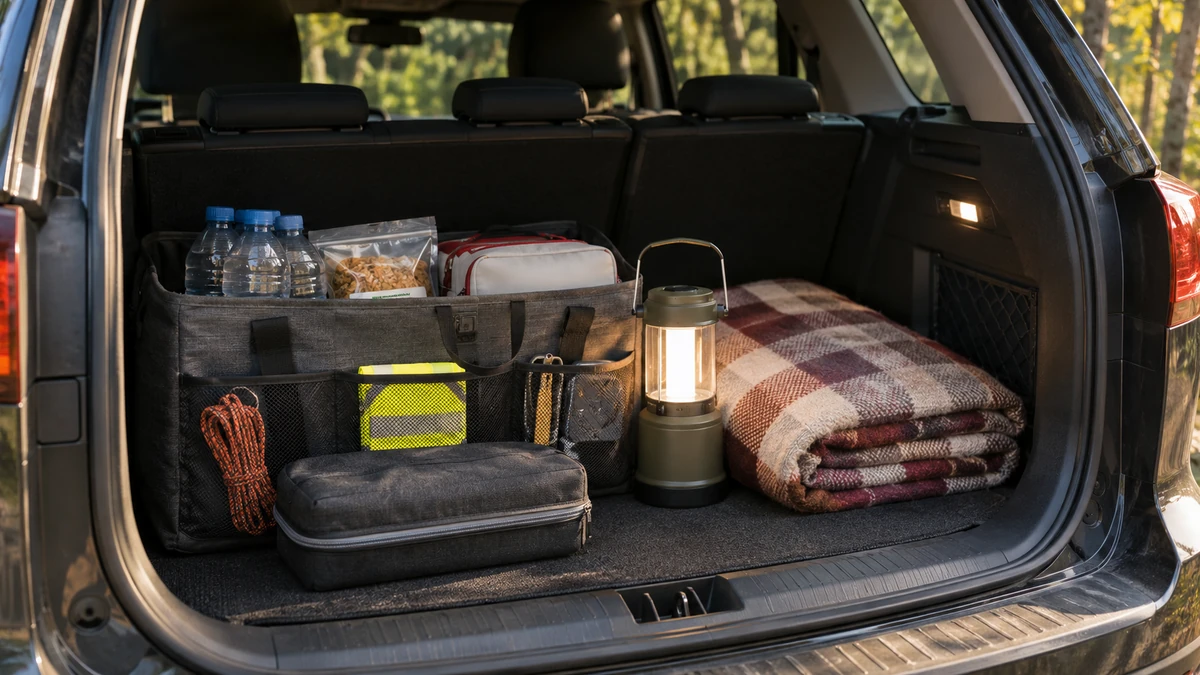
In this article
The evacuation bag you keep at home covers the scenario where you leave your home in an emergency. There's another one, less often prepared for: getting stuck far from home because of a breakdown, a closed road or something unexpected, without access to the supplies you prepared at home. A vehicle kit is designed for exactly this situation. Here's how to choose the container, what to put in it category by category, how to manage water and how to adapt it to your family and to Quebec's seasons.
In short
- Priorities: warmth (blankets, clothing), water, first aid, hygiene, lighting and a way to communicate.
- In winter, keep the tailpipe clear of snow: carbon monoxide can build up in a stranded vehicle.
- A vehicle goes through big temperature swings: medications, water, food and batteries must be chosen and checked accordingly.
- Secure the contents: an unsecured heavy object becomes a projectile in a collision.
- Review the kit at each change of season and after every use.
What the kit does and doesn't do
A vehicle kit complements your home evacuation bag and can share several supplies with it. It should be adapted to the people, the trips and the season. It doesn't guarantee you can stay 72 hours in or near the vehicle: a collision, a flood, a fire or dangerous heat may call for another form of protection and quick help. For the home bag, see Choosing your evacuation bag and our 72-hour emergency kit checklist.
Why a kit just for the vehicle
A problem can come up on any trip. Work, school and vacations don't have the same needs: think about the route, who's travelling with you and how you'll reach help, without assuming the same family setup or waiting time every time.
A vehicle can provide temporary protection, but its position, condition, the traffic, the weather and exhaust fumes all need to be assessed. A kit makes some things easier without making a flooded, damaged, overheated or collision-exposed vehicle safe. Follow emergency services' instructions and give your exact location when you call 911.
Typical scenarios:
- a breakdown on an isolated road in bad weather, for example during a snowstorm;
- a collision that blocks traffic for several hours;
- an emergency evacuation from an area with no immediate way back;
- a trip interrupted by a local crisis.
These situations aren't rare, and they seldom happen when you're alone and free of constraints. With children or dependants on board, a well-thought-out kit matters even more: food, hygiene and comfort needs are more immediate, and good preparation helps everyone cope with stress. For winter, also read A winter breakdown in a remote area: what should you do?
Choosing the right container
The ideal container must meet several constraints at once: fit the space available (trunk or under the seats), stay quickly accessible and withstand the big temperature swings a vehicle goes through over the seasons.
Recommended: a plastic bin with a lid
It keeps things organized if it fits your trunk, closes and can be secured. A "standard" size doesn't guarantee it will fit every trunk. Avoid leaving heavy objects loose, where they'd become projectiles, and don't bury what you'd need to leave quickly under a pile of luggage.
Alternative: a sturdy backpack or tote
Advantage: you can carry it if you have to leave the vehicle. Drawback: it's less structured, its contents are harder to see and organize. It can be combined with the bin for the bulkiest items.
Extra: the vehicle's smaller spaces
They can hold small items as long as they don't interfere with the pedals, airbags, seat rails or electrical equipment. Secure items, protect batteries and keep essentials reachable without leaning over while driving.
If you may need to carry the kit on foot, add a compact backpack to the contents: it will serve as a backup carrying container.
What goes in the kit, category by category
Hygiene and sanitation
Sanitation needs are often the first to make themselves felt, especially with children or during a long delay. A minimum of supplies quickly avoids uncomfortable situations.
- Toilet paper: a flattened roll (cardboard tube removed) in a sealed bag, compact and protected from moisture.
- Skin wipes, used according to their instructions; they don't replace handwashing or a surface disinfectant, and a skin reaction is possible even if unscented.
- Tissues: a small box or travel pack.
- Hand sanitizer: alcohol-based gel, travel size.
- Soap: preferably a bar, more compact and leak-free.
- Disinfecting wipes for surfaces and shared equipment.
- Extra sealable bags for garbage, soiled clothing or wet gear.
- Travel toothbrush and toothpaste for each person, and dental floss.
- Menstrual products chosen by the person; a menstrual cup requires clean water and proper hygiene, and doesn't replace other supplies.
- Paper towels.
- Medical-style emesis bags, far more practical than an ordinary bag for motion sickness or nausea.
Food
Food in a vehicle kit must meet two constraints: withstand big temperature swings (from a car parked in full sun to a winter night) and suit everyone in the household, including the youngest. Non-perishable food isn't immune to an overheated trunk or freezing: check packaging, dates and condition after any unusual exposure, not just each season.
- Jerky: compact protein that keeps a long time.
- Nuts, depending on allergies, texture and age; they can go rancid in heat.
- Shelled sunflower seeds.
- Small cans (fruit, tuna, legumes), preferably pull-tab, so you don't depend on a can opener.
- Protein bars and granola bars, avoiding chocolate-coated ones that melt in heat.
- Emergency ration bars designed for a specific temperature range: check the product, dates and temperatures listed; none withstands every extreme.
- Hard candy, only if suitable for the passengers' ages: it's a choking hazard for young children and doesn't replace a meal.
- Can opener, if not all cans open by hand.
- Compact reusable utensils: one spork per person is enough.
A drink flavouring can help some people drink more, but it must never be used to mask a suspicious taste or make untreated water seem safe.
Warmth, shelter and basic gear
This category covers what keeps you warm, gives you light and lets you act, inside the vehicle or outside if you have to leave it.
- Blankets suited to the people and the weather. A reflective emergency blanket alone doesn't insulate enough from the ground or prolonged cold.
- Fleece blankets: two metres (about 2 yards) of unsewn fleece make an effective, inexpensive blanket that can be stored compressed under a seat.
- Flashlights: at least two, a good main one and a backup in the glove compartment. Check the batteries at every review.
- Glow sticks for signalling and light without batteries.
- Rain ponchos: one per person, compact.
- Duct tape for temporary repairs and countless other uses.
- Hand or foot warmers, used according to their instructions: avoid prolonged skin contact, especially for a child or someone less sensitive to heat, and don't sleep on them.
- Paracord: 15 to 20 metres (50 to 65 feet), versatile.
- A good pocketknife, a basic tool for many situations.
- Radio, battery or crank-powered, that picks up local stations. Solar charging is often limited. Environment Canada's Weatheradio service ended on March 16, 2026, and a "NOAA weather" function doesn't provide Canadian bulletins.
- Tarp to protect you from splashes or the ground; it doesn't replace insulation or a safe shelter in all weather.
- Work gloves and a compact umbrella.
- Matches, for permitted use outside the vehicle only; never light a fire to warm a car.
- Whistle, to signal from far away without effort, and a signal mirror.
- Water treatment tablets suited to the hazard, with their dose, temperature and contact time; they don't treat chemical pollution. A filter works according to its model: a small one doesn't remove every microbe or substance.
- Folding shovel, essential in Quebec to dig out a snowbound vehicle, its wheels and its tailpipe.
- Two large, heavy-duty black garbage bags: rain protection, garbage, many uses.
Carbon monoxide: the golden rule
Never use a fuel-burning heater, barbecue or camp stove inside the vehicle, even with a window open a crack. If you're stuck in snow, clear the tailpipe regularly: if it's blocked, carbon monoxide, which is invisible and odourless, can build up inside. Common Canadian advice is to run the engine intermittently, for example about ten minutes per hour, with a window slightly open on the side away from the wind. Stay warm with your clothing and blankets. If you suspect CO exposure (headache, nausea, drowsiness) or someone's condition gets worse, get fresh air immediately and call 911.
First aid
The vehicle's medical kit is for first aid (minor injuries, allergic reactions, pain) until professional help arrives. It doesn't replace first aid training, which remains the most useful complement to any equipment.
- Basic first aid kit: assorted bandages, gauze pads, wraps, scissors, tweezers.
- Pain relievers, only according to age, contraindications and your pharmacist's advice, respecting their storage conditions.
- Chest pain or suspected heart attack: call 911 immediately and follow the dispatcher's instructions. Aspirin isn't suitable for everyone and never replaces the call; don't delay help to look for it.
- Antihistamine, on your pharmacist's advice, keeping in mind the drowsiness it can cause. It doesn't treat anaphylaxis: if someone has trouble breathing, use their prescribed epinephrine auto-injector and call 911.
- Hemostatic dressings (QuickClot, for example), only if you've had the proper training; calling 911 and the techniques you've learned come before any improvised advanced procedure.
- Disinfectant: don't keep a homemade bleach dilution in the vehicle. Choose a product designed for the intended use, with its date and temperature conditions; dosages for surfaces and drinking water aren't interchangeable.
- Thermometer, travel-size sunscreen, several pairs of disposable medical gloves and masks.
- Wounds: never close a wound with household glue. Medical skin adhesives have a specific use; clean and protect the wound according to first aid guidance, then have it assessed if needed.
- First aid guide: under stress, you don't always remember the essential steps.
- Personal medications: discuss continuity with your pharmacist or doctor. A vehicle often isn't a good place to store them; plan to bring them with you on every trip.
Medications left in a vehicle go through the same temperature swings as the rest of the kit, and some break down quickly in heat or cold. Check the storage conditions on the package. For advice in Quebec, call Info-Santé 811.
Keeping busy and keeping spirits up
During a long delay, especially with children or teens, managing the wait and boredom really matters for the mood and for coping with stress. A few light items make a real difference:
- a book suited to the youngest in the group, long enough to fill several hours;
- paper and pencils for drawing, games or notes;
- a deck of cards, compact and fun for all ages;
- small binoculars;
- something to write a note to leave in the vehicle if you truly have to leave it. First give your location and destination to emergency services, and don't leave the vehicle during a storm to look for help on foot unless instructed to;
- earplugs for comfort, only if someone stays alert to warnings and children.
Miscellaneous gear
- Sealable bags in several sizes, to organize and protect sensitive items.
- Elastic bands and straps.
- Phone charger for the vehicle's outlet: check the voltage, connectors and power, and leave it in the kit if there isn't one already in the vehicle.
- Power bank, maintained and secured, stored and charged within its stated temperature range; remove a damaged device and don't let a battery overheat in the vehicle.
- Compact comb or brush, small scissors, minimal sewing kit.
- Compact nylon backpacks, to carry essentials on foot if you have to leave the vehicle.
- Some cash, as your means allow: useful if a store is open, with no guarantee of access to an ATM during an outage. Keep it secure.
- Paper road maps: an atlas of your region and neighbouring regions, usable without GPS or cell service.
Managing water in the vehicle
One litre a day isn't an adequate benchmark. Canadian authorities recommend at least 2 litres of drinking water per person per day; planning about 4 litres (about 1 US gallon) also covers food preparation and basic hygiene. This isn't a medical prescription: heat, exertion or illness increase needs. Weight and volume often mean planning resupply points rather than storing all the water for a long wait.
Choose food-grade containers and follow their storage conditions. A bottle left a long time in a very hot car isn't necessarily safe: check that it's intact, avoid contamination and replace the water as directed. In a Quebec winter, water freezes in a parked vehicle: leave room in containers, and plan to keep some inside the cabin or bring it into the house. Water of doubtful quality doesn't become drinkable because it's an emergency. To learn more, read Water in your car: freezing, heat and rotation.
Basic supply: 1.5 to 2 litre bottles (0.4 to 0.5 US gallon)
Several small bottles let you spread out the water, well secured and easy to reach. Work out how many based on the occupants and the trip: they may not cover everyone's first hours, especially in hot weather or with someone who's ill. Replace them every 6 months.
Extended capacity: a 10 to 20 litre collapsible container (2.6 to 5.3 US gallons)
Empty, it stores flat but provides no reserve. Full, it weighs 10 to 20 kg (22 to 44 lb) without the container and takes up its full volume. Check the material, closure, cleaning, securing and access. Fill it before a long trip, or as soon as possible in a situation, with safe water.
A tablet or filter can help within the limits of its model and the type of water it's meant for. But no portable method makes any roadside water drinkable, especially after a flood or when fuel is present. Plan another water source and help contacts rather than counting on improvised collection.
| Occupants | Water for 72 hours (4 L per person per day) | Approximate weight |
|---|---|---|
| 1 person | 12 L (about 3.2 US gal) | 12 kg (26 lb) |
| 2 people | 24 L (about 6.3 US gal) | 24 kg (53 lb) |
| 4 people | 48 L (about 12.7 US gal) | 48 kg (106 lb) |
Clothing and space
A full change of clothes per person (T-shirt, pants, underwear, socks) is a real comfort during a long delay, especially for children. Vacuum or compression bags greatly reduce the volume. Rolling each change tightly (the "skivvy roll") also helps keep things organized. Above all, keep warm layers suited to the season (toque, mittens, coat, boots), footwear and hygiene needs, without sacrificing them to save weight.
Adapting the kit to your family
A generic list never covers all of a household's real needs. A few adjustments are enough, without making the kit unnecessarily heavy.
Babies and young children
Plan their usual feeding, with its preparation and storage conditions, safe water, diapers and the care they need. Powdered infant formula isn't used like ready-to-feed formula and requires safe water, which can be hard to guarantee in a vehicle. Ask for advice before the trip; heat and cold also affect these supplies.
Special health needs
Inhalers, auto-injectors and prescribed treatments must stay accessible, within their temperature range and with an action plan. They shouldn't stay in a car permanently if the temperature isn't suitable. Plan to bring them on every trip, and know what to do if they may have been damaged by cold or heat.
Pets
If an animal regularly travels with you, plan water, dry food, a collapsible bowl, a leash and waste bags for 72 hours.
Several vehicles? Start by equipping the one you use most, then the others gradually, as your means allow.
Points to watch
- Reviews: check the kit at each change of season, then after every use, long trip or unusual exposure. Adapt the contents to the season without removing layers still needed at night or in the rain. Dates and instructions decide when to replace things: two checks a year don't guarantee that a medication, water or battery stays usable in between.
- Extreme temperatures: some medications, foods and products (creams, batteries) break down in heat or cold. Check their storage conditions and temporarily remove the most sensitive ones from the vehicle during extreme cold or heat waves.
- Emergency toilet: a temporary solution requires privacy, stability, safety for children and disposal that follows local rules. A 20 to 25 litre (5 to 6.6 US gallon) bucket with a lid isn't necessarily suitable for every vehicle or roadside. Never empty it into the environment, don't block an exit and plan a way to wash your hands.
- If your vehicle goes into water: every second counts; read What to do if your vehicle enters the water.
Summary
You may already own some of this gear; cost and upkeep depend on your needs. The kit complements the one at home without covering every vehicle emergency. Checking temperatures, securing, access and replacement after use prepares you more concretely than a single purchase followed by two reviews a year.
Recommended assembly order: start with the categories that matter most (warmth, water, first aid, hygiene), then gradually add comfort and things to do, depending on the space available. To learn more about leaving by car, read Evacuating by vehicle: benefits, limitations and preparation.
The question to ask yourself
What are your household's regular trips, and which delays are most likely in those situations? Your answers will naturally guide your kit's priorities.
Customize and print your list
Use the checklist below as a starting point, then adapt the quantities, treatments and supplies to your household's trips. Your browser's print function lets you keep a copy: check the preview and print only the pages you need. Note the date of your check and replace items you've used.
These are not presented as a sign-up form or an active mailing service.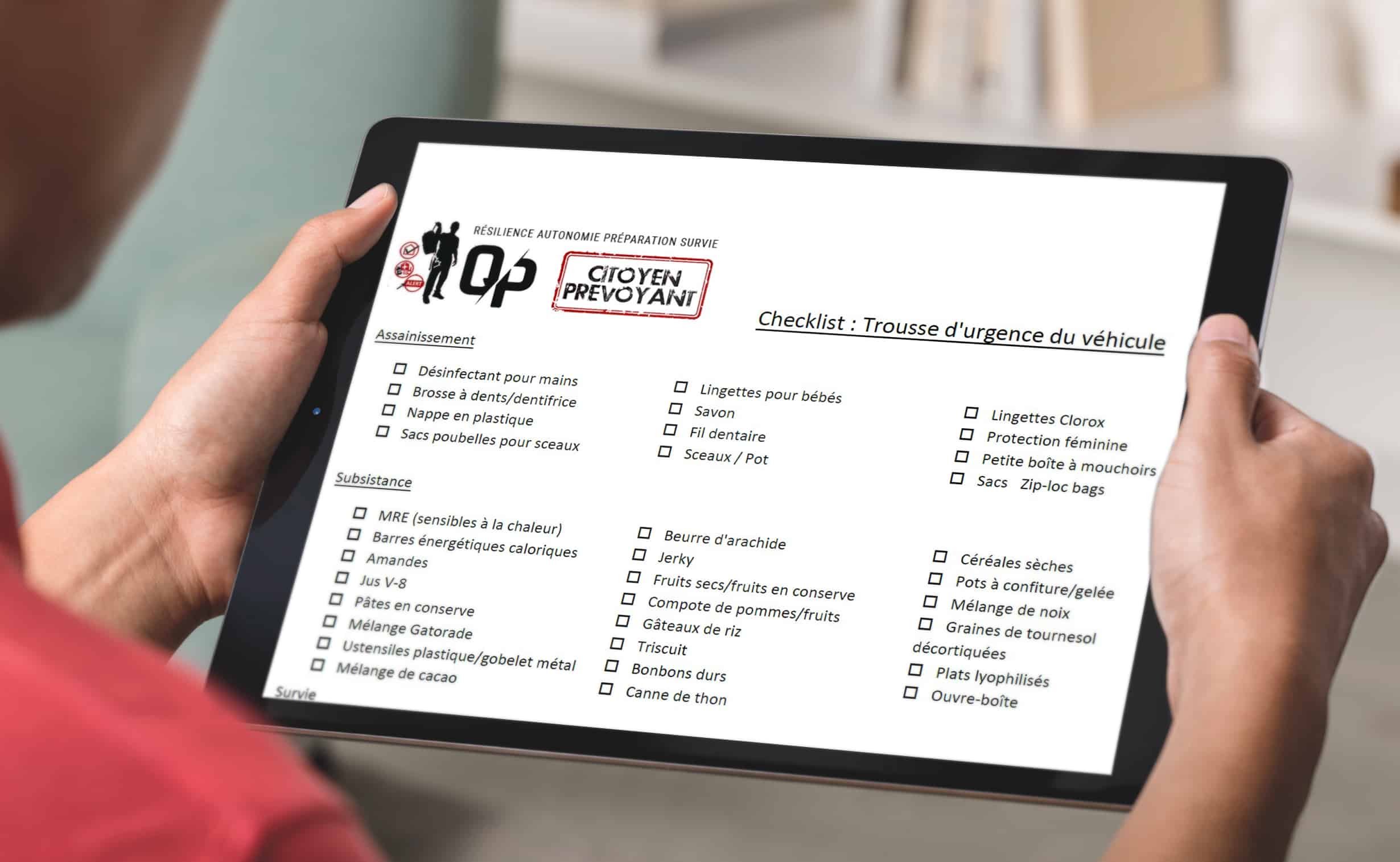
Frequently asked questions
What's the difference between a vehicle kit and an evacuation bag?
An evacuation bag is for leaving home quickly, on foot or by car. A vehicle kit covers a different scenario: getting stuck on the road, far from home, without access to your home supplies. The two complement each other without replacing one another.
How much water should I keep in a vehicle for 72 hours?
At 4 L per person per day, three days means 12 L (about 3.2 US gallons) per person, or 48 L (about 12.7 US gallons) for four people, for drinking, cooking and basic hygiene. Adjust to your needs. This amount can be too heavy to carry on foot: combine a safe supply, known resupply points and help from emergency services if needed. A filter or an empty container doesn't replace missing water.
How often should I review the kit?
At each change of season, then after every use, every change in the household or every exposure to unusual temperatures. Check dates, packaging, battery charge and access. Some products need more frequent checks; medications and consumables are managed according to their instructions.
Do I need one kit per vehicle?
Ideally, yes, starting with the vehicle you use most. If your means don't allow equipping every vehicle at once, a gradual approach is perfectly fine: fully equip the first one, then add a kit to the others over time.
Can medications stay in the vehicle permanently?
It depends on the medication. Some handle temperature swings well; others, such as insulin, some inhalers or biologic drugs, break down quickly in heat or cold. Check the storage conditions on the package or ask your pharmacist. For sensitive medications, bring them on every trip rather than leaving them in the vehicle.
Equipment to compare based on your needs
Some links below are affiliate links: we may receive a commission at no additional cost to you. Products are examples by function, to choose according to your needs; buying the entire selection is unnecessary.