
In this article
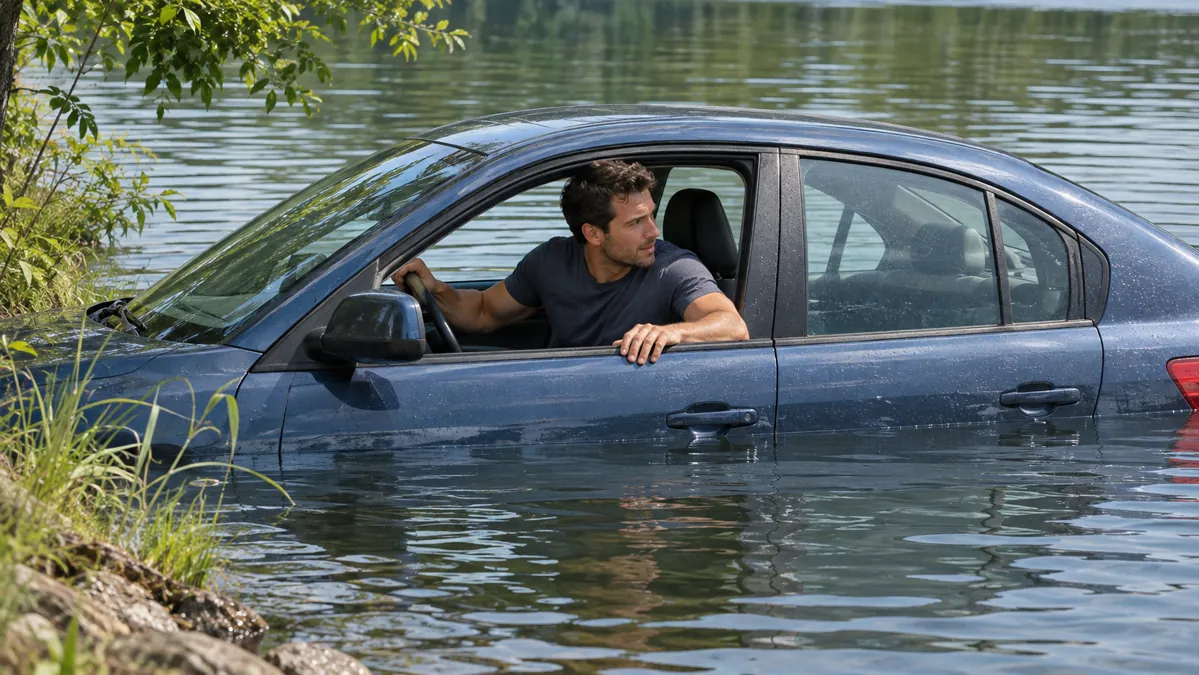
A fall in the water requires acting quickly, without relying on a flotation time. The depth, current, damage and position of the vehicle change the situation. The best prevention is to avoid any flooded roads and respect closures.
Preparing for an outing before it becomes difficult
The SAAQ guide has the following markings: detach the belt, lower a window or operate the sunroof, then exit. The quick opening of a window is to be sought before the situation deteriorates. Don’t lose these opportunities by picking up business or starting a long call.
Find out before you leave your vehicle’s controls and how to release the passenger restraints. With children or someone in need of help, prepare a division of tasks between adults rather than a formula supposed to work for all places and all occupants.
Understanding the limits of doors and windows
Water pressure can make a door very difficult to open. Waiting for water to enter in order to open it is not a preferred strategy when the exit through a window remains possible. There is no reliable chronometer valid for all vehicles.
A window breaker is not a guarantee of exit. Some side glazing is laminated and resists the tools provided for tempered glass. Check the type of glazing and the compatibility of a possible tool before relying on it. A tool that is inaccessible, not fixed or unknown to the user may also be missing at the appropriate time. Do not test on an actual glass and never simulate an immersion to train.
With children or reduced mobility
In quiet time, show commands and attachments to people who can understand them. Keep the explanations brief: listen to the adult, release the restraint when indicated and join the chosen opening. Everyone’s role depends on real abilities and occupied places, not just age.
Helping multiple occupants can be very difficult. Do not infer from it a guarantee of success or a fault of the person who cannot act as in an exercise. Special needs may warrant individualized advice prior to travel.
After the exit: the water remains dangerous
Once out, look for safety without returning to the vehicle. The cold, the current, the debris and the banks can prevent to reach a point yet close. An article does not replace learning to swim or aquatic rescue training. Do not throw yourself into the water to help without means and skills: report the missing people to the rescue.
Call 911 as soon as it can be done without compromising the exit or shelter. Give the place, the stream or the road, the number of occupants and the last known position of people. Do not assume that automatic localization is sufficient.
After exposure to cold, protect people from wind and moisture and report their condition to the rescue. Respiratory difficulty, confusion or altered consciousness is an emergency. The absence of apparent injury is not enough to rule out the consequences of the accident.
Useful preparation on a daily basis
- Check traffic conditions and avoid flooded roads.
- Inform a close relative of the itinerary during an isolated trip.
- Understand the controls and fasteners of the vehicle being used.
- Check the glass before buying or installing an exit tool.
- Provide coverage, means of communication and useful medical information.
- Learn first aid in a recognized training.
Frequently asked questions
Do electric windows work in water?
Their operation cannot be guaranteed. Look for the opening immediately rather than waiting for a supposed failure to occur at a specific second.
Does an electric vehicle change priorities?
The safety of the occupants remains a priority. After the accident, do not handle the damaged battery or equipment and indicate the engine to the responders.
Do I need to memorize an acronym?
A few clues are better than a poorly translated acronym. The main thing is to know the exit, the attachments and the needs of the people on board, without delaying the action to find a formula.
Official sources and landmarks
- SAAQ - Driving a walking vehicle, submerged vehicleOriginal PDF · source language preserved
Two items for putting these ideas into practice
Plan to carry drinking water and record quantities, rotation dates or relevant instructions.
Affiliate links: as an Amazon Associate, PrépaCivile earns from qualifying purchases. These examples are optional. Check the model, package contents and terms. Use equipment you already own first.
Bottle for carrying drinking water
Listed capacities differ: approximately 946 ml in Canada and 1 L in France. A bottle does not make contaminated water safe.
Canada — Amazon.ca
 Nalgene Bouteille d'eau à large goulot de 946,2 ml, sans BPA, durable et anti-fuite, légère pour randonnée et salle de sport, travail et voyage, bleu céruléenView on Amazon.ca
 Nalgene Gourde 'WH Sustain' Azuré 1 L
Notebook for household information
Canada: three-pack; France: individual notebook. Compare size and quantity.
Canada — Amazon.ca
 Rite in the Rain Lot de 3 cahiers à spirale résistants aux intempéries, 7,6 x 12,7 cm, couverture noire, motif universel (n° 735-3)View on Amazon.ca
France — Amazon.fr
 Rite in the Rain toutes saisons carnet a spiral , 7,6 x 12,7 cm Étanche NoirView on Amazon.fr