
In this article
A forgotten bottle in a trunk alone is not a reliable supply. In a vehicle, water is subjected to freezing, heat, vibration and the risk of leakage. Providing a small, accessible amount and checking it regularly is more useful than accumulating a volume that no one can reach.
Choose suitable containers
Use containers intended for drinking water that are clean, closed and undamaged. Avoid former chemical containers and glass exposed to impacts. Choose sizes that allow each person to drink without spilling the whole supply. Check the manufacturer’s freezing instructions and expansion allowance; do not arbitrarily alter a sealed product’s fill level.
Plan for freezing conditions
A cooler can slow down temperature changes, but it doesn’t indefinitely keep water from freezing in a parked car. Keep a transportable portion that you take with you at the start. An ice block that is difficult to remove from the container is of little use during immobilization. Do not heat a closed container on a flame and do not use a combustion device in the cabin to thaw it.
Protect water during hot weather
Store water away from direct sunlight and away from fuel, windshield washer fluid and other automotive products. Follow the manufacturer's instructions on storage. A smell, a leak or a deformed container justifies the replacement of the reserve; the absence of smell does not prove its drinking-water quality. A hiking filter does not correct all possible chemical contaminations.
Keep water accessible and secure
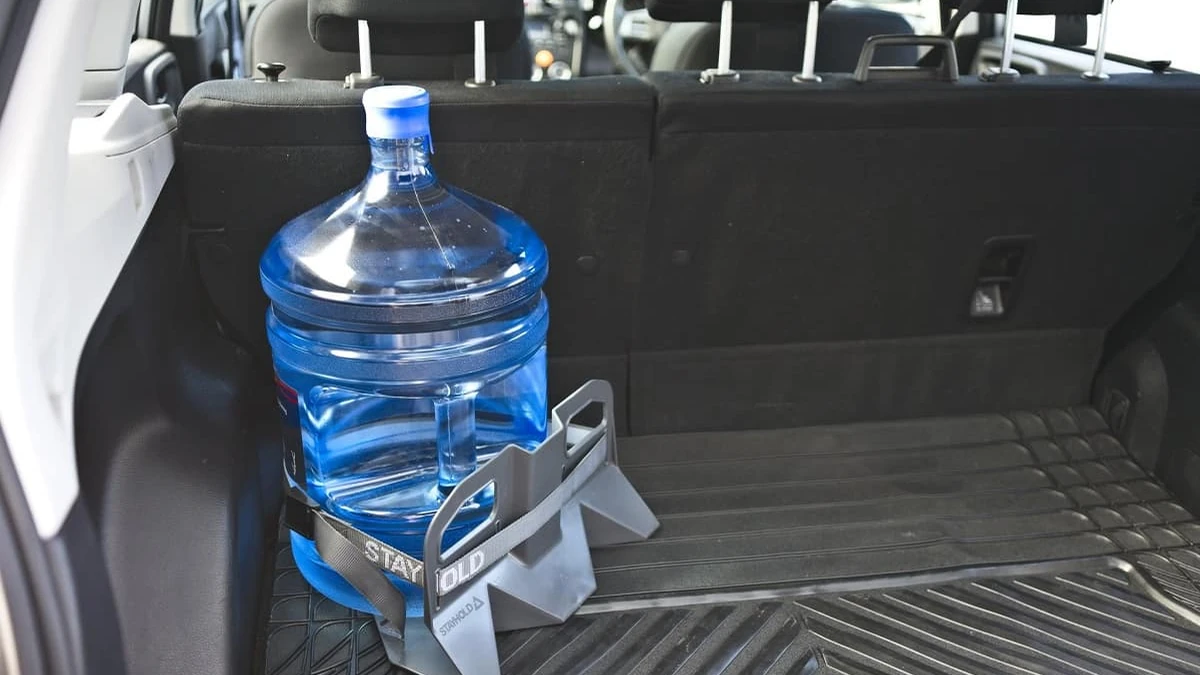
Attach the containers so that they do not roll under the pedals or into the passenger compartment. Keep a small reachable portion and place the rest in stable storage. Take into account children, animals and the actual duration of the trip. A roadside reserve complements that of the house; it should not become your only storage point.
Schedule checks and rotation
Put a check date in your calendar. The federal car-kit guide recommends replacing the water every six months; also follow the product’s instructions and account for storage conditions. Check after extreme heat, freezing weather or a leak. Review clothing, the flashlight and assistance contacts at the same time. Add fresh water before a long trip rather than relying entirely on bottles left in the vehicle.
Source: Public Safety Canada, Car Kit.
Equipment to assess for your needs
Canadian and French listings may differ. Check the exact model, instructions and suitability. No price or stock availability is guaranteed.

Nalgene 32 oz Wide Mouth Water Bottle BPA-Free, Durable & Leak Proof, Lightweight Bottle for Hiking & Gym, Work & Travel, Cerulean
View on Amazon.caAffiliate links: PrépaCivile may earn a commission on qualifying purchases. Titles and images come from the Amazon listings checked; claims in product titles are the sellers’ claims and are not validated by PrépaCivile.