
In this article
- Understand the dynamics of an isolated winter outage
- The first few minutes: what to do immediately
- Priority actions according to the situation
- The Most Common Mistakes
- And with children on board?
- When the rescue arrives
- The winter kit: what to have in the trunk
- Heating, snow and carbon monoxide
- Official sources and landmarks
- Optional equipment examples
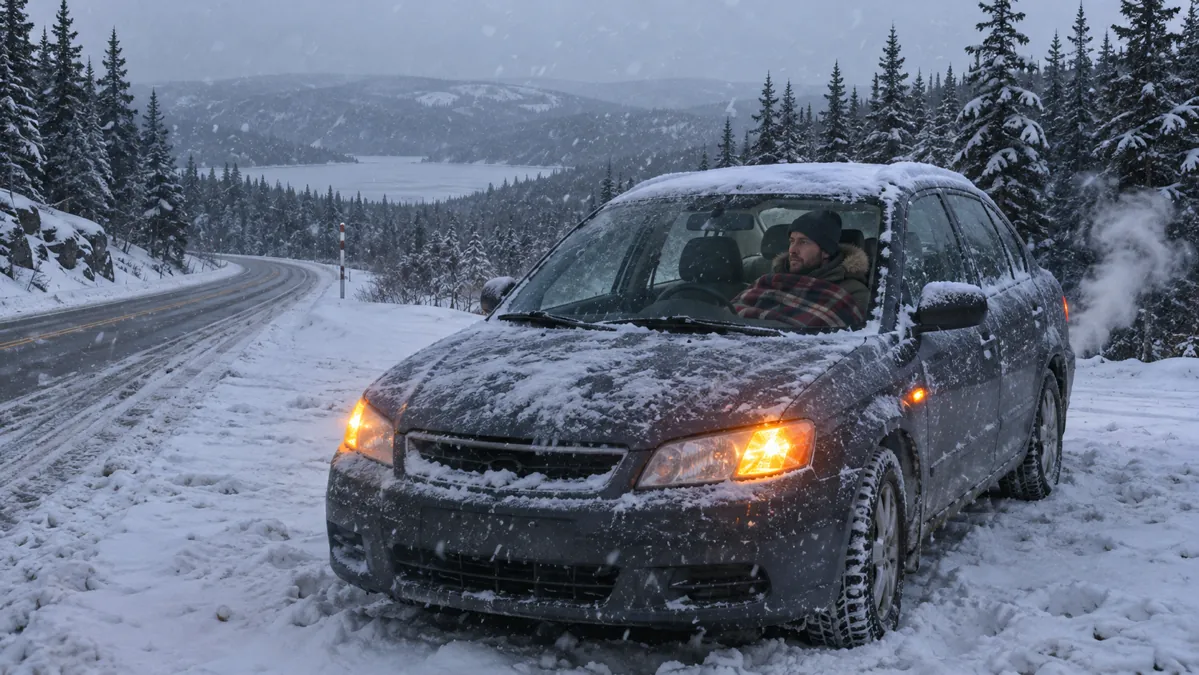
A breakdown on a Quebec secondary road in January, at -25 degrees C, without a cellular network and 40 kilometers from the nearest city: this scenario is not exceptional. It happens every winter, to people who did not plan to face it that day.
In Quebec, winter conditions represent a specific risk factor that the majority of preparation guides - often written for generic North American or European contexts - do not adequately address. Temperatures, distances, the density of the cellular network in rural areas and the potential waiting time for emergency services create a configuration that deserves dedicated preparation.
In France, this scenario concerns more mountain areas - Alps, Pyrenees, Massif Central - as well as exceptional snow events that can paralyze roads that are usually practicable. The principles are the same; geographical contexts differ.
A winter outage in isolated areas is not an immediate medical emergency - unless it becomes so due to lack of preparation. The difference between an uncomfortable wait and a dangerous situation is often due to the contents of the trunk and a few decisions made in the first few minutes.
Understand the dynamics of an isolated winter outage
What distinguishes a winter outage in isolated areas from an ordinary outage is the combination of three mutually reinforcing factors: cold, isolation and waiting time. Understanding how these factors interact allows us to anticipate the right priorities.
Dominant risks
Hypothermia
Carbon monoxide poisoning
Isolation and rescue time
In Quebec, some secondary roads may have a traffic flow of a few vehicles per hour outside peak periods. In the event of a storm, this flow can drop to zero. Emergency response time in these areas can exceed several hours - a parameter that completely changes the logic of preparation.
Buried by snow
The first few minutes: what to do immediately
As soon as the breakdown is detected and the vehicle is safely immobilized, a sequence of checks is required before any other action. These checks take less than five minutes and condition all subsequent decisions.
1. Securing the vehicle
2. Check the exhaust
Before turning the engine to warm up, check that the exhaust pipe is not obstructed by snow or ice. This check takes 30 seconds and can prevent carbon monoxide poisoning. If the hose is clogged, release it before starting.
3. Evaluate the cellular network
Check the cell coverage immediately. In an area without a network, 911 can sometimes work on the networks of other operators - try the call even without an apparent signal. If no network is available, the organization of the wait becomes the priority.
4. Assess available resources
Quick inventory: remaining fuel, blankets, warm clothes in the vehicle, water and food, flashlight, battery charger. This assessment determines the realistic duration of autonomy and guides the following decisions.
Basic rule : Stay with the vehicle. A vehicle is infinitely more visible for rescue than a single person in a snowy landscape. Leaving the vehicle to walk towards civilization is only justified in very specific circumstances – and almost never in the first few hours.
Priority actions according to the situation
If the engine is still running
Slightly opening a window on the opposite side to the wind during heating helps maintain minimal air circulation and reduces the risk of carbon monoxide build-up even in the absence of exhaust obstruction.
If the engine is no longer working
Group all people in the same area of the vehicle to pool body heat. Use all available insulation material - blankets, spare clothing, bags - to create a thermal barrier. Sit on insulating surfaces rather than directly on cold seats. Avoid unnecessary movements that consume thermal energy.
Report his presence
A vehicle buried under the snow becomes invisible. Maintain a visible presence signal: hazard lights as long as the battery allows, brightly colored flag or clothing attached to the antenna or a door that is half-open, flashlight facing the road when approaching any vehicle. If a storm is in progress, regularly clear snow around the vehicle to maintain visibility.
Deciding to leave the vehicle - when and how
If the decision is made to leave the vehicle, note the departure time in a message left in the vehicle, indicate the direction taken, and report its position to a relative if a connection is available.
Context Quebec
Context France - mountain areas
In the Alps or Pyrenees, a vehicle blocked by snow can be near a refuge or hamlet. Mountain rescue (PGHM, CRS Montagne) are generally well organized but can be mobilized on several simultaneous interventions. The same rule applies: stay in the vehicle and report its position.
The Most Common Mistakes
Run the engine without checking the exhaust
This is the most serious mistake on this list – and the most avoidable. Every winter in Quebec, people are victims of CO poisoning in their vehicles. The exhaust check takes 30 seconds and must become an automatic reflex before each start during a breakdown in snowy conditions.
Leaving the vehicle too early
The temptation to walk out is strong, especially in the early hours when energy is still available. But winter conditions can deteriorate rapidly, and a vehicle remains a significant thermal shelter even without heating. Fatal accidents related to winter breakdowns often involve people who have left their vehicles.
Exhaust the battery on the hazard lights
Do not inform a loved one of their itinerary
A person whose itinerary no one knows can wait a very long time before an alert is triggered. Systematically informing a loved one of their trip and the expected arrival time during any winter trip in a low-traffic area is one of the simplest and most effective preparation habits.
Underestimating the first signs of hypothermia
Consuming alcohol to warm up
Alcohol produces a feeling of warmth by dilating the blood vessels – but it actually accelerates the loss of body heat by bringing warm blood back to the skin. In winter breakdown, alcohol consumption increases the risk of hypothermia and alters the judgment necessary for the decisions to be made.
Look at the field : In winter rescue interventions, there is one constant: the people who do best are not necessarily those who had the most equipment, but those who had informed someone of their journey. The alert time – the gap between when someone goes out and when they start searching – is often the determining factor.
And with children on board?
Children are more vulnerable to hypothermia than adults - their body surface to mass ratio is higher, which speeds up heat loss. A child who does not complain of cold is not necessarily out of danger: young children regulate their thermal sensation less well and may not clearly express increasing discomfort.
Specific priorities with children: dress them in priority with all the insulation material available, group them with adults to benefit from collective body heat, maintain a calm activity that generates a little heat without exhausting energy reserves. Simple cognitive activities – verbal games, stories, songs – keep you awake and reduce anxiety without significant physical expenditure.
Hydration : The cold reduces the feeling of thirst but does not eliminate the need for hydration. Children dehydrate faster than adults. If drinks are available in the vehicle, ration them intelligently by prioritizing children. Do not consume snow directly - this lowers the body temperature.
When the rescue arrives
The arrival of emergency services does not necessarily mark the end of vigilance. A few points to anticipate.
Clearly report the condition of all people present, including discreet symptoms - numbness, mild confusion, unusual fatigue. Emergency responders can quickly assess an onset of hypothermia, but they need an accurate description of the conditions and duration of exposure.
The winter kit: what to have in the trunk
Thermal protection
- Survival coverage (one per usual occupant))
- Compact sleeping bag or extra wool cover
- Warm spare clothes - tuque, mittens, woolen stockings
- Manually activated chemical heaters
Signage and lighting
- Flashlight with spare batteries (or frontal))
- Signalling triangle or reflective cones
- High Visibility Vest
- Luminous sticks (cyalumes) - visible even in a storm
Tools and clearance
- Folding excavator - essential to clear the exhaust and wheels
- Starter cables or portable booster
- Sand or cat litter (ice pulling))
- Ice scraper and snow broom
Water and food
- Bottled water - prefer frost-resistant containers
- Energy bars or compact non-perishable food
- Thermos with hot drink on long winter journeys
Communication and information
- Car charger for phone
- External battery charged
- List of printed emergency numbers (911 QC, 112 FR, local towing)
- Paper road map of the area - GPS does not replace a map when the battery is empty
Basic Kit
- Mini First Aid Kit
- Essential medicines if applicable (asthma, diabetes, etc.)
- Waterproof blanket to sit on snow if needed
Essential Habit : systematically inform a relative of their itinerary and the expected arrival time during any winter trip on secondary roads or in areas with low traffic. This information can reduce the alert and response time by several hours.
Heating, snow and carbon monoxide
Stay close to the vehicle when it offers a safe shelter and report your location. However, a car stuck on an active lane, near a fire or in another dangerous area requires an appropriate decision with the emergency services. Do not walk to a supposed nearby shelter on the sole basis of a theoretical distance.
A clear exhaust pipe reduces a risk, but does not guarantee the absence of carbon monoxide. Follow the vehicle instructions and rescue instructions. If the engine is running to heat up, regularly check for snow accumulations without exposing yourself; do not sleep while letting it turn. Never use a stove, barbecue or flame in the cabin.
Unusual drowsiness, headache, nausea or confusion should be reported immediately. Both cold and CO can alter the judgment. Don’t promise that a heating kit or cycle will ensure survival time.
Protect people from the wind, insulate them from the cold, and replace wet clothing when it can be done safely. Carefully handle a very weak person and follow the medical indications of 911. Do not rub frozen areas or give alcohol to warm up.
Official sources and landmarks
Two items for putting these ideas into practice
Record roles, contacts and decisions, then plan charging for the phone used to communicate.
Affiliate links: as an Amazon Associate, PrépaCivile earns from qualifying purchases. These examples are optional. Check the model, package contents and terms. Use equipment you already own first.
Notebook for household information
Canada: three-pack; France: individual notebook. Compare size and quantity.
Canada — Amazon.ca
 Rite in the Rain Lot de 3 cahiers à spirale résistants aux intempéries, 7,6 x 12,7 cm, couverture noire, motif universel (n° 735-3)View on Amazon.ca
France — Amazon.fr
 Rite in the Rain toutes saisons carnet a spiral , 7,6 x 12,7 cm Étanche NoirView on Amazon.fr
Power bank for a compatible phone
Check connectors and cable. This is not backup power for a medical device.
 Anker Chargeur portable USB-C 10 000 mAh 30 W
 Anker Zolo Batterie externe 10000 mAh 30 W avec câble USB-C