
In this article
- 1. Choosing the wrong container
- 2. Forgetting to check the rules
- 3. Underestimating how much water you need
- 4. Not letting the roof rinse off
- 5. Drinking the water without treating it
- 6. Overpaying for a prefabricated system
- 7. Leaving the barrel open
- 8. Neglecting water access and overflow
- Through the seasons in Quebec
- Summary: the key points
- Frequently asked questions
- Sources and verification references
- Equipment to compare for your needs
Rainwater harvesting is often a household's first step toward water self-sufficiency. Simple as it looks, it has several pitfalls that make the system less effective or, more seriously, compromise water quality. Here are the eight most common mistakes, the good practices to adopt and the specifics of Quebec's climate.
At a glance
- Rainwater from a roof is not drinkable without treatment, even when clear: use it first for non-potable purposes (watering, cleaning, toilet flushing).
- An opaque food-grade barrel, a mosquito screen, a first-flush diverter and a low tap do most of the work.
- In Quebec, empty and store the barrel before the frost, and check your municipality's rules.
This article covers rainwater harvesting for household or emergency use. To get started, also read Rainwater harvesting: a practical guide for beginners.
1. Choosing the wrong container
Not every container is suitable for storing rainwater. Two problems arise: chemicals migrating from an unsuitable container into the water, and translucency, which lets algae grow in the light.
Opaque, dark-coloured plastic barrels are generally well suited: sturdy and easy to find, they keep out light. Other containers can work if they meet three criteria: enough capacity, good opacity and no chemical lining or residue.
Good choices
- Food-grade containers
- Dark-coloured HDPE (high-density polyethylene) barrels
- Tanks sold for rainwater harvesting
Avoid
- Drums that held chemicals, solvents or industrial products
- Translucent containers
- Containers of unknown origin
To find a barrel without paying much, see Reused rain barrels: seven leads to explore.
2. Forgetting to check the rules
Rainwater harvesting is regulated differently by province, country and sometimes municipality. In France, regulations distinguish between uses allowed inside the home and those limited to outdoors.
Before installing a system, check your municipality's bylaws and the provincial or national framework. This matters even more if the system is large or connected to indoor plumbing. Rules change: checking directly with your municipality or the relevant ministry remains the most reliable step before any major investment.
In Quebec / In France
In Quebec: collecting rainwater for outdoor use is generally allowed without special authorization, but some municipalities have their own rules, and several offer rain barrels at a reduced price. Any connection to indoor plumbing is subject to stricter requirements: check with your municipality.
In France: harvested rainwater cannot be used for food or personal hygiene in an ordinary household setting; the permitted uses are listed on Service-Public.fr.
3. Underestimating how much water you need
Daily water needs are often underestimated, especially for preparedness. Even when cutting non-essential uses (showers, laundry, washing), needs remain significant. An undersized system will not deliver when things go wrong. From the design stage, calculate the available roof area, your region's rainfall and your daily needs.
Estimating what you can collect
Roof area (m²) × rainfall (mm) × runoff coefficient (usually 0.8 to 0.9) = volume collected in litres. For example, 50 m² (about 540 sq. ft) in 20 mm (0.8 in.) of rain gives about 800 to 900 litres.
Estimating your needs
Health Canada recommends 2 litres of water per person per day for drinking, plus 2 litres for cooking and hygiene. With complete basic hygiene, the figure is much higher. See our household calculation.
4. Not letting the roof rinse off
When rain comes after a dry spell, the first runoff carries away everything that has built up on the roof: dust, pollen, bird droppings, decaying leaves, airborne particles. This first water is of much poorer quality than the rest of the shower.
A first-flush diverter sends part of that initial runoff away. Its volume is sized according to the roof's area and material; waiting ten minutes is not a universal rule. Diverters are sold commercially or can be made at home: it is a small investment that clearly improves the quality of the water collected, without making it drinkable.
5. Drinking the water without treating it
This is the most important point. Rainwater collected from a roof and gutters is not drinkable without treatment, even if it looks clear. Depending on the roof, air quality and storage, it can contain bacteria, parasites, metals or airborne contaminants.
| Method | What it does | What it does not do |
|---|---|---|
| Mechanical filtration (ceramic, cartridge) | Removes suspended particles | Does not disinfect on its own |
| Activated carbon | Improves taste, removes some organic and chlorinated compounds | Does not remove all chemical contaminants |
| Unscented bleach, at the proper dose | Disinfects clear water | Does not remove chemicals |
| Boiling | Kills germs | Does not remove chemicals |
| Hiking microfilter | Removes some bacteria and parasites | Does not guarantee removal of viruses, metals or roof substances |
Simple rule: use rainwater for permitted non-potable purposes (watering, cleaning, toilet flushing). For drinking, cooking and brushing teeth, use a drinking water supply. As a last resort, filtering then disinfecting reduces microbial risk, without guaranteeing removal of chemical contaminants from the roof. Details in Emergency water treatment.
6. Overpaying for a prefabricated system
Complete systems are sold commercially, sometimes at a high price. For most household or basic preparedness needs, a self-assembled system (barrel, spigot, lid with screen, downspout fitting) does the same job for a fraction of the cost.
200-litre (about 55 US gallon) food-grade drums, sometimes available from food companies or breweries, make an economical base. The accessories (spigots, seals, downspout fittings) are easy to find at hardware stores. A prefabricated system can still make sense for looks, large capacity or a connection to indoor plumbing that requires certification.
7. Leaving the barrel open
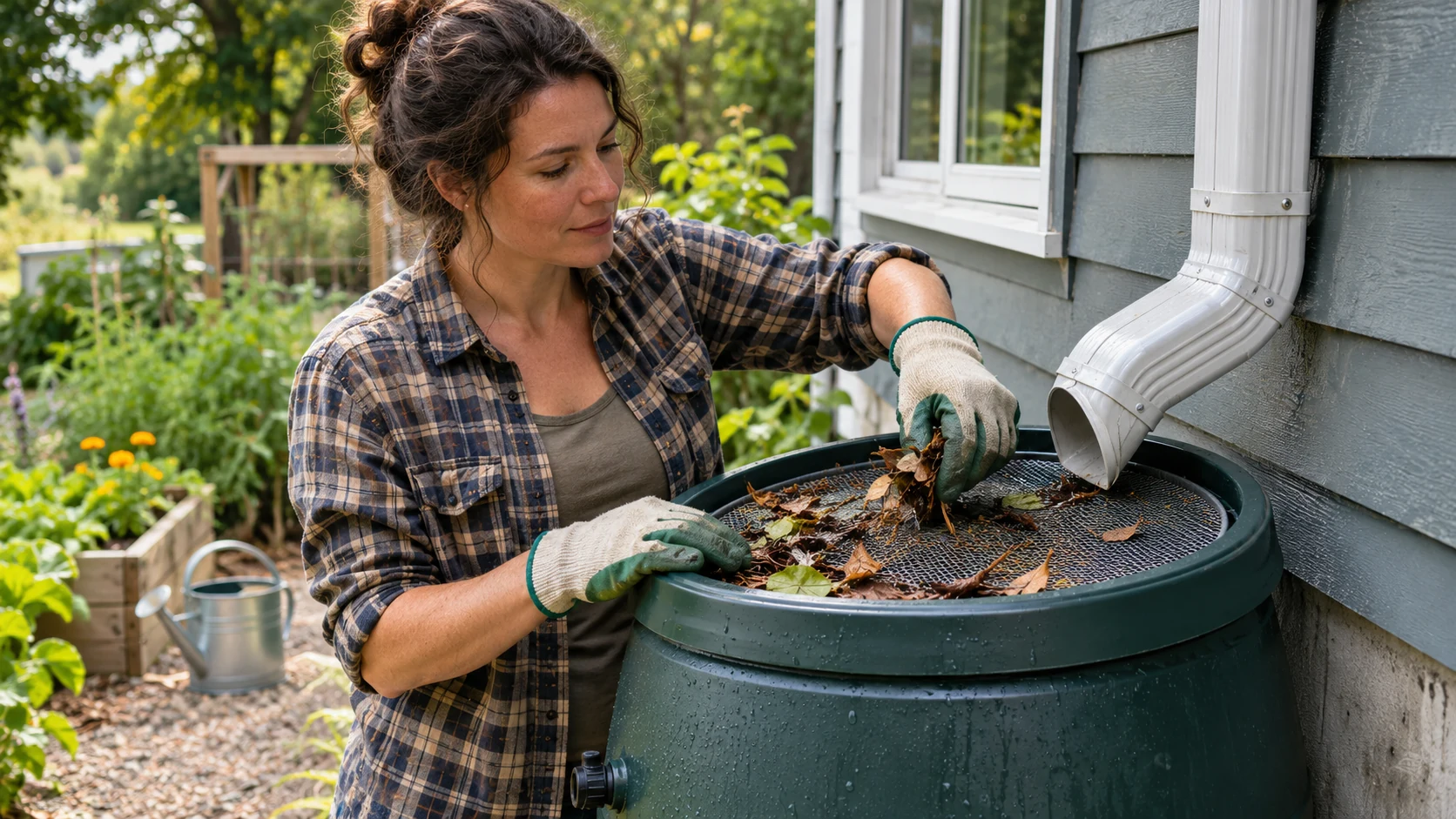
An open or poorly protected lid lets in leaves, insects, debris and mosquitoes, along with their larvae. A fine metal mesh or non-woven fabric is enough to stop large particles and keep insects from settling in.
This point is often overlooked, but it determines water quality over time. A poorly covered barrel can become a mosquito breeding site within a few warm days, a problem for the water and for public health: in Quebec, some mosquitoes can transmit West Nile virus. The lid must block light and insects while letting filtered water in: a drilled lid covered with a fine screen held by a clamp or seal works well.
8. Neglecting water access and overflow
Without a tap, you have to dip a container into the barrel: tedious and unhygienic. A spigot near the bottom of the barrel is a simple, inexpensive change that makes daily use much easier.
For larger volumes, a small transfer pump, electric or manual, moves water to other containers. Raising the barrel on a stable platform also lets gravity do the work. Watch the weight: 200 litres of water weigh about 200 kg (440 lb).
Check the seals and watertightness.
Make sure the tap stays accessible when the barrel is full.
Direct the overflow away from the foundation to avoid moisture at the base of the wall.
Test the system before you need it.
Through the seasons in Quebec
| Period | To do |
|---|---|
| April – May | Set up the barrel after the thaw, clean gutters, check the screen and diverter |
| June – August | Watch for mosquito larvae, use the water regularly, keep the lid closed |
| September – October | Clean gutters after the leaves fall |
| Before the frost | Empty the barrel, rinse it, disconnect the downspout and store it under cover: ice can split the container |
Summary: the key points
Water quality
Let the roof rinse off, screen debris at the inlet, treat the water before any food use. These three steps are non-negotiable.
Sizing
Calculate real needs before installing. A system that is too small will not deliver; slightly larger is better, if weight and space allow.
Container and equipment
Opaque food-grade container, spigot, screen on the lid. These simple adjustments make all the difference.
To go further: Harvesting rainwater: yield, storage and uses, collecting rain without gutters and the outdoor rainwater shower.
Frequently asked questions
Is harvested rainwater drinkable?
No, not directly. Use it for permitted non-potable purposes. For drinking, cooking and brushing teeth, use a drinking water supply. Filtering followed by disinfection reduces microbial risk but does not guarantee removal of chemical contaminants from the roof.
Do you need a permit to collect rainwater in Quebec?
For outdoor use, it is generally allowed without special authorization, but some municipalities have their own rules. For indoor use or a connection to plumbing, requirements are stricter. Check with your municipality before any major installation.
How much water can an ordinary roof collect?
It depends on roof area, rainfall and the runoff coefficient. As a rough guide, 50 m² (about 540 sq. ft) in 20 mm of rain gives about 800 to 900 litres. It is an order of magnitude that varies with the installation.
Can any drum be used as a rain barrel?
No. Drums that held chemicals, solvents or industrial products are not suitable. Food-grade HDPE drums, often blue or black, are best. Always check where it came from and what it held.
Can the barrel stay outside in winter?
Better not. Freezing water expands and can split the barrel, tap or fittings. Empty it before the first frost, disconnect the downspout and store it under cover until spring.
Sources and verification references
Local instructions and product instructions take precedence for your situation. References consulted for this update:
- Health Canada: keeping food and drinking water safe in an emergency
- CDC (United States): rainwater collection and your health
- Service-Public.fr: rainwater harvesting in France (in French)
Equipment to compare for your needs
Some links below are affiliate links: we may receive a commission at no additional cost to you. Products are examples by function, to choose according to your needs; buying the entire selection is unnecessary.