
In this article
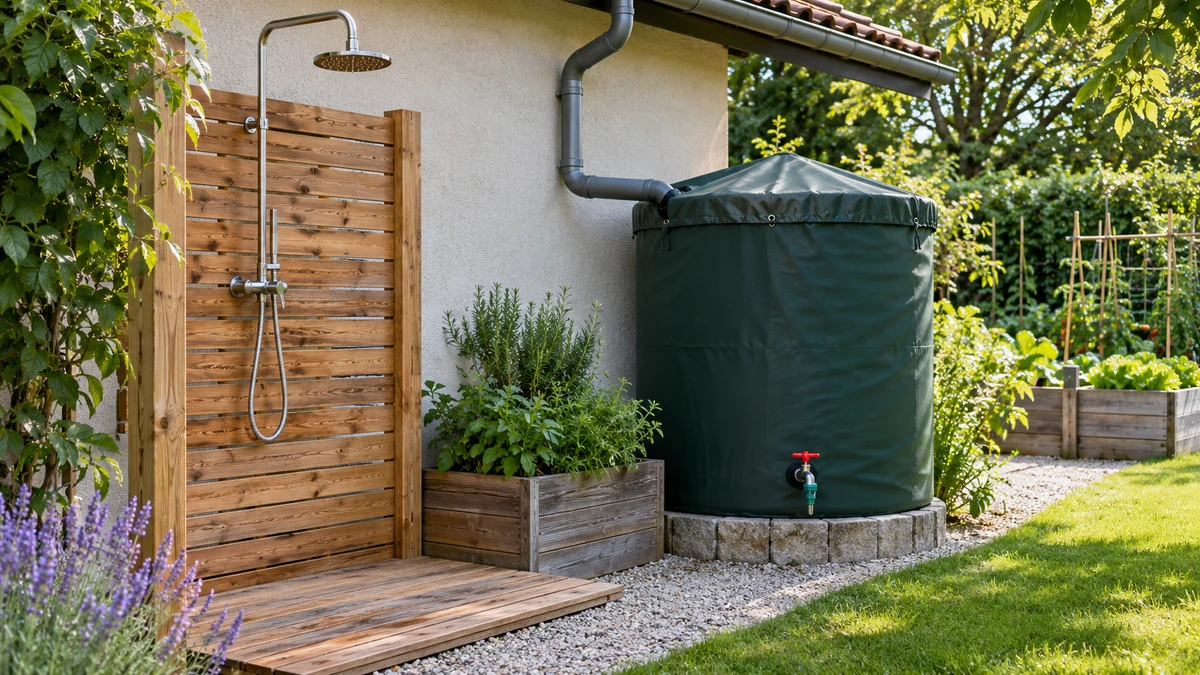
Rainwater can be recovered for certain uses, but it is not always abundant or free to collect, store and maintain. A shower exposes the skin, eyes and airways, with possible involuntary ingestion. Its perceived softness or absence of chlorine does not show any benefit to the skin or hair. Before choosing this hygiene resource, it is therefore necessary to check the authorised use and the required quality, rather than starting from the idea that natural water is automatically suitable.
Clean appearance is not enough: roofs, gutters, reservoirs and pipes can bring contaminants, while stagnant and lukewarm water can favor certain microbes. A simple particulate filter does not solve all these dangers. Installation, maintenance and discharge of water after use are separate issues. Temporary mounting is not exempt from safety because it does not have a permanent connection.
This guide examines the project’s main issues — collection, treatment, rules, gravity or pump, support, privacy and products — without providing permission or a recipe for domestic treatment. In France, the public service states that rainwater should not be used for body hygiene. In Quebec, have the installation’s applicable requirements and quality checked with the appropriate authorities and professionals. A portable shower filled with appropriate water is a different system from a domestic rainwater network.
Are rainwater showers safe?
Rainwater is not "perfectly adapted" to the shower because of its origin. It may contain microbes or substances from air, collection surfaces and storage. The absence of chlorine is not a health indicator, and fresh water can still be contaminated. A vulnerable person, wound or exposure to aerosols may alter the risk; do not use the feeling on the skin as a quality test.
Algae, odour or change of colour warrant verification, but their absence does not prove that the water is safe. It would be misleading to describe all algae as harmless without identification. Biofilms and stagnation can also be a problem. Renewing water or filtering it generally does not guarantee sanitary use; it requires a device designed for the necessary quality and appropriate monitoring, if use is permitted.
Treating rainwater for showering
The steps below describe possible functions, without composing a procedure that ensures safe shower water. The choice must be based on contaminants, rules and usage requirements, with appropriate advice. Improved collection alone neither makes water potable nor establishes that it is suitable for use on the body.
Pretreatment of rainwater
- Gutter grids: may retain leaves and some debris, without removing microbes or dissolved contaminants. Their maintenance should not lead you to climb without protection or to work on a roof in a dangerous situation.
- First-flush diversion: may limit certain contaminants after a dry period. Its volume and operation depend on the catchment; this is not the diversion of an entire first rain shower or a sufficient disinfection device.
- Screens at inlets: can limit insects and debris if adapted and maintained. Also check the openings, overflow and closure of the tank; a net does not prevent all contamination and alone does not prevent children from accessing the tank.
- Filtration: identify what the device actually removes, its limits, its flow rate and its maintenance. A sediment filter does not become a complete purification system by adding a similar second filter. Clear water may remain unfit for intended use.
Treatment of stored water
Chlorination cannot be defined only as "light" or as a general guarantee against algae and health risks. Dose, starting quality, disinfectant demand, contact, residual and system control must be established for use. If suitable treatment cannot be provided, choose another authorized source rather than guesswork.
- Product: A bleach without perfume at a given concentration is not a universal treatment of shower water. Concentrations, additives, storage conditions and permitted uses vary. Do not replace a treatment study with the choice of a bottle and never mix bleach with an acid or other cleaner.
- Unvalidated dosage: The text gave an eighth teaspoon, presented as eight drops, per gallon. The volume of a drop and the type of gallon already make this equivalence ambiguous; above all, it is not a validated protocol for every batch of stored water. Do not apply it to a domestic tank to declare its water safe. An emergency dose intended to drink a given water does not automatically translate into a shower system.
- Contact: waiting twenty-four hours and letting an odour dissipate does not prove disinfection. The apparent disappearance of chlorine may also leave a system without residual protection. The parameters and measurements must be those of a validated treatment, without assuming that evaporation makes the water both more pleasant and safe.
Sanitary management includes collection, storage, pipes, shower and water control, not just a one-time product addition. Frequent use or careful dosing does not compensate for inappropriate design. Ask what control and maintenance would be required, and then check that you can actually provide them before relying on this facility.
Are rainwater showers legal?
The rules are not the same in Quebec, France or other territories. It is necessary to distinguish rain recovery, use for hygiene, plumbing system, structure and wastewater. An authorization in one of these categories does not automatically satisfy requirements in the others; check your case before purchases or construction.
Legality of rainwater showers
- France: The Public Service sheet on rain recovery indicates that this water should not be used for body hygiene. The fact that it can be collected for other uses therefore does not mean that a shower would be permitted. This dossier does not affirm general acceptance in the majority of regions.
- Quebec and other places: ask for the requirements for the building, the type of network, the users and wastewater discharge. Acceptable water for watering is not automatically acceptable for a shower. Instructions from another country or from a camping site do not constitute a local exemption.
Standards and regulations
- Quality: check the standards and control required for water intended for hygiene. The requirements of a network or establishment are not deduced from a simple description as “outdoor”. A filtration or disinfection announced by a seller is not alone proof of compliance with these requirements.
- Plumbing: Interconnection can contaminate drinking water. The protections, separations and connection rules are to be determined by qualified professionals. Do not connect a rain tank to a domestic faucet by a pipe or a so-called watertight valve to alternate sources.
Verification of local regulations
- Consultation with local authorities: Before installing a rain shower, it is crucial to consult with local authorities to find out what regulations are in place. This avoids unintentional breaches of local building laws or codes.
- Permit: check what is required for structure, plumbing and water disposal. A hot water supply adds temperature and burn issues; it cannot be installed from a generic camping shower set.
The result may be to give up rainwater for this use or choose another permitted solution. Compliance is necessary but does not guarantee lasting safety: maintenance, quality, monitoring and conditions of use remain to be ensured. Do not start an assembly on the assumption that approval will follow later.
Do I need a permit for a rain shower?
The installation of an outdoor rainwater shower in your garden may seem an ecological and simple initiative at first glance, but it raises important regulatory questions to consider before starting the project. The following is what you need to know about permits and local code compliance:
Need for a permit for rainwater showers
- Simple assembly: its mobile nature or the absence of a foundation does not demonstrate an exemption from health, wastewater or safety rules. Ask the question for your specific situation; a shower connected to safe water is not equivalent to a reserve of runoff left in the sun.
- Permanent installation: cabin, support, network, water heater and drainage must be evaluated according to their functions. The authorizations required and the competencies of the stakeholders depend on the work. Do not limit the control to the only visible aspect of the cabin.
Verification of local requirements
- Prior consultation: Prior to installation, consultation with local zoning authorities or the building permits office in your municipality or county is essential. This will allow you to clarify the requirements specific to your area and avoid any violation of existing codes.
- Regional variations: Regulations for the use of rainwater and the installation of external structures vary considerably from region to region. In some cases, even a simple outdoor shower may require an administrative process, depending on the local interpretation of building codes and sanitary standards.
Importance of compliance
- Compliance: permits and compliance with standards contribute to prevention, but do not guarantee that water will remain safe after stagnation or that assembly will never be damaged. Organize also use, maintenance, monitoring and stopping in case of doubt.
- Before work: ask for the applicable conditions and keep the original documents. The absence of immediate control does not permit the use of a non-compliant device; correct or abandon the project if the intended use is not permitted.
Planning must therefore cover authorized use, quality, work and water after washing. An online search is not enough to declare a lawful and safe installation. In areas where rainwater cannot be used for body hygiene, choose an appropriate water supply instead of adapting a chlorination recipe to bypass this limit.
Designing a permitted outdoor shower: criteria to consider
The following five themes can help to discuss an outdoor shower with appropriate water. They are not a guide to the construction of a rain network or structural design for a support. Check water and discharge first; the simplicity of a bag or pump does not remove these conditions.
1. Shower Type: Gravity or Pump
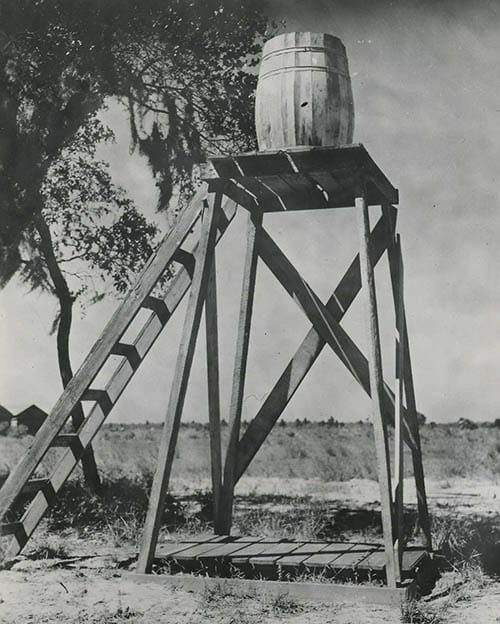
- Gravity: The pressure depends on the height and losses in the circuit, and can change when the level drops. This solution does not necessarily require electricity, but requires a reserve, load and safe access. Mounting a tank over a user does not become a benign operation because the operation seems simple.
- Pump: Choose according to the flow rate, height, power supply and conditions of use of the model. It does not guarantee constant pressure regardless of distance, battery or tank level. Electrical equipment used in a wet area requires the protections and connections provided; a portable pump does not connect like an ordinary indoor appliance.
2. Location of the shower
Location: plan where water, soap and other products go after use. Soil that absorbs is not necessarily an authorised route. Do not discharge to a watercourse, well, neighbouring land or rain drain assuming that initially rainwater remains ordinary rainwater after use for washing.
Support: a robust-looking branch or tree does not establish a known load capacity. The structure must accommodate the filled weight and forces, with installation following instructions and applicable rules. Never climb while carrying a full water bag or use an improvised attachment above someone.
Distance pumping: length, height, diameter and condition of pipes can change the flow. Also check the temperature, cleaning, storage and separation of uses. A pipe used with inappropriate water does not become a safe water-supply system by the addition of a more powerful pump.
The choice of place therefore combines water, discharge, support, mobility and external conditions. A design can reduce certain risks, without guaranteeing a result from slope or sunshine alone. Confirm the uncertain points and keep a possibility of not using the device.
3. Creation of a Platform
Platform: Ask how to avoid slipping, falls, stagnation and barriers to access, with authorized water management. A layer of round stones alone is not a proper treatment or drainage; it can also be unstable under the feet. Do not start earthwork until you have checked the relevant networks, soil and rules.
Wood and supports: choose a suitable material, a non-slip surface and a structure sized for its use. Cedar, teak or treated wood does not guarantee stability or absence of splinters. The spacing of slats, steps and any guardrails must take into account users, including children and less mobile people; a small scale does not automatically make a platform accessible.
Sun and wind: they influence comfort and drying, but they do not replace cleaning or measures against stagnant water. Inspect after use and rain, surface temperature and frost. An aesthetic or well-exposed place is not a sanitary check of water or proof that the discharge to the ground is permitted.
4. Installing a Privacy Screen
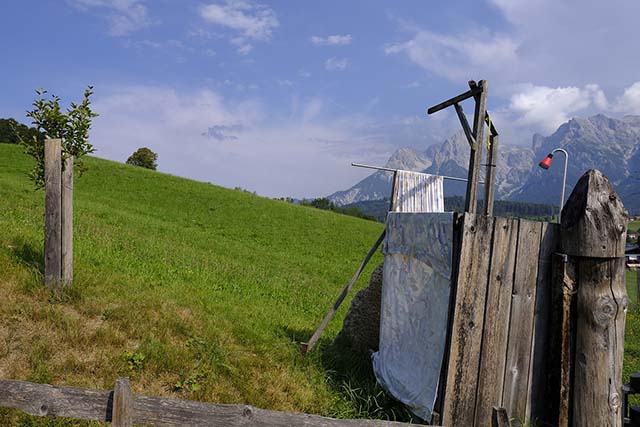
Portable screen: check the mounting, the permissible wind and access, distinguishing privacy and safety. A camping product may not be suitable for a permanent location; do not attach it to a fragile part of the tank holder and do not block the user's exit.
Homemade screen: PVC frame and curtain are possible materials for some light visual protections, without constituting an evaluated plan. The dimensions, anchoring and wind loading shall be adapted. Do not lean on this screen as a guardrail and do not use it to carry a tank. The announced economy must not mask the limits of stability, sun ageing and the need to remove it in bad weather.
Check real privacy without locking the user, creating a heat pocket or blocking access for assistance. A screen must be able to be opened or left easily. Respect the rules of the place and the neighbors; choosing a curtain does not solve the issues of water supply, wastewater discharge or accessibility of the shower.
5. Selecting the tank and shower head
Choose the tank and shower head after the checking water quality and permitted use. Compare materials, capacity, permissible temperature, maintenance and access. A closed or tank sold for camping does not guarantee that any collected water will remain of sanitary quality.
- Selection of the Reservoir :
- Separate reserve: can facilitate mobile use with appropriate water. Do not automatically fill a bag from a runoff barrel. Sun heating can produce an excessive temperature without disinfecting in a controlled manner; check the temperature before contact with the skin and avoid unnecessary storage of warm stagnant water.
- Capacity: dimension according to the users, the flow rate, the filling possibilities and especially the load supported. Each litre adds about one kilogram to the mass, plus the container. The material must be adapted to the water and temperature required; a metal or plastic available is not automatically suitable for use.
- Choosing the shower head :
- Shower head: flow, spray and maintenance must suit the system. Fine droplets can create an inhalation exposure if the water contains microbes. A pleasant spray does not establish safety. Clean and maintain the equipment according to instructions and do not use a supply of uncertain quality.
- Gravity and pump: these are two ways to move water, not two levels of safety. A pump does not guarantee a constant pressure and a tank mounted overhead is not automatically an economical solution once the safe support is included. Compare real functions and constraints rather than a promise of universal comfort.
- Installation and Assembly :
-
- Suspension: Have the support and attachment method checked for the total load. Do not suspend a full reserve at a ceiling, branch or post only because it looks solid. Keep filling and cleaning access safe, without positioning a heavy object over an occupied area unless the product and installation are designed for that use.
- Pump: follow the instructions for power supply, immersion and charging. A manual pump is not always cheaper over its whole service life, and an electric pump does not guarantee constant flow. Never charge a device in a wet area or modify wiring to use a charger beside the shower.
The selection therefore combines water quality, rules, access, temperature, wastewater discharge, support and maintenance. Saving drinking water is not a sufficient benefit if the system creates contamination or falling-object hazards. The chosen option can be a portable shower filled with suitable, permitted water, or the abandonment of the intended installation; these choices remain consistent with a responsible preparation.
Advanced 5-gallon Summer Shower
Advanced Elements five-gallon model: five US gallons equal approximately 18.9 litres, or nearly nineteen kilograms of water before the container’s weight. Check the exact model, instructions, mounting and temperature. Never suspend it from a ceiling without suitable support or confuse solar heating with water treatment.
Outdoor portable shower Ivation
Ivation, portable shower cited: identify the model, pump, battery and charging and immersion conditions. There is no current price or comparative trial to qualify it as cheap. A pump that takes water from a bucket does not filter or disinfect it; use only suitable water and a maintained device.
Sources and limits of use
- France: authorised use of rainwater, including the prohibition of use for body hygiene.
- Quebec: water quality and business obligationsread according to the field of the establishment; do not infer an exemption for a domestic project.
- CDC: Rain Collection and Health.
- Public Health Agency of Canada: legionellosis, stagnation and aerosols.
These references explain why natural or clear water is not automatically suitable for a shower. They do not constitute the validation of a treatment or construction described in this dossier.