
In this article
- In brief
- Why aim for two weeks, then thirty days?
- How to choose foods
- Calculating needs
- A basic list for 30 days (4 adults)
- The two-week version, easy to start
- Organization and storage
- Adapting the reserve to your household
- Eggs in the reserve: powdered eggs and substitutes
- Points of caution
- Frequently asked questions
Authorities recommend being able to manage on your own for at least 72 hours. That is an excellent starting point, but many real situations last longer: a winter outage of several days, a flood that cuts off an area, a strike or supply disruption, a sudden job loss. A food reserve of two weeks, then thirty days, turns these ordeals into manageable periods.
This guide offers a simple, gradual method: why aim for two weeks and then a month, how to choose foods, a commented basic list with calculated quantities, organizing storage, adapting to your household, and a practical section on powdered eggs and egg substitutes, which are often overlooked.
In brief
In brief. Aim first for two weeks, then thirty days. Count about 2,000 calories per adult per day, choose foods your family already eats that keep well and need little water and energy to prepare, and build the reserve gradually by buying a little more at each grocery run. For four adults over 30 days, you need about 240,000 calories: rice, pasta, oats, legumes, oil, peanut butter, canned goods and powdered milk provide most of it. Don’t forget water: 4 L (about 1 gal) per person per day.
Why aim for two weeks, then thirty days?
| Level | Situations covered | Effort |
|---|---|---|
| 72 hours | Short outage, storm, quick evacuation | A few targeted purchases |
| 2 weeks | Prolonged outage, closed roads, illness in the household, local disruption | One to two months of gradual buying |
| 30 days | Supply disruption, loss of income, regional crisis | A few months of gradual buying |
Two weeks is a realistic threshold for most households: the reserve fits in a cupboard or a few bins, costs little more than the usual groceries spread over a few weeks and covers the vast majority of disruptions experienced in Quebec. Thirty days adds a real safety margin against an economic crisis or a prolonged supply chain disruption.
How to choose foods
A good reserve is not a warehouse of exotic foods. It rests on a few simple criteria:
- You already eat them: rotation happens naturally and nobody discovers a hated food in the middle of a crisis.
- They keep for several months, ideally several years, without refrigeration.
- They need little water and energy to prepare; some can be eaten without cooking.
- They are dense in calories and nutrients: the goal is to nourish, not just to fill.
- They are varied: monotony wears down morale and appetite, especially in children.
Calculating needs
A moderately active adult needs about 2,000 to 2,500 calories a day; a child, 1,200 to 2,000 depending on age; someone doing physical work (shovelling snow, cutting wood), more. A reserve is therefore calculated first in calories, then in variety. For a household of four adults:
| Duration | Calories needed (2,000/day/adult) | Drinking water (4 L/day/person) |
|---|---|---|
| 72 hours | 24,000 | 48 L (about 13 gal) |
| 2 weeks | 112,000 | 224 L (about 59 gal) |
| 30 days | 240,000 | 480 L (about 127 gal) |
The food storage calculator adapts this calculation to your household, and the water storage calculator does the same for water.
A basic list for 30 days (4 adults)
Here is a sample composition that reaches about 240,000 calories. Quantities are rounded; adapt them to your tastes, dietary restrictions and number of people.
| Category | Food | Indicative quantity | Approximate calories |
|---|---|---|---|
| Starches and grains | White rice | 20 kg (44 lb) | 72,000 |
| Dry pasta | 8 kg (18 lb) | 29,000 | |
| Rolled oats | 6 kg (13 lb) | 23,000 | |
| Legumes | Dried beans, lentils, chickpeas | 6 kg (13 lb) | 20,000 |
| Fats | Vegetable oil | 4 L (about 1 gal) | 32,000 |
| Peanut butter | 4 kg (9 lb) | 23,000 | |
| Protein | Canned tuna, chicken, salmon, meat | 40 cans | 10,000 |
| Vegetables | Assorted canned vegetables | 40 cans | 4,000 |
| Fruit | Canned and dried fruit | 12 cans and 2 kg of dried fruit | 8,000 |
| Sweeteners | Sugar and honey | 4 kg (9 lb) | 15,000 |
| Dairy | Powdered milk | 3 kg (6.6 lb) | 11,000 |
| Approximate total | About 247,000 | ||
Add condiments, which cost little and make all the difference to taste: iodized salt, pepper, spices, bouillon cubes, soy sauce, ketchup, mustard, vinegar. Also plan coffee, tea, hot chocolate and drink mixes for morale, and a multivitamin per person to fill the gaps of a simplified diet (vitamins C, D, B12).
The two-week version, easy to start
For two weeks, roughly halve the quantities above and favour more ready-to-eat foods, useful if cooking becomes difficult:
- Starches: rice, pasta, instant oatmeal, crackers, cereal.
- Protein: tuna, chicken, salmon, baked beans, canned chili and stews, peanut butter, nuts.
- Fruit and vegetables: canned goods, applesauce, dried fruit, canned soups.
- Dairy and alternatives: powdered milk or shelf-stable (UHT) milk, plant-based drinks.
- Meal bases: tomato sauces, condensed soups, broths.
- Complete meals: canned prepared meals, freeze-dried meals, energy bars.
- Condiments, oils and sweeteners: oil, salt, sugar, honey, spices.
- Drinks: water, coffee, tea, boxed juice.
See also 100 foods that do not require refrigeration.
- Take inventoryWhat you already have and what your family really eats.
- Add a little each weekA few extra items at each grocery run, take advantage of sales.
- Reach 2 weeksIn one to two months, with matching water.
- Aim for 30 daysAdd well-packaged bulk staples.
- RotateFirst in, first out, checks twice a year.
Organization and storage
Storage conditions
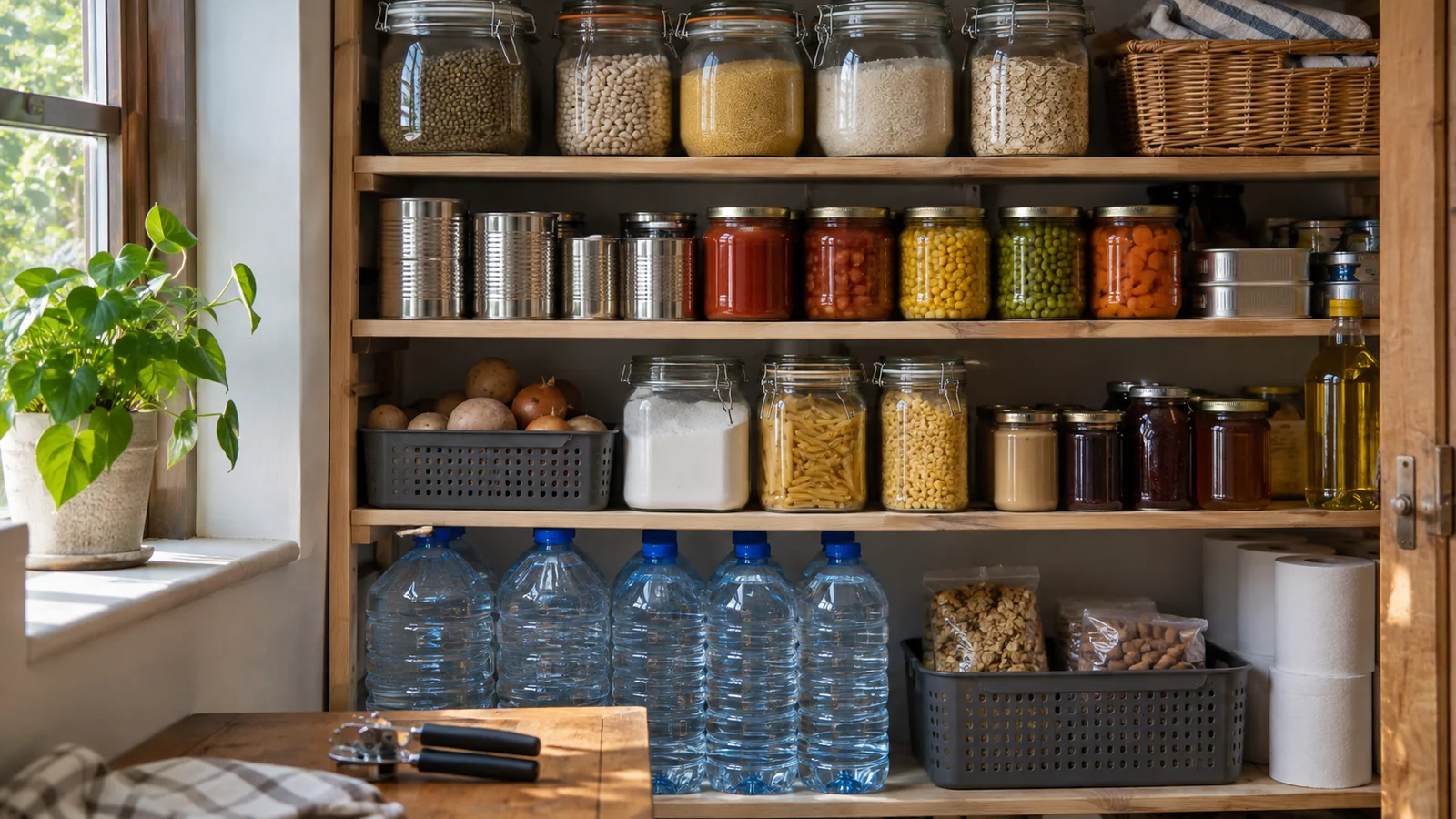
Store the reserve in a cool, dry, dark place, away from temperature swings, on shelves rather than the floor. Dry bulk foods keep much longer in Mylar bags with an oxygen absorber, placed in food-grade buckets. See long-term food storage.
Rotation, the key principle
A reserve that is never used ends up in the trash. Put new purchases at the back and use the oldest first. Work the reserve into everyday meals: it is the best way to keep it fresh and make sure you know how to cook these foods. See rotation rules.
Labelling
Write the purchase or packaging date on each container with a marker and keep a simple inventory list, on paper or in a spreadsheet. It shows at a glance what is left and what is nearing its date.
Adapting the reserve to your household
- Babies and young children: infant formula, purées, snacks they accept, and a way to sterilize.
- Allergies and intolerances: a gluten-free, lactose-free or peanut-free reserve is planned from the start, with clear labelling.
- Special diets: diabetes, low-salt diets, vegetarian or vegan eating (more legumes, nuts, seeds and powdered plant milk).
- Older adults: foods that are easy to chew and prepare, individual portions.
- Pets: their food is part of the reserve. See the dog food storage calculator.
Eggs in the reserve: powdered eggs and substitutes
Fresh eggs keep a few weeks in the fridge, but a long-term reserve has to rely on other solutions. Powdered eggs and substitutes let you keep making pancakes, bread, cakes or scrambled eggs.
Powdered eggs
They are made by spray drying (the most common and affordable) or by freeze-drying (better texture, more expensive). You can find whole egg powder, whites only or yolks only.
| Powdered eggs | Fresh eggs | |
|---|---|---|
| Storage | 5 to 10 years unopened, depending on the manufacturer; a few months once opened | A few weeks in the fridge |
| Refrigeration | No, before opening | Yes |
| Use | Excellent for baking, decent for scrambled eggs | All uses |
| Safety | Pasteurized, always cooked | Salmonella risk if undercooked |
Commercial egg powder is pasteurized and much safer than homemade powder: home dehydration of raw eggs carries a salmonella risk and is not recommended. To use it, you generally mix one heaping tablespoon of powder with two tablespoons of water to replace one egg, following the manufacturer’s directions.
Egg substitutes by use
| Egg’s role | Substitute for one egg | Best for |
|---|---|---|
| Binding | 1 tbsp ground flaxseed + 3 tbsp water, rest 5 minutes | Patties, breads, cookies |
| Binding | 1 tbsp chia seeds + 3 tbsp water | Muffins, quick breads |
| Leavening and lightening | 3 tbsp aquafaba (liquid from canned chickpeas) | Meringues, light cakes |
| Leavening | 1 tsp baking soda + 1 tbsp vinegar | Cakes, pancakes |
| Moisture | 60 mL (1/4 cup) applesauce or mashed banana | Muffins, dense cakes |
| Replacing scrambled eggs | Crumbled, seasoned tofu | Breakfasts |
| Replacing an omelette | Chickpea flour mixed with water | Omelettes, savoury pancakes |
Flaxseed, chia seeds and canned chickpeas keep well and add protein and fibre: they are good allies in a reserve. Fresh eggs can also be frozen beaten, in small portions, for a few months.
Points of caution
- Cooking without power: plan a stove and fuel, or a share of ready-to-eat foods. See portable stoves.
- Water: rice, pasta and legumes need a lot of it; your water reserve must account for that.
- A manual can opener: essential, and keep two.
- Don’t buy everything at once: a reserve built gradually costs less, rotates better and avoids hoarding products at others’ expense.
Frequently asked questions
How much does a two-week reserve cost?
The cost varies with the household and foods chosen, but spread over several weeks of groceries, the effort remains modest. Staples such as rice, pasta and legumes are among the cheapest per calorie.
How much water should you plan?
At least 4 L (about 1 gal) per person per day for drinking, cooking and minimal hygiene, or 56 L (about 15 gal) per person for two weeks.
Is powdered egg safe?
Commercial egg powder is pasteurized and safe when cooked. Avoid making your own powder from raw eggs because of the salmonella risk.
Should you buy freeze-dried meals?
They are convenient, light and keep a very long time, but cost more per calorie. They complement a reserve based on everyday foods well, especially for a go bag.
How do you keep the reserve from expiring?
By working it into everyday meals, putting new purchases behind older ones and checking dates twice a year.