
In this article
- The conditions to maintain
- The basement
- The pantry and interior cupboards
- The garage
- The root cellar and cold room
- Often-overlooked spaces
- In an apartment: realistic constraints and solutions
- Comparison table
- Frequently asked questions
- Summary
- Sources and verification references
- Equipment to compare for your needs
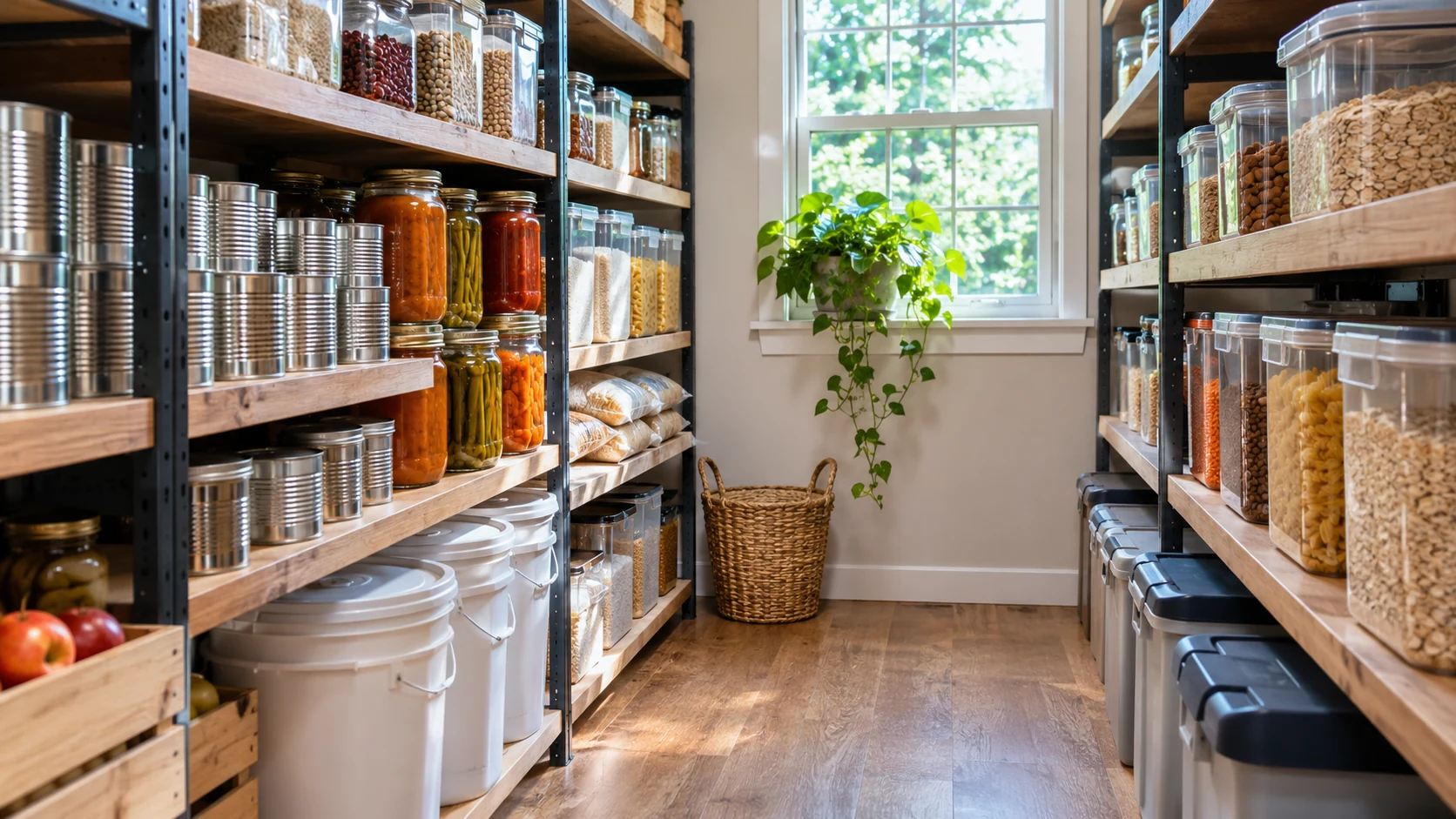
Building an emergency food supply is good; storing it in the right conditions is essential. A place that is too hot, too damp, poorly ventilated or hard to reach can ruin months of effort. This article compares the main spaces in a Quebec home (basement, pantry, garage, cold room, forgotten corners, apartment), with their real advantages, limitations and the precautions each one calls for.
At a glance
- The ideal place is cool (10 to 18°C), dry (relative humidity below 60%), dark and protected from pests.
- The best combination: a rotating supply in the pantry and a long-term supply in the basement or cold room.
- The garage is the worst place for food: keep it for non-food supplies.
The conditions to maintain
Before choosing a location, understand what degrades stored food, and how fast.
| Factor | Effect on food | Threshold to watch |
|---|---|---|
| Humidity | Mould, rusted cans, dry packaging going soft | Relative humidity above 60% |
| Heat | Oxidation, rancid fats, vitamin loss, insects | Faster deterioration above 25°C (77°F), significant above 30°C |
| Light | Loss of some vitamins, oxidation, discolouration | Prolonged direct light; an opaque container is enough |
| Pests | Contamination, punctured packaging, whole batches lost | Uncontrolled access; airtight containers essential |
| Temperature swings | Condensation inside containers, weakened plastics | Large day-night or seasonal swings |
Basic rule: for long-term storage, leave no food in its retail packaging. Cardboard, thin plastic and paper protect poorly against moisture, pests and oxygen. Transfer to suitable containers: HDPE buckets, glass, Mylar bags, airtight metal tins. See oxygen absorbers.
The basement
In a house, the basement is often the best place for a long-term supply: cool and stable, out of the light, with space. Its weak point: humidity, and in Quebec, spring flooding in some areas.
Advantages
- Cool, fairly stable temperature year-round
- Out of direct light
- Space often available
- Less exposed during an earthquake than upper floors
Limitations
- Humidity often high: mould on cardboard, rust on cans
- Flood risk (poorly drained basement, flood zone, sewer backup)
- Possible rodent access if not well sealed
Measures to put in place
Nothing directly on the floor: pallets, racks or shelves raised at least 15 cm (6 in.). Moisture wicks up, and concrete is cold and damp to the touch.
Dehumidifier: keep relative humidity below 60%, and empty the tank regularly. An inexpensive hygrometer lets you track it without guessing.
Airtight containers: HDPE buckets, Mylar bags, glass jars or metal tins; no cardboard, no original packaging.
Flood risk: if the basement has flooded before or your lot is low-lying, store the supply up high and deal with prevention first (backwater valve, drainage). Check your municipality's flood zone map. See also off-grid sanitation.
The pantry and interior cupboards
Interior spaces (pantry, cupboards, closets) give the best control of temperature and humidity, since they benefit from the home's heating and air conditioning. They are also the most accessible, which makes rotation easier. Their main constraint: space, often limited in cities and apartments.
Advantages
- Stable temperature and humidity
- Easy access, which encourages rotation
- Out of the light if the cupboard is closed
- Little exposure to pests in a well-kept home
Limitations
- Limited space for a large supply
- In the kitchen, heat from the oven or fridge warms nearby cupboards
- Containers can fall if shelves are not secured
Make the most of the space: shelves up to the ceiling (height is the most overlooked space), can dispensers that rotate automatically, under-shelf organizers, the backs of doors and gaps between appliances. See food stock rotation.
The garage
The garage often comes to mind because of its floor space. In practice, it is the least suitable place for food in Quebec: heat in summer, freezing in winter.
Advantages
- Space often available
- Suitable for non-food supplies (hygiene, tools)
Major limitations
- Extreme temperatures: very hot in summer in an uninsulated garage, freezing in winter; both damage food and cans
- Humidity hard to control
- Fumes from fuel, paint and cleaning products that plastic packaging can absorb
- Easy access for rodents
If the garage is your only option: limit yourself to airtight metal tins and Mylar bags in sealed HDPE buckets, the only containers tight enough against fumes, moisture and pests. You would also need to stay below 25°C, difficult without insulation. Keep the garage for non-food supplies if possible, and never store fuel near food.
The root cellar and cold room
A cellar, underground or partly underground, offers near-ideal conditions: cool and very stable, moderate humidity, darkness. In Quebec, many houses have a cold room (chambre froide), often under the front steps, that plays this role; cellars are also found in older homes, in France as in rural Quebec.
Advantages
- Cool, stable temperature all year
- Permanent darkness
- Ideal for home-canned goods, garden vegetables and ferments
- Often plenty of space
Limitations
- Humidity sometimes high: check with a hygrometer
- Access can be difficult in an emergency if separate from the house
- Rodents if not well sealed
- Costly to build if you do not have one
- A cold room under the steps can freeze in severe cold
A cellar or cold room is particularly suited to root vegetables (carrots, beets, potatoes, onions) and home-canned goods. For commercial canned goods and dry foods, it offers excellent conditions if humidity is controlled. See also winter food storage without a cellar.
Often-overlooked spaces
Under the stairs
In a multi-storey house, this space is often unused. Cool, dark and accessible, it suits a 30-day rotating supply, with custom or modular shelving.
Under beds
Flat bins can hold canned goods, legumes or dry rations in short rotation. Not practical for large volumes, but useful in a small home. Watch for dust and floor moisture.
Storage rooms and cool rooms
A cool room (laundry room, north-facing storage room) in a well-insulated home often resembles a basement. With shelves and airtight containers, it can hold a sizeable supply.
In an apartment: realistic constraints and solutions
In an apartment, space is tight: no basement, no cellar, often shared storage. A supply of 72 hours to 2 weeks is still achievable in most homes.
Focus on calorie density: dry legumes, white rice, pasta, oats, nuts and seeds provide a lot of calories and protein for little volume. A 20-litre (about 5 US gallon) bucket of dry legumes holds about 15 kg of food, on the order of 50,000 kcal.
Use height: shelves to the ceiling, in hallways, behind doors.
Dual-purpose furniture: coffee tables with storage, beds with drawers, storage ottomans.
Balcony: only temporarily in spring or fall, in the shade; never permanently, because of freezing, heat and humidity.
Spread the supply out: a little in each room limits losses from a localized water leak.
Correction: an earlier version stated that a 20-litre bucket of dry legumes represented 15,000 to 20,000 kcal. With about 15 kg of legumes at roughly 340 kcal per 100 g, it is closer to 50,000 kcal.
A realistic goal for an apartment: a supply of 72 hours to 2 weeks of non-perishable food, stored in cupboards, under beds and up high. That covers the most likely emergencies in a city, without changing the home.
Comparison table
| Location | Temperature | Humidity | Space | Access | Recommended for |
|---|---|---|---|---|---|
| Pantry, interior cupboard | Stable | Good | Limited | Ideal | Rotating supply (72 h to 30 days) |
| Basement | Cool | To control | Large | Good | Long term, airtight containers |
| Cellar, cold room | Ideal | Variable | Large | Sometimes outside the home | Home canning, vegetables, very long term |
| Garage | Extreme | Difficult | Large | Good | Non-food supplies; food only as a last resort, in metal or Mylar |
| Under beds, hidden spaces | Stable | Good | Small | Awkward | Apartment top-up, short rotation |
Frequently asked questions
My basement is damp: can I still store my supply there?
Yes, with a dehumidifier to stay below 60% humidity, raised shelves and airtight containers only. If it may flood, keep the supply up high or elsewhere.
Can I leave canned goods in the garage over winter?
Best avoided: freezing can swell cans and damage the seams. If a can has frozen, inspect it; throw it out if it stays bulging, leaks or has a damaged seam. See canned food shelf life.
Should I hide my supply?
No need to hide it, but spreading it over several places limits losses from a water leak or localized accident, and makes it less cumbersome.
Summary
There is no perfect place for everyone: the best one is available, accessible and lets you maintain good conditions. In most households, combining two spaces is the sturdiest approach: a rotating supply in the pantry, accessible every day, and a long-term supply in the basement or cold room, larger and opened less often. In an apartment, height, under-bed space and storage rooms allow a supply of 72 hours to 2 weeks without renovations.
To go further: choosing food preservation methods, canned food shelf life, your preparedness review and the Food category.
Sources and verification references
Local instructions and product instructions take precedence for your situation. References consulted for this update:
Equipment to compare for your needs
Some links below are affiliate links: we may receive a commission at no additional cost to you. Products are examples by function, to choose according to your needs; buying the entire selection is unnecessary.