
In this article
Preparing in the city is not the same as preparing in the country. Limited space, reliance on shared networks, density and building rules mean some approaches need adapting and others simply don't work. The good news: urban preparedness starts from very concrete needs (a power outage, a water advisory, a heat wave, a temporary departure) and needs no collapse scenario to justify it. Here are the challenges specific to city life, approaches proportionate to the risks, and the honest limits of self-sufficiency in dense housing.
In short
- Aim for 72 hours of self-sufficiency first, then one to two weeks depending on your means, space and needs.
- Your neighbours and your ability to leave matter as much as your supplies.
- No apartment can become a self-sufficient fortress: preparedness is about getting through until services return.
Canadian cities face varied risks depending on their geography, buildings and infrastructure. The 1998 ice storm showed the scale of a major disruption in Quebec. Useful preparedness targets concrete needs and instructions: it neither downplays possible consequences nor predicts widespread chaos. The COVID-19 pandemic was also a reminder that disruptions can last, with care and mutual-aid needs that go beyond a simple stockpile. To go further, read our article on household preparedness in Quebec.
Risks specific to urban environments
What changes compared with rural areas
Greater vulnerabilities in the city
- Reliance on networks: water, electricity, heating and food supply depend on complex centralized systems.
- Density: services and people are close together, which can complicate supply or help disease spread depending on conditions.
- Mobility: an evacuation can be slowed by congestion and overcrowded public transit.
- Space: storage and growing options vary from one home to another; measure rather than assume.
- Food: heavy reliance on outside supply chains, even for a household that grows a small share of its food.
Relative advantages of the city
- Nearby services: hospitals, firefighters and police are generally easier to reach than in rural areas, with no guarantee of a faster response during a crisis.
- Variety of resources: several grocery stores, pharmacies and hardware stores.
- Dense neighbourhoods: more neighbours available for mutual aid, if relationships already exist.
- Redundancy: some networks have backups, with no guarantee for every building.
Scenarios to consider based on your local risks
To set priorities, start from the risks in your area, their consequences and your household's means. The examples below are food for thought, not probabilities calculated for every city.
Common situations to include in your plan
- Power outages of 24 to 72 hours (storms, equipment failure).
- Water interruptions or advisories: tell apart boil-water, do-not-consume and do-not-use advisories; boiling does not deal with every type of contamination.
- Staying home for a few days (extreme weather, health emergency).
- Minor supply disruptions (food recalls, temporary shortages).
- Local evacuation (gas leak, fire in the building next door, flooding in one area).
Wider situations, to assess for your area
- All services disrupted at once for more than a week.
- Mass evacuation of an entire city.
- Complete breakdown of urban social order.
Spread your efforts according to the most important needs and the risks you have identified. A rare event can have serious consequences, or call for just one simple step to prepare. A short-term supply and longer-term planning are not in conflict; also think about medical treatment, accessibility and your ability to replenish supplies.
The trap of urban doom
Some content dramatizes city life with images of looting or widespread violence. Yet major crises like Katrina, the 2010 earthquake in Haiti or COVID-19 cannot be reduced to a uniform collapse, nor to resilience without harm: each context needs to be studied on its own terms. For your household, starting from local risks and official instructions avoids both constant fear and downplaying a real need.
Constraints of preparing in the city
Limited space
In an apartment, storage space is often a significant constraint, but not necessarily the main one: health, budget, mobility or temperature may come first. Measure what is available without blocking access, then choose a realistic layout.
| Home | Example floor area | What to check |
|---|---|---|
| Studio | 20 to 40 m² (215 to 430 sq ft) | The storage space actually available |
| One- or two-bedroom apartment | 50 to 80 m² (540 to 860 sq ft) | The number of rooms does not guarantee the area; measure usable and shared spaces |
| Family home | 80 to 120 m² (860 to 1,290 sq ft) | Number of occupants, circulation and furniture |
| No basement or garage | No secondary space | Storage that can be set up inside the home |
One or two square metres (11 to 22 sq ft) already take up a lot of room. And floor area doesn't tell the whole story: the weight of water, shelf load, reachable height, ventilation and circulation matter too. Don't try to recreate a house-sized stockpile in an apartment without checking these conditions.
To save space:
- Think vertical: secured shelving rated for its load, heavy items at a reachable height, never an unstable stack above people.
- Use available spaces: under the bed or in a closet, if access stays practical. Never store anything in a stairway or passage where it's prohibited or would block an exit.
- Choose multi-purpose furniture: beds with storage, hollow ottomans or benches.
- Go compact: energy-dense foods, folding or stackable equipment.
- Rotate your supplies: store what you already eat and use it day to day.
Municipal and condominium rules
Building, condominium, rental or municipal rules may limit some uses, in the city as in the country. They depend on the location and the installation: check what is allowed rather than assuming.
- Balconies and outdoor spaces: storage, fuels or equipment are often prohibited or restricted.
- Installations: solar panels, rainwater collection or other modifications require permission, proper mounting and a compatible setup.
- Generators: never inside a home, a garage or an enclosed space. A balcony is not automatically a safe outdoor location: follow the manual, the distances from openings and local rules.
- Animals: number and types are often limited, which generally rules out keeping small livestock.
- Hallways and stairwells: storing anything there is prohibited under fire regulations.
These rules narrow your options and call for creativity, within the law.
Reliance on shared infrastructure
Dependencies vary: some rural homes are connected to the grid and some urban buildings have their own systems. A well or a wood stove also depends on energy, maintenance and safe conditions. Take stock of your actual systems to plan for their limits, without idealizing either setting.
| System | Urban reliance | Backups (limited) |
|---|---|---|
| Water | Municipal network | A suitable, regularly renewed supply; identify authorized supply points. No alternative water is safe to drink by default, and purification does not deal with chemical contamination. |
| Electricity | The grid; very limited self-generation | Portable batteries, small window solar panels (very limited capacity) |
| Heating | Mostly electric or gas | Warm clothing, sleeping bags; active options are limited without fire or carbon monoxide risk |
| Cooking | Electric or gas range | Foods that need no cooking. Ventilating or opening a window a crack does not make a fuel-burning camp stove safe indoors. |
| Sanitation | Sewers | A temporary collection solution, following your municipality's health and disposal instructions |
| Food | Shopping and deliveries | A rotating supply; growing food locally is neither impossible nor enough for everyone |
In reality, complete, long-term self-sufficiency is practically impossible in an apartment. Preparedness is about holding out temporarily until services are restored.
Proportionate approaches for city dwellers
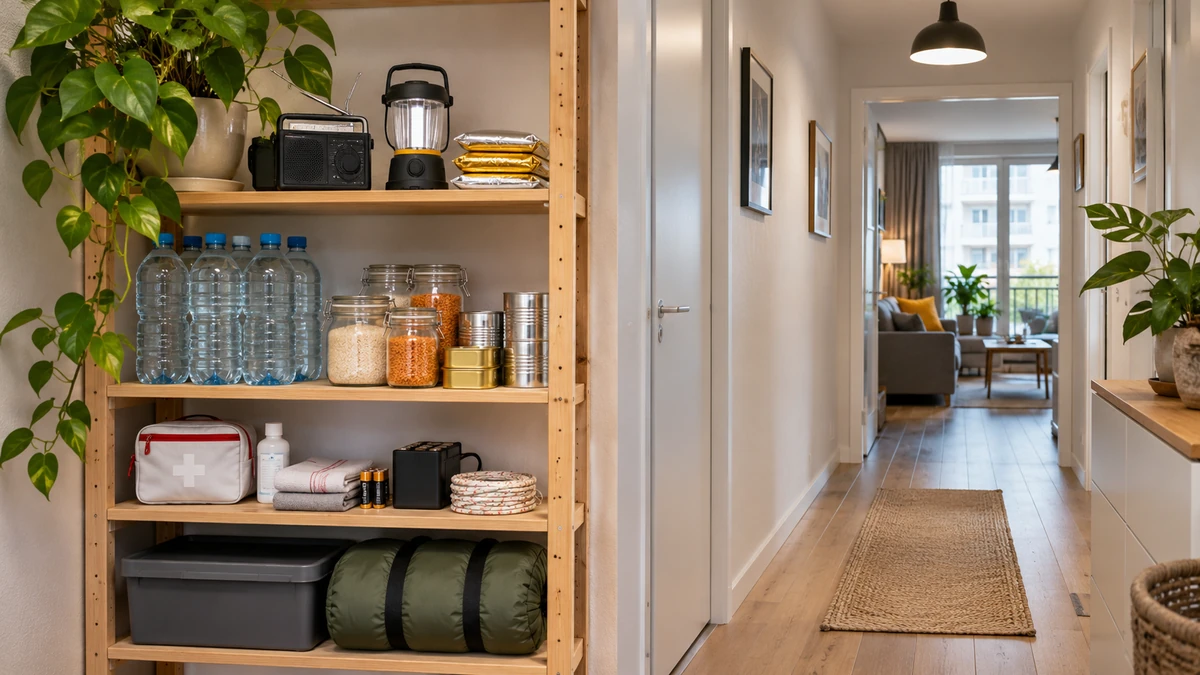
Realistic storage in a tight space
Rather than aiming for months of supplies, impossible for most city dwellers, work in stages. Canadian authorities recommend at least 2 L of drinking water per person per day; the amounts below plan for 4 L (2 L for drinking, 2 L for cooking and basic hygiene). Adjust them for your household (children, pets, heat, health).
Stage 1: 72 hours
- Water: 12 L (3.2 US gal) per person.
- Non-perishable food for 3 days.
- Flashlights, batteries, crank radio.
- Basic first aid kit.
- Copies of important documents.
- Medication: talk to your pharmacist or doctor about continuity and storage of your treatments.
Some households will need help to reach this stage. Measure actual volumes and weight: a single box under the bed won't necessarily hold the water and everything the household needs.
Stage 2: 1 to 2 weeks
- Water: 56 L (14.8 US gal) per person for 14 days, about 56 kg (123 lb) not counting containers.
- Two weeks of food: canned goods, rice, pasta, legumes.
- Cooking: a safe, permitted option, or no-cook meals. Don't store prohibited fuel and never use an outdoor appliance indoors.
- Extra hygiene supplies.
- Blankets and warm clothing.
- Cards and books to fight boredom.
Work out the space from the quantities you choose, their weight and access.
Stage 3: 1 month
- Water: 120 L (31.7 US gal) per person for 30 days; a filter does not replace missing volume or a safe source.
- A month of varied food, rotated.
- Backup equipment (several flashlights, extra batteries).
- A good stock of hygiene supplies.
- Books and reference material.
A month is an option to consider: depending on your needs, budget and available support, it may be too much or not enough. Two to three square metres (22 to 32 sq ft) may not be enough; calculate and check the load.
Active rotation rather than dormant storage
Storing what you eat every day and using the oldest first makes rotation easier and reduces forgotten items, without eliminating all waste. Keep dates, instructions and useful packaging, check storage after opening and choose meals you can make with the water and energy available. Adjust your supply when your household's diet, allergies or abilities change. For more, see our food storage guide.
Priority skills in the city
Some skills are especially useful in an urban setting. They complement equipment, but need practice and regular refreshers.
- First aid: recognized training, such as the Red Cross's, renewed regularly, is useful every day, not just in emergencies.
- Budget: accessible savings can help; the amount depends on your means and expenses, and there's no universal target.
- Basic cooking: making nourishing meals with few ingredients.
- Repairs: do the small jobs you've mastered, but leave electrical, gas and plumbing work to a qualified person.
- Knowing your neighbourhood: streets, alternative routes and transit.
- Water: knowing the limits of boiling, filtering and disinfecting; none of them treats every contaminant.
- Food preservation: follow tested methods suited to each food, such as dehydrating; drying and fermenting don't make every preparation shelf-stable without refrigeration.
- Amateur radio: in Canada, transmitting on amateur bands requires an operator certificate; don't confuse receiving, transmitting and licence-free consumer devices.
- Personal safety: focus on prevention and de-escalation (see the box below).
Personal safety in the city: what you need to know
- Legal framework: in Canada, self-defence (section 34 of the Criminal Code) only allows a response that is reasonable in the circumstances. Carrying a weapon for self-defence, including pepper spray intended for use on people, is illegal.
- Real benefits and limits: a self-defence course can build confidence and awareness, but it doesn't prepare you for every situation and doesn't replace getting away or calling for help.
- Risks: a confrontation can cause serious injury, including to you, and lead to charges.
- Civil solutions: move away, de-escalate, lock entrances, stay in a group and know your neighbours. See our article on de-escalation and avoiding conflict.
- Role of the authorities: if you're in danger, call 911. Even in a crisis, police and emergency services remain responsible for public safety.
Neighbourhood networks and mutual aid
In dense areas, neighbourhood ties are a valuable resource.
What neighbours bring:
- Sharing information during a disruption: who has power, where to find resources.
- Sharing skills, within their real limits: a profession doesn't create permanent availability or the right to step in without means or consent.
- Checking in on each other, by agreement, without intrusive monitoring or assuming someone is vulnerable because of their age.
- Voluntarily sharing resources, with their conditions: a generator or tool can't be used in just any building.
- Moral support and breaking isolation.
How to build these ties:
- Get to know at least your immediate neighbours (same floor, above, below).
- Take part in building or neighbourhood activities, if there are any.
- Offer occasional help without creating a debt, being clear about what you can do and who takes over when you're away.
- Join local online neighbourhood groups, if they exist.
Paradoxically, in dense cities, many people don't know their immediate neighbours. Breaking that isolation is effective preparedness that costs nothing.
What urban preparedness cannot do
The limits of self-sufficiency in the city
Let's be honest: some practices that work in the country are impractical in the city.
- Food: a balcony or indoor garden doesn't guarantee enough production; yield, season, rules and safety need assessing.
- Energy: producing and storing electricity requires a permitted, properly sized and safe installation; a small battery won't power every appliance.
- Water: collection and storage follow permitted uses; rainwater is not drinking water, and a well isn't possible everywhere.
- Long-term independent heating: without electricity or gas during a Quebec winter, options are very limited without fire or carbon monoxide risk.
- Sanitation: if the sewers stop working, managing human waste quickly becomes a problem.
- Security: look at entrances, exits and your real needs; an apartment isn't a target just because it shares a hallway.
How long can you hold out in the city?
Even well prepared, you can't hold out indefinitely in the city. Rather than guaranteed timelines, ask yourself these questions regularly:
- Partial services: what still works, which needs are critical, what can you replenish?
- Several services down: look for instructions and help before conditions deteriorate, without waiting for an assumed maximum of one or two weeks.
- Cold or heat: danger can appear quickly depending on the people and the home; don't count on a guaranteed few days.
If your home becomes dangerous or your needs can no longer be met, ask for help and follow shelter or evacuation instructions. Your plan should neither delay that step nor push you onto a dangerous road.
The urban fortress myth
No apartment can hold out indefinitely on supplies alone: buildings and their occupants depend on networks and support. That doesn't mean every city quickly becomes unliveable or that the country is necessarily safer. A fallback location must offer a welcome, access to care and services that are actually available. Preparedness combines temporary capacity, information and support; moving to the country is not a universal answer.
When leaving becomes the best option
In some cases, staying in the city is not the best decision.
Situations that may justify leaving:
- Several services are down: assess the consequences and ask for help, without an automatic one-week threshold.
- An official evacuation is ordered (flood, chemical leak, major fire).
- Safety in your area deteriorates significantly.
- Your supplies are running out with no sign of services returning.
- The weather is extreme and you have neither heating nor air conditioning.
Preparing to leave:
- Destination: family or friends who have agreed to take you in, or an officially open shelter; don't head for an unconfirmed location.
- Transportation: keep your vehicle's tank at least half full and plan an alternative if you don't have a car.
- Grab-and-go bag: essential needs and a shelter plan; the bag alone doesn't guarantee 72 hours of self-sufficiency. See our urban kit for journeys.
- Family communication plan.
- Routes: plan options, then follow authorized routes; a highway isn't necessarily to be avoided, nor a back road necessarily safe.
In the city, being able to leave efficiently is often more valuable than being able to "withstand a siege" indefinitely.
Resources and communities
Official programs
- Government of Canada: Get Prepared, for emergency kits and plans.
- Government of Quebec: the civil protection (Sécurité civile) section of Québec.ca.
- Montreal, Québec City and other municipalities: the emergency preparedness section of their website.
- Canadian Red Cross: first aid training and preparedness resources.
Locally, also look for neighbourhood committees with a resilience focus, community organizations that offer training and preparedness groups in your area.
Avoiding the over-preparedness trap
A real risk in the city: investing out of proportion to the risks.
Signs of problematic over-preparedness:
- Sacrificing quality of life for storage (living surrounded by boxes).
- Going into debt to buy equipment.
- Feeding chronic anxiety with doom-laden content.
- Isolating yourself by focusing only on preparedness.
- Neglecting your health, relationships or work in favour of preparedness.
Preparedness should improve your quality of life and peace of mind, not erode them. If it creates more anxiety than it relieves, it's time to rebalance. Our article on fear of disasters can help.
Further reading
Check the date and content of each resource before using it.
Resources and supplies
Organization and strategy
Mutual aid and community
Conclusion: proportionate urban preparedness
Preparing in the city calls for a realistic approach that takes into account both the strengths and the constraints of urban life.
- Proportionality: prioritize likely risks (short outages, temporary stay-at-home periods) over unlikely scenarios.
- Realism: match your goals to the space you have, without sacrificing daily life.
- Skills and equipment: learn what's useful to you and keep it up, alongside the equipment you need.
- Everyday integration: active rotation, storing what you already use.
- Neighbours: your neighbourhood ties are a valuable resource in the city.
- Limits: complete, long-term self-sufficiency is impractical in an apartment.
- Flexibility: knowing how to leave matters as much as knowing how to stay.
Properly understood, urban preparedness is neither a doom obsession nor carelessness. A few modest first steps (contacts, information, water, food, medication) already make many disruptions easier, even though no 72-hour or two-week supply guarantees a good outcome. Your plan should also include the help and adaptations you need, including when means are limited. If your home is no longer safe, another place to stay can help: check the destination, access and care before considering it the better option.
What constraints have you run into, and which solutions actually worked in your home? You can ask a question or suggest an improvement using "Contribute to this article". Contributions are reviewed before being added. Please don't post addresses, medical information or details about your supplies that could identify your household.
Equipment to compare based on your needs
Some links below are affiliate links: we may receive a commission at no additional cost to you. Products are examples by function, to choose according to your needs; buying the entire selection is unnecessary.