
In this article
- The state of citizen readiness in Quebec
- What recent crises in Quebec have highlighted
- Individual and Community Resilience: Two Complementary Dimensions
- The main steps of progressive preparation
- Individual preparation and public services: a logic of complementarity
- In summary
- Frequently Asked Questions
- Sources and references
- Supplementary resources
In December 2023, a precautionary evacuation was recommended downstream of the Morier dike in the Laurentians for residents of Chute-Saint-Philippe and Lac-des-Écorces. This was not a confirmed breach: the notice was lifted on December 14, according to the government’s April 15, 2024 release. The 2023 wildfires also caused evacuations in Quebec. These past events support discussion of household and collective preparedness; they are not active alerts.
Evacuations associated with the Morier dike and wildfires, including Lebel-sur-Quévillon and the situation in Sept-Îles in 2023, illustrate needs for information, transport and accommodation. A crisis can place heavy demands on services, change priorities and affect response times. These examples do not establish that every intervention is delayed or that each event has the same outcomes.
This is not a criticism of public services, which play a fundamental role in crisis management. It is simply a reminder that a minimum individual and family preparation can reduce the pressure on these systems — and improve each household’s ability to get through the first hours or days of a degraded situation in better conditions.
In a context where on Climate Change the frequency and intensity of certain extreme weather events, this reflection on risk management gradually becomes more relevant to a greater number of people.
The state of citizen readiness in Quebec
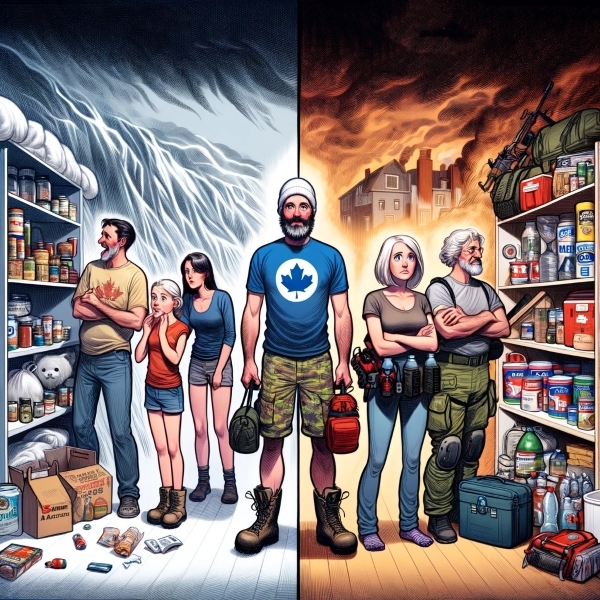
Before quantifying the level of preparation of Quebecers, one should identify a survey, its date and criteria: having a lamp does not measure the same as having a plan adapted to a medical treatment. Without this reference, we do not qualify a proportion of the population as inadequately prepared. The Government of Quebec is proposing a kit for the first few days, which helps to organize needs without ensuring a recovery or relief period.
The reliability of services on a daily basis may make certain dependencies not visible: water, heating, payment or telecommunications. Their interruption deserves concrete reflection, without saying that most Western countries would have the same level of preparation or cause. Housing age, income, treatment and support also affect the ability of each household to act.
Household preparedness does not imply distrust of institutions or anticipation of catastrophic scenarios. It starts from a pragmatic observation: in a crisis, the first hours or days are often based on what each household has already in place.
Some dimensions to consider
The preparation can be evaluated according to several complementary axes. The table below provides a reading grid — not to oppose citizen profiles, but to identify aspects that deserve more attention depending on each individual situation.
Awareness of local risks
Knowing the types of risks present in its sector — floods, fires, nearby infrastructure — is the starting point for any preparation process. Without this basic mapping, it is difficult to prioritize the actions to be taken.
Reserves and emergency equipment
Drinking water, usable food, prescribed treatments, lighting and useful documents should reflect needs during the first days. Medicines are not an undifferentiated stockpile: discuss needs and refills with the pharmacist or prescriber. Distinguish supplies kept at home from items actually portable when leaving.
Family emergency plan
Defining in advance the meeting points, emergency contacts and roles of each — including for Pets — avoids improvised decisions under pressure. A family emergency plan does not need to be complex to be useful.
Basic competencies
First aid, choice of risk-appropriate water treatment and alternative means of communication require learning and verification. A filter does not remove all contaminants, and a radio may be receive-only. Choosing a useful skill, taking appropriate training and keeping records avoids confusing a tool's ownership with knowing how to use it.
Community networks
Community resilience is based on links between neighbours and members of the same community. Knowing your neighbours, who might need help or who has specific skills, is a resource that is often underestimated.
Regular update
Storage requirements and conditions are changing. An annual review can be used as an appointment, with additional checks after a change of treatment, a move, a family change or the use of supplies. The dates and instructions of the products remain a priority; annual verification alone does not guarantee that any preparation remains adequate in the meantime.
What recent crises in Quebec have highlighted

The 2023 wildfires led to evacuations in several Quebec regions. The Sûreté du Québec’s 2023–2024 report for Lebel-sur-Quévillon mentions evacuations in June and July. Cree communities, the Canadian Rangers and Sept-Îles involve other locations, responders and episodes: identify their dates and roles before comparing responses rather than combining them into one total.
For the Morier dike, the precautionary evacuation of December 3, 2023 was followed by an authorized return under the authorities’ plan. Any count of affected people must specify its scope and date; it does not describe people currently evacuated. To prepare for departure, examine these practical factors:
- Immediate availability of essential documents (identification documents, medical orders, contacts).
- The ability to leave quickly with essentials, without having to pack under pressure.
- The existence or otherwise of a place of destination identified in advance.
- Communication within the family, especially for members who were not in the same place at the time of the alert.
These situations do not mean that emergency services have failed — they have managed complex crises on a large scale. Rather, they illustrate that individual preparation and institutional preparation are complementary, not substitutable for each other.
Some practical measures adapted to these scenarios
- Water and food reserves: in PrépaCivile’s planning scenario, initially count two litres per person per day to drink, plus two litres for food preparation and minimum hygiene, then adapt to needs and conditions. This benchmark does not cover all domestic uses and is not a medical prescription. Provide food that can be prepared with the equipment and energy available during the first days.
- Energy and charging: A charged external battery or other compatible solution can help keep a phone working. A solar charger depends on sunlight and its actual power. A generator requires a safe exterior location, in accordance with its instructions and instructions against carbon monoxide; it must not be used in a dwelling, garage or near openings. A connection to the building requires an appropriate installation.
- Water treatment: choose a process according to the origin of the water, the contaminant and the instructions of the apparatus or product. A small filter or tablet does not make every water source safe to drink and does not replace a safe reserve. Chemical contamination or do-not-consume notices may require another source, even after boiling. Also provide the time, temperature and equipment required by the treatment selected.
- Communication plans: Identifying in advance a common point of contact outside the affected area — a trusted person outside the region — facilitates family coordination when local networks are saturated.
Individual and Community Resilience: Two Complementary Dimensions
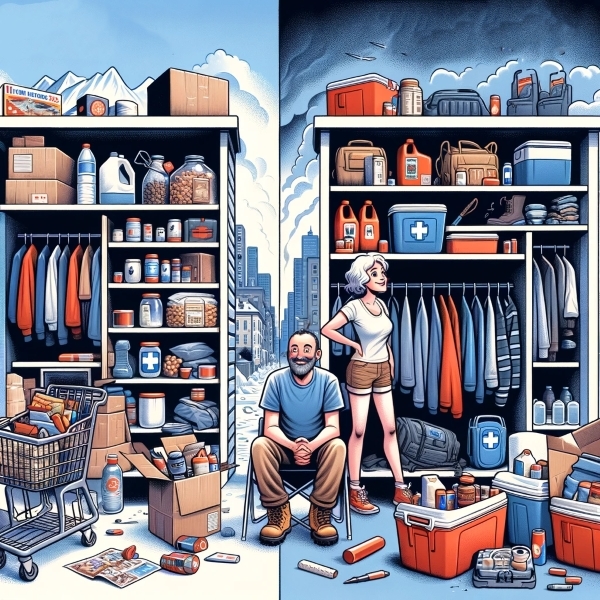
Resilience to crises is built on two levels that reinforce each other. The Individual resilience — reserves, skills, family plan — reduces immediate dependence on collective resources. The Community resilience — neighbourhood ties, skills sharing, local self-help — enhances collective capacity to absorb shocks.
Canada's National Adaptation Strategy, published in 2023, provides a framework for reflection on risks and adaptation; it does not alone establish a specific program for all citizens. Municipal plans, training and warning systems depend on the territories and agencies. Checking their availability and local accessibility makes it possible to connect the action of the home to collective resources without promising a uniform offer.
Know your risk environment
Inquiring with the municipality about risks in your area — flood zones, transport routes for dangerous materials, local threat assessment — is an accessible starting point.
Participate in local initiatives
Many municipalities and community-based organizations offer emergency-preparedness workshops. These spaces also allow us to connect with neighbours and identify local resources available when needed.
Building on the tools available
The portal Civil Safety of Quebec provides practical resources on disaster preparedness. These documents provide a useful basis, to be completed according to the local context and the preparation objectives of each household.
The main steps of progressive preparation
Citizen preparation does not mean changing everything overnight. It is gradually built, in stages, according to the priorities and constraints of each household. Here's a logical progression.
1. Assess your local risks
Start with the risks identified for the sector: flood, forest fire, ice, heat, breakdown or nearby facilities, according to local information. Urban density is not in itself evidence of social tensions or violence. Instead, identify the specific dependencies — lift, transport, common heating, access to water — and the applicable instructions to prioritise the appropriate measures.
2. Building basic reserves
Organize the first days based on local recommendations and household needs. A longer reserve can be considered according to budget, space and renewal, without becoming an identical standard for all. Canned foods, dry meals and legumes have different requirements: water, cooking, fuel and allergies. A food that is long preserved but you cannot prepare does not meet the need; the lists are used to check functions, not to accumulate without a plan.
3. Acquiring practical skills
Skills need to be maintained: they can be forgotten, techniques evolve and abilities change. A first aid training with reminders, reading a map or understanding a notice can be useful in everyday life. Choose an appropriate body and content rather than assume that a survival course validates all shelter or water treatment actions. Also check the accessibility of the exercise and the equipment required.
4. Developing a family plan
A family emergency plan does not need to be exhaustive to be effective. Alternative meeting points, out-of-region contacts, individual responsibilities, procedures for Pets These simple elements can make a significant difference in the real situation. The evacuation plans If the local risk profile so warrants, it should be considered.
5. Stay informed and keep your preparations up to date
Subscribing to local alerts — via municipal applications, official social media accounts, or emergency warning systems — allows for rapid information. At the same time, regularly reviewing supplies (expiry dates and changing household needs) maintains the relevance of the preparation over time.
Individual preparation and public services: a logic of complementarity
It is useful to clarify one often misunderstood point: citizen preparation is not based on mistrust of public services. It is in line with a logic of complementarity.
Emergency and civil security services organise protection and response according to needs and expertise. A family preparation can facilitate waiting, information or departure, but its absence does not remove any right to apply for assistance. Some people will always need support, especially for care, mobility or medical energy. This support and reporting is also part of the preparation; you must not wait until you have exhausted a reserve to call in the presence of a danger.
To become familiar with the Municipal and provincial emergency plans, knowing local warning systems and understanding official disaster instructions makes it possible to effectively link individual preparedness with existing collective arrangements.
Community resilience is built at the intersection of these two levels. Prepared citizens, who know their neighbours and their risk environment, are a fabric of local security that public services alone cannot reconstruct in a major crisis.
In summary
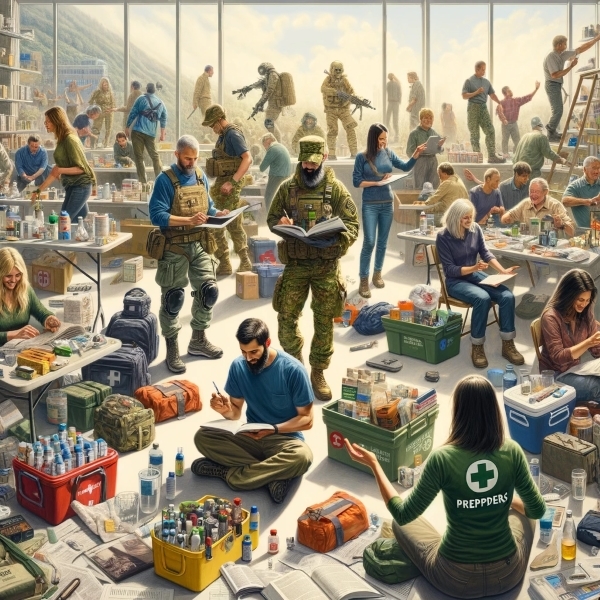
Recent crises in Quebec — Morier dike, forest fires, regional emergencies — do not call for panic. They invite a pragmatic reflection on the minimum preparation that each household can set up, gradually and at its own pace.
This approach is part of a vision of citizen resilience that goes beyond the individual: a prepared home contributes to the resilience of its neighbourhood, a prepared neighbourhood strengthens the capacity of the entire community to cope with crises. Individual preparation and collective solidarity are not opposed — they are mutually reinforcing.
One question to go further: by examining your current situation, what would be the most useful element to put in place first — basic reserves, family plan, or knowledge of your local risk environment?
- Checklist for a family emergency plan
- Basic equipment for preparation
- How to develop an evacuation plan
- Risk assessment and resilience
- Involve family in preparation
- What happens if public services are disrupted?
Frequently Asked Questions
Where do we start if we don't have any preparation in place?
Start with a concrete need: finding contacts, discussing a place to meet or inventory water and food already available. A reserve for the first days can be built up gradually, without waiting for a perfect set. A simple communication plan can be initiated quickly, but its duration depends on the family situation; these two measures do not cover the majority of scenarios alone or the specific medical needs.
What budget should be provided for basic preparation?
The budget depends on what already exists, the number of people, their needs and housing conditions. Some first actions are free; others may exceed a few tens of dollars. Inventorying, organizing and renewing consumed products helps to limit unnecessary purchases. If an essential need exceeds the means of the home, seeking local support is part of the plan. A general estimate should not minimize these constraints or promise a full package at a fixed price.
How to involve children in family preparation?
The preparation can be approached with children in an educational way, integrating into concrete activities: building a personal kit, learning emergency numbers, meeting point exercise. The goal is to make them actors rather than spectators, without creating anxiety. Article on raising prepared citizens explores this issue in detail.
Does citizen preparation also concern urban areas?
Yes. Natural hazards also affect cities: heat, floods and earthquakes are not restricted to rural areas. Dependencies may differ, for example an elevator, a heating system or public transport. Rural areas may have longer distances and limited access. The approach remains to identify local risks, needs and supports available, without presenting an environment as systematically more exposed or safer.
Sources and references
- Global News — Dike-related evacuation in the Laurentians
- Global News — Digue Morier : évacuees des Laurentides
- CTV News — Rupture imminente dans les Laurentides
- Sécurité civile du Québec — Emergency resources
- Civil Safety of Quebec — Natural Hazards
- Global News — Canadian Rangers and Cree Evacuations
- Global News — Evacuation in Lebel-sur-Quévillon
- City of Sept-Îles — situation update, June 2, 2023