

In this article
- A timeline for reassessment—not a prediction of mortality.
- The Family Planning Process
- Step 1: Recognize the need for a family emergency plan
- Step 2: Decide on an action plan
- Step 3: Prepare your family emergency plan based on the survival pyramid
- Step 4: Take Action
- The Essentials of Creating Your Family Emergency Plan
- Equipment to compare for your needs
Disruptions can compound one another: a power outage might affect your heating, while a closed road could complicate travel or access to medical care. A family plan helps you examine these interdependencies without assuming that society as a whole is on the verge of collapse. Situations and capabilities vary; public and community support are potential resources, just as physical supplies are. Your plan should remain proportionate to your specific needs, available means, and local risks.
The absence of a plan does not necessarily mean that an individual will suffer more or perish; factors such as material resources, personal health, access to assistance, and the actual level of danger also play a role. Being prepared can make certain actions easier, though it cannot guarantee a specific outcome. Those who require assistance should not be viewed as being at fault or lacking foresight; anticipating the need for such help is, in fact, part of a well-constructed plan.
The guide retains four steps: recognizing needs, assessing the situation, preparing multiple options, and taking action. It does not promise survival in every possible disaster. The initial scenarios, timeline, categories of needs, and the PACE method are preserved, with corrections made to unsubstantiated numerical predictions and medical timeframes—which should not be interpreted as instructions to simply wait.
The familiar acronym "SHTF" (Shit Hits The Fan) has been used to denote a very serious crisis. However, it is not an official classification that implies all local, national, or international aid has been rendered ineffective. A widespread disruption should instead be described by its observed effects: which services are impacted, the geographic area affected, the people involved, and the current directives. Using precise language makes it possible to seek out support that may still be available, rather than assuming it is absent by default.
Extreme examples—such as a major volcanic eruption or an asteroid impact—are not necessary starting points for developing a plan. Cascading effects can also stem from more common events: power outages, extreme cold, water supply interruptions, or transportation difficulties. A conceivable sequence of events is not a forecast of its likelihood or its ultimate outcome. The hypotheses outlined below are intended to help identify dependencies, without automatically prioritizing the most dramatic scenario.
Three categories of scenarios to distinguish
Scenario 1 — Large-scale natural event
Large-scale natural disasters are both possible and have occurred throughout history.
Specific phenomena, timeframes, and rates would require distinct points of reference; a percentage—lacking context regarding the affected population, the underlying cause, and the methodology—does not constitute a usable fact. These examples are presented as extreme hypotheses, without implying that they share the same historical basis. For a household, identifying the needs that would be affected is more useful than attempting to assign a specific probability to each scenario.
Scenario 2 — Human-caused event
A conflict, an industrial accident, or an attack on a system can have far-reaching consequences. It would be incorrect to claim that, historically, only states have been capable of causing large-scale damage. Responsibilities, capabilities, and circumstances vary; a general description cannot identify a specific actor or predict their actions. Household preparedness should focus on the consequences and the necessary response instructions, rather than on trying to determine who might be responsible.
While certain actors may exploit specific technologies, this does not necessarily indicate a continuous, quantifiable increase in the overall potential for catastrophe. In the event of a suspected cyberattack or technical incident, verify information provided by the relevant service and follow the applicable recommendations. Avoid assuming that a service disruption is proof of an attack before a competent authority has established its origin.
Here are some examples of large-scale, human-caused catastrophes:
- Cyberattack: a hypothetical scenario involving an interruption to energy services—though this does not imply that Hydro-Québec would cease operations permanently, nor that the majority of Canada would be affected. The scope, duration, and response measures would depend on the actual incident.
- The manipulation or collapse of national and international financial systems.
- Armed conflict or the use of weapons: a serious scenario where protection measures fall under the purview of government authorities and international law; this does not categorize "rogue nations" as a formal technical risk classification.
Scenario 3 — Cascading Effects
Escalating small-scale disasters occur when a minor issue triggers—or creates the conditions for—another escalating small-scale disaster. In turn, the subsequent disaster paves the way for further problems and catastrophes, ultimately leading to widespread issues and potential "SHTF" (shit-hits-the-fan) scenarios.
Below are examples of small-scale disasters that could potentially lead to large-scale SHTF scenarios:
- This allusion to the Holocaust cannot be reduced to a simple, automatic chain of events caused by a lack of preparedness. The history of Nazism and genocide requires its own specific context; it should not be used as an analogy to predict every future crisis. While one can certainly take away the importance of upholding rights and scrutinizing rhetoric that singles out a specific group as being responsible, one should not turn a historical tragedy into an operational scenario for a family emergency kit.
- The origin of a pandemic and its consequences cannot be asserted based solely on such a narrative. This passage presents a hypothesis, not a proven account of an actual event. In the context of a health crisis, the focus should be on following updated recommendations, ensuring access to medical care, and maintaining essential services, rather than assuming that a political collapse is inevitable.
- While a conflict between states may escalate, a confrontation between armed forces does not automatically lead to nuclear war. Risks and decisions depend on specific analyses and contexts. A family emergency plan does not need to account for such a complex chain of events to be useful; instead, it can focus on preparing for access to alerts, medical care, a safe location, and communication channels, in accordance with official guidance.
A timeline for reassessment—not a prediction of mortality.
A figure provided without a verifiable source does not constitute a reliable forecast for Canada. While a service disruption can be serious, its consequences are shaped by factors such as the cause, scope, duration, the time of year, and the interventions taken. Do not interpret an extreme hypothesis—or a quote taken out of context—as an expected mortality rate for your own household.
Incorporating unvalidated percentages would only create a false sense of precision. An emergency plan does not require a speculative national casualty estimate; rather, it should identify the members of your household, their specific needs, the services they rely on, and how to reach out for assistance.
These do not represent a mandatory progression toward total collapse. At any point, the situation could improve, worsen, or require a change in strategy; an urgent need might even necessitate action before the first day.
Period 1 — The First Few Days: Needs and Instructions
Immediately identify any treatments, medical devices, or assistive aids that rely on electricity or services that may be interrupted. Those who depend on these are not a "doomed" population, nor are they the only group at risk. Contact the appropriate professionals and services as outlined in your plan—do not wait a week to seek assistance. Clearly communicate any requirements for transportation or the continuity of care.
Assess local safety based on facts and official guidance. The mere passage of time does not mean that the rule of law will automatically collapse into violence. Maintaining social ties, avoiding the spread of rumors, and reporting genuine dangers allows you to address the situation without reflexively viewing your entire neighborhood as a future threat.
Evaluate whether your current location still offers protection, which needs are being met there, and what instructions apply. The decision to stay or leave should not be dictated by a rigid seven-day timeline; an evacuation might be necessary immediately, while, conversely, moving could actually increase your exposure to danger. Always identify a destination and potential sources of assistance, while remaining open to re-evaluating your situation.
While changing circumstances may limit your options for departure, waiting a few days does not necessarily render your neighborhood uninhabitable. Monitor conditions such as temperature, access to medical care, water supplies, the structural integrity of your shelter, and the availability of reliable information. Do not flee into a dangerous area simply to preempt violence predicted by an arbitrary or unfounded timeline.
With this in mind, we will now cover the planning and decision-making process regarding sheltering-in-place versus evacuation as part of the family planning framework below.
Period 2 — A prolonged disruption: renewal and support
If difficulties persist, check on food, water, medical treatments, and access to aid points. Cities have varying needs and resources, which must be assessed locally rather than being dismissed as uniformly destined for destruction.
In rural areas, factors such as distance, accessibility, infrastructure networks, and energy supplies can also complicate the provision of assistance. Proximity to natural resources does not guarantee a safe food supply or a lower risk of violence. Evaluate locations based on actual needs and available services, rather than assuming that low population density automatically provides protection.
Period 3 — Revising the plan beyond the initial weeks
A prolonged disruption requires ongoing attention to healthcare, hygiene, supplies, and housing. It cannot be assumed that cities will be empty or that they will be habitable only by the best-prepared individuals. Seek out support and reception services, and re-evaluate your destination if necessary; stockpiled supplies are no substitute for infrastructure or critical healthcare needs.
Displaced persons may require shelter and services. They should not be characterized as an inevitable cause of violence in rural areas. Coordinating efforts, respecting rights, and following established guidelines helps organize solidarity without attributing hostile intent to individuals arriving from an affected area.
Phase 4 — Continuity and Long-Term Recovery
There is no basis for predicting a return to rural population levels from an 1870 census, nor for assuming an additional 20% mortality rate. Recovery depends on the specific event and collective decisions, rather than on a supposedly stable historical baseline. Preserving essential information, documents, and contact details can facilitate the recovery process, with a focus on long-term needs such as housing, income, healthcare, and psychosocial support.
The Family Planning Process
These scenarios and phases are intended to facilitate discussion regarding needs, rather than establishing a fixed timeline. The following process helps transition from a hypothesis to a concrete plan: identifying available resources, necessary support, operational guidelines, and contingency options. The plan should remain flexible, allowing for adjustments based on new information, changes within the family, or challenges identified during testing.
Re-evaluation criteria and the PACE (Primary, Alternate, Contingency, Emergency) framework are incorporated into the development of options, followed by a verification of the planned actions.
Step 1: Recognize the need for a family emergency plan
Deciding that a family emergency plan is necessary is the first step in preparing for a "SHTF" (Shit Hits The Fan) event.
Addressing risk can be difficult, but a lack of preparation should not be diagnosed as a "normalcy bias" in an individual. Factors such as cost, health, time, and housing can limit one’s resources. Discussing accessible needs, offering support, and identifying priorities is more constructive than categorizing residents based on their perceived attitude toward a potential disaster.
Reading a guide is merely the beginning of the thought process; it is not proof that one is better prepared than others. Verifying contact information, taking an inventory, and discussing needs helps determine what is already in place. An individual can engage in this process through small, practical steps or by asking for help—without needing to envision extreme, catastrophic scenarios in order to be taken seriously.
Step 2: Decide on an action plan
Situational awareness—or situational management—is essential in any emergency. Therefore, it is crucial to assess the situation before developing a plan. This is especially true in a "SHTF" (shit hits the fan) scenario, where resources may be limited and conditions can change rapidly.
Gathering relevant information can help clarify your options, though it cannot guarantee a plan that will be effective for every possible event. Identify the source, date, and location, as well as what remains unknown. An urgent directive or an immediate danger may require action before a full analysis can be completed. Seeking clarification or assistance is also a form of decision-making, and plans can always be revised.
Step 3: Prepare your family emergency plan based on the survival pyramid
The assessment process allows you to list the household’s essential needs and the support required to meet them. Medical treatments, mobility, the presence of children, or ambient temperature can shift priorities; a rigid, predetermined order must not delay the response to an immediate danger.
The "rule of threes" does not provide reliable medical timeframes, nor does it offer a valid hierarchy for every emergency situation. Air, temperature, water, and food are all critical, but the urgency of each need varies. Alerting others, providing medical care, or following specific instructions may take precedence; no one should wait three minutes, three hours, or three days to take action simply because a formula suggests doing so.
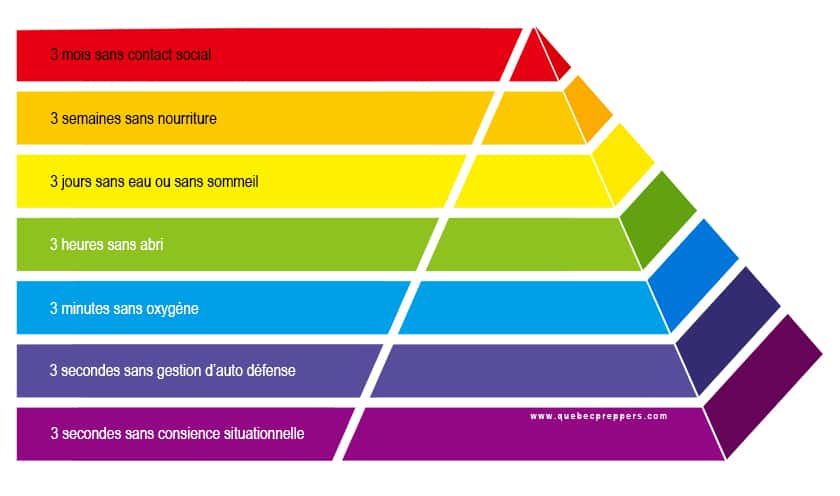
A simplified framework can be helpful, provided its limitations are kept in mind. It cannot predict which deficiency will prove fatal next, nor can it determine the exact time remaining. Considering multiple needs simultaneously—for example, an injury, exposure to cold, and a lack of water—prevents one from viewing these categories as mandatory, sequential steps that must be completed one by one.
Mindset
A willingness to listen to instructions and reconsider a decision can be helpful. Confidence or determination alone is not enough to ensure care, access, or safety. Preparing written materials and arranging for potential assistance lightens the burden on any single individual—without casting blame for a fear-based reaction or attempting to pass judgment on someone’s state of mind.
Action: Choose an initial, verifiable outcome—such as noting down a contact or checking a light source. Simply reading a guide does not mean a task is permanently mastered; reviewing what has been done and identifying where further help is needed makes progress tangible.
Situational awareness
While paying attention to one’s surroundings is useful, the idea of a "one-third-second" threshold or the blunt assertion that "you’re dead" is of no value as a general guideline. It is impossible to constantly monitor every potential danger. Detectors, alerts, and collective organization complement individual vigilance—especially when someone is asleep, working, or possesses different sensory capabilities.
Action: Identify sources of alerts, keep a list of contacts, and agree on a method for notifying one another. Verify that what has been communicated is actually understood and accessible. Awareness must be actively maintained; it cannot be considered "settled" simply because a scenario has been imagined.
Protecting people and preventing conflict
When faced with a threat, seek distance, a secure location, and appropriate assistance. Self-defense skills do not guarantee the ability to neutralize an attack, and a crisis does not suspend fundamental rights. Any plan should avoid confrontations and steer clear of roles that involve administering punishment or conducting patrols.
Action: prepare means for raising an alarm, the ability to exit an interaction, and a list of useful contacts. Everyday equipment should address actual needs and comply with local regulations; it does not mandate the carrying of a weapon. If training is chosen, verify its framework and prioritize prevention, non-violent conflict management, and an awareness of one’s own limitations.
Oxygen
Absent or abnormal breathing combined with a loss of consciousness are situations that must be addressed immediately by raising an alarm and performing the appropriate emergency procedures. Causes and timeframes vary; the following points do not constitute a medical scale that justifies waiting or declaring an outcome to be impossible.
- "Thirty seconds": a loss of consciousness can stem from various causes and does not follow a universal safety timeline.
- "One minute": this timeframe cannot be used to determine the exact moment when brain cell death begins in any individual case.
- "Three minutes": do not wait for a suspected risk of injury to arise before raising an alarm and following emergency instructions.
- "Five minutes": this threshold cannot be used to predict death, nor does it justify abandoning the necessary emergency procedures.
- "Ten minutes": specific circumstances, the care provided, and environmental temperatures can alter outcomes; no text can definitively diagnose the occurrence of permanent injury.
- "Fifteen minutes": do not conclude that survival is impossible or abandon efforts to provide assistance based solely on this duration.
The appropriate course of action depends on the observed condition and instructions from emergency responders—not on a predetermined table of time intervals. An oxygen-depleted space can endanger multiple people; do not enter such an area to perform a rescue unless you possess the proper qualifications and appropriate equipment. Filtering respiratory protection does not provide oxygen. Preparation also includes the use of detectors, regular maintenance, and the prevention of exposure.
Action: Complete first aid and CPR training; know how to raise the alarm and understand the equipment available to you. Severe hemorrhaging requires rapid intervention—following your training and established instructions—rather than relying on a universal three-minute rule. Techniques such as applying a tourniquet or performing advanced medical procedures should not be improvised based solely on a written text. Specific medical treatments and equipment should be prepared in consultation with the relevant professionals.
Shelter
Exposure to cold or heat can quickly become an emergency, though a lack of shelter does not necessarily mean survival is limited to less than an hour. Assess the individual’s condition, their clothing, moisture levels, and the weather; then, move to a safe location and seek assistance if needed. Breathing and other vital needs may also be at risk; general classifications are no substitute for an actual, on-site assessment.
There are two forms of shelter. The first form consists of the clothing we wear. The second form is the structure in which we reside to protect ourselves from the environment.
Protection relates to cold, heat, wind, and rain, as well as risks specific to a given location or its wildlife. Other people should not simply be viewed as "two-legged" predators. Having a safe space, accessible exits, maintaining contact with others, and following established guidelines all serve to provide protection—without implying that the environment is inherently hostile.
Action: Think of shelter as more than just protection against the elements; it can also ensure physical safety. Consequently, be deliberate in your choice of footwear and clothing. Furthermore, always plan ahead and be prepared to take shelter.
Sleep and Water
Sleep and water are two distinct needs; there is no universal "three-day" threshold beyond which incapacity or death becomes inevitable. A lack of rest can impair vigilance and attention; concerning symptoms require appropriate assistance. Plan for shifts and breaks—without resorting to exhausting, constant guard duty—and avoid assuming that the mere passage of time automatically leads to hallucinations.
A lack of water can cause a person’s condition to deteriorate, depending on factors such as heat, physical exertion, and individual health. It is not the case that death is an inevitable outcome within three days. Ensure a supply of safe water and a means to replenish it; recognize when difficulties arise and seek assistance without waiting for a specific threshold to be reached. Additionally, if you are undergoing medical treatment, you may need to seek specific advice regarding your fluid intake.
Action: Discuss access to safe water and opportunities for rest, including potential forms of assistance and alternatives. A water filter cannot remove every type of contaminant and is not a substitute for a stored supply. Regarding sleep, ensure that the chosen location and support arrangements are suitable for the needs of children, those who are ill, and their caregivers—without sacrificing rest for the sake of constant surveillance.
Food
Food provides the energy we need to survive. Without it, we would lose both energy and our ability to survive within a matter of days. Therefore, after addressing water and sleep, we must ensure we have enough food to maintain peak functionality.
Action: Select food items that can be consumed given the available resources, individual allergies, and specific dietary needs; then, plan for how to replenish these supplies. Maintaining a stockpile does not mean you are obligated to stay at home if the location becomes dangerous; furthermore, one cannot assume that a neighborhood will necessarily become deserted. Focus on remaining open to receiving others or seeking help, rather than simply waiting for a total societal collapse.
Society
Social connections can be invaluable—whether for making a phone call, running an errand, or providing pre-arranged assistance. Someone who is ill or injured may require professional medical care or transport that neighbors cannot provide. Discuss commitments and boundaries, ensuring that everyone involved has given their consent. Constantly guarding one’s home is not a requirement for preparedness and can quickly exhaust caregivers; it is essential to plan for breaks and identify external sources of support.
Action: Work on building friendships with others who share your values. Begin to establish a network or community of people you can rely on when essential services are unavailable. Start with your family and your network of friends, and build outward from there.
Establishing Re-evaluation Criteria
You will also need to establish re-evaluation criteria for your SHTF (survival) plan.
Making decisions with serious consequences during a crisis can be difficult. Therefore, we all need a plan that helps minimize the impact of emotion on our critical choices.
Pre-established criteria can signal the need to re-evaluate or take action—though this does not mean abandoning critical thought. A detector alert or an evacuation order calls for an appropriate response; a rumor requires verification. Thresholds must be tied to the level of danger and remain consistent with any new directives. A pre-determined distance or duration cannot account for every possible release, fire, or travel scenario.
Your triggers might include events such as:
- Local authorities recommending that people shelter in place.
- Verified information regarding a change in services that affects a specific, concrete need; a rumor that police are absent should not automatically trigger a departure.
- A warning or identified danger in the area, accompanied by specific instructions; a predetermined distance alone is not sufficient to determine the level of exposure.
- A genuine difficulty in ensuring protection or care: seek clarification and assistance, rather than concluding on your own that the authorities have completely lost control.
Actions taken in response to your pre-established triggers may include:
- Contacting loved ones according to your plan—without asking them to cross a dangerous zone or to retrieve children who have already been secured by their school or institution.
- Revising your plans.
- Checking access points and exits—ensuring there are no hazardous barricades, confrontations, or unauthorized installations.
- Loading your supplies into your vehicle.
- Leaving your home.
These criteria can be useful at any time; they are not limited to a specific window of zero to seven days. The rule of law does not automatically vanish as time passes. An immediate directive may take precedence over your existing plan, and an improvement in the situation might allow for the easing of certain measures. Re-evaluating the facts prevents your household from fleeing based solely on a generalized prediction of violence.
Consequently, the best way to manage the risks associated with remaining in a danger zone is to plan for various potential scenarios now—establishing specific triggers that you can act upon at any time.
Creating a PACE Plan
PACE planning is a process that helps you consider how to respond to issues that may arise while executing your initial plan.
Having alternatives allows you to adapt if a particular option is no longer viable. Risk does not necessarily increase over time; the arrival of help, the completion of repairs, or changes in weather could actually improve the situation. Keeping track of up-to-date information and critical needs helps in deciding the next step, rather than simply escalating the alert level as time passes.
The PACE framework distinguishes between a Primary option, an Alternative, a Contingency, and an Emergency response. It is a method for exploring possibilities—not a requirement to have four distinct plans, nor a universal, official protocol. The order of these options may shift depending on the nature of the threat.
In a "SHTF" (crisis/disaster) scenario, a PACE plan might look like this:
Primary Plan – Sheltering in Place
Example: Staying put—provided your home offers protection, essential needs are met, and official directives allow it. Monitor reliable information and stay in touch with your support network. If a specific criterion is met, re-evaluate the option; do not assume that staying at home must continue until a pre-defined threshold is strictly crossed.
Alternative Plan – Planned Evacuation
Example: Moving to a pre-arranged location via an approved route, using appropriate transport and resources. Have necessary medications, documents, and portable supplies ready—but do not delay an urgent departure to load up your entire stockpile or hide belongings. Self-defense equipment is not a mandatory component; existing laws and regulations regarding its transport remain applicable.
Emergency Plan – Rapid Evacuation
Example — depart immediately if a danger arises or instructions dictate doing so. Take only what is accessible without causing a dangerous delay; alert others and follow the designated routes or guidance provided. A pre-planned route may not necessarily be the safest option at the actual moment of the event. Once in a secure location, re-establish contact and reassess your needs—do not return to the restricted zone to retrieve items.
Emergency Option — sheltering in place (if leaving would increase your exposure to danger)
Example — if instructions require temporary sheltering in place, implement measures specific to the nature of the threat and stay informed. Do not barricade exits or establish a 24-hour guard. Whether or not to seal off openings (e.g., to prevent the entry of contaminants) depends on the specific risk; this is not applicable to every type of threat (such as certain infectious diseases). Anticipate health and assistance needs, and follow official instructions regarding when it is safe to leave, rather than opting for an indefinite period of sheltering.
Note: This is an example of a potential emergency plan. Your own plan may look very different and should be tailored to your specific situation and risk profile.
Step 4: Take Action
Taking action can begin with a verifiable task: updating contact lists, testing a flashlight, or arranging a meeting point. Afterward, assess what is missing, what requires further qualification, and what can be deferred. A simple, practical exercise—free from surprises or risks—can reveal potential difficulties regarding access or communication. Note any necessary adjustments, and revisit the plan whenever there is a change in your family situation or medical treatment.
The Essentials of Creating Your Family Emergency Plan
A family plan organizes options and support systems; it does not guarantee survival in every type of disaster. The four-step process maintains a straightforward progression, with criteria and solutions that should be periodically reviewed. Local information, immediate needs, and specific instructions take precedence over any written scenario. Success is not measured by the quantity of supplies stockpiled, but by the ability to take useful actions and seek the necessary help.
Equipment to compare for your needs
Some links below are affiliate links: we may receive a commission at no additional cost to you. Products are examples by function, to choose according to your needs; buying the entire selection is unnecessary.