
In this article
Gardening, sewing, woodworking, preserving food, hunting: these skills were common less than a century ago. Today they seem to belong to another world. Yet from a citizen preparedness perspective, they are practical resources, not for surviving an apocalypse, but for keeping some self-reliance when usual systems are temporarily unavailable.
In brief
In brief. Seven traditional skills strengthen a household’s self-reliance: growing some of your food, sewing and mending, woodworking, hunting, fishing or raising animals legally, cooking from scratch and preserving, understanding basic construction, and maintaining and repairing tools. A functional level is enough. Start with one area, learn by doing, use local resources and respect the law.
Growing dependence on centralized systems
Daily life relies heavily on complex, interconnected infrastructure: power grids, supply chains, digital payments, industrial food supply. This organization offers undeniable efficiency and comfort, but it also carries a fragility that few people really grasp.
An extended power outage, a supply chain disruption or a major cyberattack can, within hours, cut off services we take for granted. This is not science fiction: such scenarios happen, to varying degrees, in different parts of the world.
The aim is neither to master everything nor to reject technology, but to broaden your ability to act when usual resources are lacking, and to avoid being helpless in the face of a foreseeable practical constraint. Looking back in order to plan ahead is not nostalgia: it is a pragmatic approach. Skills that earlier generations practised out of necessity can now serve as a safety net, complementing our technological comfort.
Seven traditional skills worth taking seriously
These skills do not require perfect mastery. In most cases, an intermediate level, enough to handle basic tasks independently, is already a significant advantage when conditions deteriorate.
| Skill | What it lets you do | An accessible first step |
|---|---|---|
| Gardening and foraging | Grow some of your own food | A vegetable bed of a few square metres |
| Sewing and mending | Repair and adapt clothing and equipment | Sewing on a button, repairing a tear |
| Woodworking | Repair and make useful objects | A storage crate or simple shelf |
| Hunting, fishing, trapping and livestock | Obtain animal protein | An official hunter education course or a fishing licence |
| Basic cooking and preserving | Cook without processed foods and preserve harvests | Baking your own bread; a first fermentation |
| Basic construction | Make improvements, assess a structure, build a simple shelter | A small shed or raised-bed project |
| Tool maintenance and repair | Extend tool life, repair rather than replace | Sharpening a knife, replacing a handle |
1. Gardening, foraging and food production
Growing some of your own food is one of the most directly useful skills. A vegetable garden, even a modest one, can contribute to a household’s diet for several months of the year, depending on the climate. You do need to stay realistic, though: gardening takes time, knowledge (crop rotation, soil management, pest control, adapting to the local climate) and physical stamina that people often overestimate before trying. Foraging for wild edible plants requires serious training to avoid identification mistakes, which can be fatal.
Where to start: a vegetable bed of a few square metres with simple crops (lettuce, radishes, tomatoes, squash) is an accessible first step. Libraries, community gardens and local horticultural clubs offer resources suited to your climate. See our articles on starting a garden and on saving seeds.
2. Sewing, mending and making
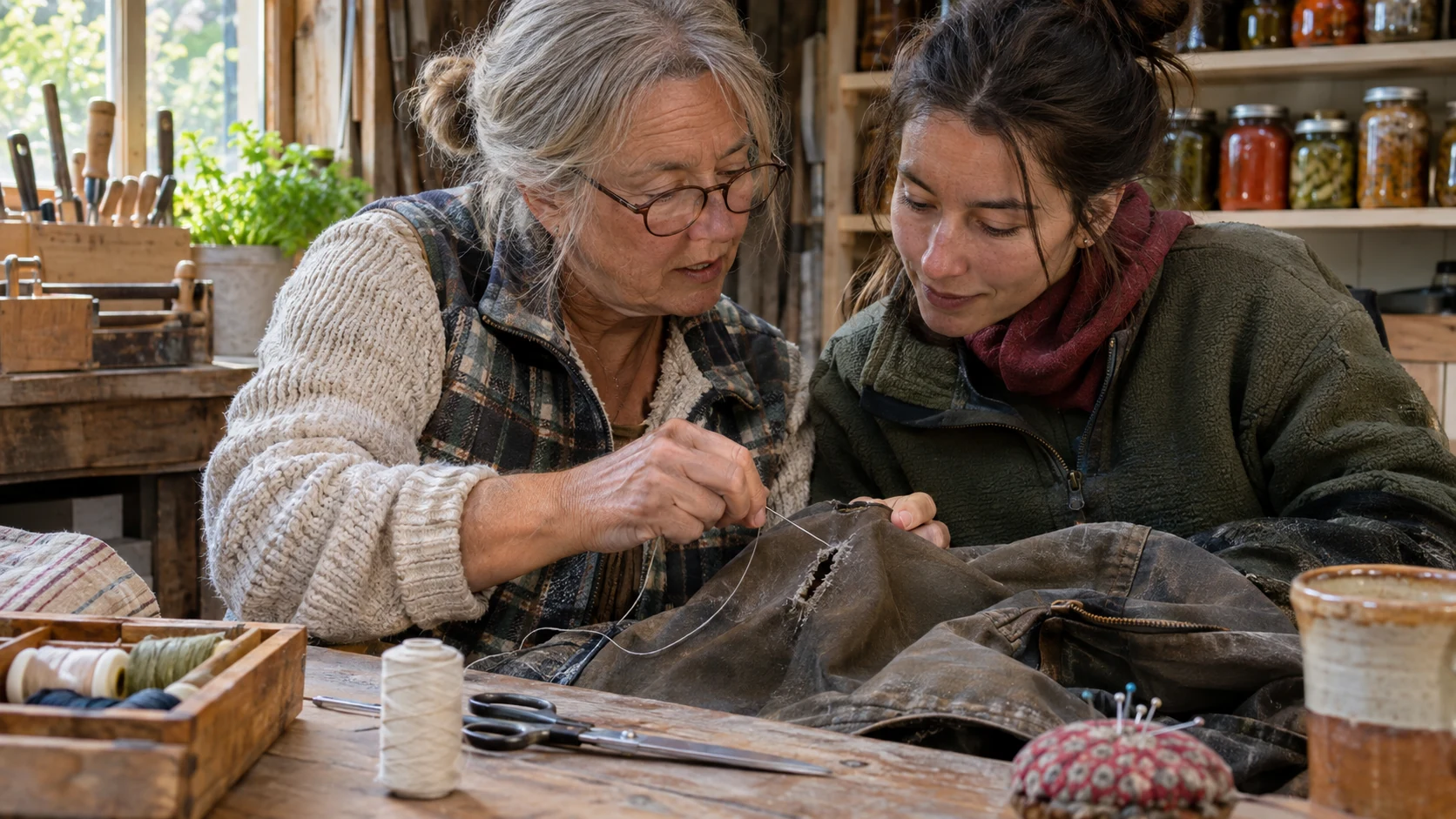
Making a complete garment is an advanced skill. But being able to sew on a button, repair a tear, adjust a piece of fabric or put together simple items is practical self-reliance that most adults no longer have. Sewing is often underestimated until you really try it: even a simple item, such as a pouch or a cover, reveals how much precision it takes. It is therefore better to approach it gradually, through small projects, rather than waiting until you need it. A basic sewing kit with needles, strong thread, pins, scissors and patches fits easily into your supplies.
3. Woodworking and carpentry
Woodworking covers a range of skills, from repairing furniture to building rough shelters. Even partial knowledge, joining pieces securely, understanding wood species and their properties, using hand tools correctly, opens up many possibilities. During shortages or supply difficulties, being able to make or repair useful items (shelves, storage crates, tool handles, light structures) is a tangible resource. With the spread of composite materials and flat-pack furniture, these skills are becoming increasingly rare.
4. Hunting, fishing, trapping and raising animals
Animal protein is one of the hardest nutritional challenges in prolonged self-reliance. Hunting and trapping are often seen as intuitive, but they require in-depth knowledge: animal behaviour, regulations, techniques, game processing. Fishing is often more accessible. Raising animals, even on a small scale (poultry, rabbits, goats), is another approach: it requires a regular presence, constant care and some knowledge of animal health. In a community, people with land and livestock experience are valuable resources.
Hunting, fishing, trapping and keeping animals are governed by specific regulations that vary by country, province, state or region (licences, seasons, species, zoning for animals). An official course, such as the hunter or trapper education courses required in many jurisdictions, is the recommended starting point.
5. Basic cooking, preserving and canning
Cooking from raw ingredients (flour, eggs, milk, vegetables) without processed products or sophisticated equipment is a rarer skill than it seems, given how widespread reliance on ready meals and electric appliances is. Preserving, canning, dehydrating, lacto-fermenting, drying, extends the life of harvests and surpluses and is a lasting way to build food storage.
These techniques are accessible, well documented and can be learned gradually without a large investment. For canning, always follow methods and processing times tested by recognized organizations: a mistake can lead to botulism. See our articles on dehydration and fermentation.
6. Basic construction
Understanding the fundamentals of construction, foundations, framing, insulation, drainage, lets you make simple improvements, assess a structure after an event or build a functional shelter, without attempting complex projects. This knowledge is acquired gradually, ideally through hands-on practice on small, concrete projects. For major work, electricity, gas and load-bearing structures, hire professionals and follow building codes.
7. Blacksmithing, tool making and tool maintenance
Blacksmithing is probably the most specialized skill on this list: it requires specific equipment and long training. In a community, having one or more people able to make or repair metal tools is a considerable collective advantage during a prolonged supply disruption.
At a more accessible level, maintaining, sharpening and repairing your tools, honing a blade, filing a saw, replacing a hammer handle, is a practical skill anyone can develop without major investment. Our challenge on maintaining hand tools suggests a routine.
Why these skills matter today
| Individual value | Community value |
|---|---|
| Each skill you master reduces a specific dependence and increases your ability to act on your own when usual resources are lacking, even temporarily. | In a group, a variety of skills is a collective resource: complementary profiles make a group more resilient than isolated individuals. |
These skills do not replace public services, emergency responders or collective resources. They buy time, keep basic functions going and reduce pressure on systems that are already stretched during a crisis. This complementarity is at the heart of realistic citizen preparedness.
A simple principle. You do not need to master all these skills, but each one you learn reduces a concrete vulnerability. The most effective approach is to identify the most likely gaps in your situation and close them gradually, at your own pace.
Where to start in practice
There is no need to relearn everything at once. A gradual progression, built on concrete and achievable projects, is more effective and more lasting:
- Assess your priority gaps: which skills would you miss most if normal supplies were interrupted for two weeks?
- Start with a single area: choose an accessible skill, gardening, basic sewing, preserving, and learn it by doing rather than by reading.
- Look for local resources: horticultural clubs, sewing workshops, repair cafés, hunting and fishing courses and skill-sharing groups often exist near you.
- Practise regularly, even on a small scale: a skill that is not practised fades; building it into daily life maintains what you have learned.
- Share and learn from others: exchanging skills within a group or neighbourhood speeds up learning and strengthens ties, two assets for resilience.
To organize how skills are shared in your household, see our article on essential skills for every family member.
Points to watch
- Do not overestimate theoretical knowledge: reading about a skill and practising it are two very different things. Practice, even imperfect, is irreplaceable.
- Take your real situation into account: a garden in an apartment, hunting in an urban area or keeping animals in a condo all bring practical constraints; solutions must adapt to them.
- Respect the law: hunting, fishing, trapping, keeping animals, small-scale food processing or selling products are governed by rules that vary by jurisdiction.
- Do not aim for total mastery: a functional level in several areas is often more useful than perfect expertise in one.
- Think safety: sharp tools, forging, hunting and canning carry risks; get trained and equipped accordingly.
Traditional skills do not reflect a rejection of modernity. They are complementary resources that strengthen the ability of a person, and of a community, to cope when usual systems are no longer enough. Learning them now, in stable times, is exactly the right moment.
Frequently asked questions
Which skill should I learn first?
The one that addresses your most likely gap. For many households, food preservation or a small vegetable garden are excellent starting points, because they are accessible and useful every day.
Can these skills be learned in the city?
Yes. Community gardens, balcony planters, repair cafés, sewing and cooking classes exist in most cities. Hunting and keeping animals are harder in urban areas, but fishing and preserving remain accessible.
Do you need a lot of equipment?
No. Most of these skills start with simple tools: a sewing kit, a few good-quality hand tools, some jars and a good reference book.