
In this article
Saving seeds lets gardeners follow selected varieties over several seasons and learn how they perform locally. Success requires choosing plants, allowing seeds to mature, and managing drying and storage. A full envelope guarantees neither germination nor complete food self-sufficiency.
Distinguish open-pollinated and hybrid varieties
An open-pollinated variety can reproduce relatively stable characteristics if pollination conditions are appropriate. An F1 hybrid may produce viable seeds, but the progeny will not necessarily reproduce the qualities of the purchased plant. “Hybrid” does not automatically mean sterile.
Keep the exact name, provider and information available. An old variety is not automatically adapted to your terrain. Choose according to season, exposure and observed results. For annual vegetables, the number of days available and the maturity of the seeds can count more than a single hardiness zone.
Start with a few crops
Tomatoes, peas and beans are among the common possibilities to get started. Other crops require more attention to crossbreeding, distance, or controlled pollination. Nearby species, varieties and gardens influence what is possible; the same isolation rule is not suitable for everything.
Carrots and beets are examples of biennial crops whose seed production involves a second season. This requires special organization in a cold climate. Start with a small project that you can follow before storing the seeds of all the crops in the vegetable garden.
Select plants and keep records
Choose healthy plants that meet the desired characteristics, taking into account the diversity required for the crop. A selection based solely on the largest fruit can neglect other qualities. Mark the plants before the whole crop is consumed.
Note the date, conditions and observations: maturity, taste, possible diseases and quantity obtained. A seed from a sick plant can pose a different problem than a simple drop in germination. Use a method adapted to the species and seek advice when the health of the lot is uncertain.
Harvest seeds at the right stage
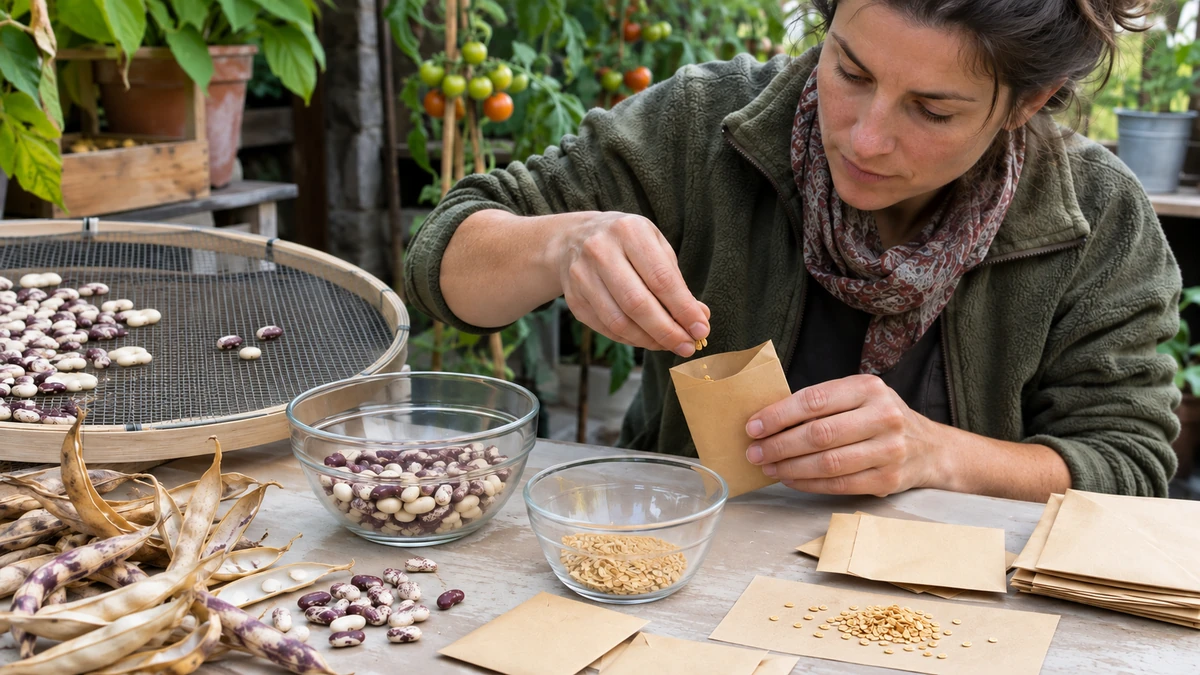
For peas and beans, seed harvesting usually requires more advanced maturity than fresh vegetables. The pods should be monitored and sheltered when conditions require. A seed that is still wet and immediately locked up is likely to be badly preserved.
For fleshy fruits, extraction and cleaning depend on the crop. The fermentation used for some tomato seeds is not a rule to be applied to all vegetables. Follow a specific horticultural protocol, then rinse and dry according to this method. Keep the batches separate during all handling.
Dry without damaging
Place the seeds in a suitable layer, in a clean and ventilated place, away from excessive heat. An oven, an intense sun or an uncontrolled temperature can reduce their viability. The time required depends on the seeds and conditions; a single duration does not prove that the drying is complete.
Clean the debris and check the condition before packing. Do not try to save a moldy lot by mixing it with a healthy lot. Hermetic storage is only suitable when the seeds are sufficiently dry according to the chosen method.
Store and test
Label species, variety, year, provenance, and useful observations. Keep cool, dry and away from light as needed. A refrigerator may be suitable for certain batches that are properly packed, but openings and condensation must be controlled. Allow a closed container to return to the appropriate temperature before opening it in moist air.
Do a germination test on a known sample before the main seeding. The percentage obtained describes this test, not a guarantee for each seed in the garden. It helps decide whether to renew a lot or adjust the project. The published viability periods are variable benchmarks, not universal dates.
Exchange responsibly
A network of gardeners or a seed library can facilitate learning. honestly state the provenance, year and pollination uncertainties. Respect the distribution rules and rights applicable to the variety. Documented conservation and repeated testing bring a stronger skill than a large stock without identity or tracking.
Reference: University of Minnesota Extension, Vegetable Seed Conservation.