
In this article
An elevator jolts to a stop. A stranger beside you is hyperventilating. Help is on the way, but not here yet. This scenario explores a common, seemingly ordinary situation that nonetheless calls on concrete crisis-management skills.
The situation
This evening was supposed to be pleasant: your colleagues are gathering for the office receptionist’s housewarming, on the 23rd floor of a downtown building. You arrive a few minutes early and take the elevator with another guest, a friendly stranger who turns out to be a long-time friend of the host.
The conversation flows naturally. Then, without warning, a loud bang echoes through the shaft. The car stops dead between two floors. Adrenaline surges instantly.
You look at your fellow passenger: she is already hyperventilating. Her eyes are fixed. She is shaking. She tries to speak, but the words won’t come. Clearly, she has an intense fear of confined spaces.
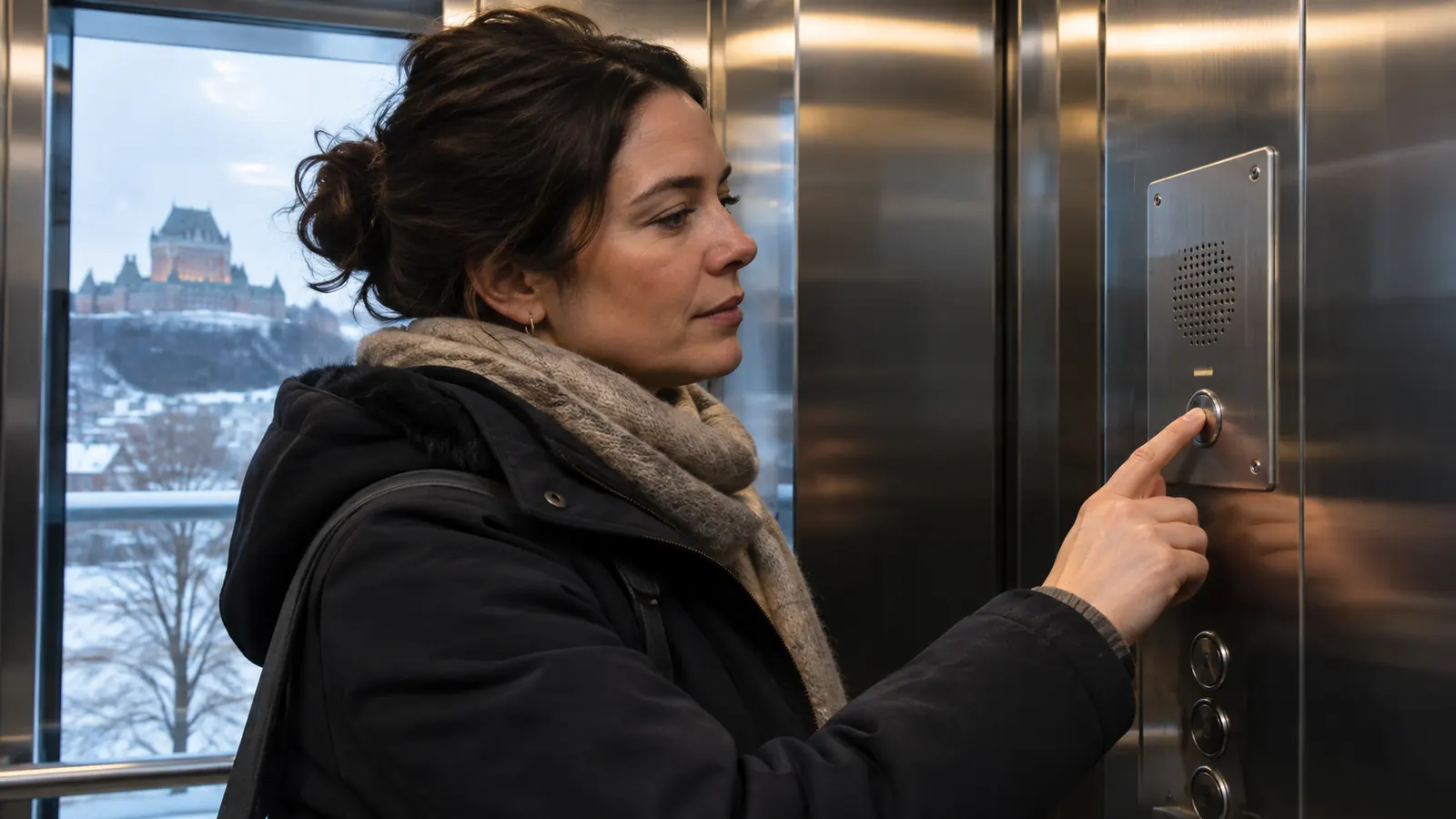
You press the alarm button. The voice on the line confirms that firefighters are on their way, but it will take some time. You are alone with her. The car is small. The air already seems less fresh.
An important fact: an elevator car is not airtight. It is ventilated and air does not run out, even after several hours. The cables and safety brakes are designed to hold the car: a free fall is extremely unlikely. The feeling of suffocation comes from stress, not a real lack of oxygen.
The real question is not technical. The broken elevator is not the immediate danger. It is the psychological distress of the person beside you — and your ability to respond to it calmly and usefully.
What this scenario tests
Before thinking about concrete actions, it helps to identify the variables at play. This situation tests several skills at once:
Stress management
Your own calm is your most valuable resource. A person in panic needs a stable outside anchor. If you panic too, the situation deteriorates quickly.
Psychological first aid
Hyperventilation, shaking, inability to communicate: these are physiological reactions to acute stress. They are reversible. Knowing what to do — and what to avoid — makes a big difference.
Crisis communication
How do you talk to someone who can no longer speak? How do you stay connected without making the anxiety worse? Tone, words, pace: everything counts.
Lines of thought: what can you do?
This scenario has no single right answer. It has several, depending on your training, temperament and the exact context. Here are some ways to structure your thinking.
1. Manage your own reaction first
Before helping someone else, avoid becoming an extra source of stress yourself. Breathe slowly, adopt a steady posture, avoid sudden movements. This is not about heroic composure — it is simply what helps most in the first few seconds.
2. Make reassuring contact without intruding
A person in intense panic may react badly to unsolicited physical contact. Before putting a hand on their shoulder, it is usually better to ask — even briefly — or watch whether they are looking for a physical anchor themselves. Making eye contact, speaking in a low, steady voice and not raising it even if they don’t answer: these simple things can help interrupt the anxiety spiral.
3. Manage hyperventilation
Hyperventilation amplifies the feeling of panic. A common technique is to invite the person to slow their breathing deliberately — for example by counting aloud with them, or breathing visibly and exaggeratedly slowly so they can match your rhythm. The goal is not to fix everything at once, but to break the cycle.
Note: breathing into a paper bag for hyperventilation is an old practice whose effectiveness and safety are debated in the medical literature. If you have any doubt about someone’s general health, avoid it and favour guided breathing techniques.
4. Manage the immediate environment
The car is small. The air may feel stuffy. If the elevator has ventilation, check that it is working. If the light is too bright or too dim, see whether it can be adjusted. Making the environment as neutral and predictable as possible helps stabilize the person. If the car is dark, a phone light placed face up toward the ceiling gives a soft glow. Sit on the floor together: sitting is reassuring and prevents falls if someone feels faint.
Never try to force the doors or climb out through the roof hatch. The car can restart at any moment, and falls into the shaft are the main cause of serious injury in this kind of incident. Wait for firefighters or technicians, who cut the power before any evacuation.
5. Stay in contact with responders
Don’t hang up too quickly after the first call. In some cars, you can keep an open line to building security or the fire department. You can also tell the person in distress that help is making progress — as long as you phrase it reassuringly and realistically, without promising an imminent arrival if that is not the case.
6. Don’t minimize or dramatize
Two common mistakes: saying “it’s nothing, calm down” (minimizing, which often makes the reaction worse) or, conversely, commenting at length on how serious the situation is. Anchoring in the present — “we’re here, the car is stable, help is coming” — is generally more useful than any attempt to explain or reason.
7. Recognize a medical emergency
A panic attack can look like a heart problem, and vice versa. Tell responders immediately, through the intercom or 911, about chest pain spreading to the arm or jaw, loss of consciousness, bluish lips, worsening confusion, or a person who mentions a health condition (asthma, diabetes, heart). Responders can then prioritize the call.
What this scenario reveals about preparedness
Involuntary confinement — an elevator, a basement, a crashed vehicle — is not rare. It happens in ordinary settings, to ordinary people. Most of the time, there is no immediate physical danger. But it can become seriously problematic when someone near you is in acute psychological distress and you lack the reflexes to respond.
Citizen preparedness is not only about storing supplies or knowing evacuation procedures. It also includes the ability to stay functional — and useful — when someone else no longer is.
This kind of scenario also highlights a common gap: we often prepare our own reactions, but rarely our ability to support someone else’s distress in an unexpected situation. Psychological first-aid training — distinct from physical first aid — is a skill worth building into any serious preparedness approach.
Going further: questions to ask yourself
Take a moment to answer these questions honestly, alone or with your family:
- Have you ever been trapped somewhere involuntarily? How did you react?
- Can you recognize the signs of a panic attack or severe hyperventilation?
- Do you know simple techniques to help someone regulate their breathing?
- What would your priority be in the first 30 seconds after the elevator stops?
- Is there anything in this scenario you would not know how to handle — and would like to understand better?
Your decision
Write down your answer, then discuss it with your family or colleagues. This kind of thought exercise is most valuable when it is talked through. Scenarios help identify the blind spots in our preparation in advance — before a real situation reveals them.
There is no perfect answer to this scenario. There are better-prepared answers than others. The goal is to have thought about it before facing it.
See also
To go deeper, read our guide to acute stress and acting methodically, our analysis of denial and freezing in a crisis and our article on psychological resilience.
Disclaimer: this article is provided for information only and does not replace first-aid training or the advice of a health professional. In an emergency, call 911.
Frequently asked questions
Can you run out of air in a stuck elevator?
No, under normal conditions. Elevator cars are not airtight and are ventilated. Feeling short of air is a very common stress reaction.
How long does it take to be rescued?
It depends on the place and time: often from several tens of minutes to an hour or more. Stay in contact through the intercom and don’t try to get out on your own.
Should you touch a panicking person to reassure them?
Ask first. Some people appreciate a hand on the shoulder; others feel it as an intrusion. A calm voice, slow breathing the person can copy and sitting down are often more effective.