
In this article
Preparedness is not just supplies and gear. In a sudden emergency, a fire, an accident, an evacuation, a loved one collapsing, the most decisive factor is often the ability to think clearly and act fast. Yet when faced with the unexpected, the human brain goes through predictable reaction phases that can cost precious seconds or minutes: denial, freezing, routine actions that create an illusion of normality.
The good news: these mechanisms are well known, and the way we react under stress is not entirely innate. It depends largely on what has been thought through and practised in calm conditions. This guide explains what happens in the brain during a crisis, describes the six observed reaction phases, and offers nine concrete ways to train your mind and body to move to action faster.
In brief
In brief. In a crisis, the brain often starts by denying or downplaying what it perceives, then tries to buy time with familiar actions. This delay is normal, but dangerous. You shorten it by accepting in advance that an emergency can happen anywhere, practising situational awareness, learning a breathing technique, writing simple plans for likely scenarios, sharing them with your household and taking hands-on training such as a first aid course. Reacting under stress is not improvised: it reflects what has been practised.
What happens in the brain under stress
Under intense stress, the brain triggers a survival response that favours fast, automatic reactions over analytical reasoning: the fight, flight or freeze response. The heart races, vision narrows, hearing filters out sounds, fine motor skills become clumsy. This response works against an immediate physical threat; it becomes counterproductive when a sequence of decisions is needed, such as managing an evacuation, giving first aid or coordinating a group.
Cognitive dissonance
Cognitive dissonance is the discomfort we feel when new information contradicts our beliefs or our picture of the world. To reduce that discomfort, the brain tends to reject, downplay or misinterpret the disturbing information, or to seek support from people who think alike.
In an emergency, the brain receives information radically incompatible with its picture of everyday life: smoke at the office, the sound of an explosion at the mall, a loved one collapsing. Its first reflex is often to look for a reassuring explanation (“it must be a drill”, “someone burned some toast”) rather than immediately taking in the threat. This processing delay, from a few seconds to several minutes, is when you are most vulnerable.
Normalcy bias
Closely related to cognitive dissonance, normalcy bias is the tendency to underestimate the likelihood and impact of an unusual event simply because you have never experienced it. It is one of the factors most often noted in post-disaster reviews: people who stay home despite an evacuation order, who carry on with their meeting despite the fire alarm, who wait to see what others do.
Mental preparation aims precisely at reducing these biases: someone who has already accepted that an emergency can occur in their surroundings short-circuits part of the denial phase.
The six phases of reaction to a sudden crisis
Research on behaviour in crises describes a succession of phases. Their length varies widely depending on the person, their physical state and their level of preparedness.
- Denial“This can’t be happening.”
- DelayRoutine actions: gathering belongings, finishing an email.
- DiagnosisThe senses gather clues: smell, sound, light.
- Acceptance“It’s real, and it’s now.”
- ConsiderationWeighing options, choosing a plan.
- ActionEvacuate, take shelter, give care, call for help.
- Denial: the initial refusal to accept that the event is happening. It is often the longest phase in unprepared people.
- Delay: substitute behaviours that create an illusion of normality. This is what drives people to tidy up, grab their luggage or shut down their computer instead of leaving immediately.
- Diagnosis: the person begins to take in sensory information and understand what is going on.
- Acceptance: recognizing that the crisis is real. Once past this threshold, the ability to react increases sharply.
- Consideration: weighing the options. A minority remain frozen at this stage and need someone else to move forward.
- Action: carrying out a plan. Its quality depends heavily on how quickly the previous phases were passed through.
The goal is not to eliminate these phases, which are natural mechanisms, or to act without thinking. It is to get through them faster and reach a clear-headed diagnosis quickly.
What survivors tell us
Accounts from disaster survivors illustrate these mechanisms. People evacuated from the World Trade Center towers on September 11, 2001, described a moment of freezing before heading for the stairs, some taking time to gather documents or personal items. Plane crash survivors describe the tendency to retrieve cabin baggage despite instructions. In house fires, occupants try to save photo albums before getting out.
These examples all come from survivors. People who did not survive may have experienced the same delays without getting past them in time, which probably leads us to underestimate their impact.
Common reactions described by research
In his reference work on crisis intervention, researcher Albert R. Roberts describes a sequence of frequent reactions: perceiving a threat, realizing that usual ways of coping are not enough, the onset of fear, confusion and acute stress, symptoms of physical and psychological distress, then a state of imbalance where the situation feels insurmountable. These reactions do not mean you can’t act: they are its preliminary steps. Training for first aiders, firefighters or soldiers aims precisely at compressing them.
| Common belief | What is actually observed |
|---|---|
| People panic in a crisis | Active panic is rare; freezing and waiting are far more common |
| Good reflexes are innate | They come mostly from training and mental preparation |
| Freezing is a sign of cowardice | It is a common biological response that can be shortened |
| You must act immediately, without thinking | You need to speed up the decision, not skip it |
| Thinking about emergencies makes you anxious | Having plans reduces anxiety about the unexpected |
Nine ways to train your brain to react
None of these approaches requires military training. They rest on accessible principles, to be built gradually into everyday life.
1. Cultivate situational awareness
Situational awareness is the habit of actively observing your surroundings: who is there, what is going on, what seems unusual. A simple way to develop it is to ask “what if?” in ordinary situations: at the grocery store, at the cinema, on the metro, where are the exits? What could change quickly here? What would be the first thing to do?
Practised pragmatically, this habit does not create anxiety: it is about being present rather than distracted. It lets you spot a problem a few seconds before others, which can change everything. See observing without overinterpreting.
2. Practise noticing details
A simple exercise is to observe a place for a few seconds, then mentally recall specific details: number of people, clothing colours, where the fire extinguishers, a defibrillator and the exits are. The goal is not to watch others, but to train the brain to capture information more finely and quickly. It is also a great game to play with children.
3. Master your breathing
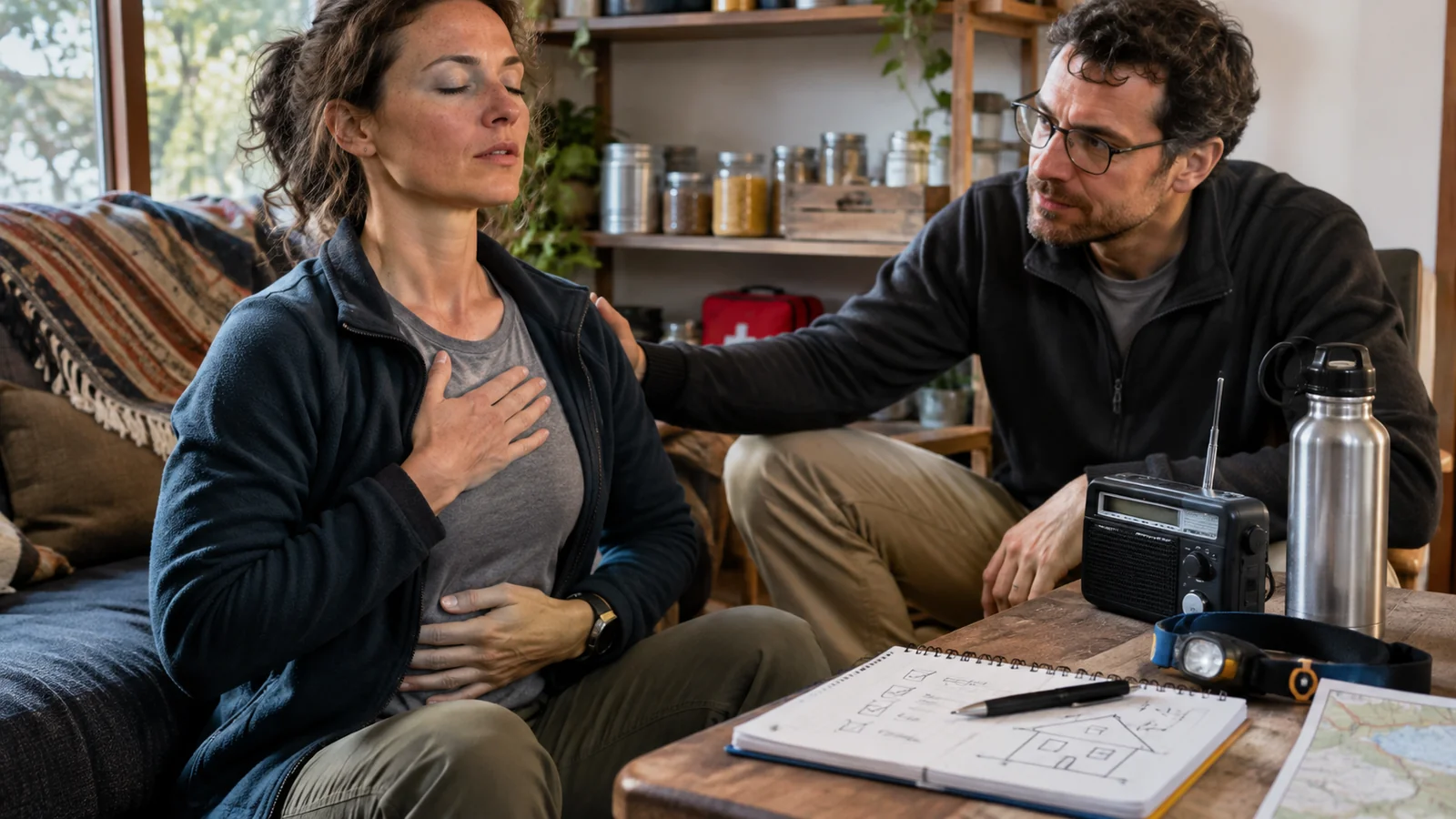
Breathing is one of the few physiological mechanisms you can consciously control to influence your nervous system. Box breathing, used in various stress management courses, is simple:
- breathe in slowly through your nose for 4 seconds;
- hold your breath for 4 seconds;
- breathe out slowly for 4 seconds;
- wait 4 seconds before the next breath in.
A few cycles slow the heart rate, reduce muscle tension and make reasoning more accessible. It is discreet, needs no equipment and works all the better for having been practised in calm conditions, for example once a day for a few weeks. See finding your bearings under acute stress.
4. Write plans for likely scenarios
A written plan directly improves your ability to act under stress: when the brain has already processed a sequence of actions calmly, it finds it more easily under pressure. No need to imagine complex disasters; start with the most likely emergencies in your own context.
| Scenarios to consider | Structure of a minimal plan |
|---|---|
| Prolonged power outage | Trigger: what activates this plan? |
| Extreme cold, ice storm | First action: what to do in the first minute? |
| House fire | Resources: where are they? |
| Emergency evacuation | People to contact or gather |
| A loved one’s medical emergency | Meeting point if the house is inaccessible |
| Flooding, depending on the region | Expected duration and review if the situation drags on |
| Communications outage | |
| Sheltering in place for an epidemic or toxic spill |
These plans don’t need to be exhaustive. What matters is that they exist, are accessible and are known to the household. See how a household plan can save lives.
5. Involve the people close to you
A plan only one person knows is fragile: if that person is absent, injured or frozen, everything falls apart. Sharing the essentials with your household broadens your collective ability to react and lightens the mental load. Children can gradually learn, without anxiety, where a building’s exits are, what to do if they get lost and what the family meeting point is. Informal conversations (“if a fire started in the kitchen tonight, what would each of us do?”) let them go through these scenarios mentally, in calm conditions. See children in a crisis.
Also plan for the possibility that a member of the group freezes: someone may need to give them a short, direct instruction, or even physically guide them to the exit. Deciding in advance who helps whom is an often-forgotten part of the family plan.
6. Get hands-on training
Thinking things through is a solid foundation; practice completes it decisively. Someone who has already practised bandaging, cardiopulmonary resuscitation (CPR) or using a defibrillator will act with more precision and confidence than someone who has only read the instructions.
- First aid and CPR: offered by several recognized organizations, with regular refreshers at the intervals recommended by the certifying body.
- Wilderness first aid: relevant for anyone who spends time in nature, far from help.
- Disaster preparedness: community and emergency management organizations offer courses, often free or low-cost.
- Volunteering: volunteer search and rescue organizations and the Red Cross train their volunteers and let you practise in real conditions.
See first aid skills.
7. Manage your exposure to risk wisely
A big part of resilience is not putting yourself in risky situations unnecessarily. This is not living in suspicion: it is making decisions based on the information available. Avoiding an area where tensions are reported, cutting down contacts during an epidemic, postponing a trip during a storm are all ordinary risk management.
The real difficulty is often social: the discomfort of explaining a cautious decision, the fear of seeming excessive. Recognizing that pressure and preparing for it is part of preparedness.
8. Reduce digital distraction
Situational awareness is incompatible with attention fully absorbed by a screen. In public or unstable places, looking up from your phone directly improves your ability to see what is happening. This is not about giving up digital tools, which are useful in a crisis, but using them deliberately rather than letting your attention be sucked in. In an emergency, the question is not whether to film, but whether to act or move away; see film or act during an emergency.
9. Keep your body in shape
Physical reactivity depends on fitness and muscle memory. An athlete who catches an unexpectedly thrown object doesn’t think: their body performs a movement repeated thousands of times. The same principle applies to emergency actions.
- Basic fitness: being able to walk for a long time, go down several flights of stairs, carry a child or a heavy bag. Cardiorespiratory capacity is often the first real-world limit.
- Balance and coordination: walking on uneven ground, yoga, climbing, useful in a cluttered, dark or slippery environment.
- Concentration under stress: combat sports, emergency role-play and some forms of mindfulness meditation train the ability to stay focused despite noise and commotion.
- Repeating critical actions: a few useful knots, using an extinguisher, the recovery position, applying a tourniquet. What must work under pressure is rehearsed in calm conditions.
Building practice into daily life
None of these approaches works if you tick it off once. Mental training works through repetition and gradual integration. The goal is not to turn daily life into a survival exercise, but to build enough habits that, the day things go wrong, part of the work has already been done.
- Three small stepsBox breathing once a day, spot the exits in two places you often visit, choose a scenario to plan.
- A first planWrite the plan for the chosen scenario, talk it over with your household, find a local first aid course.
- ConsolidateTake or renew a course, add two or three scenarios, make observation a habit.
Important nuances
- Even trained professionals make mistakes under heavy pressure. Preparation reduces their likelihood and scale, without eliminating them.
- Judging yourself harshly for a past reaction that wasn’t what you would have wanted is counterproductive. The value of this work lies in the future.
- Mental preparation is no guarantee of perfect performance. It is a real increase in your chances of keeping a functional line of reasoning when everything pushes you to lose it, and that is enough to make a difference.
- If a past experience keeps causing distress, insomnia or flashbacks, it helps to talk to a professional; in Quebec, Info-Social 811 offers support day and night.
To go further, see deciding under stress, simplifying decisions under stress and preparedness and mental health.
Frequently asked questions
Is it normal to freeze in a crisis?
Yes, and very common. Freezing is a documented biological response, distinct from fear or panic: the nervous system suspends action while the brain processes information incompatible with its model of the world. It is not cowardice. Training to recognize emergencies early shortens it.
How long does the denial phase last?
From a few seconds to several minutes depending on the person and situation. A gradual event, such as a smell of smoke growing stronger, can cause longer denial than a sudden one. Mental preparation shortens it without eliminating it.
Do some people naturally react faster?
Temperament, experience of stressful events, fatigue, hunger or pre-existing stress all affect reaction speed. Emergency professionals generally react faster, but mainly because of their training.
Does preparing your brain for crises mean living in fear?
No, quite the opposite. Anxiety is stronger in the face of the unknown than when plans exist and reflexes are in place. Preparation reduces subjective uncertainty, and therefore stress.
At what age can you prepare children?
From school age, calmly and gradually: meeting point, what to do if lost, how to call 911. The goal is to make them alert and capable, not worried, adapting the content to their age.
Does box breathing really work under intense stress?
It works all the better for having been practised regularly in ordinary situations. A few weeks of daily practice are enough to anchor the reflex.
Should you plan for everything?
No. It is better to plan for the most likely scenarios in your context, such as a winter power outage, then broaden gradually.