
In this article
First aid skills are probably the most useful form of preparedness in everyday life. They matter long before any disaster: a child choking at the table, a colleague who collapses, a deep cut in the workshop, a crash on the road. In those moments, help always takes a few minutes to arrive, and your actions are what fill those minutes.
This guide brings together the essentials: the nine core skills to master, the myths that still cause harm, priorities for serious trauma, how to progress beyond a basic course, and what a serious injury reveals about a household’s preparedness. It does not replace hands-on training: it helps you know what to learn and why.
In brief
In brief. Nine skills cover most emergencies: CPR and the defibrillator, clearing a blocked airway, bleeding control, managing shock, wound care, immobilization, burns, hypothermia and heat stroke. Several common beliefs (butter on a burn, tilting the head back for a nosebleed, inducing vomiting) are dangerous. A basic course is a starting point: you then need to practise, recertify and ideally take wilderness or trauma training.
Reminder. This content is for information. It replaces neither recognized training nor advice from a health professional. In an emergency, call 911 in Canada, or 15 or 112 in France. In Quebec, Info-Santé 811 answers non-urgent questions day and night.
Why first aid deserves a central place
People often talk about water, food and gear. Yet the skill that saves the most lives is often the simplest: knowing what to do in the first minutes. Cardiac arrest without chest compressions very quickly reduces the chances of survival; severe bleeding can kill within minutes. In both cases, the ambulance almost always arrives after the decisive moment.
In a crisis, this reality is amplified. During a storm, a flood or a prolonged outage, emergency services are overwhelmed, roads may be cut and delays grow longer. The skills of each household member then become a shared resource. And unlike equipment, they do not wear out, get lost or weigh anything in a pack.
Training also has a less visible effect: it reduces freezing. Someone who has already practised CPR on a manikin acts faster and with more confidence in front of a real casualty. That is why interactive courses with scenarios are far more effective than reading alone.
The nine core skills
| Skill | Situations | Urgency | Where to learn it |
|---|---|---|---|
| CPR and AED | Cardiac arrest | Minutes | CPR course, standard first aid |
| Clearing a blocked airway | Choking | Minutes | Standard first aid |
| Bleeding control | Serious wound, accident | Minutes | Bleeding control course |
| Recognizing and managing shock | Bleeding, burns, severe reaction | Minutes to hours | Standard first aid |
| Wound care | Cuts, scrapes | Hours | Standard first aid |
| Immobilization | Sprain, fracture | Hours | First aid, wilderness first aid |
| Burns | Cooking, heating, fire | Minutes to hours | Standard first aid |
| Hypothermia | Cold, water, heating failure | Hours | Wilderness first aid |
| Heat stroke | Heat wave, exertion | Minutes to hours | Standard first aid |
1. Cardiopulmonary resuscitation (CPR) and the defibrillator
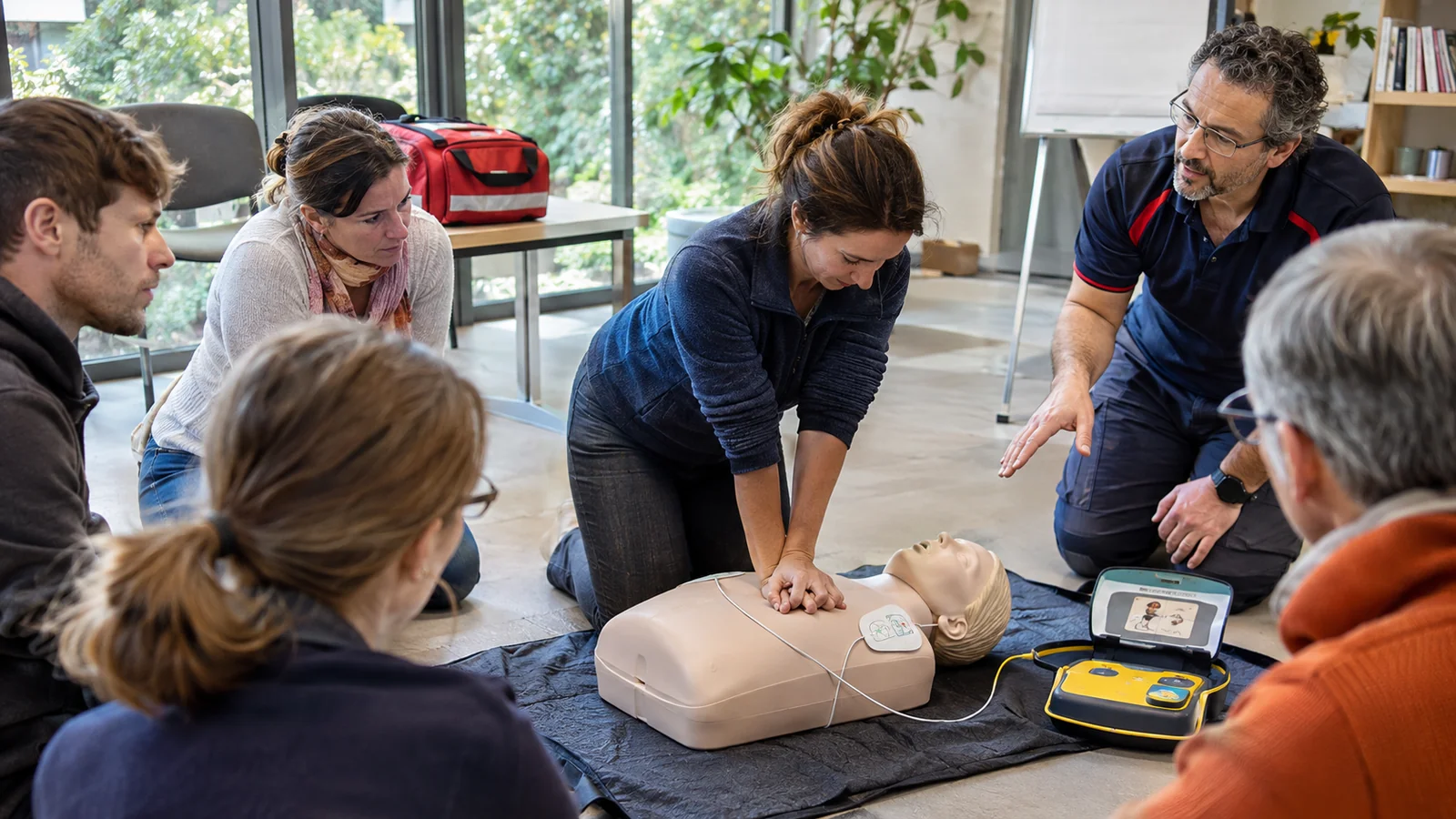
When someone is unresponsive and not breathing normally, every minute counts. Call or have someone call for help, ask for an automated external defibrillator (AED), then start chest compressions in the centre of the chest: hard, fast (about 100 to 120 per minute) and deep (about 5 cm, or 2 in, in adults). The AED guides the user by voice: it is designed for the general public. CPR for children and infants follows specific adaptations, which is why a course matters.
2. Clearing a blocked airway
A person who can no longer speak, cough or breathe and brings their hands to their throat is choking. For adults and children, alternate back blows and abdominal thrusts (the Heimlich manoeuvre); for infants, back blows and chest compressions. If the person loses consciousness, call for help and start CPR. As long as they are coughing effectively, encourage them to keep coughing without intervening.
3. Controlling bleeding
Firm, direct pressure on the wound with a clean cloth is still the first step. If bleeding from a limb is massive and does not stop, a tourniquet is the recommended solution; for areas where one cannot be applied (groin, armpit, neck), pack the wound with gauze, ideally hemostatic, and keep up the pressure. Note the time a tourniquet was applied and do not remove it yourself. The right kit is described in the first aid kit and IFAK guide.
4. Recognizing and managing shock
Shock occurs when organs no longer receive enough blood: pale, cold and clammy skin, a fast and weak pulse, rapid breathing, confusion, thirst. It often accompanies bleeding, an extensive burn or a severe allergic reaction. Lay the person down, treat the cause (stop the bleeding), cover them to keep them warm, give them nothing to eat or drink and reassure them while waiting for help.
5. Cleaning and protecting a wound
Wash your hands or put on gloves, rinse the wound thoroughly with drinking water, remove surface debris, then cover with a clean dressing. A wound that is deep, gaping, very dirty, caused by a bite or that keeps bleeding needs medical care. Watch for signs of infection in the following days: spreading redness, warmth, swelling, pus, fever. For small straight cuts, see wound closure strips.
6. Immobilizing an injured limb
For a sprain or likely fracture, immobilize the limb in the position found, including the joint above and below the injury. A malleable splint, a rolled-up magazine, sticks or strong tape can be improvised. Then check circulation (colour, warmth, sensation in fingers or toes). An open fracture far from help is covered in the hiking fall scenario.
7. Treating a burn
Cool under lukewarm to cool water for at least 20 minutes, remove jewellery and clothing that is not stuck, then cover with a non-stick dressing or cling wrap. Seek care for any burn that is extensive, deep, chemical or electrical, or located on the face, hands, feet or genitals.
8. Recognizing and treating hypothermia
Shivering, clumsy hands, confused speech, drowsiness: hypothermia sets in gradually, sometimes at temperatures as mild as 10 °C (50 °F) when you are wet and exposed to wind. Get the person to shelter, remove wet clothing, insulate them from the ground, cover the head and torso, and give warm sweet drinks if they are conscious and able to swallow. A very cold person should be handled gently. See cold-weather survival.
9. Recognizing and managing heat stroke
Hot skin, confusion, headache, nausea, sometimes no more sweating: heat stroke is an emergency. Call for help, move the person to shade or a cool place, remove excess clothing and actively cool them (cool water, wet cloths, fanning, immersion if possible). Older adults, young children and people who work outdoors are most vulnerable during heat waves.
Fourteen myths that still cause harm
Several beliefs passed down through generations persist because they seem logical, because we have seen them done or because they used to be taught. Recommendations have changed: here are the ones to forget.
| Myth | What to do instead |
|---|---|
| Put butter or grease on a burn | Cool with lukewarm to cool water for at least 20 minutes, then cover |
| Disinfect a wound with hydrogen peroxide | Rinse thoroughly with clean water; peroxide damages tissue |
| Pull out an object stuck in a wound | Leave it in place, stabilize it with pads and call for help |
| Suck a wound or bite to clean it | Rinse with water; the mouth contains many bacteria |
| Chest compressions do more harm than good | Without CPR, survival drops quickly; a cracked rib is the lesser evil |
| CPR always requires rescue breaths | Compression-only CPR is recommended for adults if you are not trained or comfortable |
| The defibrillator is only for professionals | The AED is designed for the public and guides by voice |
| Tilt the head back for a nosebleed | Lean forward and pinch the nose for 10 to 15 minutes |
| Put ice directly on a sprain | Wrap ice in a cloth, in 15 to 20 minute periods |
| A tourniquet inevitably leads to amputation | Properly applied and followed by prompt care, it saves lives with few complications |
| Remove an injured motorcyclist’s helmet | Do not remove it except to clear the airway, ideally with two people |
| Induce vomiting after swallowing something toxic | Call the Poison Centre (1-800-463-5060 in Quebec) or emergency services |
| Give sugar to an unconscious diabetic person | Nothing by mouth if unconscious; sugar only if they are conscious and can swallow |
| Keep someone awake at all costs after a head injury | Have them assessed and watch for warning signs: vomiting, confusion, unusual drowsiness |
Burns and wounds: why these actions backfire
Butter, oil or greasy creams hold heat in the skin instead of releasing it, which prolongs the burn, and they increase the risk of infection. Running water, on the other hand, cools deeply and relieves pain. Ice should also be avoided: extreme cold adds a second injury to the burn. Hydrogen peroxide, long used by reflex, destroys cells involved in healing; thorough rinsing with drinking water is enough in most cases, possibly followed by a mild antiseptic. As for an object stuck in a wound, it often plugs the cut blood vessels itself: pulling it out can trigger heavy bleeding. Stabilize it with rolled pads on each side and let professionals remove it.
Cardiac arrest: daring to act
Fear of doing it wrong is the main barrier to CPR. Effective compressions can indeed crack a rib, especially in an older person, but without compressions a person in cardiac arrest has practically no chance of surviving. Current recommendations emphasize continuous, high-quality compressions and accept compression-only CPR in adults. The defibrillator, often installed in shopping centres, arenas, schools and workplaces, analyzes the heart rhythm itself and only delivers a shock when needed: it is impossible to “shock by mistake” someone who does not need it. Find out now where the AEDs are near your home and workplace.
Trauma and bleeding: reflexes to correct
Tilting the head back for a nosebleed sends blood down the throat, which can cause nausea and vomiting and hide how much is being lost. Lean forward and pinch the soft part of the nose without letting go for 10 to 15 minutes. For a sprain, ice helps, but never directly on the skin: wrap it in a cloth and limit applications to 15 or 20 minutes. Tourniquets were long presented as an almost certain cause of amputation; experience from emergency departments and recent conflicts has shown the opposite when they are properly applied and the person receives prompt care. Finally, a motorcyclist’s helmet often protects a vulnerable cervical spine: remove it only if the person is not breathing and it prevents access to the airway, ideally with two trained people.
Poisoning and special situations
Inducing vomiting after a toxic ingestion can worsen injuries, especially with caustic products (cleaners, drain openers) or petroleum products, which burn a second time on the way up or get into the lungs. In Quebec, the Poison Centre (1-800-463-5060) answers day and night; in France, regional poison centres can be reached through 15 or directly. For a person with diabetes, sugar is the right reflex for low blood sugar, but only if they are conscious and able to swallow: nothing should be given by mouth to an unconscious person, because of the choking risk. Place them in the recovery position and call for help. After a head injury, the old advice to keep the person awake all night has been nuanced: what matters is to have them assessed, then watch for warning signs (worsening headache, repeated vomiting, confusion, difficulty waking, seizures, unequal pupils) and seek care right away if they appear.
These fourteen points have one thing in common: they replace a simple, proven action with a “home” remedy that delays proper care or makes things worse. A recent course is a good way to clean up these reflexes, especially if your last training was more than five years ago.
Priorities for serious trauma
Civilian guidelines inspired by tactical medicine, such as TECC (Tactical Emergency Casualty Care), were designed for situations where serious injuries occur in an environment that is still dangerous: a major accident, a collapse, an attack in a public place. Their logic is useful to any citizen, without needing to adopt military vocabulary.
Two main phases
- While the danger is present: the priority is to get to safety and help the casualty do the same. The only reasonable medical action is to stop massive bleeding from a limb, often with a quickly applied tourniquet.
- Once in a safe place: assess the casualty methodically and treat problems in order of severity while waiting for help.
The order of priorities
- Massive bleedingPressure, tourniquet, packing: what kills fastest.
- AirwayClear it, recovery position if unconscious and breathing.
- BreathingChest wound, difficulty breathing: cover, monitor.
- CirculationSigns of shock, other bleeding, pulse.
- Hypothermia and headCover, insulate from the ground, monitor consciousness.
For a prepared citizen, this means three practical things: knowing how to apply a tourniquet and pack a wound, having that equipment close at hand, and staying able to think of your own safety before stepping in. Trauma equipment without training remains of limited use, however: a bleeding control course such as Stop the Bleed takes a few hours and transforms your confidence. For violence in a public place, see also what to do during an armed attack in a public place.
Progressing beyond the basics
A basic first aid course of one or two days is designed for a setting where help arrives within minutes. That is its built-in limit: it teaches you to stabilize and call for help, much less to manage a casualty for hours. For solid preparedness, you need to progress in stages.
- Master the basicsCPR, AED, choking, bleeding, shock.
- MaintainRecertify every two to three years, review regularly.
- Prepare mentallyScenarios, stress management.
- SpecializeWilderness, trauma, water rescue.
- Get involvedVolunteer first aid at events.
- Pass it onTeach those close to you, anchor the skills.
Maintaining your skills
Skills fade quickly: a few months without practice are enough to hesitate over compression depth or hand position. Retake a course every two to three years, regularly review a reference guide, and practise with those close to you: recovery position, applying a bandage, a simulated 911 call. Keep a quick reference card in every kit.
Developing mental preparation
Stress changes your abilities: vision narrows, fine motor skills deteriorate, time seems distorted. Realistic scenarios, repetition and a few simple techniques (slow breathing, giving yourself one concrete first action) help keep a cool head. See managing acute stress.
Taking specialized training
- Wilderness first aid (16 to 80 hours depending on the level): managing a casualty for hours, improvising, deciding whether to evacuate. Ideal for outdoor enthusiasts and rural residents.
- Trauma first aid: bleeding, serious wounds, priorities in dangerous settings.
- More advanced training: first responder or paramedic-level courses for those who want to go further.
- Water rescue: especially relevant near lakes and rivers and during floods.
Getting involved and passing it on
Volunteering in first aid, for example at public events, lets you practise regularly alongside experienced people. Finally, passing on what you know (to your children, neighbours or workplace) is the best way to anchor your own knowledge and make those around you more resilient. See building support through shared skills.
What a serious injury reveals about preparedness
People who have experienced a serious injury at home or in the woods often draw the same lessons. Hospital emergency departments stabilize, treat and refer, but the rest of the recovery (dressings, pain management, getting around, eating) often happens at home, sometimes alone. Preparedness should therefore cover convalescence too.
- Wound care: plan for more dressings than you think; a large wound may need daily changes for weeks.
- Pain management: keep common pain relievers and discuss any specific needs with your doctor or pharmacist ahead of time.
- Prescription medication: a small reserve and an up-to-date list prevent many problems. Antibiotics cannot be improvised: they are prescribed. See medication continuity with your pharmacist.
- Protective equipment: gloves, glasses, hearing protection, chainsaw chaps, proper footwear. Many serious injuries at home are preventable.
- Living alone or in a remote area: keep a way to call for help on you at all times, a neighbour or relative who checks in, and a plan to get to hospital if you cannot drive.
Making first aid a family practice
First aid is easy to share within a family. A few practical ideas: enrol two adults in the household in the same course, teach children to dial 911 and give their address, post useful numbers near the phone, practise CPR on a pillow once a season, and check the kit together when the clocks change. The most rewarding skill for the effort involved is still CPR: a few hours of training are enough to be able to act.
| Effort | Action | Benefit |
|---|---|---|
| One evening | CPR and AED course | Ability to act in a cardiac arrest |
| One or two days | Standard first aid | The nine core skills |
| A few hours | Bleeding control | Tourniquet and wound packing |
| Two to eight days | Wilderness first aid | Prolonged casualty care |
| A few minutes a month | Family review and practice | Skills that stay available |
Points of caution and limits
First aid aims to preserve life, prevent things from getting worse and make professional care easier. It does not replace medical diagnosis or treatment. In a crisis, it can be tempting to go further (sutures, medication, advanced procedures): without training and supervision, these actions carry serious risks. The best preparedness combines solid basic skills, suitable equipment and the ability to reach emergency services. To assess your priorities, take the preparedness review.
Frequently asked questions
What is the most important first aid skill?
CPR with use of a defibrillator, because cardiac arrest leaves only a few minutes. Close behind are clearing a blocked airway and bleeding control.
How often should you retake your training?
Every two to three years in general, and more often if you never get to practise. Recommendations also change, which justifies regular updates.
Can you do CPR without rescue breaths?
Yes. For adults, compression-only CPR is recommended if you are not trained in rescue breaths or not comfortable with them. For children and infants, breaths matter more, which is why a course is useful.
Is a tourniquet dangerous?
Properly applied to severe limb bleeding and followed by professional care within a reasonable time, it saves lives with few complications. The danger mostly comes from poor-quality tourniquets and lack of training.
Which training should you choose if you live in a rural area or spend time outdoors?
A wilderness first aid course, which teaches you to manage a casualty for several hours, improvise equipment and decide on an evacuation.