
In this article
- In brief
- What we know about evacuations
- A timeline
- If you are stuck in the city
- Communication
- By type of event
- What to take at the last minute
- Children, older adults, pets
- A family drill
- Once you are out of the city
- Emergency messages and reception centres
- Finding your way in the city
- Obstacles
- Preparing your plan
- Summary
- Frequently asked questions
- Further reading
A major flood, a wildfire at the city’s edge, an industrial accident, a hurricane: several kinds of events, natural or human-caused, can force an urban population to evacuate. The worst situation for a household is having to improvise a departure at the very moment thousands of others are doing the same. Getting around a city is already hard in normal times; during an evacuation, population density, the limited number of exits and road congestion complicate everything.
This guide offers a chronological look at an urban evacuation, before the event, in the first hour, the following hours and the first day, to show why planning and timing matter so much. It draws on what disaster research and real evacuations have taught us, and corrects several persistent misconceptions along the way, such as the idea of widespread panic.
In brief
In brief. An urban evacuation is mostly decided before the event: alternative routes, a family meeting point, a ready bag, a vehicle at least half full. When the authorities order you to leave, leave early and follow the indicated routes; when they ask you to shelter in place, stay put. As the hours pass, traffic and scarcity increase, but panic and violence remain far rarer than people think. If you are stuck, secure your home and follow instructions. The authorities’ reception centres are part of the solution.
What we really know about evacuations
Movies and fiction often show panicked crowds, widespread looting and roads given over to chaos. The reality observed by disaster social scientists is very different: in the vast majority of disasters, people remain remarkably calm, help one another and follow instructions when they are clear. Panic in the strict sense is rare; the most common problem is hesitation, being slow to leave.
The real challenges of an urban evacuation are mostly logistical: road congestion, fuel shortages, scattered families, people without vehicles, overloaded communications. The evacuation of Fort McMurray, Alberta, in May 2016 is a good example: about 88,000 people left the city in a very short time ahead of a wildfire, through considerable traffic jams, but in a largely orderly way. By contrast, the evacuation of Houston ahead of Hurricane Rita in 2005 caused traffic jams more than 150 kilometres long, and some of the deaths linked to the event occurred during the journey itself. These two examples show that an early, planned departure reduces risk.
Every event is different. A hurricane is forecast days in advance; an industrial accident or an earthquake strikes without warning. That is why it is better to prepare several scenarios than to rely on a single plan.
What often happens, and the household’s priority at each stage.
- Before the eventAlerts, forecasts, first instructions
- First hourDecisions, first departures, networks starting to saturate
- After a few hoursHeavy traffic, gas stations overwhelmed
- After about twelve hoursStores emptied or closed, services stretched
- First day and beyondSituation stabilizing or worsening depending on the event
Source: summary of this article; always follow official instructions.
A timeline of an urban evacuation
Although each disaster triggers different reactions, an urban evacuation often follows similar stages. Breaking them down over time helps explain why every hour counts, and why the preparation done beforehand changes everything.
| Time | What often happens | Household priorities |
|---|---|---|
| Before the event | Alerts, forecasts, first instructions | Follow official sources, fill up the tank, prepare to leave, gather the family |
| First hour | Decisions, first departures, networks starting to saturate | Decide, pick up loved ones according to plan, leave by the planned route |
| After a few hours | Heavy traffic, gas stations overwhelmed | Avoid saturated main roads if the authorities allow it, stay calm |
| After about twelve hours | Stores emptied or closed, services stretched | Rely on your own supplies, go to a reception centre if needed |
| First day and beyond | Situation stabilizing or worsening depending on the event | Stay informed, register with the authorities or the Red Cross, help if you can |
Before the event
More and more cities and countries send alerts to mobile phones, radio and television: Alert Ready (En Alerte) in Canada, Alerte Québec, FR-Alert in France. Heeding these messages lets you leave the area before traffic becomes difficult. For an event that is forecast, such as a flood, a hurricane or an advancing wildfire, the time available is precious: use it to fill up the tank, gather the family, pack the bags and let the people who will host you know.
Not every event calls for leaving. In a chemical accident or a nuclear emergency, the authorities generally ask people to shelter indoors with doors and windows closed rather than take to the road: you are better protected in a building than in a car stuck in traffic. The golden rule is therefore to follow the instruction given for the event at hand. Our article on industrial hazards explains this difference.
Timing matters. Leaving when everyone leaves guarantees the heaviest traffic. When possible and recommended by the authorities, leaving early, even before the official order for an evacuation that is clearly coming, gives you more freedom. Our article on getting started also lists what is worth completing when an alert is announced.
The first hour
The first hour after a sudden event is often decisive. You have to decide whether to leave, with whom and where to. A route plan prepared in advance saves precious time, provided you have several: depending on where the event occurred, some roads will be closed or dangerous. Plan at least three routes out of your area, avoiding if possible the arteries that will attract the most people, unless the authorities designate them as evacuation routes. Do not improvise on the way: unplanned detours waste time.
Keep the go bags in a place everyone knows and can reach easily, near the exit. Set aside one spot in the house for all evacuation gear: any family member can then gather it quickly.
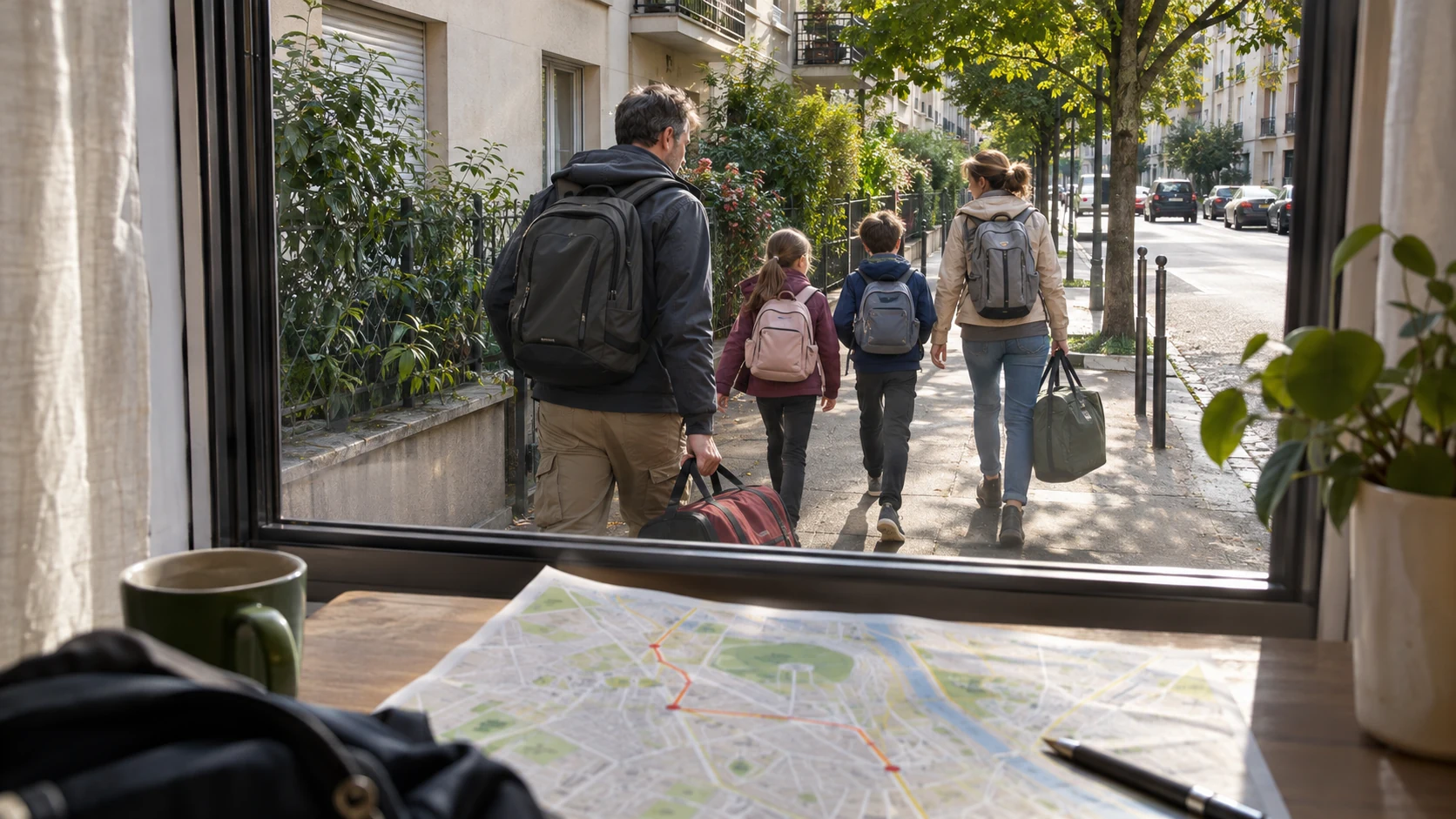
Gathering the family is often the hardest part, especially when children are at school or daycare. Learn about the school’s emergency plan: many schools keep children on site or move them to a planned location and release them only to authorized people. Agree in advance on who picks up whom, and on a meeting point if you cannot get home. Building these steps into the plan avoids leaving your route in the middle of an evacuation.
After a few hours
As time passes after a major event, traffic intensifies and communication becomes harder. Road accidents and pedestrians caught in traffic are a real risk: stay alert, slow down and avoid crowd surges in very densely populated places.
Gas stations and grocery stores can be overwhelmed, and some will close for lack of power or staff. Opportunistic theft may occur, but it remains the exception: most people are simply trying to get their families to safety. That is why leaving with a tank at least half full and a ready kit makes such a difference.
After about twelve hours
Supplies start running short, whether essential or not. Waiting for the disaster to stock up is a bad strategy: it becomes very difficult to get anything once stores are closed or emptied. Your supplies and your bag are then your main resources.
Less-prepared people may ask you for help. Most are simply in need: a family whose car has broken down, an older person alone, someone looking for water. Helping, as far as your means allow and without putting yourself in danger, is part of citizen preparedness. Also direct people to the service centres opened by the authorities. If a situation seems threatening, move away and alert emergency services.
The first day and beyond
The type of event changes the situation a great deal. After a storm or a flood, many people are simply stuck and need help; emergency services and volunteers are at work. After a lasting event, such as an advancing wildfire or a prolonged widespread outage, the goal is to reach a safe place and follow developments.
In most cases, it is better to have left the threatened area within the first hours when an evacuation is ordered: each additional hour adds traffic and uncertainty. But never rush toward a more dangerous area: if the road is cut off, the smoke is too thick or the authorities ask you to shelter, staying is the right choice.
Be careful with people trying to take advantage of the situation, such as fake contractors or fake volunteers, without falling into general mistrust. The law still applies, and self-defence is strictly limited in Canada as in France: the best strategy remains avoidance, moving away and calling for help. Our article Seeing an armed person offers a thinking exercise on this topic.
If you are stuck in the city
You may be unable to evacuate: a sick child, closed roads, a situation too dangerous to leave right away. This is not a failure: it is sometimes safer to wait for the danger to pass than to head into risky areas. In that case:
- let the authorities or your municipality know you are there if an evacuation is under way, especially if someone in the household needs help to leave;
- secure your home, lock the doors and stay away from windows;
- plan safe sources of light and heat: LED lights, light sticks, warm clothing, blankets; never a fuel-burning appliance indoors;
- keep a battery-powered or hand-crank radio to follow instructions;
- save your phone battery and keep a power bank charged;
- be ready to leave as soon as conditions allow.
Most disasters lead to power outages. A small hand-crank or pedal generator, portable solar panels and a power bank can recharge a phone or radio; light sticks are an inexpensive way to have light without electricity. A gasoline generator must only be used outdoors, away from openings.
If your vehicle breaks down on the way
If your vehicle breaks down on the way to your fallback location, the worst reaction is panic: this is exactly why you planned alternative routes. At least one of your plans should include travelling on foot. It takes longer, but it may be safer if the roads are congested.
Get away from traffic lanes as soon as possible: rushed or tired drivers may not see you. Wear light-coloured or reflective clothing, walk facing traffic on the shoulder and stay together. Once away from the main roads, head to your fallback location if it is within walking distance, otherwise to the nearest safe place: a relative’s home, an official reception centre, a police or fire station. Book lodging as early as possible if you are counting on a hotel: rooms go fast during an evacuation. Stay alert to changes and to official instructions.
Communication during the evacuation
When the cellular network works, the phone remains the best way to communicate. When it is saturated, text messages often get through better than calls: keep them short and leave the network for emergencies. Two-way radios (FRS in Canada, PMR446 in France) are useful over short distances to keep in touch between two vehicles or within a group, as long as the channels are not crowded.
Designate a contact outside the region, often easier to reach than a relative affected by the same event, whom everyone can call to share news. Write important numbers on paper: a dead phone is useless.
Staying discreet about your plans
Discretion also applies to evacuation: routes, fallback location, equipment and the number of people do not need to be broadcast publicly, on social media for example. That does not mean distrusting everyone: share this information with the people involved in the plan, and give the authorities what they ask for. Our article Protecting household information helps strike the balance.
Adapting your response to the type of event
Not all urban emergencies are handled the same way. The following table summarizes basic reflexes; the authorities’ instructions for the current event always take precedence.
| Event | Usual warning time | Main reflex |
|---|---|---|
| Flood | Hours to days | Leave early if your area is targeted; never drive or walk through water |
| Wildfire on the outskirts | Hours to days, sometimes very short | Leave as soon as the order or alert comes, by the indicated route; do not wait to see flames |
| Hurricane, post-tropical storm | Days | Follow evacuation orders for coastal areas; otherwise shelter in place |
| Chemical or industrial accident | None | Shelter indoors, close doors and windows, turn off ventilation, unless ordered to evacuate |
| Earthquake | None | Drop, cover and hold on; then leave carefully if the building is damaged |
| Nuclear or radiological emergency | Variable | Get inside, stay inside and stay tuned, unless told otherwise |
What to take at the last minute
When the order to leave comes, you may have only a few minutes. To avoid forgetting anything essential, think in a few simple categories:
- People and pets: is everyone there, including pets with leash, carrier and food?
- Medications and prescriptions, glasses, medical devices and their chargers.
- Documents: ID, insurance, copies of important papers.
- Means of payment: cards and some cash.
- Irreplaceable items: photos, keepsakes, backup hard drives.
- Personal needs: clothing, hygiene products, chargers, comfort items for children.
Before leaving, if you have time and the authorities ask you to, shut off water, gas and electricity, lock your home and leave a note saying where you are going, according to local instructions.
Evacuating with children, older adults or pets
Those who need the most time to evacuate should leave first. Children need simple, reassuring explanations, their comfort items and a routine as normal as possible: a calm adult is their best anchor. Our article on an evacuation bag suited to children helps prepare for their needs.
Older people or people with reduced mobility may need help getting around, medication, a wheelchair or oxygen. Identify in advance who will accompany them, and if possible register them on your municipality’s vulnerable persons registry where one exists. Think of neighbours who live alone too: a phone call or a knock on the door can make all the difference.
Pets should never be left behind during an evacuation unless instructed otherwise. Plan a carrier, a leash, food, water, medication and a copy of vaccination records. Not all reception centres accept animals: find out in advance which places do.
A simple family drill
An evacuation plan only comes to life when it is tested. Here is an exercise of about an hour, to repeat once or twice a year:
- Choose a realistic scenario for your city, such as spring flooding or a wildfire on the outskirts.
- Announce “leaving in 15 minutes” and time how long it takes to gather bags, medications, documents and pets.
- Take the car and drive an alternative route to your first meeting point, without GPS, using the paper map.
- Have each family member call the out-of-region contact.
- Back home, note what was missing, what took too long and what needs fixing.
Children remember a plan they have lived through much better than one that was explained to them. And each drill makes the real decision, when the day comes, much less stressful.
Once you are out of the city
Communication remains important throughout the evacuation, including once you are out of the city. Losing track of a family or group member is very stressful, and the risk is not negligible in the confusion of a mass departure. The best way to reduce this stress is to finalize your plan before the event.
- Show the route to everyone leaving with you.
- Mark intermediate meeting points on the map where someone who gets separated can be found, for example every 30 or 50 kilometres.
- If you are travelling in several vehicles, agree on a radio channel or a call schedule.
- Keep a paper road map of the region: maps from gas stations and rest areas can also help.
When it is safe, stop now and then at a gas station or rest area. Staff and local people are often the best informed about road conditions ahead. Never be too proud to ask for information: it can save you a needless detour, or even a danger.
Reaching your fallback location does not mean it is all over. Keep following the news and instructions, let your loved ones know you have arrived and, if the authorities ask, register as an evacuee, for example with your municipality or the Red Cross, to help reunite families and access assistance.
Emergency messages and reception centres
During an evacuation, radio, television, official websites and phone alerts broadcast essential information: affected areas, evacuation routes, closed roads, reception centres and service points. Follow them first. They will tell you whether you need to leave, which way, and where to find help.
Reception and disaster services centres opened by the authorities are designed to welcome evacuees safely: beds or shelter, meals, care, help with medications, information. They can be busy, but they are supervised, safe places. If you have a fallback location with a relative, you free up space for those who do not; if you do not, these centres are part of your plan. Register there even if you are staying elsewhere, when asked: it is often a condition for receiving financial assistance or news about your area.
When planning your route, keep in mind that the areas around reception centres and distribution points will be busier: allow extra time, and avoid blocking these access routes if you do not need to go there.
Finding your way in an urban area
In a city, it can be hard to find your way if you are not used to it, especially when the usual landmarks are hidden by smoke, darkness or a lighting outage. A few tips help:
- Many North American cities are built on a grid, with streets running roughly north-south and east-west. Knowing your city’s orientation helps you find the right direction. Note that in Montreal, for example, the “north” used for streets does not match geographic north.
- Identify in advance the natural obstacles that limit exits: bridges, tunnels, railways, rivers. On an island like Montreal, bridges are unavoidable crossing points and may be congested or closed.
- Keep a paper map of the city with your routes highlighted, and learn to read it with a compass.
- Note major visible landmarks: a mountain, towers, a river, main roads.
If you have to evacuate on foot, avoid major roads and crowded areas as much as possible. Parallel streets, bike paths or parks often let you move more calmly. Some people who have the means keep a second vehicle or a bicycle at a relative’s home on the outskirts: if the roads are too congested, they can walk there and continue.
During a mass evacuation, the authorities sometimes reverse the direction of some lanes to increase outbound capacity. Respect signs and police directions: improvising in these conditions is a recipe for accidents.
Sheltering in place is sometimes the smartest option, for example during a chemical accident, a violent storm or when the roads are more dangerous than staying home. The right decision depends on the event and the instructions, not on a single rule.
Obstacles you may encounter
Every evacuation is different, but some problems come up often. Anticipating them helps you react calmly.
Blocked roads
In a disaster, streets can be jammed, and a road blocked by a crash, a tree or flooding can immobilize a long line of vehicles. A few reflexes:
- never drive onto a flooded road: 30 centimetres of moving water is enough to sweep a car away;
- never force your way through other vehicles or a roadblock: it is dangerous and illegal;
- if you are stopped, turn the engine off at times to save fuel, except in extreme cold or heat, and keep water and snacks within reach;
- give the passenger the map and the radio, to follow instructions and look for alternative routes while the driver concentrates on the road;
- keep enough distance from the vehicle ahead to be able to manoeuvre.
If the situation becomes dangerous, for example as a wildfire approaches, follow the instructions of responders: they know which routes are open. Our article Evacuating by vehicle offers more advice.
Less-prepared people
In a disaster, most people will not have a plan, supplies or a ready bag. They are not enemies: they are your neighbours, your colleagues, families like yours who find themselves without resources. Stress and fatigue can make some behaviour unpredictable, but research shows that mutual aid largely outweighs hostile behaviour.
Keep your supplies discreet, help as far as your means allow and point people to official resources. Encouraging your loved ones and neighbours to prepare before a crisis is, in fact, the best way to reduce the number of people left without resources on the day.
Crowds and tensions
Large gatherings can form around distribution points, gas stations or reception centres. Tensions can arise, and rare incidents have been seen during some events. A few simple precautions are usually enough:
- avoid gatherings and places where tension is rising;
- keep children close and agree on a meeting point in case you get separated;
- do not respond to provocation and calmly move away;
- report dangerous situations to the authorities.
Our article on de-escalating tensions offers techniques for calming a tense situation.
Preparing your urban evacuation plan
To make the timeline above work in your favour, here is what to prepare in quiet times:
- Know your city’s risks and evacuation plans: many municipalities publish their risk areas and reception centres.
- Map at least three exit routes, including one on foot, on a paper map.
- Choose a meeting point near home and another outside the neighbourhood.
- Designate an out-of-region contact and write the numbers on paper.
- Learn the emergency plan of your children’s school or daycare.
- Prepare the bags and keep the tank at least half full.
- Arrange the help needed for people with reduced mobility or without a vehicle, and find out about transportation services offered by the municipality.
- Test the plan at least once a year, for example by driving an alternative route.
Our guide Preparing an evacuation plan details each of these steps.
Summary
Evacuating a city takes preparation and a good sense of timing. The earlier you prepare, the better able you will be to act calmly, leave at the right time and keep your family safe. Time is the key factor: leave early when the authorities ask, shelter in place when that is the instruction, and never improvise a route you could have planned. Stay alert to your surroundings and to official messages: that is what will let you make the right choices. Finally, remember that your neighbours are going through the same situation: sharing reliable information, offering a seat in your vehicle or checking on someone who lives alone is part of a successful evacuation, for you and for the whole community.
Frequently asked questions
Should you leave before the evacuation order?
When an event is forecast and the authorities recommend preparing or considering leaving, leaving early avoids traffic jams, especially for people who need more time: older adults, people with reduced mobility, families with young children. If you are outside the targeted area, however, an unnecessary departure can clog the roads for those who really need to leave. Follow the instructions for your area.
Should I avoid reception centres?
No. They are organized by the authorities and organizations such as the Red Cross to welcome evacuees safely. They can be busy, but they offer shelter, meals, care and information. If you have another fallback location, register anyway when asked.
What if I do not have a vehicle?
Ask your municipality now: many plan transportation for people without vehicles during an evacuation. Also arrange with a neighbour or relative to pick you up, and plan a walking route to a pickup point or safe place.
How long does it take to get out of a large city?
It varies enormously depending on the event, the time of day, the city and how many people are leaving. A trip that takes twenty minutes in normal times can take several hours during a mass evacuation. Hence the importance of leaving early, with water, snacks, medication and enough fuel.