
In this article
Preparing does not mean anticipating the end of the world. It means deciding, clear-headedly, not to depend solely on collective resources during the first hours or days of a degraded situation. This guide presents the basics of citizen preparedness for those who want to understand before acting: the decision to stay or leave, the evacuation plan, the fallback destination, the vehicle, the go bag, the get-home bag and skills.
In brief
In brief. The first decision is whether to stay or leave; it should be prepared in advance, and an order from the authorities settles it. A successful evacuation relies on a clear plan, a known destination, a maintained vehicle with alternative routes, and a ready go bag. A get-home bag covers the case where the event catches you away from home. Skills remain the most lasting resource. Start with 72 hours of water and food and a family communication plan.
Why prepare?
Disasters, whether natural, economic or personal, come without warning. They affect ordinary families in ordinary settings. An extended power outage, an ice storm that paralyzes roads, a sudden job loss or a fast-rising flood are not exceptional events: they happen regularly, in Quebec and elsewhere.
Citizen preparedness starts from a simple observation: in the first hours or days after a disruptive event, collective resources, emergency services, supply chains, infrastructure, may be temporarily unavailable or under heavy strain. Reducing your immediate dependence on these resources, even partly, buys time, helps you stay calm and leads to better decisions.
Founding principle. Citizen preparedness does not replace emergency services and does not oppose institutions. It aims to reduce immediate vulnerability, support informed decisions and create room to manoeuvre when collective resources are stretched. Instructions from the authorities always take precedence.
Many households have only a few days of food at home, and grocery stores are restocked just in time, almost day to day. An interruption of a few days in the supply chain, because of a storm, a closed road or a health crisis, is enough to empty shelves. This is not a doomsday projection: several regions of Quebec and Canada have experienced it recently, during floods, wildfires or at the start of the COVID-19 pandemic.
The first big decision: stay or leave
When a situation deteriorates, the first question is what to do: shelter in place or evacuate. There is no universal answer: it all depends on the type of event, the location, the household and the resources available.
| Shelter in place | Evacuate | |
|---|---|---|
| When | Short events: storm, power outage, lockdown, industrial accident with a shelter-in-place instruction | A home that is no longer safe or livable: flood, fire, contamination, lasting loss of services, evacuation order |
| Conditions | Functional home, enough supplies, no immediate danger outside | Clear plan, ready equipment, known destination, safe routes |
| Main risk | Staying too long as the situation worsens | Leaving too late, or improvising under pressure |
Whether to evacuate or stay is one of the most debated questions in preparedness circles. There is no perfect answer, and every family faces different constraints. What matters is having thought it through in advance rather than improvising under stress. When the authorities order an evacuation, the question is settled: you leave. Our article Evacuate or stay offers a detailed decision framework.
Evacuation: a planned process, not flight
Evacuating without preparation can expose your family to additional risks rather than protect it. An effective evacuation rests on three pillars: a clear plan, suitable equipment and a destination identified in advance. Leaving in a hurry without having thought about these three elements multiplies the decisions made under pressure, exactly where mistakes cost the most. The aim of good preparation is to keep the number of critical decisions in the heat of the moment to a minimum.
The evacuation plan
An evacuation plan is not a fixed document: it is a thinking framework built around your family’s realities. It answers a few essential questions:
- Who is in the group, and what are each person’s abilities and limits?
- When do you decide to leave, and which signals trigger the evacuation?
- How do you regroup if the event happens while family members are scattered?
- Which way do you go, and are there alternative routes if main roads are blocked?
- Where do you go, and is the destination accessible, safe and supplied with what you need?
- What do you do once you get there?
A good plan takes real constraints into account: older people or people with reduced mobility, young children, pets, medical needs. There is no universal model: your plan has to work for your situation. Also designate a contact outside the region, who will be easier to reach than relatives affected by the same event.
An untested plan is only hypothetical. Even a partial simulation, tracing a route on a map, picking a meeting point, checking the bag’s contents, greatly improves your real-world responsiveness. Our guide Preparing an evacuation plan walks you through it step by step.
The fallback destination
The fallback destination is where you plan to go if you have to leave home. It is not necessarily an isolated shelter in the woods, although that option suits some people. It can be:
- a relative’s home outside the affected area;
- a family cottage;
- a piece of land you know and have prepared in advance;
- temporary lodging or a disaster services centre opened by the municipality;
- a natural area you have scouted, with access to water and the possibility of shelter.
Whatever option you choose, assess several criteria in advance:
| Criterion | Question to ask |
|---|---|
| Water | Is there a drinking water source or supply on site? |
| Food | Can you feed yourselves there or leave supplies in advance? |
| Shelter | Is the accommodation available, heated and large enough for the group? |
| Access | Do you know the way without GPS, and is there an alternative route? |
| Distance | Is it realistic with the transportation and fuel available? |
| Exposure to hazards | Is the destination itself exposed to the same hazard (flood zone, forest during fire season)? |
A destination that is ideal on paper but never visited can hold unpleasant surprises. Scouting it in advance, even once, greatly improves the quality of the decision when the time comes. Also let the people who would host you know: a plan that relies on a relative only works if that relative agrees.
Transportation
In most cases, the evacuation vehicle will simply be the family car. What matters is not the type of vehicle but how well it is prepared: a tank kept above half full, regular maintenance, a basic kit in the cabin and trunk, important documents within reach. A four-wheel-drive vehicle can help on some roads, gravel roads, forest roads or snowy roads, but it is not essential.
What matters more is having thought through several scenarios. What if the roads are blocked? Is there a realistic route on foot if the vehicle becomes unusable? During a mass evacuation, main roads can quickly become congested regardless of the vehicle. Knowing secondary routes is often more useful than a more powerful vehicle. Do, however, follow the routes indicated by the authorities: some secondary roads may be closed or dangerous. Our article Evacuating by vehicle explores the topic further.
The go bag
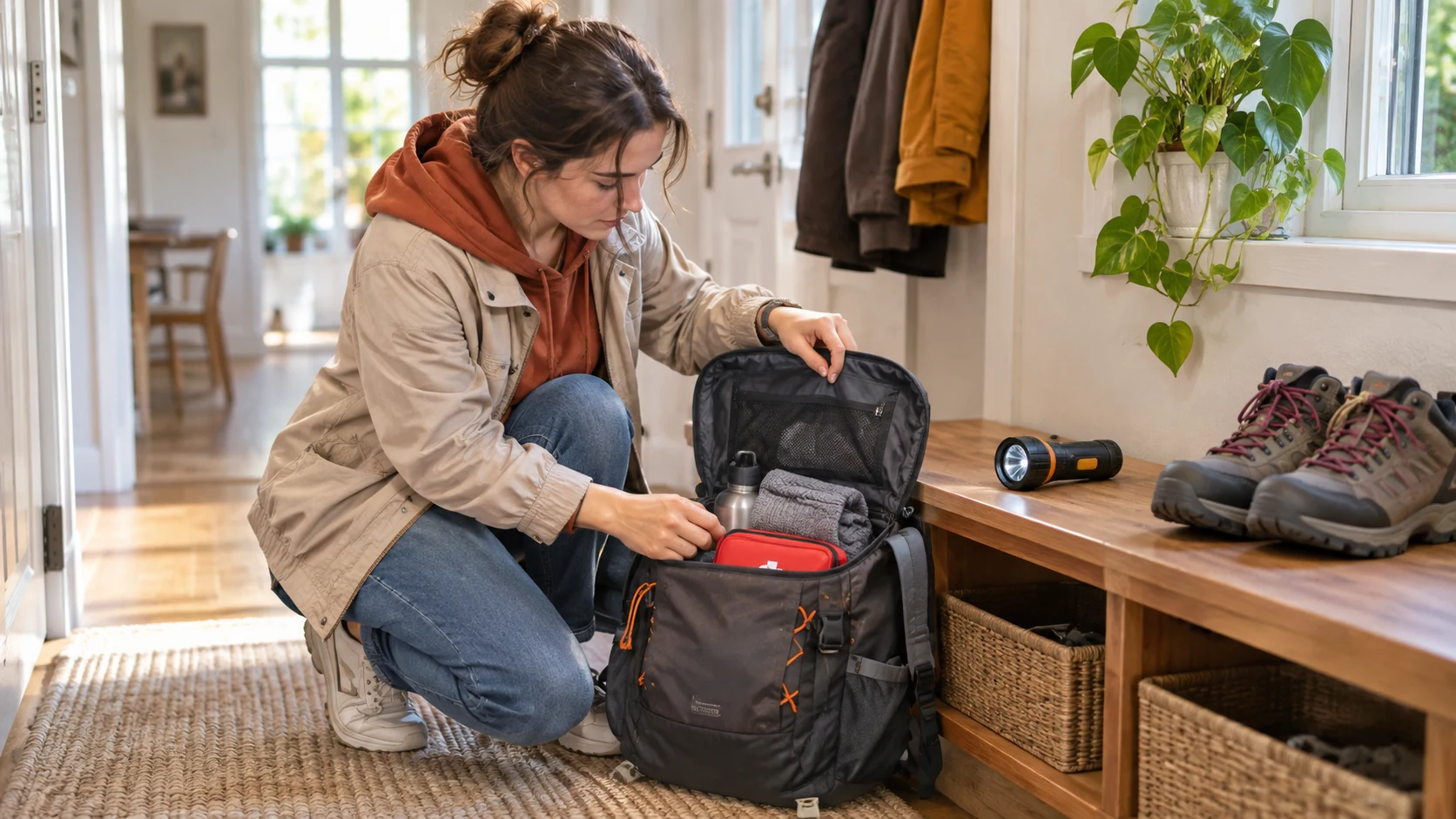
The go bag is a backpack prepared in advance that holds what you need to be self-sufficient for at least 72 hours. You can grab it in seconds, without having to figure out what to take. Its basic contents usually include:
- water and a way to treat it;
- light, non-perishable food for 72 hours;
- a first aid kit and personal medications;
- a way to start a fire;
- emergency shelter: a light tarp, a compact sleeping bag or an emergency blanket;
- clothing suited to the season;
- copies of important documents;
- a headlamp and spare batteries;
- a multi-tool;
- cash in small bills;
- a charger and power bank, a paper list of contacts.
The go bag is the last thing you will keep if you have to abandon the vehicle. Everything else is added to it, but it forms the foundation of your immediate self-sufficiency.
A perfect bag that is too heavy to carry is not a good bag. Weight is a real constraint, especially with children. A bag suited to your actual physical abilities is better than one that is complete in theory. See our guides Choosing your evacuation bag and the family evacuation bag.
The get-home bag
A disaster does not necessarily strike when you are at home. On weekdays, most adults are at work, children are at school, and family members are scattered. Any preparedness approach has to take this into account.
The get-home bag is a lighter kit designed to help you get home from work or anywhere else the event might catch you. It is not meant for extended self-sufficiency, but for the needs of a trip that could take several hours on foot: walking shoes, water, snacks, a warm or waterproof layer, a flashlight, a power bank, a paper map, a first aid kit and medications. If you do not always have it with you, a more compact everyday carry kit can serve as a minimal safety net.
| Kit | Purpose | Where to keep it | Intended self-sufficiency |
|---|---|---|---|
| Everyday carry (EDC) | Handle small mishaps | On you | A few hours |
| Get-home bag | Get home, often on foot | At work or in the vehicle | A trip of several hours |
| Go bag | Leave home | At home, near the exit | At least 72 hours |
The get-home bag and the go bag follow opposite logics: one brings you home, the other lets you leave home. The two are complementary. See our articles A disrupted journey home and Building your EDC kit.
Skills: the most lasting resource
Equipment can be lost, stolen or forgotten. Skills stay with you. In citizen preparedness, developing practical skills is often more valuable in the long run than accumulating gear. Useful skills to build gradually include:
- lighting and maintaining a fire in different conditions, where permitted;
- finding and treating water;
- building a basic shelter;
- navigating without GPS, using a map and compass;
- giving first aid;
- preserving and cooking food without refrigeration;
- recognizing a few local edible plants, with a reliable guide;
- managing communication in a group under stress.
These skills cannot be learned from books alone: they require practice. A weekend of camping without modern comforts, a first aid course, an outing in the woods with a paper map are concrete experiences that anchor learning. Our guide What is bushcraft? suggests projects to get started.
Mindset is also a skill. Keeping a calm line of reasoning under pressure, prioritizing actions, not being overwhelmed by emotion: this disposition can be cultivated. It cannot simply be summoned at the moment you need it.
Summary: the five components of basic preparedness
- An evacuation plan thought out in advance, suited to your family and known to everyone.
- A fallback destination identified, scouted and assessed according to the resources available there.
- Prepared transportation, maintained, with known alternative routes.
- A go bag and a get-home bag ready, suited to your physical abilities and checked regularly.
- Practical skills acquired gradually and tested in realistic conditions.
Citizen preparedness is not a state you reach but an ongoing process. No equipment list replaces thinking ahead, and an imperfect plan that is known and practised is better than a perfect plan left in a drawer. Start with one element, consolidate it, then move on to the next: this steady progress is what builds real resilience.
Frequently asked questions
Where do I actually start as a beginner?
The priority is to build a supply of water and food for at least 72 hours for everyone in the household. Next, set up a family communication plan in case you are separated. These are two simple, inexpensive steps with a big immediate impact. Our guide to getting started and progressing covers what comes next.
Do you necessarily have to plan an evacuation into the woods?
No. Evacuating into the wilderness is one option among others, and often the hardest to do well. For most people, going to a relative’s home outside the affected area, a neighbouring region or lodging provided by the authorities is more realistic and often safer.
What is the difference between a go bag and a get-home bag?
The go bag is for leaving home and staying self-sufficient for at least 72 hours. The lighter get-home bag is for getting back home if you are elsewhere when the event happens. They address opposite situations and complement each other.
Does citizen preparedness oppose institutions?
No. It complements emergency services without replacing them. A prepared person who does not need immediate help frees up resources for those who need them more.