
In this article
An old saying goes: “The more skills you have, the less gear you need.” It is an excellent mindset for citizen preparedness, and it is the heart of bushcraft. Whether you already have outdoor experience or are simply wondering what the word covers, this guide presents the skills to learn, useful tools, a realistic progression and a few first projects to try, while respecting the law and nature.
In brief
In brief. Bushcraft is the art of using the resources of the natural environment to live comfortably in the woods with little gear. It brings together five broad families of skills: foraging, wildlife observation and trapping, water, shelter and fire. You start with simple tasks (cutting wood, tying knots, lighting a small fire), using a knife, a hatchet or a saw, then progress through practice. Foraging, trapping, cutting wood and fires are governed by rules you need to know.
What is bushcraft?
Bushcraft is the art of using the resources the natural environment provides to live and get by outdoors. It combines knowledge of plants, animals and terrain with a few basic tools to make life in the woods easier, safer and more efficient. In Quebec, it ties into a long tradition of life in the forest, that of First Nations, trappers, hunters and campers.
Learning bushcraft brings many benefits:
- a greater ability to adapt to new situations;
- more self-reliance;
- stronger self-confidence;
- useful skills for the unexpected outdoors, such as an unplanned night in the woods;
- better preparation for unforeseen problems, including at home.
Bushcraft is not a single skill but a set of related abilities that help you overcome obstacles with what you have at hand. While it is traditionally associated with the forest, its spirit, making the most of what surrounds you, also applies in urban or suburban settings: repairing, improvising, keeping warm, lighting, purifying water during an outage. Learning it takes time, but every skill you acquire makes you calmer and more capable when something unexpected happens.
See also our article on the links between bushcraft and citizen preparedness.
The main bushcraft skills
Bushcraft brings together traditional techniques for meeting your needs in the natural environment. This guide focuses on the five families of skills most closely tied to outdoor safety. Each includes many sub-skills.
| Family | Sub-skills | Point to watch |
|---|---|---|
| Foraging | Knowing local plants, avoiding toxic species, harvesting without depleting the resource, cooking | Never eat a plant without absolute certainty |
| Wildlife and trapping | Reading tracks, observing movements, knots and cordage, preparing game | Hunting and trapping require licences and follow seasons |
| Water | Finding water, filtering it, boiling or disinfecting it, making a container | Always treat water taken from nature |
| Shelter | Gathering materials, limbing, assembling, insulating from the ground, waterproofing | Use dead and down wood; no felling without permission |
| Fire | Gathering wood, preparing tinder, building a fire pit, choosing the type of fire, friction fire | Respect fire bans and put fires out completely |
Foraging
Foraging means knowing local plants, avoiding toxic ones, harvesting efficiently and cooking what you find. In Quebec, several deadly plants, such as spotted water hemlock, resemble edible species: identification should be learned with a recognized field guide and, ideally, an experienced person. Never eat a plant you are not 100% sure of. Also respect park rules, where foraging is often prohibited, and take only a small share of what you find.
Wildlife observation and trapping
This family includes reading tracks and signs, understanding animal movements, using knots and cordage, and preparing game. In Quebec, in France and elsewhere, hunting and trapping are strictly regulated: licences, training, seasons, territories and permitted gear. Tracking and observation, on the other hand, can be practised anywhere without a licence and are an excellent entry point.
Finding and purifying water
You need to know where to look for water, how to filter it to remove particles, how to purify it by boiling, a suitable filter or chemical disinfection, and how to make or improvise a container. Making a fire to boil water is also part of this skill. Clear stream water can contain parasites such as Giardia: always treat it.
Building a shelter
A shelter is built by gathering materials, limbing, assembling a frame, covering it with branches, bark or leaves, and insulating it from the ground, which draws away a lot of heat. Knots and cordage are essential. Preferably use dead wood lying on the ground: cutting live trees is prohibited without permission on most public land and in parks.
Making fire
Fire requires gathering dry wood of different sizes, preparing tinder, building a safe fire pit and knowing the types of fire and their uses. Friction fire is an advanced and rewarding skill, but always carry a lighter and matches. Before every outing, check open-fire bans, published in Quebec by SOPFEU and in France by the prefectures, and always put the fire out completely with water.
How long does it take to learn?
There is a lot to learn, and mastering bushcraft can take years. But many small skills can be learned in a few hours and refined with every outing. Some, such as making cordage or carving a useful stick, serve in several disciplines at once.
| Level | Skills to work on |
|---|---|
| Beginner | Cutting and splitting wood safely, carving simple tools, lashing a tripod, tying a few knots, lighting a small campfire |
| Intermediate | Foraging with a guide, fire without matches or a lighter, building a shelter, trapping basics within a legal framework, water purification |
| Advanced | Making rope and cordage, elaborate structures (camp oven, raised bed, thatched roof), advanced foraging and tracking, navigation |
If you are just starting
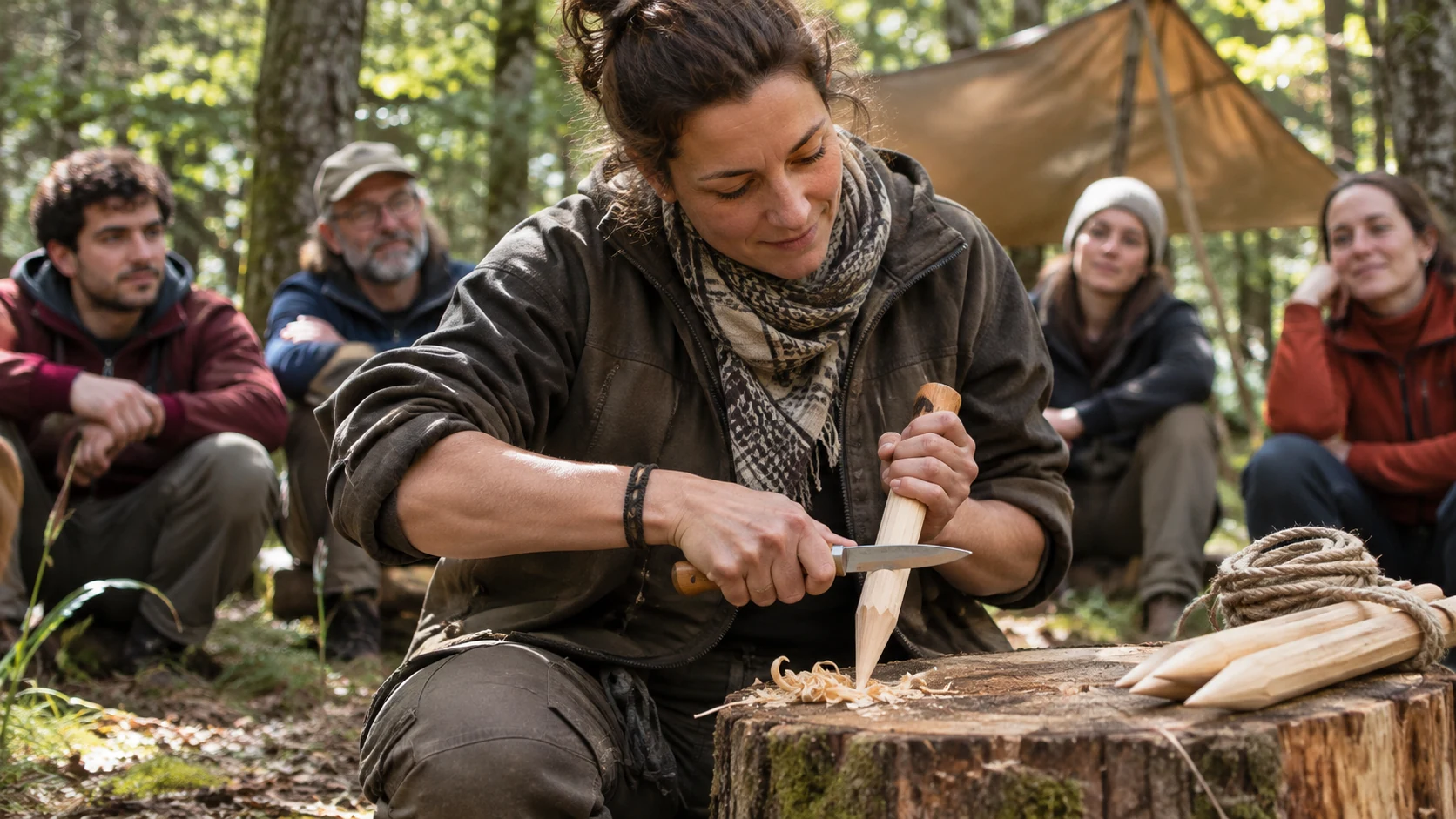
Start with the easiest skills, which can be learned in a few hours and improve with every practice: handling a knife and saw safely, cutting wood, carving a stake, tying a few basic knots, lashing a tripod and lighting a small fire in an established fire pit. An afternoon in a park or campground is enough to get started.
If you already have the basics
With some knowledge, you can tackle intermediate skills: recognizing a few edible plants with a guide, lighting a fire without matches or a lighter, building a shelter for one night, purifying water in several ways. For trapping, take the training required in your jurisdiction.
For experienced practitioners
If you have solid outdoor experience, take on advanced projects: making rope from natural fibres, building more elaborate structures, refining foraging, tracking and map-and-compass navigation. A course with a recognized instructor saves a lot of time.
Bushcraft tools
In its purest form, bushcraft means heading into the woods with the clothes on your back and a cutting tool. Almost every skill and most projects rely on a cutting tool. Here are the main ones and what they are used for.
| Tool | Main uses | Limitations |
|---|---|---|
| Fixed-blade knife | Cutting branches thinner than your wrist, carving, removing bark, preparing food | Not efficient for large-diameter wood |
| Hatchet or tomahawk | Cutting and splitting wood, driving stakes, heavy work | Requires safe technique; heavier |
| Machete | Clearing brush, cutting large branches | Of little use in dense boreal forest; carrying is regulated |
| Folding saw | Cutting branches precisely with little effort | Single purpose, but very effective |
| Backpack | Carrying tools and gear | Must be fitted to your body |
The knife
A fixed-blade knife is the most common tool. It suits light and medium tasks: cutting branches thinner than your wrist, carving or whittling wood, removing bark, preparing traps where permitted, cooking. Choose a sturdy full-tang blade, a comfortable handle and a secure sheath, and learn to sharpen it. Follow the rules on carrying blades: a knife packed in your bag for an outdoor activity does not have the same status as a knife carried in town.
The hatchet or tomahawk
A small axe is a very versatile tool, better suited to heavier work: cutting and splitting wood, driving stakes, rough carving. It requires good technique: always work in a clear area with your legs out of the swing path, and wear gloves and sturdy footwear.
The machete
A machete is a hybrid between a large knife and a small axe. Its long, heavy blade suits medium to heavy cutting: clearing brush, large branches, wood. It is very useful in tropical environments, much less so in the boreal forest, where a saw and a hatchet are often more helpful.
The saw
The saw is more specialized, since it only cuts, but it does so very efficiently and with little fatigue. It becomes invaluable for projects that require a lot of cleanly cut wood: a platform, a small cabin, a camp table or chair, a ladder. It is also the safest tool for beginners.
The backpack
Finally, the pack carries your tools and the rest of your gear. Choose one in your size, comfortable when loaded, water-resistant, with several compartments rather than one large pocket: you will find what you need faster. Our guide Choosing your evacuation bag details the carrying criteria.
What is the best tool?
All these tools can be used for almost any task. One of the central ideas of bushcraft is adaptability: the best tool is often the one in your hand. Think about what you want to accomplish and the resources available where you are. Lots of wood to cut? Bring a saw and a hatchet. Mostly carving and fine work? A good knife will do. It is better to bring the right tool for the project than an arsenal you will not need.
Five projects to get started
Starting with a few simple projects is the best way to get going. Here is one for each of the five families of skills.
- Foraging: identify with certainty a common edible plant in your region using a recognized field guide, without necessarily eating it. Note where and when it grows, and which toxic plants resemble it.
- Wildlife: find and identify a set of animal tracks. Learn about the common species in your region and their habits; focus on the most common ones to improve your chances.
- Water: learn and practise a water treatment method: boiling, a filter, tablets. For a first try, practise with tap water so you master the technique without risk.
- Shelter: build a simple shelter, such as a lean-to or a debris hut, using dead wood. Then pour a bottle of water over it to check whether it would keep you dry, and take it apart and return the materials.
- Fire: light a small fire in an existing fire pit where it is permitted. This draws on several skills: gathering wood, preparing tinder, building the fire, then putting it out completely. If you have already mastered the classic fire, try an upside-down fire, which burns from the top down and needs little tending.
If you complete all or some of these projects, you will be well on your way to developing your skills and being better prepared.
Practising safely and respecting the land
- Tell someone your route and return time, and bring a first aid kit, a flashlight, water and a way to start a fire.
- Check the weather and fire bans before you leave.
- Learn the rules of the territory: national parks, controlled harvesting zones (ZECs), reserves, private land and public forests have different rules on cutting wood, foraging, camping and fires.
- Follow Leave No Trace principles: leave places as you found them, pack out your waste, take down your structures.
- Start close to a vehicle or a shelter, and increase the difficulty gradually.
Going further with your learning
Bushcraft is a vast field, and this guide only offers an overview. To progress, combine several sources: plant identification guides for your region, recognized outdoor and survival manuals, courses offered by outdoor clubs, bushcraft schools or certified instructors, and above all regular practice. A printed manual can be consulted without a network or battery.
Summary
Bushcraft is a varied and useful set of skills to add to your preparedness. This guide helps you get started, but there is no better teacher than experience. Get out, practise, try again: you will be surprised at how quickly you progress and how much confidence you gain, in the woods and in everyday life.
Frequently asked questions
Is bushcraft the same thing as survival?
Not exactly. Survival aims to get out of an emergency, often as quickly as possible. Bushcraft aims to live comfortably in the woods through your skills. The two overlap a great deal, and bushcraft is an excellent way to prepare for a survival situation.
Can you practise bushcraft anywhere?
No. Rules vary by territory: parks, ZECs, public or private land. Cutting live wood, making fires, foraging or camping may be prohibited or require permission. Check before every outing and ask the owner’s permission on private land.
Which tool should you buy first?
A sturdy fixed-blade knife and a small folding saw cover most of a beginner’s needs. Add a hatchet once you have learned to handle these tools safely.