
In this article
You may already have an evacuation plan and a go bag ready at home. That is an important step. But most unexpected events do not happen while you are at home with your bag within reach: they happen at work, on public transit, in the car, out on a walk. That is where EDC comes in, short for Every Day Carry: the items you carry on you every day.
This article explains what an EDC kit is, how to build it around three categories of needs, which kinds of items to consider and, above all, how to fit it to your real risks with a simple matrix that combines likelihood and impact. Everyday incidents and more serious situations alike remind us that nobody is immune; the goal is not to be alarmed, but to have the essentials on you to handle a setback or get to a safe place.
In brief
In brief. An EDC is a small set of items carried at all times to solve everyday annoyances and cope with an emergency until you reach a safe place. You build it in three layers: the items you already carry, tools for common mishaps, and a few pieces of equipment chosen for the risks specific to your surroundings. A likelihood × impact matrix helps you decide what to keep. Discretion, light weight and compliance with local laws on carrying blades are essential.
What is an EDC kit?
The EDC concept rests on everyday preparedness for the unexpected. It is a carefully chosen collection of items that you carry on you at all times to deal with a variety of situations, from the most mundane to serious emergencies.
The goal is twofold: to solve small everyday annoyances, such as a package to open, a power outage in a stairwell or a dead phone battery, and to give you the means to handle a crisis until you reach a safe place or help arrives.
Your EDC should reflect your everyday life: your surroundings, your routine, your travel and the risks specific to your region. Adaptability is key. The kit of someone who rides the subway in the city has little in common with that of someone who drives alone on rural roads in winter.
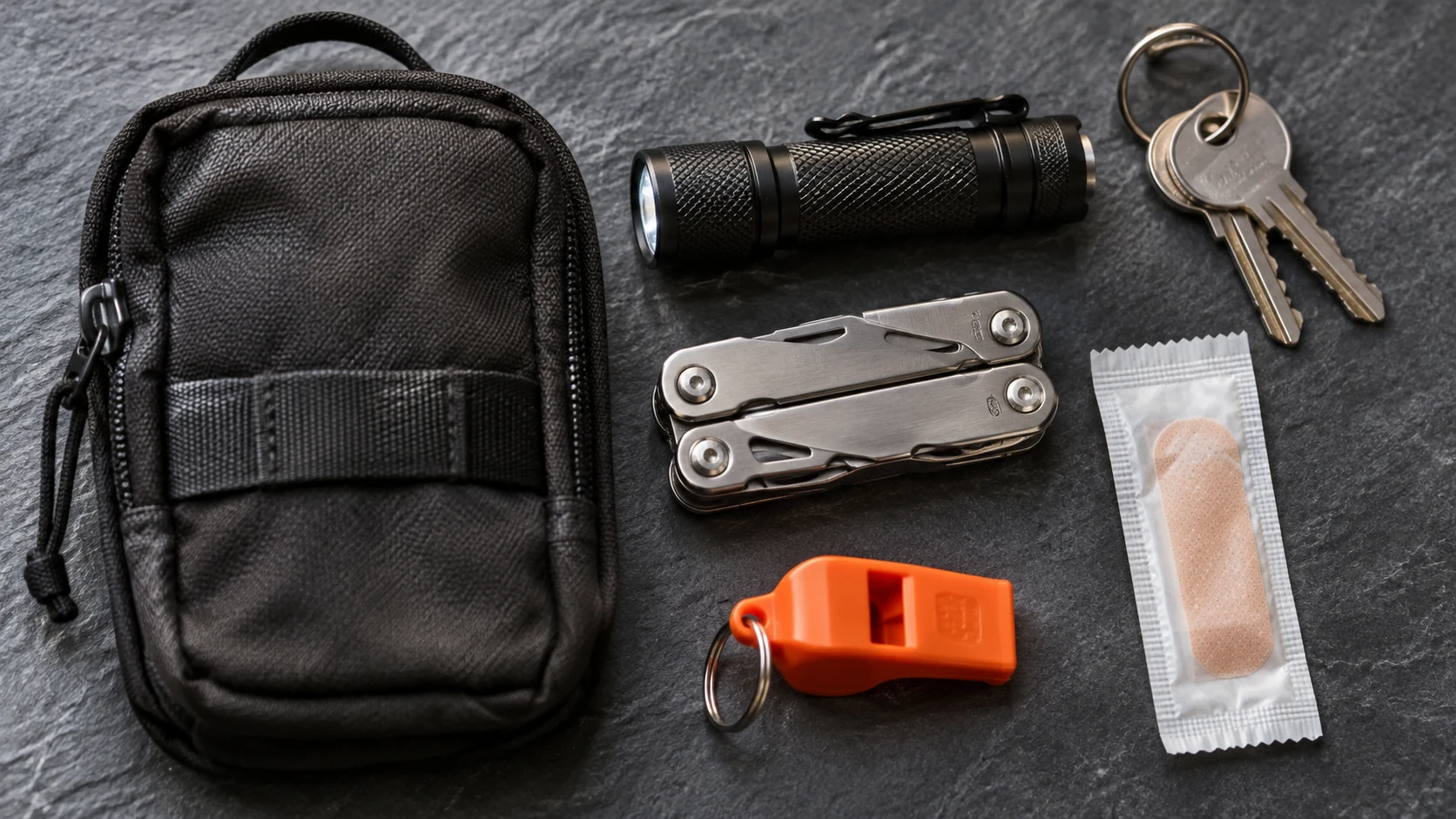
In terms of size and quantity, EDC items should stay minimal and compact, favouring discretion without sacrificing effectiveness. Ideally the essentials fit in your pockets; a small pouch or bag can carry the rest comfortably. Low-key gear that does not draw attention is preferable. Some people deliberately limit their kit to about ten versatile items, getting the most out of each without clutter.
The three categories of an EDC list
Your EDC should consist of items that meet three categories of needs: those you already use every day, those that make small mishaps easier to handle, and those that could help you in exceptional situations.
| Category | Role | Examples |
|---|---|---|
| 1. Everyday items | The foundation, already in your pockets | Wallet, keys, phone, watch |
| 2. Common mishaps | Making setbacks manageable | Knife or multi-tool (where legal), flashlight |
| 3. Exceptional situations | Covering the risks specific to your surroundings | Window breaker and seatbelt cutter, cord, whistle, mini first aid kit |
1. Everyday items
Look at the items you always take with you when you leave home. They reflect your essential needs and form the basis of your list.
- Wallet: essential for your ID and means of payment. A compact but well-organized wallet holds cards and a little cash, which is useful when payment terminals stop working during an outage.
- Keys: vital for getting into your home and vehicle. Your key ring can hold a small useful tool, such as a mini flashlight or a paracord key fob, without becoming bulky.
- Phone: your link to the world. Store your emergency contacts and a medical ID accessible from the lock screen, and slip a paper card with essential numbers into the case in case the battery dies.
- Watch: more than an accessory, a reliable watch tells the time without relying on your phone; some models add a compass or other useful features.
2. Tools for common mishaps
Identify the recurring obstacles or problems you run into regularly, and choose tools that make those situations easier to handle.
- Knife: useful for countless tasks, from small repairs to opening packages. A sturdy model that opens easily with one hand is practical. Check the rules, though: in France, carrying a knife without a legitimate reason is prohibited; in Canada, carrying an object with the intent to use it as a weapon is an offence, and many places (schools, public buildings, aircraft) ban blades.
- Flashlight: invaluable during power outages or for getting around at night. A compact, rechargeable LED light with a low mode to save battery comes in handy almost every week.
- Multi-tool: the essence of versatility, able to replace a small toolkit. Choose a model that covers your real needs without being too heavy; blade-free versions exist for places where knives are banned.
3. Equipment for exceptional situations
These items are chosen according to the risks specific to your surroundings. They are used less often, but they can make a real difference in an emergency.
- Window breaker and seatbelt cutter: a small tool, sometimes built into a pen or key ring, that lets you get out of a stranded vehicle, for example after a crash or if the car is submerged. Keep it within reach in the cabin, not at the bottom of the trunk.
- Small pry tool: useful for freeing a stuck object or making a makeshift repair. It never replaces emergency services for a person trapped in a vehicle: call 911 in Canada, or 112 or 18 in France.
- Paracord: light and strong, it can serve in many situations, from tying down a tarp to repairing gear. A paracord bracelet carries a few metres without getting in the way.
- Useful extras: a whistle to signal your presence, a few bandages and any essential personal medication, a power bank, a mask, a folded emergency blanket.
In short, a well-thought-out EDC is your first layer of preparedness for the unexpected. By focusing on these three categories, you get a kit that is both practical every day and useful in a serious situation. For a detailed checklist, see our EDC checklist.
Examples of equipment to look at
In the original version of this article, the author described the tools he carried himself, chosen for their versatility, reliability and ease of use. These models remain examples to look at, not universal recommendations: product lines change, and the best tool is the one that matches your real tasks, your budget and the laws where you live. Check current specifications with the manufacturer before buying.
| Function | Example mentioned | Why it was chosen | Point to watch |
|---|---|---|---|
| Folding knife | Smith & Wesson Military & Police SWMP4LS | Sturdiness, partially serrated blade, one-handed opening | Carry is regulated depending on the country and the place |
| Flashlight | Nitecore P12GT | Powerful, compact and durable LED light, useful for signalling or moving in the dark | Check the battery type and runtime |
| Multi-tool | Leatherman MUT EOD | Many functions for unexpected repairs | Fairly heavy; more compact versions exist |
| Sturdy pen with window breaker | UZI tactical pen 1 | Solid writing instrument with a glass-breaking tip | Treat it as a pen and vehicle-escape tool, not a weapon |
| Small pry bar | Böker Minibar | Compact tool for freeing, prying or opening | For legitimate tasks only |
| Paracord bracelet | The Friendly Swede | Discreet cord, clasp that doubles as a fire starter | Check the actual length of cord |
These items are not just gear carried out of habit: they are insurance against the unexpected and give you confidence to face a range of situations. To compare other versatile tools, see our selection EDC tools: twelve references to compare.
Everyday items and self-defence. Choosing an EDC item for defensive use is not advisable. A flashlight or pen presented as a “weapon” may be treated as one by the law, in Canada as in France. The best personal safety strategy remains avoiding risky situations, moving away and calling for help.
Assessing your risks to fine-tune your EDC
Risk assessment is the step that turns a generic list into a truly useful kit. Understanding and anticipating the threats specific to your surroundings lets you build an EDC that serves you every day while preparing you effectively for emergencies. Two criteria are enough to start: likelihood and impact.
Likelihood of threats
The likelihood that a threat will materialize is the first factor to consider. It varies widely depending on the nature of the threat and where you are. For example:
- High likelihood: slipping on ice in winter, being left in the dark during an outage, being delayed on transit. These events are frequent and predictable.
- Medium likelihood: a vehicle breakdown or an extended power outage, less frequent but realistic.
- Low likelihood: an earthquake or major natural disaster, rare in most regions but with potentially serious consequences.
Potential impact
The second criterion is the threat’s impact if it occurs. It can range from a mere inconvenience to a danger to life:
- Minor impact: a temporary inconvenience that is quickly resolved without outside help.
- Moderate impact: a situation that requires medical care or the help of emergency services.
- Severe impact: an event that directly threatens life and requires an immediate response.
The threat assessment matrix
To visualize and prioritize these threats, a simple matrix combines likelihood and impact. It helps you decide which items deserve a place in your EDC.
| Likelihood \ Impact | Minor | Moderate | Severe |
|---|---|---|---|
| High | Medium priority | High priority | High priority |
| Medium | Low priority | Medium priority | High priority |
| Low | Low priority | Low priority | Medium priority |
- High priority: frequent or serious threats call for immediate preparation, for example a flashlight and ice cleats for a walking commute in January.
- Medium priority: risks that are less likely but serious, or more likely but less consequential.
- Low priority: unlikely, low-impact threats need little specific preparation.
This matrix helps you balance your EDC: covering both everyday needs and emergency preparations without overloading your pockets. It encourages strategic thinking and adapting the kit to your own surroundings and needs. Keep it handy when you review your EDC, for example at every change of season: effective preparedness is a balance between likelihood and impact. Our guide to managing household risks applies the same logic to the whole home.
Refining your everyday preparedness
A carefully chosen EDC is a pragmatic approach in a world where the unexpected is part of life. By taking the time to assess your needs and the risks you could face, you give yourself the means to respond to most common situations. The key is to choose items that meet your immediate needs while staying versatile.
Preparedness is also a way of looking at things. It is often said that luck favours the prepared mind, and this holds true in handling small and large crises alike. Your EDC is not just a set of tools: it is the concrete expression of your determination to take charge of your safety and well-being.
EDC and go bag: two complementary layers
If you have put together your EDC but not yet your go bag, that is the next step. The go bag adds a layer of preparedness for situations that require leaving home quickly or staying self-reliant for several days away from home. Our guides Choosing your evacuation bag and Every EDC is different will help you assemble a coherent set.
Your preparedness journey is your own. If you found this article useful, share it with the people close to you: preparedness is a shared responsibility, and a good idea passed on can make a real difference. Your feedback on the items that actually served you is welcome through the PrépaCivile contact page.
Frequently asked questions
How many items should an EDC include?
There is no ideal number. Many people stick to about ten versatile items. The right test: being able to carry everything every day without discomfort. A kit that is too heavy often ends up left at home.
Can you carry a knife as part of your EDC?
It depends on the jurisdiction and the place. In France, carrying a knife without a legitimate reason is prohibited. In Canada, there is no general rule on blade length, but carrying an object with the intent to use it as a weapon is an offence, and many establishments ban blades. A blade-free multi-tool is an alternative for sensitive places.
How often should you review your EDC?
At every change of season and after every real use. Recharge the flashlight and power bank, replace used bandages, and adapt the contents for winter or summer.