
In this article
The gear you carry every day—often referred to as "EDC" (Everyday Carry)—should reflect the reality of your daily life. Someone walking to the subway, a parent accompanying a child, and a professional traveling for work will all have different requirements. Your bag could be a messenger bag, a backpack, a handbag, or any other container you already own. A compartmentalized model, such as the Maxpedition Jumbo, offers one way to organize your gear, but it is by no means a universal solution.
The shape, storage layout, and appearance of a bag affect how comfortable it is to carry in public spaces. Choose a size that doesn’t hinder your movement, and a material suited to how you intend to use it. Color is largely a matter of practical preference; it offers no guarantee of safety or invisibility. In fact, a highly visible bag can be an advantage when you *want* to be seen. The right choice depends on your specific situation, as well as your sensory or mobility needs.
To assemble your EDC, start by considering the tasks you perform and any unexpected situations you’ve encountered in the past. Have you ever run out of battery, water, needed written information, or lacked basic first-aid supplies? First, take stock of what you already carry in your pockets or bag. Then, add items that you know how to use—keeping in mind their weight, your budget, and any restrictions that may apply to the places you visit.
Evaluate the bag’s size, durability, and carrying system as a whole. Test it while fully loaded—try walking, sitting down, and using public transportation. The shoulder strap or backpack straps should never cause pain or restrict your ability to move freely. Store frequently used items in an easily identifiable pocket, and ensure that documents, items prone to leaking, and sharp objects are properly secured. A clear, logical layout is more important than the number of compartments.
Useful gear should remain accessible and easy to maintain. After use, replenish any consumed supplies, recharge devices, and check expiration dates. Review the contents whenever your itinerary, the season, your health status, or the people you are with change. An Everyday Carry (EDC) kit complements other household preparedness measures; it is not a substitute for a family emergency plan or a home-based emergency kit.
Example: Adapting to a day interrupted by an outage
Imagine a power outage during a workday. Certain activities may come to a halt, and elevators might become unavailable. Consult building guidelines and information from transport providers before deciding on your next move. An outage does not automatically mean you must leave the premises; your decision should be guided by the immediate danger, access to a safe location, and any applicable instructions.
In such a situation, your bag might provide a charged battery, a small flashlight, and important contact information. Check the status of your route and notify those close to you if your plans change. If you are required to leave, choose a viable path and keep your hands free if the situation demands it. While your gear can assist with these actions, it cannot make an inherently dangerous route safe.
A friend, family member, or colleague might need information or minor assistance. Offer help that is within your means, but do not assume that someone else is incapable of responding simply because they lack the same equipment as you. Having a written contact, an accessible address, and an agreed-upon meeting point can be more useful than carrying an extra item in your bag.
Choose footwear suited to the actual route you anticipate taking and to your own level of mobility. Taking a detour on foot can be tiring, but the solution is not necessarily to run or push through a crowd. Consider your transport options, safe places to wait, and the needs of any children or others you may be accompanying. Testing out a familiar route can help you gauge the weight of your bag.
This scenario helps identify everyday needs: communicating, having a light source, staying hydrated, managing medical treatments, and reaching a suitable destination. List the functions that are truly necessary, then select the simplest means to address each one. Preparation also involves building contacts, gathering information, and developing good habits; it does not depend solely on purchasing a bag.
The Essentials: A Minimalist Approach
The following list serves as a starting point, to be adapted based on your specific activities. Some items are better suited for outdoor excursions and are not necessary for every urban trip. Keep essentials—such as charging equipment, lighting, personal care items, and important documents—in mind, then consider the following additions:
- Lighter or matches: A means of ignition can be useful for authorized outdoor activities. It requires protective storage and must comply with transport and fire safety regulations. It is not a universal necessity, cannot replace appropriate clothing, and should never be used to start a fire indoors.
- Water and treatment: Start by carrying potable water in a clean container. Depending on the specific contaminants and the manufacturer’s instructions, a filter or purification tablets may be suitable for certain outings. No small-scale treatment method can guarantee that any water source is safe—especially in the event of chemical contamination. Always plan for an alternative water supply when the quality of available water is unknown.
- Snacks: Choose food items that you are accustomed to, can tolerate well, and are easy to consume. Consider potential allergies, portion sizes, packaging, and storage requirements. Replace any items you consume; do not assume that snacks like energy bars or dried fruit will remain safe or suitable indefinitely if kept in a bag exposed to heat.
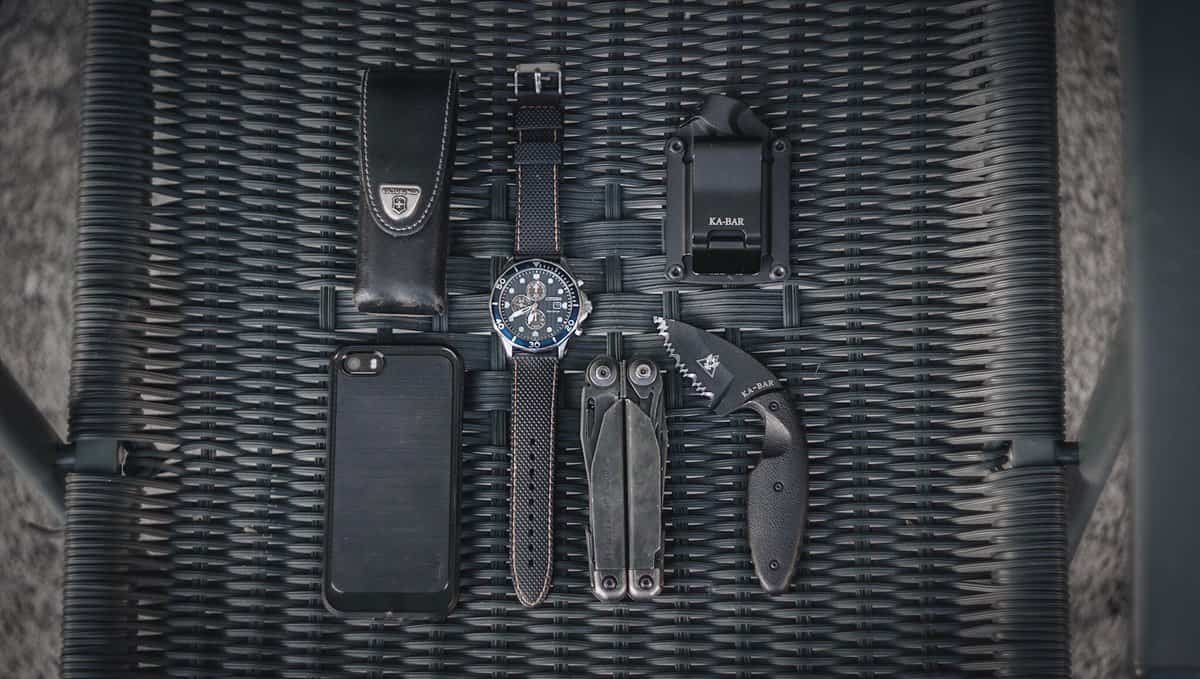
- Multitool: A small pair of pliers, scissors, or a utility tool can be helpful for specific tasks. Evaluate the functions you need and how comfortable the tool is to hold before making a selection. Models that include a blade require protective storage and must comply with regulations for your journey; they are not a substitute for specialized professional tools.
- Basic Sewing Kit: A loose button or a tear can be more than just a minor nuisance. A small sewing kit—containing a needle, thread, and a few spare buttons—can make a significant difference.
- Notebook and Pen: Being able to jot down notes, map out a route, or leave a message can prove crucial. A notebook and a water-resistant pen are useful additions.
- Short Length of Cord: A few meters of cord can help with organizing gear or performing minor repairs. Choose a reasonable length and ensure the ends are sealed. Standard paracord is not certified equipment for climbing, fall protection, or rescue operations; furthermore, a stated breaking strength does not validate any and all configurations.
Next, customize your selection: include any necessary medications (properly labeled and discussed with your pharmacist), menstrual products, items for children, mobility aids, or specific tools required for your activities. Organize your items so they are easy to access—don’t bury essential, frequently used gear behind items you rarely need.
Now it’s your turn: what items do you consider essential for your EDC (Everyday Carry) kit? How do you prepare your pack to meet the unique challenges of your daily life and stay ready for the unexpected?
A successful EDC setup is one that you actually carry, can easily access, and keep well-maintained. Test it out during a typical day, take note of what’s missing or what gets in the way, and then make gradual adjustments.
Equipment to compare for your needs
Some links below are affiliate links: we may receive a commission at no additional cost to you. Products are examples by function, to choose according to your needs; buying the entire selection is unnecessary.