
In this article
- A fictional scenario: the return is no longer direct
- Distinguish the desired destination and the truly accessible shelter
- Know an alternative route without making it a guarantee
- GPS position, map and mobile network: different functions
- Prepare information before equipment
- Small equipment suitable for travel
- On foot, by bike or by public transport: check the real possibilities
- A news protocol that remains simple
- Review the plan after a safe trial
- Official sources and information
A regular commute can become difficult without the home being the safest destination to reach immediately. A closure, a stop on public transit, a storm or a communication breakdown may require waiting, changing routes or requesting appropriate assistance.
Preparing for the return is about knowing several options and their limitations. The speed of departure does not guarantee safety: the instructions of the authorities, the state of the journey and the capacities of the people must guide the decision.
A fictional scenario: the return is no longer direct
A person is at work when the transportation service is interrupted. His usual route includes a bridge; his phone is not very charged and his relatives are waiting for news. This educational scenario does not describe a specific historical event. It is used to examine dependencies, without inventing a timeline of closures or a return time.
Before leaving, the person looks for official information about the disturbance, checks whether its current location is safe and warns a loved one when they can do so. If roads or transportation are dangerous, waiting in a safe place may be better to improvise a move.
Distinguish the desired destination and the truly accessible shelter
The home may be inaccessible or affected by an evacuation. The plan should therefore consider a solution close to the place of work or study, a confirmed welcome and a way to communicate the decision. A business or library is not guaranteed to be open, heated or equipped with a functioning network during a crisis.
Check the conditions of access of the proposed place, its known schedules and the instructions of the staff. Plan another option if this location closes or needs to be evacuated. Mobility, care and medication needs must be considered before the wait goes on.
Know an alternative route without making it a guarantee
In quiet weather, find another route for regular trips: home, work, school or place of care. A map can help identify binding passages and landmarks. A test in safe conditions allows to discover a difficulty of access, but does not guarantee that the course will remain open.
At the time of the disturbance, check the closures and the instructions. Don’t take a barred or flooded road because an app offers it. Do not try to bypass a security device by a small street, a trail or a private entrance.
In Quebec, Quebec 511 gives information about the road network; in France, Bison Futé and the competent local services can inform about the restrictions. The information displayed can change: note the time of consultation and remain attentive to the indications on the spot.
GPS position, map and mobile network: different functions
A loss of mobile data does not automatically mean that the reception of satellite positioning signals is lost. On the other hand, an application may need access to data to load its cards, search for an address, or get traffic status. The reception, the power supply and the functions of the device each have their limits.
If your tool allows it, prepare the maps offline before moving and check how to find them. Update them according to the supplier’s instructions. They do not necessarily give the current state of the roads and should not be considered valid indefinitely.
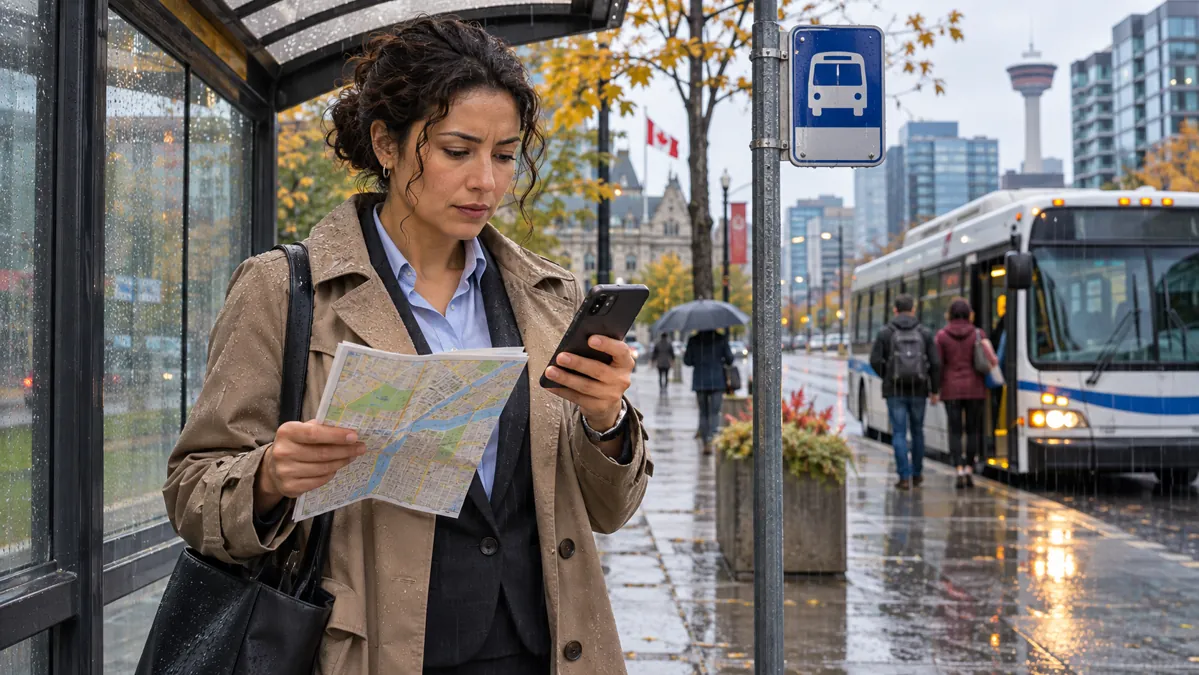
A paper card and some noted coordinates remain useful when the phone is no longer available. They also do not indicate closures in real time. The goal is to have a complement, not a tool presented as infallible.
Prepare information before equipment
| Element | Useful verification |
|---|---|
| Main transportation | Official coordinates and channels of the carrier or road network. |
| Another course | Truly known access, mobility needs and limits in case of closure. |
| Place of waiting | Possible welcome to be confirmed, schedules and alternative. |
| Contacts | Numbers accessible on paper and accepted role of relay persons. |
| Health needs | Plan agreed with professionals when waiting or transportation poses a risk. |
Small equipment suitable for travel
Provide appropriate water and food as needed, lighting, compatible means of recharging, and clothing appropriate to the conditions. The content must remain transportable and usable by the person concerned. An identical list is not suitable for all journeys, seasons and health conditions.
Really check the operation of the charger and cable. A capacity announced in mAh does not allow to promise a fixed number of recharges for all phones. Respect the manufacturer’s conditions of use and storage.
Food and medicine left in a vehicle are exposed to varying temperatures. Do not assume that they remain usable for months in a chest; check their storage conditions and seek advice from the pharmacy for treatments.
In winter, waiting in a vehicle also requires precautions against cold and carbon monoxide. markers for a winter breakdown in isolated areas and official instructions adapted to your situation.
On foot, by bike or by public transport: check the real possibilities
A distance that seems short on a map can be difficult with cold, limited mobility, children or luggage. Do not turn a road trip into a pedestrian route without checking that it is authorized and safe. Do not leave a vehicle to walk on a highway or cross a dangerous area in order to save time.
During a subway, bus or train stop, follow the staff. Replacement transportation, a taxi or an available loved one must be confirmed; it does not become accessible because it appears in your plan. A mobility aid or medical equipment may require an adapted vehicle.
A news protocol that remains simple
Agree with loved ones on how to report a delay or change of destination. A brief message can make it clear that you are safe, the place of waiting and the next opportunity to give news. SMS can be a family communication option, but no network is guaranteed to be available.
If contact is impossible, everyone should know the basic instructions: do not undertake an improvised search on a closed road, keep the relevant coordinates and follow the local instructions. A lack of response alone does not make it possible to know the situation of the other.
Review the plan after a safe trial
Review a route, try to find the contacts on paper and check equipment in ordinary conditions. Note what is missing. It is not necessary to voluntarily put yourself in trouble, exhaust the battery of an indispensable device or simulate a disappearance to test the plan.
Update information after a change of job, school, address, transportation or health needs. The plan remains a decision support, with explicit limits and relay possibilities.