
In this article
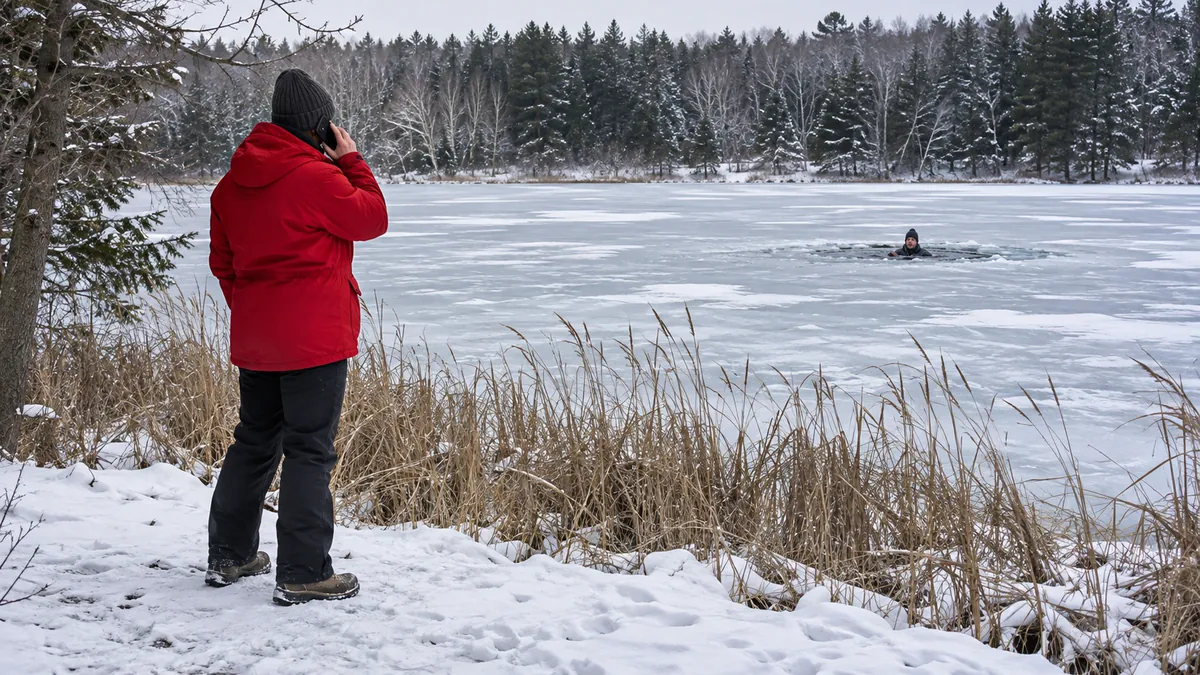
It has been cold for several days. The lake is frozen. You run like every morning on the path that runs along it. At the last curve, you hear screams. You look towards the shore: footprints on the ice, and in the middle of the lake, a dark hole. You know immediately what happened.
The following exercise imagines an accident on a frozen body of water. It does not describe a specific documented event. His goal is to prepare the first reflexes of the witness, without encouraging him to undertake an ice rescue.
The scenario
You come back from an early morning jog around a lake. The temperature was below zero for several days. At the turn of the trail, you hear the panicked cries of children. Looking towards the lake, you see a series of footprints that advance on the ice and end abruptly in a hole. One or more people fell through the ice.
You're alone. You have your phone. There's no visible rescue equipment nearby.
What is your decision?
Before you read the thinking elements below, take a moment to formulate your answer. This type of mental exercise – imagining one’s own decision before a situation actually occurs – is one of the foundations of preparedness.
Scenarios are not used to test your bravery. They serve to identify your automations, your gaps, and the knowledge that is missing to act effectively.
Elements of reflection
Some cues are essential: call for help, stay on a safe surface and not become a second victim. Remote help should only be attempted if it does not expose you.
1. Alert immediately
Call 911 quickly. Give the name of the body of water, the access point, the visible markers and what you observe. Follow directions and keep communication when requested. If another adult is available, they can guide the responders from safe access.
2. Do not step forward on the ice
The reflex of running towards the victim may seem natural, but it exposes the rescuer to falling in turn. A second victim drastically complicates the rescue. The general rule: never approach on ice that has already yielded.
3. Remotely help from a safe place
When possible safely, tend or throw an object from a stable location to help the person stay on the surface or get closer to the shore. Do not step forward on the ice and do not enter the water if the object does not reach it. The failure of remote options does not make direct contact safe.
Evaluate only accessible means without moving towards danger. Do not lose your balance by holding an object and do not attach yourself to a person or a rope that could train you. Specialized helpers should be alerted even if remote help seems possible.
What this scenario puts to the test
- Your management of the initial emotional shock - the cries of children trigger a reaction of intense stress. How do you channel this emotion to act rather than freeze?
- Your priorities: report the emergency and your position, keep a safe distance and follow the instructions; no supposed survival time justifies getting on the ice.
- Your available means: phone, location markers and, only if accessible without danger, an object to stretch or throw. Improvisation should not create a second victim.
- Your limits: Knowing how to swim does not make an intervention in ice water safe. The cold can quickly affect breathing and movements.
- Witnesses: Keep children away from the dangerous shore and ice. Entrust useful tasks to available adults, without sending a child to an area at risk.
Understanding the effects of cold water
Cold water can disrupt breathing and physical abilities before significant hypothermia sets in. The reactions and the available time vary: do not turn an educational marker into a survival stopwatch.
The resources of the Lifesaving Society explain these phenomena and the limits of the indicative durations. They make it possible to prepare knowledge before an outing, without replacing practical training.
A submerged person may lose the coordination necessary to maintain themselves or to get out of the water. The witness must therefore call for help quickly, without assuming that a good physical condition or swimming experience will suffice.
Prevention: what we often forget
This type of scenario highlights a dimension too little addressed: the prevention of the accident itself. There are a number of questions that need to be considered before the situation occurs.
- Do not validate a surface from a single digit of thickness. The quality and thickness can vary on the same water. Consult the site manager and local conditions; do not use a closed or uncertain surface.
- A crack, an area of open water or a change in appearance should attract attention. The absence of visible signs does not prove the strength of the ice.
- Have you ever discussed these risks with your children or the people under your care?
A few cold days are not enough to demonstrate the safety of a lake. Currents, snow, depth, and temperature variations change conditions. Choose an activity and a site whose conditions can be verified.
Repeat the exercise on paper
The real situation varies, but the protection of the witness and the call for help remain central landmarks. Exercise is not used to promote risk-taking or improvised rescue.
Write your sequence: stay safe, call 911, describe access, keep witnesses away from danger, and evaluate the help remotely without exposing yourself. Compare it to the instructions of a rescue organization.
It is this type of collective exercise that makes it possible to identify blind spots and build, gradually, a better capacity for reaction.
Preparedness is not a discipline reserved for experts. It starts with the ability to imagine a difficult situation before it happens – and to think honestly about what you would do with the real means at your disposal.
To go further
- Consult the resources and adapted training offered by rescue organizations, checking the content and availability.
- Consult your municipality’s resources on ice-risk areas
- Provide equipment recommended for the activity, including a means of communication protected from water and suitable devices; it does not make ice unsafe.
Learning before the outing, checking the conditions and keeping the possibility of giving up are the first preventive measures.
Sources and benchmarks
References for Quebec and Canada. Sources consulted on November 2, 2026.