
In this article
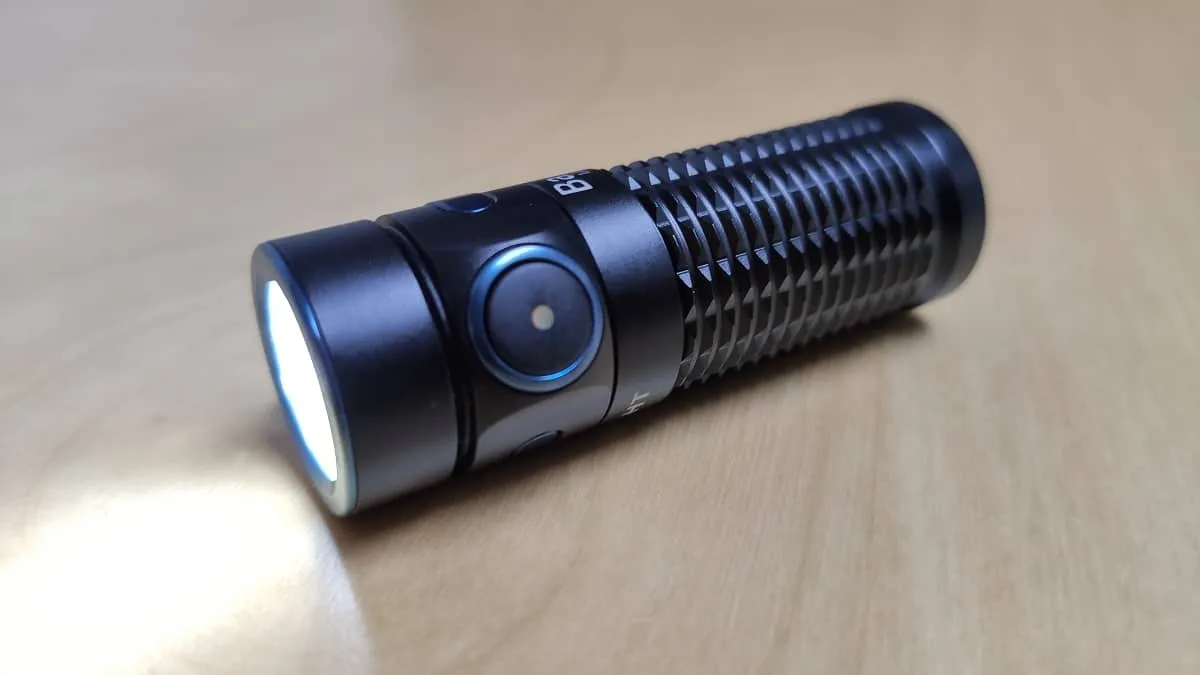
The Olight Baton 3 succeeds the S1R Baton II. It fits in your palm, weighs 53 g and claims 1,200 lumens from a small rechargeable 16340 battery. It is a very popular everyday-carry light, with a magnetic tail, a battery indicator and a very frugal Moonlight mode. For preparedness, its strengths are real, but its proprietary battery calls for a few precautions. Here is our review.
Our take in short
In short. The Baton 3 is impressive for its size: 1,200 lumens peak, a 0.5-lumen Moonlight mode that lasts 20 days, a handy magnetic tail and a three-colour battery indicator. On the other hand, its 16340 battery is modified by Olight: it only charges inside the light, with the proprietary magnetic cable. The 1,200 lumens last only a minute and a half before stepping down, and the tint is cool. It is an excellent everyday light, best backed up by one that runs on common batteries.
Specifications
| Feature | Olight Baton 3 |
|---|---|
| Emitter | high-performance cool white LED, TIR optic |
| Claimed maximum output | 1,200 lumens |
| Claimed intensity | 6,889 candela |
| Claimed throw | 166 m (544 ft) |
| Battery | 550 mAh 3.7 V IMR16340, modified by Olight |
| Charging | MCC magnetic USB cable (1 A) on the tail |
| Switch | electronic side switch with battery indicator |
| Water resistance | IPX8 |
| Drop resistance | 1.5 m (4 ft 11 in) |
| Length | 63 mm (2.48 in) |
| Diameter | 21 mm (0.83 in) |
| Weight | 53 g (1.87 oz), clip and battery included |
What’s in the box
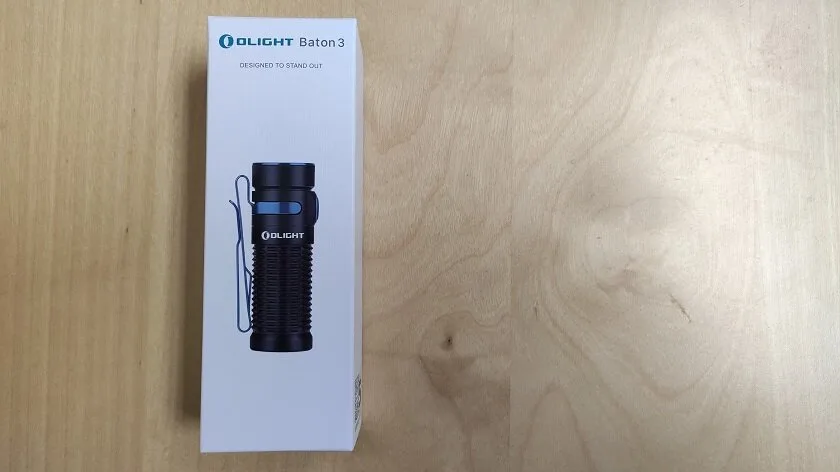
- the Baton 3 with its clip;
- a 550 mAh IMR16340 battery;
- a battery case;
- a 1 A MCC magnetic charging cable;
- a lanyard;
- a pouch;
- the manual.
Build and carry
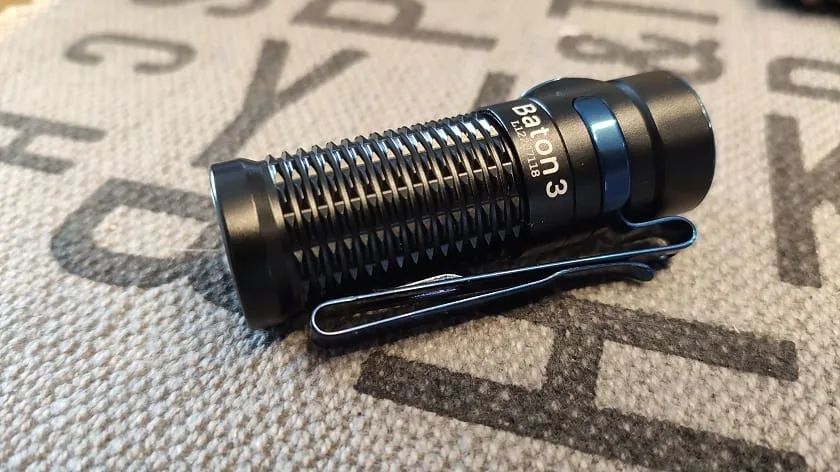
The aluminum body is knurled along its whole length, and the grip is good despite the small size. At 63 mm and 53 g, it disappears in a pocket. The clip is fixed: you can’t move it, but it keeps the light discreet and secure.
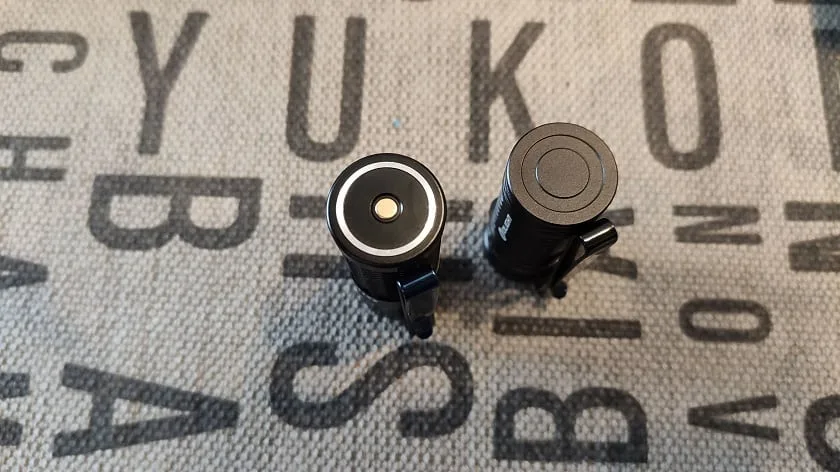
The tail is magnetic. That is a real everyday plus: you stick the light to the side of a fridge, a car hood or a metal shelf to work hands-free.
Battery and charging: what you need to know
The Baton 3 uses a 550 mAh IMR16340 battery. Olight modified it by adding an insulator between the positive and negative terminals. As a result, it cannot be charged in an external charger. It, and any spare batteries, charge only inside the light.
Charging uses the MCC magnetic cable, plugged into any USB port: phone adapter, computer or power bank. The connector’s indicator is red while charging and green once the battery is full.
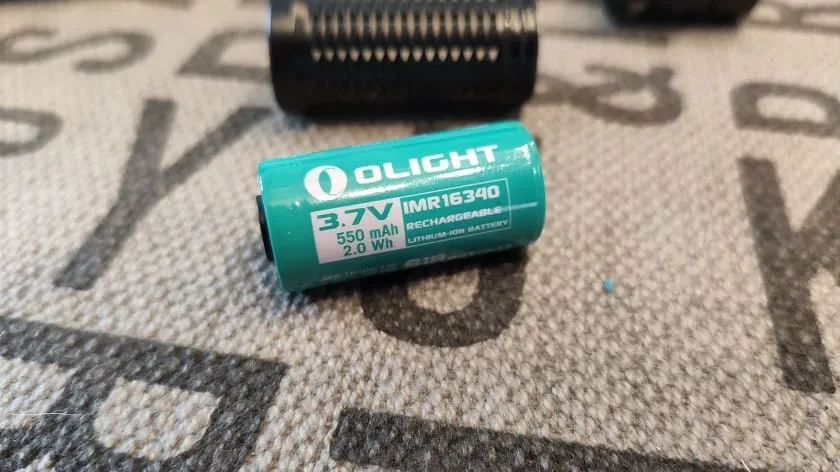
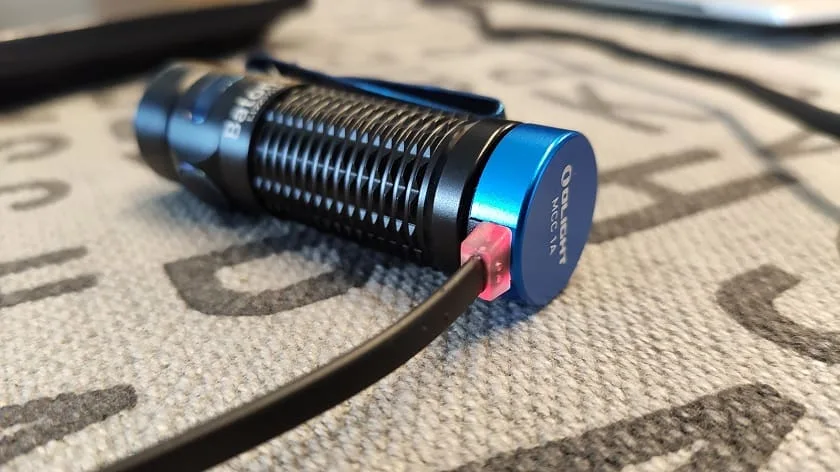
Two notes for preparedness. First, if the cable is lost, the light becomes useless once the battery is empty: keep a spare cable. Second, battery voltage remains on the tail contacts, even when the light is locked. Avoid storing it loose with keys or coins.
Modes and runtime
| Mode | Claimed output | Claimed runtime |
|---|---|---|
| Turbo | 1,200 lumens, then about 300 lumens | 1.5 min, then 75 min |
| High | 300 lumens | 95 min |
| Medium | 60 lumens | 7.5 h |
| Low | 12 lumens | 33 h |
| Moonlight | 0.5 lumen | 20 days |
| Strobe and SOS | yes | — |
Turbo is a sprint: 1,200 lumens for a minute and a half. During an outage, Low and Moonlight are what matter: 12 lumens for 33 hours, or 0.5 lumen for 20 days to find your way around a room without blinding yourself.
The interface
| State | Action | Result |
|---|---|---|
| Off or on | Click | On (last mode used) or off |
| On | Press and hold | Cycle Low, Medium, High |
| Off | Hold about 2 s | Moonlight |
| Off or on | Double click | Turbo |
| Off or on | Triple click | Strobe |
| On | Double click then hold | 3-minute shut-off timer (repeat for 9 min) |
| Off | Hold about 3 s | Lock or unlock |
The switch indicator shows remaining charge: green above 60%, yellow between 60 and 10%, red below 10%. Below 10%, Turbo is no longer available. You can also lock the light mechanically by loosening the tail cap a quarter turn.
The beam
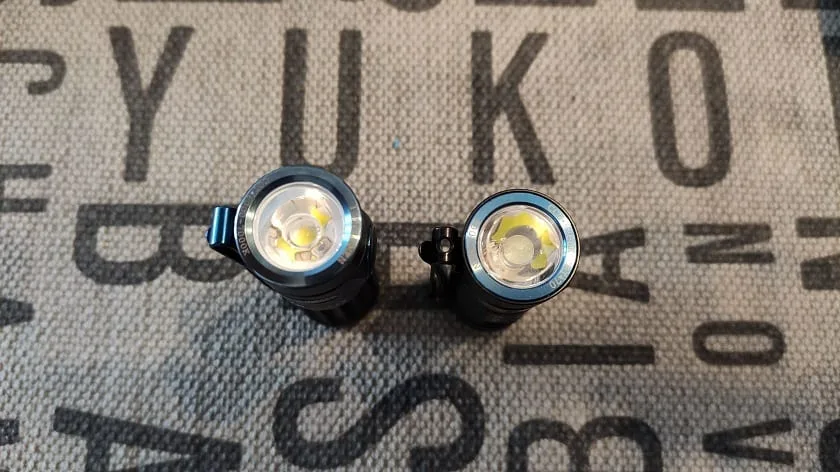
The TIR optic gives a fairly defined hotspot with little spill. It is a close-range light, for spotting an object or lighting a path, rather than a wide floodlight. The tint is cool.
Where does it fit in a preparedness kit?
- The light that’s always on you: small enough to never leave your pocket, and powerful enough to get out of a building or a dark parking lot.
- Moonlight for endurance: 0.5 lumen for 20 days makes a very frugal emergency night-light.
- Precautions: a spare cable, a power bank to charge without grid power, and a second light that runs on AA or AAA batteries.
Strengths and limitations
- Strengths1,200 lumens in 63 mm; 20-day Moonlight; magnetic tail; battery indicator; direct Turbo and strobe; lockout and timer; IPX8.
- LimitationsModified 16340 battery, charges only in the light; proprietary magnetic cable; 1.5-min Turbo; cool tint; fixed clip; voltage on the tail.
The verdict
The Baton 3 deserves its reputation: very small, very bright, with a remarkable Moonlight mode and a magnetic tail you end up using every day. For preparedness, treat it as your everyday light, not your only light: its proprietary battery and cable mean you should keep a spare cable and a light that runs on common batteries.
Frequently asked questions
Can I use a regular 16340 or CR123A battery?
Olight supplies a modified 16340 designed to charge in the light. For preparedness use, keep spare Olight batteries and follow the manual before trying another battery type.
Can I charge the battery in a universal charger?
No. The insulator Olight added prevents charging in an external charger. The battery charges only inside the light.
How is it different from the Baton 3 Premium?
The Premium version comes with a wireless charging case. We reviewed it separately: see our Baton 3 Premium Edition review.
Transparency. The photos and observations are our own; specifications come from Olight’s manual and may have changed since our review. Check the manufacturer’s page before buying.
Sources
- Olight, Baton 3 manual (specifications, modes and interface).
- PrépaCivile, review of the tested unit: photos and observations.
Go further: our reviews of the Baton Pro and the i5T EOS, the Power outage fact sheet and the emergency equipment builder.