

In this article
A flashlight is part of basic everyday gear, especially during a power outage. The Olight Baton 3 Premium Edition stands out for its tiny size and a charging case that doubles as a power bank. Here is the review of this unit: contents, design, battery life, interface, beam, and what to check before buying.
At a glance
- A 63 mm (2.48 in) light, up to 1,200 lumens in turbo mode, for a very short time.
- The charging case has a built-in 3,500 mAh battery that recharges the light up to 3.7 times without an outlet.
- The 16340 battery is proprietary: a regular 16340 cell will not work in this light.
Historical review: the observations concern the model and unit examined at the time. The sample was provided by Olight. Check the manual, safety notices, warranty and terms of sale for the exact model before buying.
The format and the charging case


Everyone needs a flashlight in their everyday carry. At the time of this review, Olight had just launched the Baton 3 Premium Edition, and it had what it takes to replace many people's favourite flashlight. Let's take a closer look.
What is it?
The Olight Baton 3 is a small LED flashlight that comes with a charging case designed for it. The case recharges the light up to 3.7 times with no cable, outlet or solar charger.
What's in the box


- Olight Baton 3 flashlight
- Charging case
- USB charging cable
- Microfibre cleaning cloth
- User manual
Design and features
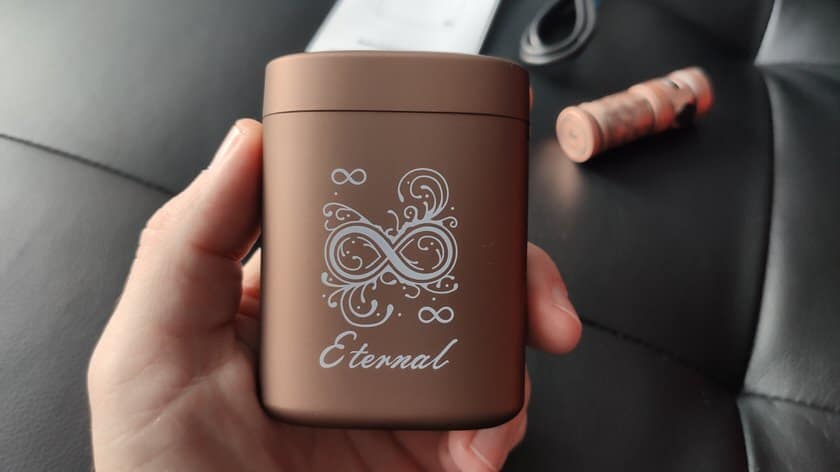


It may look like a small hip flask, but it is much better than that: as far as I know, it was the first charging case for a flashlight.

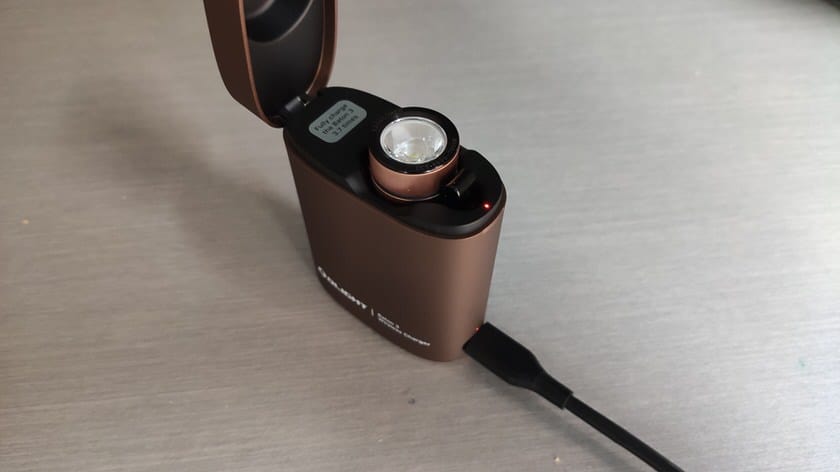
The case is a power bank designed for the Baton 3. It is charged itself through a USB-C cable, included. Above the USB-C port, an indicator glows red while the case charges and turns green when charging is complete.

Open the top of the case and you find the miniature light nestled in its perfectly fitted magnetic charging slot.

The case has a built-in 3,500 mAh battery that recharges the Baton 3 up to 3.7 times. The light has its own rechargeable, replaceable battery: an IMR16340, 550 mAh, 3.7 V. It is not compatible with other batteries.

The bottom of the charging slot is magnetic, like the magnetic tail-cap charging cables of the Olight Baton S2R or Warrior Mini. In fact, you can use the same magnetic cable if you own other Olight Baton lights.
The Warrior Mini was recalled in 2022, along with the M2R Pro, because of a risk of accidental activation and overheating. Check Health Canada's recall notice before using these older models again.


A small indicator inside the case shows the light's charge: red while charging, green once charged. The Baton 3 fully recharges in about an hour.

What a nice detail! At just 63 mm (2.48 in) long, it looks like a toy, but it puts out up to 1,200 lumens in turbo mode. It comes in red, blue or black, with a removable pocket clip.

The button is on the side. An indicator under the switch glows green when the light is on, turns orange when the charge drops to 60%, red at 10% and flashes red at 5%.


Despite its small size, I had no trouble holding and using it, thanks to its well-knurled body.
Power and battery life
The Baton 3 Premium Edition, like the standard edition, runs on a single lithium-ion cell.

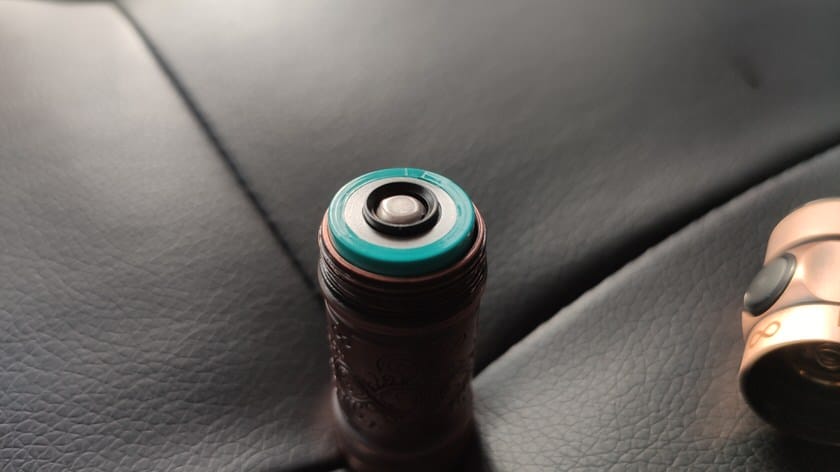
It is a proprietary 16340, with positive and negative terminals on the same end. A regular 16340 will not work in this light.

What is more, the positive terminal is recessed in a plastic shroud, which prevents charging in most, if not all, bay chargers.



On a bench power supply, I observed the indicator change colour as follows:
| Measured voltage | Indicator colour | Manual's description |
|---|---|---|
| Above 3.7 V | Green | Over 60% |
| 3.3 to 3.7 V | Orange | 10 to 60% |
| 3.2 to 3.3 V | Red | 5 to 10% |
| Below 3.2 V | Flashing red | "Under 10%" according to the manual (sic) |
On the bench supply, the light seems to shut off around 2.6 V; with a real cell, I think the cut-off is higher, around 2.7 or 2.8 V.
Interface and operation
The electronic switch, with indicator, is on the side of the head. Its textured cap stands out enough to be found easily without being pressed by accident, at least in my experience. It is very similar to the Warrior Mini's switch.


Here is the interface table. Olight regulars have known it for years: the S1R Baton II uses the same one.
| State | Action | Result |
|---|---|---|
| Off | Click | On (last mode memorized)* |
| On | Hold (release at desired mode) | Mode cycle: moon, low, medium, high (no turbo) |
| Off | Hold | Moonlight |
| Any | Double click | Turbo |
| Any | Triple click | Strobe |
| Strobe | Click | Off |
| Strobe | Hold | Previous mode |
| Off | Long hold (after moonlight) | Lockout |
| Locked | Hold | Unlock to moonlight |
| On | Quick click and hold** | Timer (one flash: 3 minutes; two: 9 minutes) |
| Timer | Quick click and hold** | Switch between 3 and 9 minutes |
* Moon, low, medium and high are memorized; turbo is memorized as high. ** The manual says "double click and hold", but it is really a click followed by a quick hold: any double click ends in turbo or strobe. The manual still had not been corrected at the time of the review.
LED and beam
Olight kept the usual Baton setup: a tight-fitting bezel, TIR optic and cool white (6,000 to 7,000 K).

What is new is the emitter: a Luminus SST-40, already used in lights such as the Warrior Mini, where its colour rendering index (CRI) was listed at 70. It is probably the same here. This emitter is excellent for output, but I would not have chosen such a cool white.
Brightness levels
| Mode | Output | Throw | Runtime |
|---|---|---|---|
| Turbo | 1,200 lumens, then 300 | 166 m | 1.5 minutes, then 75 minutes |
| High | 300 lumens | 82 m | 95 minutes |
| Medium | 60 lumens | 38 m | 7.5 hours |
| Low | 12 lumens | 18 m | 33 hours |
| Moonlight | 0.5 lumen | Not stated | 20 days |
The light also has a strobe mode, but no SOS or beacon mode. During a power outage, low and medium are the most useful modes: they last for hours.

This is my living room at night with the lights off: you can see a few small spots of light from electronic devices.

And here is the same room lit by the Baton 3 in turbo mode.
Strengths and limitations
What I like
- Charging case included, usable without an outlet
- Small but powerful
- Replaceable battery
- Five-year warranty advertised at the time of the review (check current terms)
What I would change
- Add wireless (induction) charging to the case itself
The verdict
In this review, the Baton 3 Premium Edition stands out for its very small size and its charging case. The case lets you recharge the light on the go as long as it still has energy: it will need recharging too. Comfort, beam and runtime should still be compared with the use you have in mind. These impressions concern the unit tested at the time; past offers and prices are not current terms of sale.
Frequently asked questions
Is such a small light enough for a power outage?
As a personal flashlight, yes, in low or medium mode. To light a room for hours, a lantern or headlamp is more practical. Also plan a way to recharge the case, or a second light that takes standard batteries.
Can I use another 16340 battery?
No. The original battery is proprietary, with both terminals on the same end. Use only a replacement battery specified by the manufacturer; do not try to adapt another lithium-ion cell.
Read next
Equipment to compare for your needs
Some links below are affiliate links: we may receive a commission at no additional cost to you. Products are examples by function, to choose according to your needs; buying the entire selection is unnecessary.