
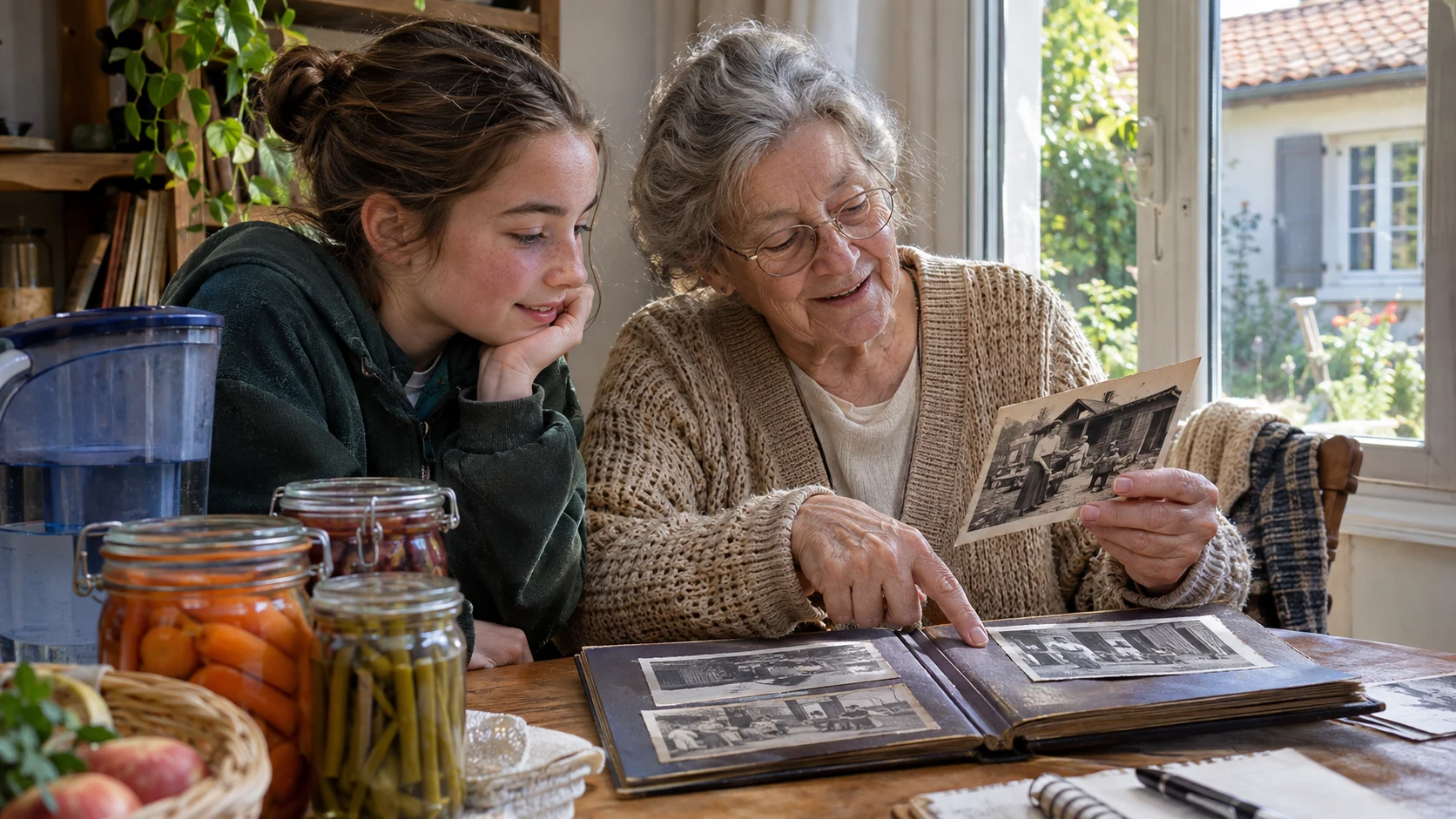
A century ago, in much of the French-speaking world and beyond, self-reliance was not a choice: it was a condition of life. Gardening, preserving food, maintaining your home and managing water without centralized infrastructure were ordinary skills. Today most of that know-how has disappeared from households, replaced by dependence on networks and services. Revisiting those practices, not to copy them exactly but to draw principles that are useful now, is one of the most solid foundations of citizen preparedness.
In brief
In brief. The past teaches six main areas of self-reliance: food, water, housing, collective safety, hygiene and health. The goal is not to turn back the clock, but to combine yesterday's skills (manual know-how, careful use of resources, neighborly mutual aid) with today's tools (modern medicine, water treatment, solar power, communications). Start with water, then food, first aid, sanitation, practical skills and your local network.
A very different context, principles that still apply
In the early twentieth century, a large share of the population lived without reliable electricity, running water, refrigeration or a nearby grocery store. In Canada as in France, the rural population then made up roughly half of the total or more, and many families depended directly on the land for food. Families were larger, houses smaller and resources shared out of necessity.
There was nothing romantic about that way of life. It involved real constraints, major health risks, high infant mortality and a heavy daily workload that often fell mostly on women. But it rested on a logic that citizen preparedness seeks to recover: reducing immediate dependence on centralized systems so you can keep functioning when they are disrupted, for example during an ice storm, a flood or an extended outage.
The question, then, is not to go backward, but to understand what worked at the time, why, and how to combine it intelligently with the resources available today.
Six areas drawn from historical experience
Looking at daily life in that era reveals six broad categories of skills, which map directly onto the pillars of modern citizen preparedness.
1. Food
Producing and preserving food was at the heart of household self-reliance. Several practices are worth knowing and, depending on the situation, adapting:
- Gardening: growing part of your own food, even on a small scale, reduces dependence on supply chains. During both world wars, "war gardens" and later "victory gardens" spread across Canada, the United States, the United Kingdom and elsewhere to support food supplies. That reflex of local production remains relevant, and urban community gardens are a modern version of it.
- Cooking from basic ingredients: knowing how to make a full meal from flour, legumes, vegetables and protein is a concrete skill, transferable to a degraded situation and economical day to day.
- Small-scale livestock: hens, rabbits or goats provided eggs, milk and meat. This is still possible in some rural or peri-urban settings, but it is governed by municipal and health bylaws, which often prohibit farm animals in cities: check them before you start.
- Hunting, fishing and trapping: these activities supplemented rural diets. Today they require licenses, mandatory training and strict compliance with seasons and limits, which vary by province, state or country.
- Preservation: canning, smoking, drying, lacto-fermentation, root cellars. These methods kept harvests for months and remain reliable, accessible and inexpensive, as long as you follow modern food safety rules (in particular, pressure canning for low-acid foods to prevent botulism).
Food preservation is one of the most directly useful skills for any household wanting to strengthen its self-reliance, regardless of any crisis scenario. See our guide to food dehydration.
2. Water
Access to clean, safe water was, and still is, the top priority in any extended period of self-reliance.
- Water quality: cholera and typhoid have nearly disappeared in countries with modern infrastructure, but they were common early in the century for lack of water treatment. Knowing how to purify, filter and store water remains a fundamental skill. See our drinking water treatment sheet.
- Alternative sources: wells, streams, rainwater harvesting. Without running water, households had to find and protect their source. Today, water from a private well should be tested regularly, and rainwater or surface water treated before drinking.
- Managing without plumbing: having no indoor plumbing forces you to rethink storage, distribution and wastewater disposal. Hygiene and sanitation are inseparable from water management.
3. Shelter and housing
- Maintenance and repair: tradespeople were not as accessible as they are today. People maintained their own roofs, insulation, heating and woodwork. Learning basic DIY skills is a real resilience investment, while leaving electrical, gas and structural work to qualified professionals.
- Functional clothing: wardrobes were limited and each item had a specific use. Knowing how to dress for the climate, and how to repair and care for clothing, is part of the idea of shelter.
- Small spaces, high efficiency: houses were smaller and easier to heat and maintain. During a heating outage, gathering the family in a single well-insulated room applies exactly that logic.
4. Safety and community cohesion
This section describes historical realities. It does not question today's institutions and does not suggest replacing collective mechanisms with isolated individual initiatives.
- Distant emergency services: early in the century, police and fire services covered vast areas with limited communications, and response times were long. In a modern crisis (communications failure, natural disaster, overloaded emergency services), long delays are still possible: it is useful to know how to prevent a fire, put out a small one and give first aid while waiting.
- Community cohesion: in small communities everyone knew each other. That closeness created natural mutual watchfulness and spontaneous solidarity. Rebuilding neighborly ties remains one of the most effective forms of collective safety: see our article on mutual aid and shared skills.
- Resourcefulness: the prevailing mindset valued initiative and responsibility. In preparedness terms, that means being able to assess a situation, decide and act without waiting for outside instructions, while still following official guidance where it exists.
5. Hygiene and sanitation
The absence of modern sanitation was directly linked to the prevalence of many infectious diseases. The lessons from that period are clear:
- Simple, effective products: soap, vinegar, baking soda, hot water. These basics work without a complex supply chain. Handwashing with soap remains one of the most effective public health measures. Never mix bleach with vinegar or ammonia, which releases toxic gases.
- Waste management: without collection, waste was handled on site: composting, burying, burning. Today open burning is often banned or regulated; during an extended collection outage, keep waste in sealed bags and tight containers away from the home, and compost organic material.
- Substitute toilets: outhouses and privies were the norm. If the water is cut off, an emergency toilet (a bucket with a sealed bag and an absorbent such as cat litter or sawdust) is a safer temporary solution. Any outdoor latrine must be kept away from wells and waterways, at the distances set by local regulations. See our guide on wastewater and septic systems during disruptions and our hygiene kit.
6. First aid and health
- Local care: in many regions, hospitals as we know them were rare. The country doctor, where there was one, had limited means, and basic care relied on family and neighbors.
- Basic knowledge: treating common injuries, recognizing signs of infection and providing first-line care has always been a household skill. It becomes essential again when health services are overloaded or hard to reach.
- Build on progress, do not ignore it: antibiotics, vaccination, sterilization and modern medicine have transformed the outlook for many injuries and illnesses that were once fatal. Medical preparedness today should rely on those advances (a complete kit, up-to-date knowledge, recognized first aid training, a reasonable reserve of essential medications discussed with your doctor) rather than a return to old remedies.
Combining yesterday's skills with today's tools
The goal is not to reproduce early-twentieth-century living conditions, but to identify the skills that made real self-reliance possible then and combine them with the best that current technology offers.
| What the past brings | What the present brings |
|---|---|
| Manual and practical skills | Accessible solar power and efficient batteries |
| Managing resources without infrastructure | Amateur radio and backup communications |
| Thrift, repair and reuse | Modern medicine and advanced first aid |
| Knowledge of seasons and natural cycles | Access to information, alerts and training |
| Spontaneous neighborly solidarity | Improved materials, clothing and equipment |
A well-stocked modern first aid kit is worth far more than an old-time medicine cabinet. A quality water filter is more reliable than a poorly maintained well. An emergency radio or an amateur radio station lets you stay in touch when other networks go down. Citizen preparedness is precisely about not choosing between yesterday and today, but taking what works from both: basic skills that need no infrastructure, and modern tools that improve efficiency or safety without creating fragile dependence.
Where to start in practice
With six areas to explore, the natural question is where to put your effort first. A few simple guidelines:
- Water first: it is the top priority, ahead of food and gear. Understanding how to store, filter and purify water is the most critical skill.
- Then food: a basic reserve, preservation techniques and, if possible, an introduction to gardening.
- First aid: train at least one household member and build a kit suited to your actual needs.
- Sanitation: plan now how you would manage without running water or waste collection, even temporarily.
- Practical skills: basic repairs, sewing, cooking from raw ingredients, all learned gradually without specialized equipment.
- Your local network: knowing your neighbors and the skills available around you remains one of the most underestimated forms of resilience.
None of these steps requires a huge investment or a radical lifestyle change. Each can be tackled gradually, according to your household's priorities and constraints. The aim is to build real capability, not to recreate a bygone way of life. To go further, see our article on traditional skills worth relearning.
Frequently asked questions
Do you have to live like it is the early 1900s to be prepared?
No. The point is to keep the useful skills and principles, such as careful use of resources, partial food self-reliance and mutual aid, while benefiting from modern medicine, communications and technology.
Which traditional skill should you learn first?
Food preservation and cooking from basic ingredients are accessible starting points, useful every day and inexpensive, as long as you follow current food safety rules.
Can traditional remedies replace a modern first aid kit?
No. Some old knowledge remains useful, but medical preparedness should rely on current knowledge, recognized training and a modern kit, with advice from a health professional.