
In this article
- Why hygiene is a factor of resilience
- Concrete risks in a degraded health situation
- Basic content: the essentials
- The pouch 6 multiplied by 6: compact reference option
- Customization according to profile and situation
- Adapting the kit to a household
- Weight and Volume: Finding Balance
- Points of vigilance
- Synthesis and reflection
- Frequently asked questions
Evacuation can limit access to sanitary facilities, water and usual products. An adapted hygiene kit helps manage these needs; this article does not classify the causes of complications or health needs on a universal frequency.
What are we talking about here: an evacuation bag hygiene kit is a compact package covering basic sanitary needs for a period of 72 hours to two weeks, outside the home and without guaranteed access to the usual infrastructures (running water, sanitary, pharmacy).
Why hygiene is a factor of resilience
In a normal situation, daily hygiene is so integrated into the routine that one forgets the role. In an evacuation situation - high stress, demanding physical conditions, uncontrolled environment - its absence is felt quickly, on two distinct levels.
On the physical level
The body subjected to sustained exertion, heat or cold, sweat and rubbing is much more vulnerable to skin infections, irritations and benign conditions that become problematic without accessible treatment. A single poorly managed bulb can immobilize a person. A dental infection can make a decision difficult. These situations are not anecdotal in documented evacuation contexts.
On the mental level
Access to hygiene and privacy is part of a dignified welcome. Needs and preferences should be discussed with people, without assigning them a uniform psychological response.
In shared accommodation, prepare access to water, cleaning, privacy and waste management. Agree rules with the people in charge of the place and respect the individual needs.
Concrete risks in a degraded health situation
Identifying the most likely risks helps prioritize the content of the kit. The following problems occur regularly in evacuation or prolonged containment contexts: :
Skin
Irritation and skin infections
Repeated rubbing (prolonged walking, equipment), unmanaged sweating, minor scrubs not cleaned. Without simple care, these situations evolve into local infections that are difficult to treat without medical access.
Digestive
Fecal-oral contamination
Contaminated hands or objects can transmit infectious agents. Prepare water, soap and adapted resources. A hydroalcoholic gel does not replace all uses of hand washing and should be used according to its label.
Mouthwash
Dental problems
Neglected in most kits, oral care avoids incapacitating pain. A dental infection without accessible treatment is a serious medical emergency.
Female
Menstrual hygiene
Systematically underestimated in generic lists, menstrual hygiene deserves a dedicated section in any kit intended for a woman or a mixed household. The absence of suitable equipment generates discomfort, stress and health risks.
Basic content: the essentials
The following list serves as a starting point. Adapt it to the users, the available water, the planned accommodation and the advice of the professionals concerned.
Body cleaning
- Compact solid soap or body wipes
- Hydroalcoholic gel (travel size)
- Reduced format deodorant
- Compact Microfiber Towel
Oral care
- Toothbrush (shortened sleeve if lighter)
- Fluorinated Toothpaste adapted to age and needs
- Dental Filtration
Skin care
- Multi-use cream or balm (lips, hands, irritation)
- Reduced size sun protection
- Various dressings
- Liquid or spray antiseptic
Female hygiene
- Adapted periodic protections (stamps, towels, cut)
- Intimate wipes
- Hermetic bag for waste management
Measure the weight and volume of the content actually retained. No standard weight guarantees coverage of a person’s needs for 72 hours or two weeks.
The pouch 6 multiplied by 6: compact reference option
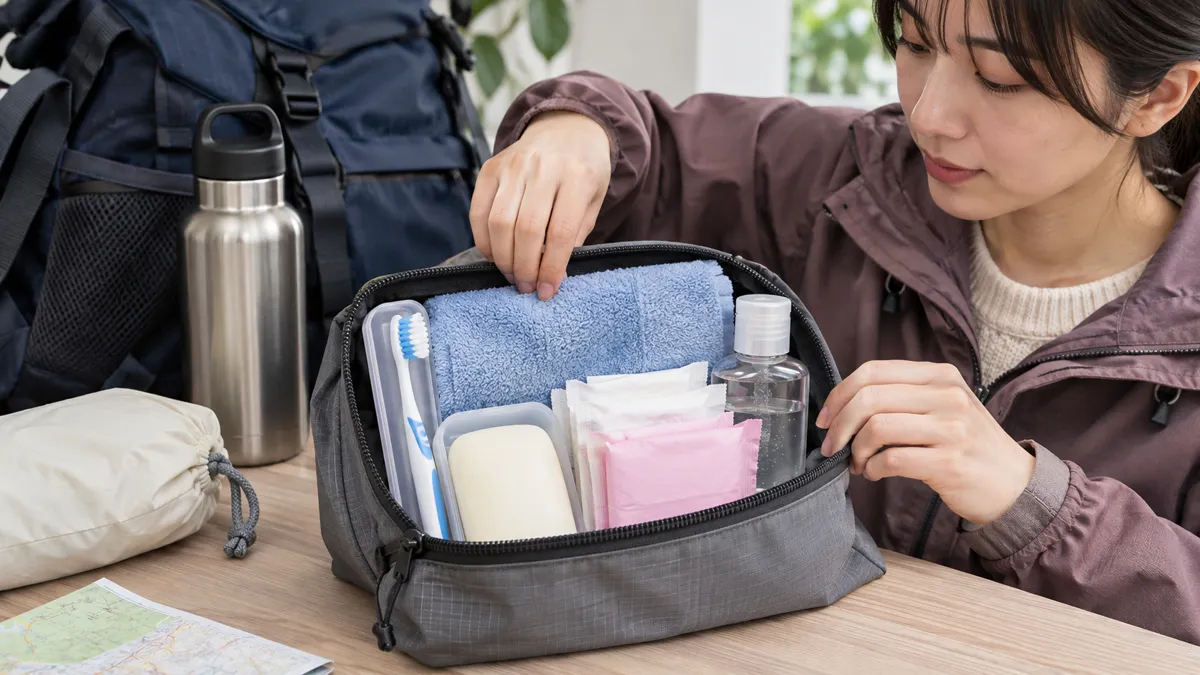
A pouch 6 multiplied by 6 is a container, not a complete kit by its size alone. Check the content sold, the volume and the products needed by the person; the illustrated accessories are not always included.
The Pouch
Contents of the kit
The proposed content covers basic needs: body cleanliness, oral care, minimal comfort and prevention of common irritation.
To keep in mind: This kit is a general basis. It does not contain specific medical products, feminine hygiene adapted to each profile, nor equipment for people with special needs. The next section details how to customize it.
Customization according to profile and situation
A generic hygiene kit never covers all needs. Customization is not optional - it's what makes the difference between a kit that really works and a kit that stays at the bottom of the bag.
Simple rule: Anything that you use daily for your health or hygiene and that cannot be easily replaced in a degraded situation should be in your kit.
Elements to add according to the profile
Vision
Lenses and glasses
Rinsing solution, hard case, pair of emergency glasses. In situations of stress and difficult conditions, losing your lenses without an available alternative is a major constraint.
Medication
Daily medications
Prepare the renewal and storage of medicines with the pharmacist or professional concerned. The quantity depends on the treatment, conditions and applicable rules. Keep the list and useful contact information accessible.
Reduced mobility
Specific needs
Equipment related to a particular health condition: catheters, stomas, hearing aids and batteries, portable dialysis equipment if applicable. These elements must be the subject of a specific plan.
Children
Kit child
Diapers or protection according to age, soft wipes, anti-irritation cream, thermometer, basic pediatric drugs. The children's kit deserves its own identifiable pouch.
For very specific needs, the Other kits available can usefully supplement this base.
Adapting the kit to a household
A unique hygiene kit for the whole family is rarely suitable. A few principles make it possible to organize collective hygiene effectively in evacuation situations.
One kit per adult, one kit per child
Each self-contained adult should have their own hygiene pouch in their bag. This avoids depending on a single bag in case of separation, and distributes the weight in a balanced way.
Lightweight Secondary Kit
Resilience Tip: provide a lighter version of the kit in a secondary bag or in the bag of a larger child. In case of loss or abandonment of a main bag, this redundancy can be valuable.
Collective hygiene in group accommodation
In a shared accommodation situation - evacuation center, homestay, camp - having its own hygiene equipment avoids relying on often limited collective resources, and helps to maintain good relations with other occupants.
Weight and Volume: Finding Balance
Hygiene is often the first category sacrificed during a bag lightening. That’s understandable – but a few simple choices help maintain proper coverage for minimal weight.
Easy discounts
- Choose suitable formats without losing the label or instructions. Do not systematically transfer medications, antiseptics or chemicals.
- Keep a small size of toothpaste suitable, with its instructions
- Shorten the handle of the toothbrush
- Microfiber towel instead of cotton
- Solid soap rather than liquid shower gel
Weigh tested formats; weight saving does not justify removing an essential need or safety instructions.
Do not cut on
- Alcoholic gel or soap (infectious prevention)
- Antiseptic
- Bandages
- Personal Daily Medications
- Female hygiene if applicable
These elements have a very favorable weight/benefit ratio
Points of vigilance
Expiry Dates: Several elements of the kit (creams, antiseptics, medicines) have deadlines for use. A biannual revision of the kit allows to keep the whole in real use.
Allergies and Sensitivities: check that the products chosen are compatible with the sensitivities of each member of the household. A product that causes an allergic reaction in an emergency is an avoidable complication.
Climate conditions: Some products react badly to extreme temperatures - creams that freeze, liquids that expand. Adapt the contents according to the season and the planned evacuation region.
Waste management: In an evacuation situation, the management of hygiene waste (used protections, wipes, soiled material) requires a minimum of anticipation. A few airtight bags in the kit help to avoid uncomfortable situations.
Synthesis and reflection
A question remains open: how far to lighten the hygiene kit without compromising real health prevention? The answer depends on the duration of the evacuation, the number of people involved and the likely housing conditions – all variables that deserve to be considered in advance.
👉 To deepen the whole logic of equipment and preparation, find our reference page : Equipment & logistics - complete guide.
Frequently asked questions
What weight to expect for a hygiene kit in an evacuation bag?
Weigh the actual chosen content, then try its porting. The targeted duration does not allow to set a universal weight; preserve health needs and instructions.
Do I need one hygiene kit per person or one for the whole family?
One kit per autonomous adult is the most resilient approach. This distributes the weight, allows everyone to have access to their equipment in case of separation and facilitates customization according to individual needs. For children, a suitable kit can be integrated into their bag or worn by an adult depending on the age.
How often to review the contents of the hygiene kit?
A biannual review is usually sufficient to check expiry dates, adapt the content to the season (sun protection in summer, protective cream in winter) and integrate changes in needs (drugs, specific products). The hygiene kit has the same overhaul as the rest of the evacuation bag.
Which hygiene products are the most important not to forget?
Hydroalcoholic gel or soap (prevention of contamination), antiseptic with dressings (care of minor wounds) and personal daily medications are the elements to never sacrifice, regardless of weight arbitrage. Then come oral care and feminine hygiene if applicable.
Does the pouch 6 times 6 cover all hygiene needs in evacuation?
The dimension 6 multiplied by 6 does not, in itself, provide information on the content. Check the items sold and complete the pouch according to the users; an empty container does not cover any sanitary needs.