
In this article
Dried meat, whether you call it jerky, biltong or charqui, is one of the oldest preserved foods. Indigenous peoples of the Americas, Africa and Asia have used it for thousands of years to turn fresh meat into a stable, nutritious, easy-to-carry food. But contrary to popular belief, beef jerky does not last forever.
How long it keeps varies widely with the meat, the preparation, the remaining moisture and above all how it is stored. Between commercial jerky, which often keeps about a year unopened, and homemade jerky, which can spoil within weeks, understanding these factors helps you avoid waste and, more importantly, food poisoning.
Why is jerky trickier than other dry foods? Unlike rice or pasta, it keeps some moisture and contains fats that can go rancid. That combination makes storage more complex and safe preparation more important.
In brief
In brief. Unopened commercial jerky keeps until its best-before date, often around a year; once opened, follow the label and refrigerate. Homemade jerky keeps one to two weeks at room temperature according to the National Center for Home Food Preservation, and up to one or two months according to the USDA if it is very dry and well packaged; beyond that, refrigerate or freeze it. For safety, heat the meat to 71 °C (160 °F), or 74 °C (165 °F) for poultry, before or after drying. Wild game can carry parasites that neither drying nor freezing kills. If you see mould, smell rancidity or feel stickiness, throw it out.
1. Can jerky really go bad?
Yes. Despite drying, jerky is still a food that deteriorates. Three main threats affect it.
Mould (too much moisture)
If jerky was not dried enough or picks up moisture from the air, mould can grow. Some moulds produce harmful mycotoxins. A hot, humid summer kitchen, a pantry next to the dishwasher or a damp basement all speed this up.
Manufacturers measure the moisture available in a food as “water activity” (aw). USDA jerky guidelines consider a water activity of 0.85 or lower necessary for a product to be shelf-stable. At home you cannot measure it, which is why advice for homemade jerky is more cautious and relies on cold storage.
Rancid fat (oxidation)
This is the most common problem with homemade jerky. Exposed to oxygen, heat and light, fats oxidize and produce compounds that taste and smell unpleasant: sour, oily, like paint or old cardboard. It is not always dangerous, but the jerky quickly becomes inedible. Rancidity sets in faster:
- with fatty or marbled meat, and with pork, whose fat is richer in unsaturated fatty acids than lean beef;
- at higher temperatures: every few degrees speeds up oxidation;
- in light, especially in a clear container;
- with prolonged contact with air.
Bacterial contamination (poor preparation)
If the meat was not heated enough, pathogenic bacteria can survive drying. The main concerns are Salmonella, E. coli O157:H7 and Listeria monocytogenes. Low-temperature drying alone does not destroy them: the meat dries before it has been hot long enough, and bacteria become more heat-resistant in dry conditions. That is why authorities recommend heating meat to 71 °C (160 °F), or 74 °C (165 °F) for poultry, before or after drying.
2. How long does jerky keep?
Shelf lives quoted online vary enormously. Here are cautious guidelines based on USDA and National Center for Home Food Preservation (NCHFP) advice. They assume safe preparation and cool, dry, dark storage.
| Type and location | Approximate time | Notes |
|---|---|---|
| Commercial, unopened, pantry | Until the best-before date, often about 1 year | Sealed packaging, often with an oxygen absorber |
| Commercial, opened | Per the label, often a few days | Reseal; refrigerate if the label says so |
| Homemade, airtight container, room temperature | 1–2 weeks (NCHFP), up to 1–2 months (USDA) if very dry | Cool, dry spot; check regularly |
| Homemade, refrigerator | A few months | Airtight container against fridge humidity |
| Homemade or commercial, freezer at −18 °C (0 °F) | Safe indefinitely; best quality within a year | Airtight packaging, portions |
These times cover quality and safety in good conditions. In a hot, humid or open spot, jerky can spoil within days.
3. What affects shelf life
- Type of meat: lean beef, bison, deer and moose, all naturally lean, keep best. Poultry makes good jerky but must reach 74 °C (165 °F). Pork and fatty meats go rancid faster.
- Fat content: the more visible fat left, the faster it goes rancid.
- Degree of drying: jerky that is too pliable holds too much water and moulds.
- Ingredients: salt, sugar, curing salts and acidic marinades slow microbes but do not replace heating.
- Packaging: an ordinary zip bag lets air and moisture through; an airtight, opaque container, or one kept in the dark, protects much better.
- Storage temperature: a cool place, ideally below 20 °C (68 °F), slows oxidation.
4. Four storage methods
Here are the main methods, from the most reliable to the trickiest for homemade jerky.
Method 1: freezing, the safest for the long term
The freezer is the simplest, most reliable way to keep homemade jerky for a long time. According to the USDA, food kept at −18 °C (0 °F) stays safe indefinitely; only quality slowly declines. It is the method to choose:
- if your jerky is still a little pliable;
- if your home is hot and humid in summer;
- for poultry or pork jerky, which is more fragile;
- if you do not have a cool, dry, dark pantry.
Good practice:
- Portions: divide into one-week portions so you do not thaw and refreeze the whole batch.
- Airtight packaging: freezer bags with the air pressed out, or vacuum-sealed bags, to prevent freezer burn and odour pick-up.
- Labels: date, type of meat and marinade.
- Thawing: a few hours in the fridge, or eat it straight away: jerky stays chewable even cold.
A freezer does depend on electricity. During an outage, a full, closed freezer holds its temperature for about 48 hours; well-dried jerky then tolerates a few days in a cool place, which makes it a good bridge food.
Method 2: refrigeration, a middle ground
A fridge at 4 °C (40 °F) or colder greatly slows rancidity and microbial growth. It suits homemade jerky you plan to eat within the next few months, and opened commercial jerky.
The trap to avoid: fridge air is humid. Without an airtight container, jerky picks up moisture and can mould. Use a well-sealed jar or box, and let the jerky cool completely before storing it to avoid condensation.
Method 3: an airtight container at room temperature
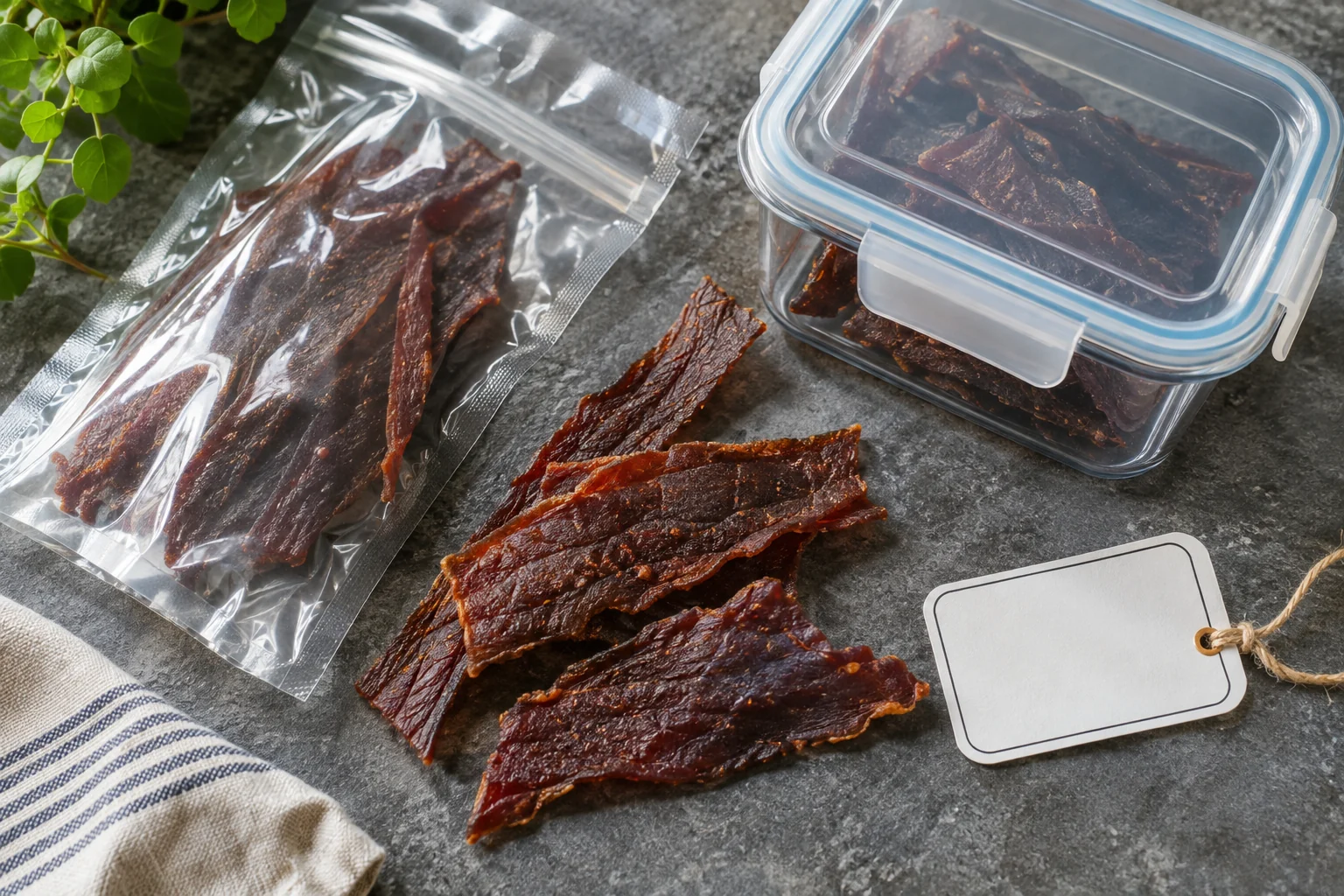
For short-term eating, a glass jar or airtight container kept somewhere cool, dry and dark works for well-dried jerky. Check it regularly: droplets on the inside mean it was not dried enough, and it should be dried further, refrigerated or frozen.
What about oxygen absorbers? They work very well for truly dry foods such as rice or beans. For homemade jerky, caution is needed: the USDA and extension services point out that oxygen absorbers are only suitable for foods with low moisture, around 10% or less. An oxygen-free environment, a low-acid meat and too much residual moisture are exactly the conditions that favour Clostridium botulinum, the bacterium that causes botulism. Manufacturers that use absorbers control water activity precisely and use curing salts; at home, you cannot check these parameters. For storage over several months, the freezer remains the best choice for homemade jerky.
To use these products properly with foods that suit them, see our guides to oxygen absorbers and Mylar bags.
Method 4: vacuum sealing, handy in cold storage
Vacuum sealing removes the air around jerky and slows oxidation. It is an excellent way to prepare portions for the freezer or fridge. At room temperature, however, it does not reliably extend the life of homemade jerky, for the same reason as oxygen absorbers: the environment becomes low in oxygen while moisture is not controlled.
Why does vacuum-packed commercial jerky keep so long? Because manufacturers control drying temperature and humidity, measure water activity, often use preservatives such as sodium nitrite and use high-barrier packaging. A home machine does not reproduce those conditions. To compare the two types of packaging, see our article on metallized and vacuum-sealed bags.
5. Making safe homemade jerky
If you make your own jerky, these rules improve both safety and shelf life.
Rule 1: choose lean, fresh meat
- Recommended: lean beef (inside or outside round, sirloin tip), bison, deer, moose.
- Possible, eat sooner: chicken and turkey, heated to 74 °C (165 °F).
- Avoid for storage: pork and marbled beef, which go rancid quickly.
Work with very fresh meat kept in the fridge at 4 °C (40 °F) or below, and wash hands, boards and utensils before and after handling. Marinate in the fridge, never on the counter, and do not reuse raw marinade.
Rule 2: trim all visible fat
Even lean meat has streaks of fat. Take the time to remove them with a sharp knife: it is one of the simplest ways to delay rancidity.
Rule 3: wild game needs special care
Game can carry parasites and bacteria. Black bear, wild boar, cougar or walrus can carry Trichinella, parasitic worms that cause trichinellosis. Some northern species, such as Trichinella nativa, survive home freezing, and drying does not kill them. Game meat for jerky must therefore be heated to 71 °C (160 °F) before or after drying. For bear and wild boar, it is better not to make jerky at all. Also follow your province’s hunting and meat-handling rules and advisories on wildlife diseases such as chronic wasting disease in deer.
Rule 4: heat the meat to 71 °C (160 °F)
This is the most important step. The NCHFP and USDA describe two approaches:
- Before drying: bring the marinade to a boil, add the strips and keep them there until the meat reaches 71 °C (160 °F), or 74 °C (165 °F) for poultry, then drain and dry. Another option is to cook the strips in the oven to that temperature.
- After drying: put the dried strips in an oven preheated to 135 °C (275 °F) for about 10 minutes. This step is harder to verify, because measuring the temperature of a thin strip is difficult.
Curing salts, such as Prague Powder #1, contribute colour, flavour and safety to cured meats. They do not replace heating and must be measured exactly according to the manufacturer’s directions: in excess, nitrite is toxic. Keep them out of reach of children and clearly labelled so they are never mistaken for table salt.
Rule 5: a salty, slightly acidic marinade
Salt slows microbial growth and acidity helps. Vinegar, lemon or lime juice, Worcestershire sauce or wine add acidity; soy sauce mostly adds salt. These ingredients improve safety and flavour, but they never replace heating to 71 °C (160 °F).
Rule 6: thin, even slices
Slices about 5 mm (3/16 in) thick dry evenly. A thick piece can stay moist in the centre while the outside is dry. To make slicing easier, put the meat in the freezer for 30 to 60 minutes. Slice across the grain for tender jerky, with the grain for chewier jerky.
Rule 7: dry enough, at the right temperature
The dehydrator should hold at least 60 to 63 °C (140 to 145 °F) throughout drying, according to the NCHFP. Preheat it, do not overload the trays and expect 4 to 12 hours depending on thickness and the appliance. In an oven, use the lowest setting that reaches at least 60 °C (140 °F), and prop the door open to let moisture escape; use an oven thermometer, because settings are often inaccurate.
Jerky is ready when a cooled strip bends and cracks without snapping: the surface is dry and no moisture shows when you bend it. Jerky that bends like soft leather is too moist to keep at room temperature. Sun-drying is not recommended for meat: the temperature is too low and uneven, and insects and dust easily contaminate the strips.
Let it cool completely before packaging, or condensation will encourage mould. For other foods, see our guide to food dehydration techniques.
6. How to tell jerky has gone bad
Knowing the signs of spoilage helps prevent food poisoning. Always inspect jerky before eating it, especially if it is homemade or has been stored a long time.
Look
- Mould: fuzzy white-grey, green or black spots, sometimes web-like, often in the folds. It smells like a damp cellar. Throw out the whole container: invisible filaments and spores may have reached the other pieces.
- A shiny white film: an even, slightly oily coating that wipes off easily, with no unusual smell. This is usually fat or salt migrating to the surface and is harmless.
- Salt crystals: small, hard, angular white crystals that come off when scratched. Normal, but often mistaken for mould. Fuzz and smell tell the difference.
Smell
- Normal: smoke, spices, salt, meat, marinade.
- Rancid: sour, oily, like paint or old cardboard, sometimes metallic.
- Mouldy: damp cellar, earth, mushrooms.
- Putrid: rotten, ammonia, rotten eggs.
Touch
Good jerky is dry and firm, not sticky. A sticky, damp or slimy surface signals moisture pick-up or microbial growth. Never taste suspicious jerky to “check”: some toxins have no taste or smell.
The golden rule: when in doubt, throw it out. Jerky is not worth the risk of food poisoning, especially in an emergency when medical care may be harder to reach.
7. Understanding package dates
Date labels differ by country.
- In Canada: a “best before” date tells you how long an unopened, properly stored product keeps its freshness, flavour and nutritional value. It is not a safety date: well-stored jerky can be eaten shortly after it if it shows no signs of spoilage. Once the package is opened, the date no longer applies; follow the label, for example “refrigerate after opening.”
- In the United States: “best if used by” dates are also about quality, not safety, for shelf-stable products like jerky.
- In France: the minimum durability date (“à consommer de préférence avant”) works the same way, while the use-by date (“à consommer jusqu’au”) is a safety limit to respect strictly.
8. Jerky in an emergency supply
Jerky is a compact source of protein, useful in a grab-and-go bag, a car kit or on a hike. It has a few limits to keep in mind for a household supply:
- It is very salty: it increases your water needs, which matters if water is rationed. Always store enough water, at least 4 litres (about 1 gallon) per person per day.
- It has few carbohydrates: pair it with nuts, dried fruit, crackers or energy bars for a more complete intake.
- It is expensive per calorie: for a supply of several weeks, legumes, rice, canned meat or fish and freeze-dried meals are cheaper and keep longer.
- It expires: choose commercial jerky for an emergency bag, note the best-before date and rotate it, for example by eating it on an outing and replacing it.
To organize food rotation, see our ten practical rules for stock rotation and our article on storing dried foods.
9. Key takeaways
Dried meat is a practical preserved food, as long as you respect three pillars:
- Food safety: fresh meat, good hygiene, heating to 71 °C (160 °F), or 74 °C (165 °F) for poultry, and caution with wild game.
- Moisture control: thorough drying, cooling before packaging, airtight containers, a dry place.
- Protection from oxidation: lean meat, fat trimmed, cool dark storage, and freezing for the long term.
In short: commercial jerky keeps until its best-before date while sealed; homemade jerky is for eating within weeks, or for the freezer. Claims that homemade jerky keeps for years at room temperature are not backed by any official guidance.
Frequently asked questions
Can I eat jerky after the best-before date?
Yes, if the package is intact, it has been stored properly and it shows no signs of spoilage. Flavour and texture may decline. A use-by date, where it exists, must be respected.
Does unopened commercial jerky need refrigeration?
Usually not: it keeps in a cool, dry pantry. Follow the label, though, which may ask you to refrigerate after opening. In very hot weather, a cool spot preserves quality longer.
Does frozen jerky lose nutritional value?
Very little. Freezing preserves protein and minerals well. Texture may change slightly after thawing.
How long does jerky last in an ordinary zip bag?
Not long: these bags let air and moisture through. For homemade jerky, count on a few days to a week or two in a cool place, or keep the bag in the fridge or freezer.
Why does my homemade jerky go mouldy after two weeks?
Most often it was not dry enough, it was packed while still warm, or it is stored somewhere damp or in a poorly sealed container. Dry it longer, let it cool completely and refrigerate or freeze it.
Can I make jerky from ground beef?
Yes, but the bacterial risk is higher because grinding spreads bacteria throughout the meat. Choose extra-lean meat, work quickly, heat to 71 °C (160 °F) and keep the jerky in the fridge or freezer.
Are Mylar bags with oxygen absorbers suitable for homemade jerky?
Not for room-temperature storage: without measuring water activity, an oxygen-free environment can favour botulism if the jerky is too moist. The freezer is safer.
Further reading
- Storing dried foods: no miracle shelf lives
- Food dehydration techniques
- Metallized and vacuum-sealed bags: choosing the right packaging
- Food stock rotation: ten practical rules
Sources
- USDA Food Safety and Inspection Service, Jerky and Food Safety, and jerky compliance guidelines.
- National Center for Home Food Preservation (University of Georgia), jerky preparation guidance.
- Canadian Food Inspection Agency, information on best-before dates.
- Health Canada, information on trichinellosis and safe cooking of wild game.