
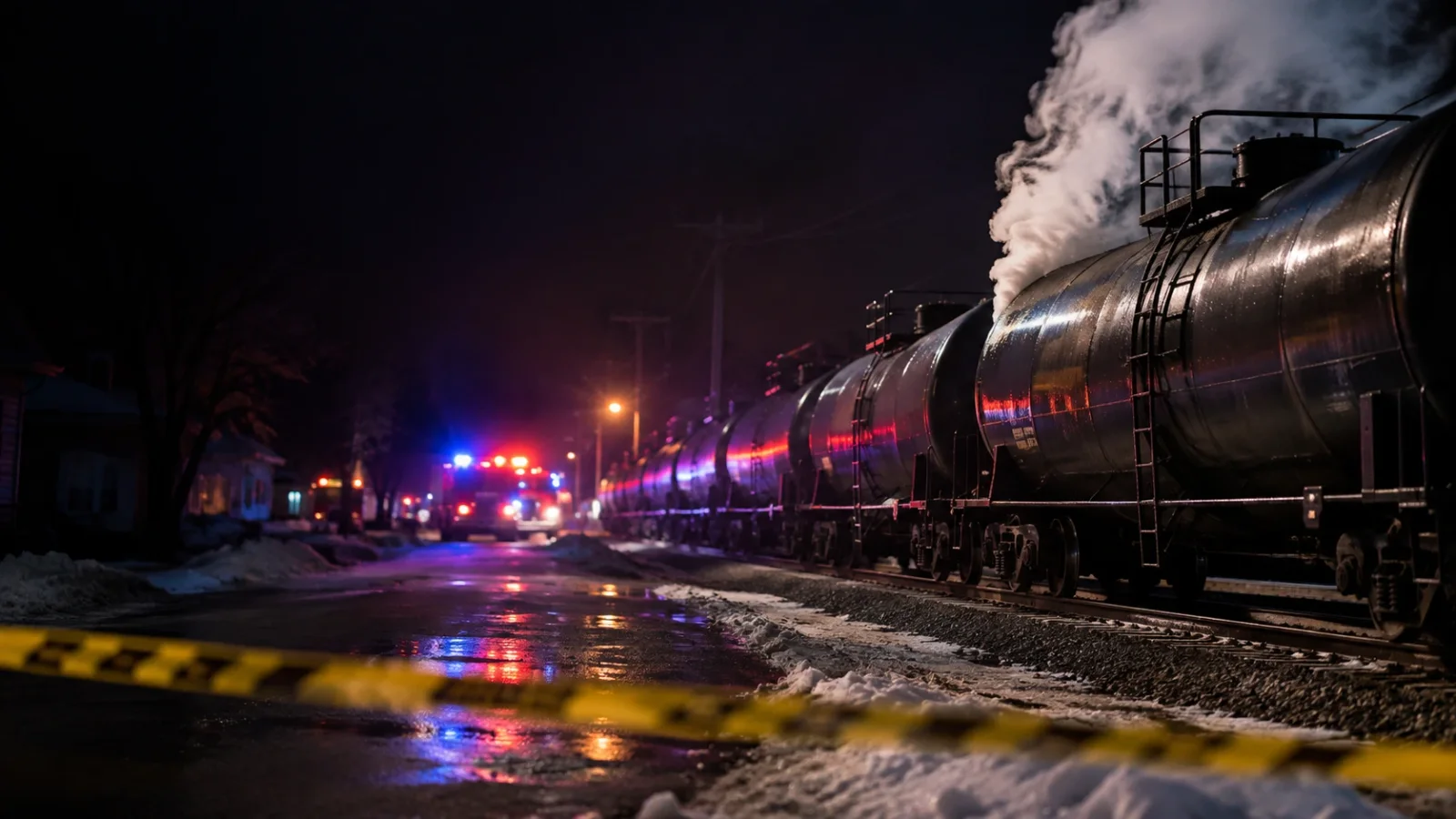
Technological · Risk index 6/9 (Quebec) · 6/9 (France)
Hazardous materials transport
Trains, trucks and pipelines carry fuels, gases and chemicals near homes every day. An accident can cause a fire, an explosion or a toxic cloud. You need to know how to move away, shelter in place and follow instructions.
Quebec / Canada
France
If you only do three things
- 1Find out whether a rail line, highway or pipeline runs near your home
- 2Move away from the accident with your back to the wind
- 3Shelter in place or evacuate as instructed, without picking children up from school
Lasting collapse?
Key figures
A danger that passes your door.
Understanding the risk
Products that travel everywhere.
Hazardous materials (fuels, gases, acids, chemicals) move by road, rail, waterway and pipeline. An accident can cause a fire, an explosion, a toxic release or pollution of soil and water.
Each truck or rail car carries an orange placard with two numbers: the hazard code on top, the substance’s UN number below. These codes are for responders; you do not need to identify the product yourself.
Severity
Close to the accident, the risks are burns, blast effects and poisoning. Further away, a toxic cloud can require a whole neighbourhood to shelter in place.
Accidents mostly happen in transit, far from industrial sites, which takes residents by surprise.
In detail
What to do depending on where you are.
| You are… | What to do | Avoid |
|---|---|---|
| Witnessing the accident | Raise the alarm (location, placard, leak, fire), move away with your back to the wind | Going closer to help or film |
| At home, shelter-in-place order | Close up, shut off ventilation, interior room, radio | Going out to see what is happening |
| Evacuation order | Leave by the indicated route, with your go-bag | Taking a shortcut toward the site |
| In a car | Close windows, shut off ventilation, leave the area | Driving through a cloud or smoke |
| Children at school | Let the school apply its plan | Going to get them and exposing yourself |
Assess your exposure
Are you more exposed than average?
Tick what applies to your situation.
Get prepared
Your preparedness checklist
Tick items as you go: your progress is saved on this device.
Suggested kits and plans
Before, during, after
The right actions, before, during and after.
Before
- Transit routes located
- Shelter room chosen
- Battery radio ready
- Alerts on
- School plan known
During
- Raise the alarm without going closer
- Move away with your back to the wind
- Shelter or evacuate as instructed
- Do not pick up the children
- Listen to the radio
After
- Air out only once the alert ends
- Follow instructions about water and gardens
- Get care if symptoms appear
- Report damage
- Look after your mental health
In Quebec, Canada and France
What changes depending on where you live.
Quebec / Canada
Transport Canada regulates dangerous goods transport, and CANUTEC advises responders 24/7. In Quebec, the municipality and firefighters give shelter-in-place or evacuation instructions.
- Emergency
- 911
- Alerts
- Municipality, Alert Ready
- Health
- Info-Santé 811
- Poisoning
- Quebec Poison Control Centre 1-800-463-5060
France
Hazmat transport risk is listed in the departmental major risks file (DDRM) and the DICRIM of the communes it crosses. The national warning signal (rising and falling tone) orders people to shelter.
- Emergency
- 112, 18
- Local risk
- DICRIM, Géorisques
- Alerts
- Siren, FR-Alert
- Radio
- France Bleu / ici, France Info
Domino effect
This risk often triggers others
Our guides on this topic
Frequently asked questions
Frequently asked questions
What does the orange placard mean?
On top, the hazard code (for example 33 for a highly flammable liquid); below, the substance’s UN number. It is mainly useful to responders.
Should I pick my children up from school?
No. The school applies its shelter plan; you could expose yourself and block responders.
How long does sheltering in place last?
Often a few hours. Wait for the all-clear before airing out.
What if I breathed in a strong smell?
Get to shelter, rinse eyes and skin, and call 911 (or 15/112) if you have symptoms.
365 Program
Prepare for this risk, week by week
Data checked on November 23, 2026. Figures come from the organizations cited; consult them for updates.
Sources
Data checked on November 18, 2026. Figures come from the organizations cited; consult them for updates.
- Transportation Safety Board, Lac-Mégantic report R13D0054
- CTV News, notable Canadian train derailments
- Isère prefecture, hazmat transport fact sheet (in French)
- Haut-Rhin prefecture, DDRM 2023: hazmat transport (in French)
- Government of Quebec, Hazardous materials accident (in French)
This page provides general preparedness information. It does not replace instructions from the authorities: in an emergency, call 911 in Canada or 112 in France.
Start with the basics.
Our free “Be Prepared” guide: 72-hour kit, family plan and your own risk assessment.
Hazardous materials transport
Index Quebec/Canada 6/9 · France 6/9
If you only do three things
- Find out whether a rail line, highway or pipeline runs near your home
- Move away from the accident with your back to the wind
- Shelter in place or evacuate as instructed, without picking children up from school
During
- Raise the alarm without going closer
- Move away with your back to the wind
- Shelter or evacuate as instructed
- Do not pick up the children
- Listen to the radio
After
- Air out only once the alert ends
- Follow instructions about water and gardens
- Get care if symptoms appear
- Report damage
- Look after your mental health
Emergency numbers: 911 (Canada) · 112 (France)
prepacivile.com/en/risks/hazmat-transport/