

Malicious acts and conflict · Risk index 2/9 (Quebec) · 2/9 (France)
Electromagnetic pulse (EMP)
A powerful electromagnetic pulse could disable some electronics and the power grid over a vast region. The scenario is very unlikely, but it’s a reminder of the value of being able to live a few days without electronics.
Quebec / Canada
France
If you only do three things
- 1Be able to live several days without power or phone
- 2Keep a spare radio and flashlight in a metal box
- 3Have a family plan that doesn’t depend on phones
Lasting collapse?
Key figures
The 1962 precedent.
Understanding the risk
A wave that hits electronics.
An electromagnetic pulse (EMP) is a brief, intense electromagnetic wave. A nuclear blast at very high altitude would produce one over a huge area, possibly a continent. It has several components: a very fast one (E1) that can destroy electronic circuits, and a slow one (E3), similar to a solar storm, that induces currents in long power lines and can damage transformers.
Cables act as antennas: the longer the wires a device is connected to, the more exposed it is. Modern electronic components are more sensitive than older equipment.
Severity
The main expected effect would be a widespread, lasting power outage, with communications and digital services down. Consequences would resemble a major outage, but over a much larger area.
Contrary to some beliefs, most cars probably wouldn’t be affected, since their circuits are short and partly shielded by the body. A few breakdowns would still be enough to cause traffic jams.
In detail
What’s most and least exposed.
| Equipment | Exposure | Why |
|---|---|---|
| Power grid and transformers | High | Long lines pick up the wave |
| Devices plugged into the grid | High | Wires act as antennas |
| Unplugged phones and small devices | Medium | Short circuits, but sensitive components |
| Cars | Fairly low | Short circuits, metal body |
| Devices in a closed metal box | Low | Faraday cage effect |
Assess your exposure
Are you more exposed than average?
Tick what applies to your situation.
Get prepared
Your preparedness checklist
Tick items as you go: your progress is saved on this device.
Suggested kits and plans
Before, during, after
The right actions, before, during and after.
Before
- Long-outage readiness
- Protected radio
- Numbers on paper
- Road maps
- Meeting point
During
- Apply power-outage routines
- Go to the meeting point if communications fail
- Save water, heat and batteries
- Listen to a battery radio
- Check on neighbours
After
- Check devices one by one
- Plug back in gradually
- Review what worked
- Restock supplies
- Update the family plan
In Quebec, Canada and France
What changes depending on where you live.
Quebec / Canada
In Canada, recommended EMP preparation is that for a prolonged outage: at least 72 hours of self-sufficiency. A solar-origin event is covered in the Space weather fiche.
- Emergency
- 911
- Outages
- Hydro-Québec Info-pannes
- Alerts
- Alert Ready
- Preparedness
- Get Prepared (Canada.ca)
France
In France, an EMP would fall under national defence plans. For households, the “Tous responsables” guide recommends 72 hours of self-sufficiency and a battery radio.
- Emergency
- 112
- Outages
- Enedis
- Alerts
- Sirens, FR-Alert
- Guide
- Tous responsables (SGDSN)
Domino effect
This risk often triggers others
Frequently asked questions
Frequently asked questions
Will my car work after an EMP?
Probably, according to available analyses: car circuits are short and partly shielded by the body. A few vehicles could fail.
Is a surge protector enough?
Ordinary surge protectors are too slow for an EMP’s fastest component. Unplugging devices is safer.
Is an EMP dangerous to the body?
No: it affects electronics, not people directly. The danger comes from consequences, such as losing heat or medical devices.
How is it different from a solar storm?
A solar storm mainly affects long power lines. A nuclear EMP adds a very fast pulse that can hit small devices.
Sources
Sources
Data checked on November 18, 2026. Figures come from the organizations cited; consult them for updates.
This page provides general preparedness information. It does not replace instructions from the authorities: in an emergency, call 911 in Canada or 112 in France.
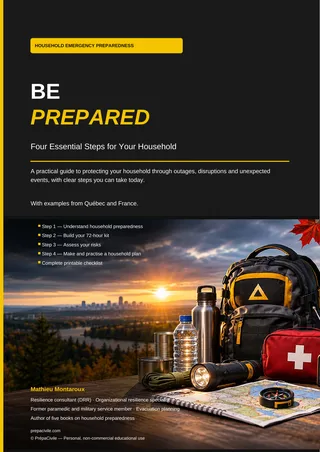
Start with the basics.
Our free “Be Prepared” guide: 72-hour kit, family plan and your own risk assessment.
Electromagnetic pulse (EMP)
Index Quebec/Canada 2/9 · France 2/9
If you only do three things
- Be able to live several days without power or phone
- Keep a spare radio and flashlight in a metal box
- Have a family plan that doesn’t depend on phones
During
- Apply power-outage routines
- Go to the meeting point if communications fail
- Save water, heat and batteries
- Listen to a battery radio
- Check on neighbours
After
- Check devices one by one
- Plug back in gradually
- Review what worked
- Restock supplies
- Update the family plan
Emergency numbers: 911 (Canada) · 112 (France)
prepacivile.com/en/risks/emp/