
In this article
Water-bath canning lets you keep jams, fruit, pickles and tomatoes at room temperature for months. It is a valuable skill for food self-reliance, on one condition: following strict safety rules. A badly made preserve can contain botulism toxin with no visible sign.
In short
In short. Water-bath canning is suitable only for acidic foods: fruit, jams, jellies, vinegar pickles, and tomatoes with added acid. Vegetables, meat, fish, soups and beans require a pressure canner. Use only tested recipes, new canning jars and lids designed for canning, and follow processing times.
The acidity rule
The bacterium Clostridium botulinum grows without oxygen in low-acid foods, and its spores survive boiling water. In acidic food, it cannot multiply. That is why the method depends on the food:
| Food | Method |
|---|---|
| Jams, jellies, most fruit | Boiling water bath |
| Vinegar-based pickles and relish (tested recipe) | Boiling water bath |
| Tomatoes and tomato sauce | Boiling water bath with added acid (bottled lemon juice or citric acid) as per the recipe |
| Vegetables, meat, fish, soups, beans | Pressure canner only |
For low-acid foods, see our pressure canning guide.
Equipment
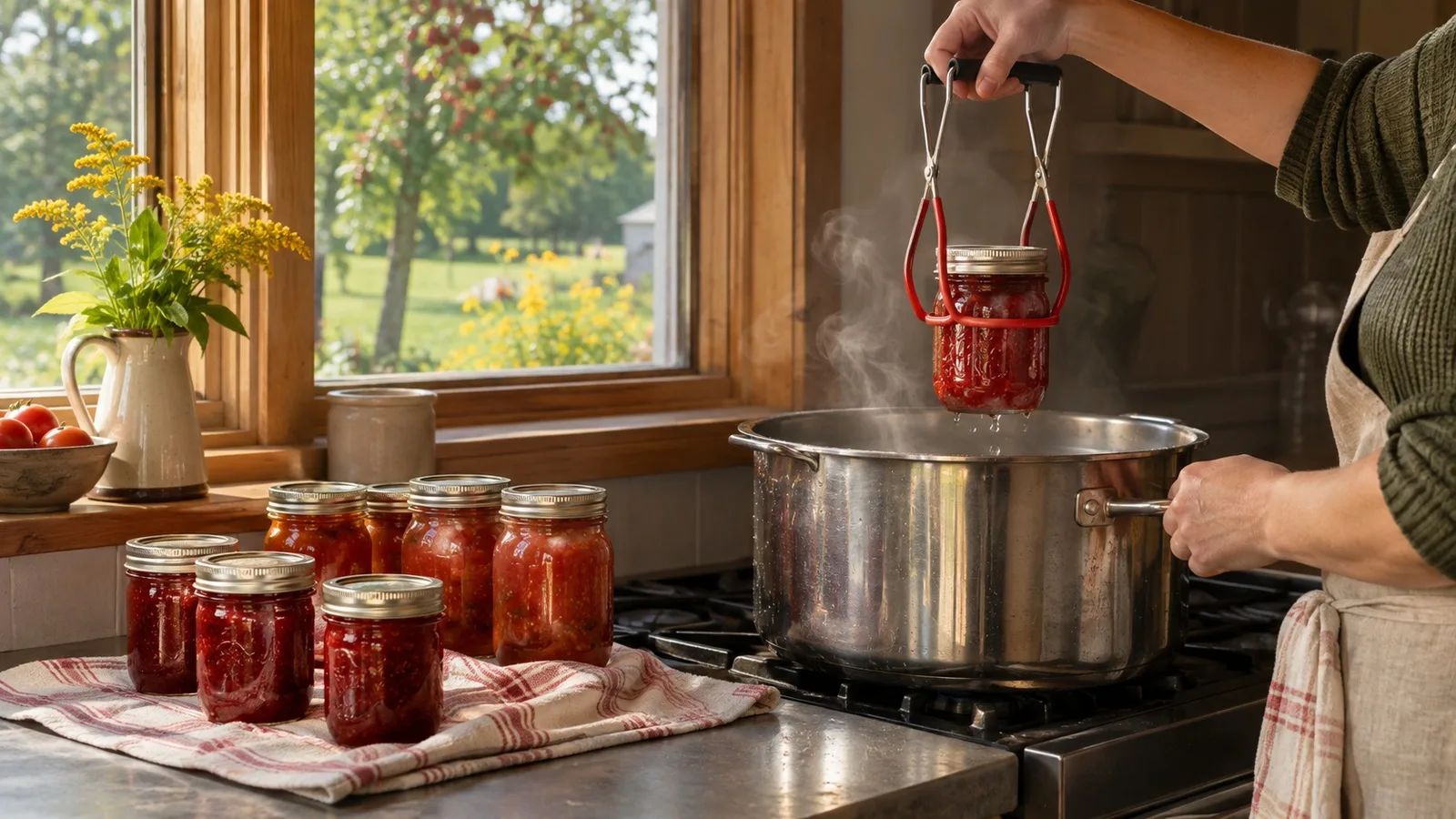
- a large pot deep enough to cover jars with 2.5 cm (1 in) of water, with a rack at the bottom;
- Mason jars in good condition and new flat lids (bands can be reused);
- a jar lifter, a wide-mouth funnel, a spatula to remove air bubbles;
- a tested recipe from a recognized source.
Steps
- Wash jars in hot soapy water and keep them hot. Prepare lids as the manufacturer directs.
- Prepare the food following the recipe, without changing the proportions of acid, sugar or vinegar.
- Fill hot jars leaving the headspace stated in the recipe, remove air bubbles, wipe the rim.
- Place the lid and screw the band on fingertip-tight.
- Set jars on the rack, cover with 2.5 cm of water, bring to a full boil and start timing once boiling.
- Increase processing time at altitude, as the recipe states.
- At the end, wait a few minutes, lift jars out upright and let them cool for 24 hours undisturbed.
Check and store
- The lid should be concave and not move when pressed. An unsealed jar goes in the fridge and is eaten soon, or is reprocessed within 24 hours.
- Remove bands, label (contents and date) and store somewhere cool and dark.
- For best quality, eat within a year.
Signs never to ignore
Bulging lid, liquid spurting on opening, unusual smell, mould, foam or cloudy liquid: do not taste. Dispose of the contents safely, without opening over a food preparation surface, and wash your hands.
Key points
- Acid onlyFruit, jams, pickles, acidified tomatoes.
- Tested recipeDo not change proportions or times.
- CheckSealed lid; when in doubt, throw it out.
Frequently asked questions
Can jars be processed in the oven?
No. Dry oven heat does not process preserves safely and can make jars burst.
What about paraffin on jams?
This method is no longer recommended: it does not guarantee an airtight seal.
Food safety. Always follow a tested recipe. If symptoms appear after eating a home preserve (double vision, trouble swallowing or speaking, weakness), call 9-1-1 immediately.
Sources
- Health Canada, home canning and botulism.
- Government of Quebec (MAPAQ), safe home canning.
- USDA, Complete Guide to Home Canning.
Go further: our pressure canning guide and our guide to fermentation.