
In this article
This is part four of our series on the first steps of emergency preparedness. Part 1 covered priorities and water storage, part 2 the food reserve and personal safety, and part 3 financial security and medical supplies. This fourth step tackles backup power: generators, solar, batteries, and how to keep food and medication cold during an outage.
Note: the electrical information in this article is general. Any connection of a power source to your home’s electrical system must be done by a qualified electrician, in line with the applicable code.
In short
In short. Power isn’t vital for most people during a short outage, but it becomes vital for some (medical devices, refrigerated medication, winter heating). Start with the essentials: lights, power banks, a radio, and ways to protect freezer food (about 48 hours if it’s full and kept closed). Then a generator used properly (outdoors, with a transfer switch installed by an electrician) and/or a small solar-and-battery system round out your preparation.
Step 7: backup power
As in the previous parts, this approach assumes you’re starting from scratch, which is rarely the case. Most households already have flashlights, batteries, a power bank or camping gear that can form a base, even if they’ve never thought of it as a system.
With water, food and safety, we’ve covered the basics. Power falls into another category: it generally isn’t essential to get through an outage of a few days, but it makes life much easier, and in some cases it becomes vital.
That’s true for people who depend on an electric medical device (oxygen concentrator, breathing device, pump), and for some medications. Insulin, for example, must be refrigerated until opened; once in use, most insulins can be kept at room temperature for a limited time, generally around four weeks depending on the product. Check the exact instructions for your medications with your pharmacist, and keep a cooler and ice packs on hand. If someone in your household depends on electricity for their health, let your utility and your municipality know if a registry exists, and plan how to get to a powered location during a prolonged outage.
In winter, in Quebec as in other cold regions, power also affects heating: most systems, even gas or oil, need electricity to run (blower, pump, ignition).
Keeping food cold
Power also keeps fridge and freezer contents longer, so you can eat that food before dipping into your long-term reserves. During long outages, whole neighbourhoods have organized big shared meals to grill freezer meat before it spoiled: a great way to waste nothing and lift morale.
Even without backup power, a few steps greatly extend storage:
- Keep the doors closed. According to Health Canada and U.S. Department of Agriculture benchmarks, a closed fridge keeps food cold for about 4 hours; a full, closed freezer for about 48 hours, and a half-full freezer for about 24 hours.
- Fill the freezer. Frozen food acts like blocks of ice. A well-stocked freezer stays cold longer; fill empty spaces with containers of frozen water, which also double as a water reserve.
- Insulate. Covering the freezer with heavy blankets can help, without blocking the vents if the unit is running.
- Prefer a chest freezer. Cold air, being heavier, stays at the bottom when you open it, while it spills out of an upright freezer.
- Check temperatures. An appliance thermometer tells you whether the fridge stayed at 4 °C or below and the freezer at −18 °C. When in doubt, throw it out: your health is worth more.
- Use winter cold, carefully: a cooler outside, out of the sun and away from animals, can help, but outdoor temperatures vary and the sun can warm a container even in cold weather.
To know what to keep and what to throw out after an outage, see our guide on checking fridge and freezer food after an outage.
In hours, doors kept closed
- Fridge≈ 4 h
- Half-full freezer≈ 24 h
- Full freezer≈ 48 h
Health Canada and U.S. Department of Agriculture benchmarks; always check temperatures
Generators
The two most common backup power options are generators and solar. Each has pros and cons, and a balanced approach often combines both. Wind and micro-hydro also exist but are only viable in particular conditions.
Generators come in a wide variety of formats, outputs and fuels (gasoline, propane, diesel, dual-fuel). They often vanish from store shelves the moment a big storm is forecast, and some resellers have exploited people’s distress by reselling them at inflated prices. It’s better to equip yourself ahead of time, calmly.
Fuel, the real limit
A generator is only useful as long as it has fuel and oil. It consumes both, and running low on oil can damage the engine. Fuel storage should therefore be planned at the same time as the purchase: approved containers, quantities allowed by municipal bylaws and your insurer, storage in a ventilated place away from the house and ignition sources, and stabilizer for gasoline. Propane keeps longer than gasoline, but cylinders must always stay outdoors.
Choosing the right output
Every generator has a rated output. The higher it is, the more appliances you can plug in, but unless you have a large permanent home standby generator, you’ll have to choose what you power. To size it properly, distinguish two types of loads:
- Resistive loads draw the same power at start-up and while running: light bulbs, coffee makers, toasters, baseboard heaters. Many produce heat and draw a lot.
- Motor loads (fridge, freezer, furnace blower, well pump, air conditioner) need a surge of power to start, often two to three times their running wattage, then much less.
To assess your needs, read the wattage on each appliance’s nameplate, or use an inexpensive plug-in watt meter from a hardware store. Add up the running watts of your priority appliances, add the starting surge of the largest motor, and keep a margin. Don’t expect to light the whole house: a mid-sized portable generator can typically run the fridge or freezer in cycles, a few lights and small appliances, and charge phones.
Connecting safely
Never plug a generator directly into a wall outlet or the electrical panel without the proper device. That can send power back into the grid (backfeeding) and electrocute line workers restoring service, as well as damage your wiring. Connecting to the panel requires a transfer switch installed by a qualified electrician, in line with the applicable code. Without one, plug appliances directly into the generator using outdoor-rated extension cords of the right gauge.
Carbon monoxide and safety
A generator gives off carbon monoxide, an invisible, odourless and deadly gas. It must always run outdoors, away from doors, windows and air intakes, never inside the house, the garage (even with the door open), the basement or a shed. Install battery-powered carbon monoxide alarms in the house. Let the generator cool before refuelling, and protect it from rain with a cover designed for the purpose; see our article on running a generator in the rain.
Generators are also noisy and can be stolen. A chain and padlock, or an anchor, reduce the risk of theft. The noise, meanwhile, tells the whole neighbourhood you have power: during an outage, when everything goes quiet, you quickly hear neighbours’ generators starting up. It’s also an opportunity for mutual aid (charging a neighbour’s phone, keeping their medication cold). To cut the noise without compromising safety, see our article on generator noise.
Solar power
With solar there’s no noise, no fuel to store, no oil and no exhaust: it can run safely right next to the house. As long as the sun rises, you have a renewable energy source, a decisive advantage in a prolonged outage, since you can never store enough gasoline to last indefinitely. The silence also lets you hear what’s going on around you, and doesn’t advertise your equipment to the whole neighbourhood.
A backup solar system generally includes:
- photovoltaic panels, which produce direct current;
- a charge controller, which protects the batteries;
- batteries to store energy: deep-cycle lead-acid batteries are economical, while lithium iron phosphate (LiFePO4) batteries cost more up front but are lighter and last longer;
- an inverter, which converts the batteries’ direct current (often 12 or 24 V) into 120 V alternating current (230 V in Europe) for your appliances.
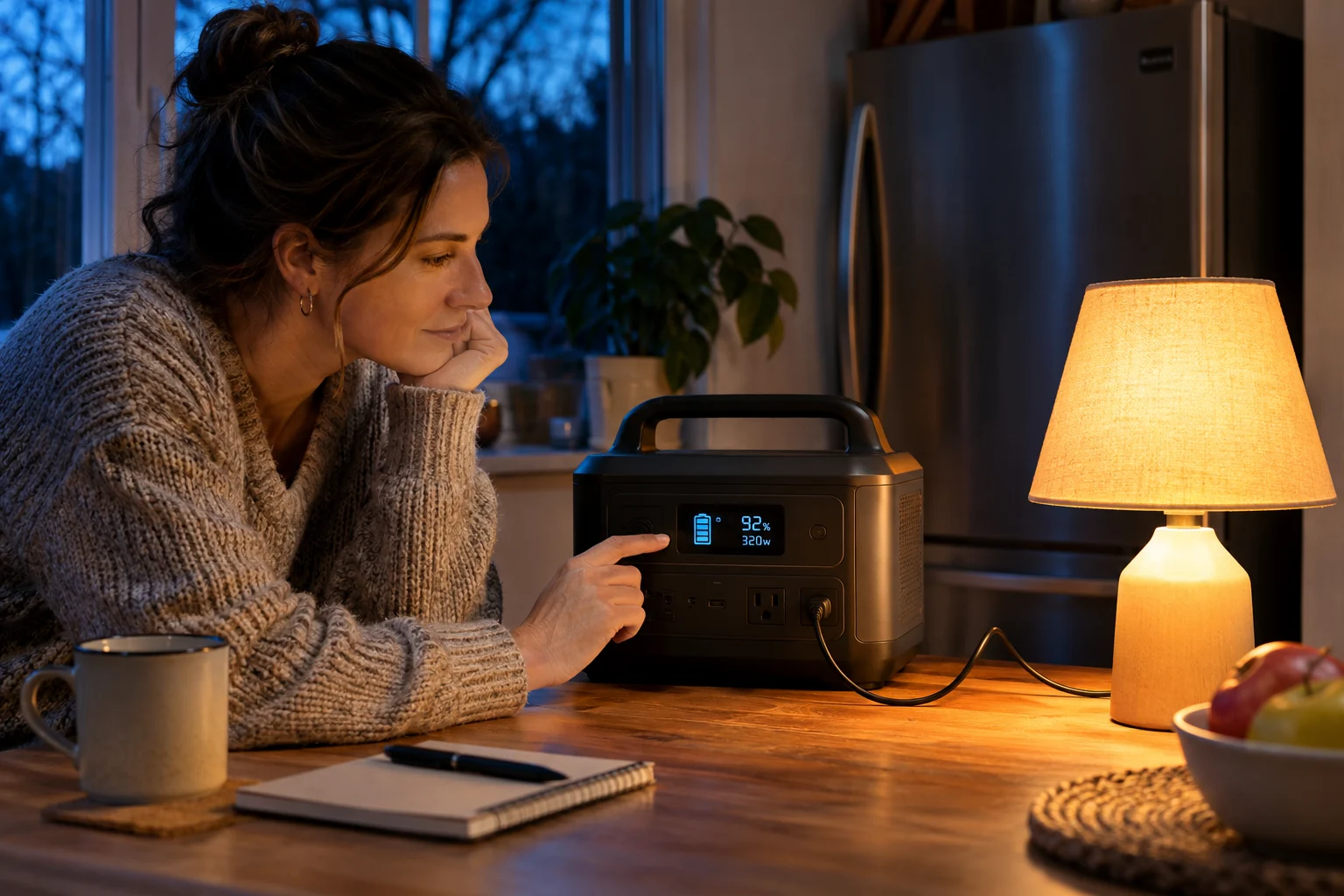
For a simple start, portable “power stations,” which combine battery, inverter and controller in one unit, recharge from an outlet, in the car or with a folding solar panel. They can power lights, phones, a laptop or a small medical device for several hours, depending on capacity. Check the actual capacity (in watt-hours) and output power before buying.
Solar has its limits too. Panel quality varies by manufacturer. Output drops sharply in winter, in cloudy weather and when panels are covered with snow or dust: keep them clean and clear. A south-facing orientation (in the northern hemisphere) and suitable tilt are generally enough; a sun-tracking system improves output but isn’t necessary for backup use. Panels can be damaged by hail, high winds or falling branches, and a pole-mounted panel in the yard is easier to steal than one on the roof. Finally, a system connected to your home’s panel must be installed by an electrician, with the required protections.
Combining solutions
The ideal setup combines both: a generator for long cloudy spells and heavy loads, and solar panels that recharge the batteries on sunny days. Some dream of a complete system, with a dual-fuel generator connected to natural gas, a propane reserve, a big battery bank and several kilowatts of panels. It’s possible but expensive, and most households don’t need it to get through an outage of a few days.
A realistic step-by-step plan:
- First: rechargeable or battery LED lights, spare batteries, power banks, a hand-crank radio, carbon monoxide alarms, thermometers for the fridge and freezer.
- Next: a portable power station and a folding solar panel, for phones, lighting and small medical needs.
- Then: a generator sized for your priority appliances, with a fuel plan and, ideally, a transfer switch installed by an electrician.
- Long term: a solar-and-battery system, or a permanent standby generator, depending on your budget and needs.
We all have to start somewhere, and there’s no shame in aiming smaller. Assess your real needs, especially medical and heating, and equip yourself gradually. Part five of the series covers home security and the final steps of the plan. In the meantime, see our guides on preparing for power outages and emergency lighting options.
- EssentialsLights, batteries, power banks, radio, CO alarms, thermometers.
- Portable stationBattery + inverter + folding panel for phones and small medical needs.
- GeneratorProperly sized, fuel planned, transfer switch by an electrician.
- Long termSolar with batteries or a standby generator.
The most common mistakes
Every prolonged outage brings the same mistakes, often serious ones:
- Running a generator or barbecue indoors, in the garage or under an enclosed shelter: the leading cause of carbon monoxide poisoning during outages.
- Plugging the generator into a wall outlet with a “male-to-male” cord: a risk of electrocution for you and for line workers, and a fire risk.
- Buying the generator on the day of the storm, with no fuel, no proper cords and having never started it. Do a test start every few months.
- Storing gasoline in the basement or in unapproved containers.
- Leaving candles unattended: they cause many fires during outages.
- Constantly opening the freezer to check its contents, which shortens how long it keeps.
- Forgetting refrigerated medication and the needs of people who depend on an electric device until the outage hits.
Avoiding these mistakes costs almost nothing and protects far more than any expensive equipment.
Frequently asked questions
How long does food stay safe during an outage?
About 4 hours in a closed fridge, about 48 hours in a full, closed freezer, and about 24 hours if it’s half full. Check temperatures with a thermometer and, when in doubt, throw it out.
Can you plug a generator into a household outlet?
No. It’s dangerous for you and for line workers. Use extension cords straight from the generator, or have an electrician install a transfer switch.
Does solar work in winter?
Yes, but output is much lower: short days, low sun, snow on the panels. Plan more battery capacity or a backup generator.