
In this article
Opening a bag of rice and finding small, maggot-like larvae is unpleasant, but it happens far more often than most people think. The good news: rice does not turn into maggots. The larvae come from insect eggs that were already on the grains, often long before you bought them, and they develop when rice sits too long at room temperature without proper protection.
Knowing where they come from, how to recognize them and a few simple habits will protect your food supply without wasting it. This article explains where the larvae come from, how to get rid of them, the real health risks and how to clean your pantry after an infestation.
In brief
In brief. Rice does not produce larvae: insects lay eggs on the grains in silos and warehouses, and the eggs hatch if the rice stays at room temperature for a long time. To prevent it, rotate your stock, freeze rice for at least 4 days at −18 °C (0 °F) before storing it, then keep it in truly airtight containers or Mylar bags with oxygen absorbers. The larvae are not known to transmit disease; still, throw rice out if it smells rancid, is mouldy or is covered in webbing.
1. Where do the larvae come from?
Many insects feed on grains such as rice, flour, oats and pasta. So that their young have food the moment they hatch, they lay their eggs directly on the grains. This often happens in silos, processing plants and warehouses, well before the product reaches store shelves.
It is therefore almost unavoidable for a bag of store-bought rice to contain a few microscopic eggs. They are invisible to the naked eye and cause no trouble as long as they do not hatch. The problem starts when rice sits for weeks or months at room temperature in flimsy packaging: the eggs hatch, the larvae grow and become visible.
The presence of eggs has nothing to do with brand or price, and it does not mean the manufacturer was careless. Prevention mostly happens at home, in how you treat and store rice after buying it.
2. They are not real maggots
Strictly speaking, a maggot is a fly larva. Flies lay their eggs mainly in moist or decaying matter, not in dry grains, so it is very unlikely you will find true maggots in properly stored dry rice.
The small whitish larvae found in rice usually belong to two very common pantry pests:
- The Indian meal moth: its larvae leave silk threads that clump grains together, and the small adult moths fly around the kitchen.
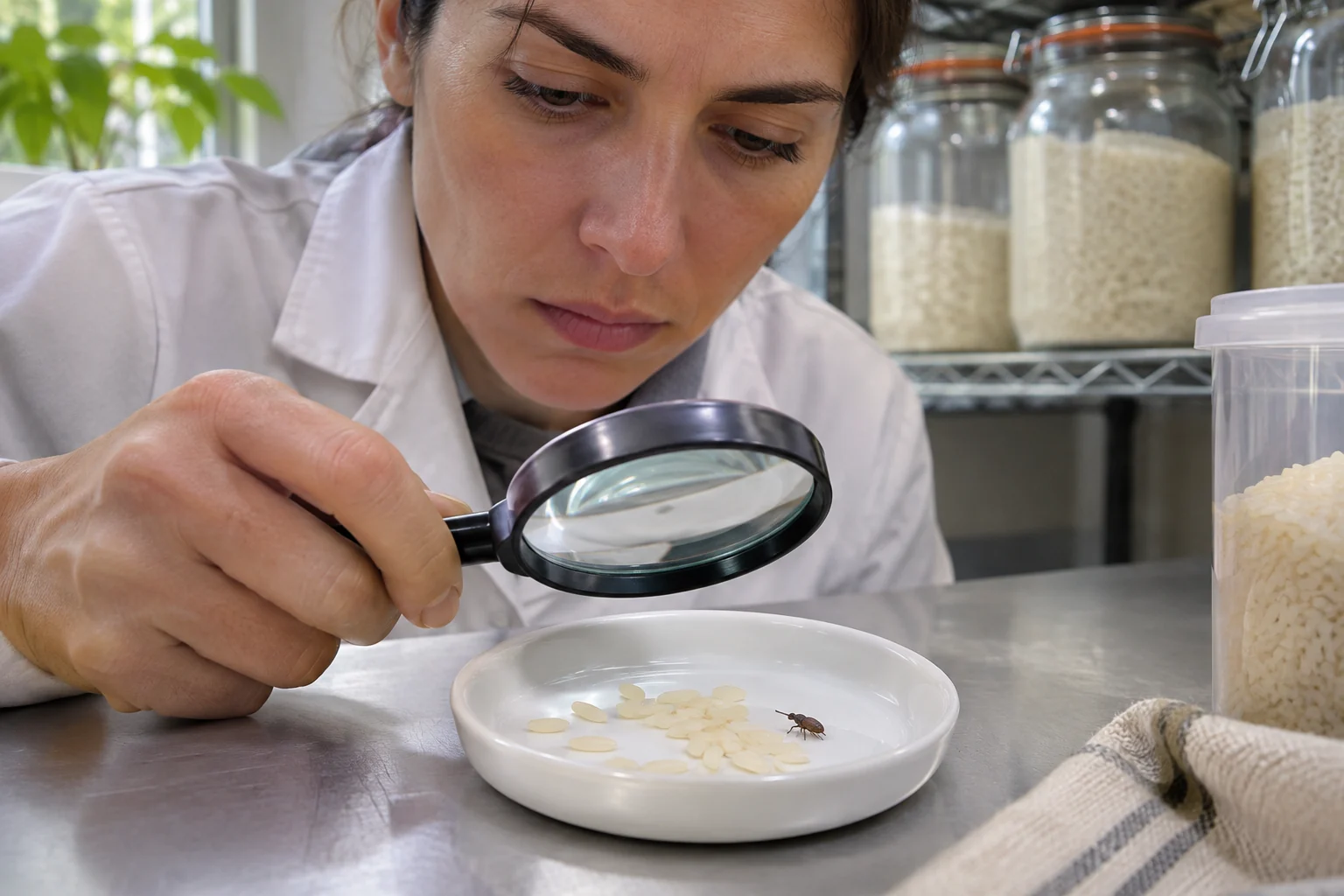
- Weevils: small dark-brown beetles with a long snout, whose larvae develop inside the grains themselves.
Other insects can be involved depending on the region, the season and where the product came from, such as some small stored-product beetles. What they share: they easily get into thin pouches, cardboard boxes and some plastic bags, and move from one container to the next in the pantry.
3. Why an infestation speeds up
The trouble with pantry pests is how fast their life cycle runs. A single adult insect can lay dozens or even hundreds of eggs. These hatch, the larvae feed, turn into adults, and those adults lay eggs in turn. In a warm house, the cycle can repeat several times a year.
That is why a small infestation caught early is easy to deal with, while a bag forgotten at the back of a cupboard can contaminate nearby grains within weeks. Acting quickly and checking your supplies regularly makes all the difference.
4. How to get rid of them
Two complementary approaches break the cycle:
- Use the rice before the eggs hatch. At room temperature, eggs can hatch within a few weeks to a few months. Regular stock rotation, on a "first in, first out" basis, keeps rice from sitting long enough for an infestation to develop.
- Kill the eggs before storing the rice. Freezing is the most reliable method: put the rice in a freezer at −18 °C (0 °F) or colder for at least 4 days. For a large bag, allow a week so the cold reaches the centre. Then let the rice return to room temperature in its closed packaging before repacking it, to avoid condensation.
Microwaving rice for a few minutes is sometimes suggested. This method is less reliable: heating is uneven and some spots may not get hot enough. If you use it, treat small amounts and let the rice cool completely before storing it.
Once treated, rice must go into a container that prevents new eggs from being laid. Treatment alone does not protect against reinfestation from another product in the pantry.
5. Store rice so the larvae do not come back
Airtight glass or thick plastic containers slow infestations considerably, but they are not all equal: meal moth larvae can chew through thin bags and get past a loose lid. Choose lids with a gasket, and do not leave rice in its original bag once it is open.
For long-term storage, heat-sealed Mylar bags with oxygen absorbers, possibly placed in a food-grade bucket, offer the best protection. Without oxygen, insects can neither develop nor survive. Label each container with its contents and the packing date, and keep your supplies somewhere cool, dry and dark.
For the full method, see our guide on long-term rice storage and our article on oxygen absorbers.
6. Is it dangerous to eat?
In most cases, no. The larvae and eggs found in dry rice are not known to transmit disease, and many cultures eat insects as a source of protein. Accidentally eating a few larvae is generally not a health problem.
If you would rather remove them, rinse the rice thoroughly in cold water in a fine sieve: most larvae float to the surface and wash away. Boiling takes care of the rest.
Throw the rice out, however, in some cases: a rancid or musty smell, visible mould, grains clumped together by webbing, or a heavy infestation with many adult insects. A heavy infestation brings moisture and insect debris that spoil the food. People allergic to dust mites or shellfish may also react to insect debris: when in doubt, do not eat it.
7. Cleaning the pantry after an infestation
Finding larvae in a bag of rice is a signal to check the whole pantry, because adults move easily from one product to another. Here is a simple method:
- Inspect every container of grains, flour, pasta, dried fruit, nuts and pet food.
- Throw heavily infested products into a sealed bag and take it out of the house.
- Freeze lightly affected or doubtful products for at least 4 days.
- Empty the shelves, vacuum corners and cracks, then wash with soapy water or white vinegar and let dry.
- Repack everything in airtight containers and keep an eye on the pantry for a few weeks.
For weevils in particular, our article on responding to a pantry weevil infestation covers identification and what to do.
Frequently asked questions
How can I tell if the rice I bought already contains insect eggs?
You cannot see them: the eggs are microscopic. It is best to assume any store-bought rice may contain some, without this reflecting poor hygiene. The answer is not to look for "egg-free" rice but to freeze rice routinely before storing it for a long time.
Do larvae mean my whole supply is contaminated?
Not necessarily, but you should check. Adults move easily between containers if the pantry is not airtight. Inspect everything, throw out heavily infested food, freeze lightly affected products, clean the shelves and repack in airtight containers. Rice with only a few larvae, no smell and no mould is still safe to eat after rinsing.
Can rice kept in the freezer develop larvae?
No. At −18 °C (0 °F), insects cannot develop, and any present are killed within a few days. The freezer removes this risk, but it takes space and depends on electricity. For room-temperature supplies, freezing before airtight packing remains the safest method.
Is brown rice more vulnerable than white rice?
Yes. Brown rice keeps its bran, which is richer in oil: it goes rancid faster and attracts some insects more. It keeps for less time than white rice and should be used and replaced more often.
Further reading
- Long-term rice storage: methods, containers and common mistakes
- Pantry weevils: responding to an infestation
- Mylar bags for food storage: methods and precautions
- Food stock rotation: ten practical rules
Sources
- University of Kentucky Entomology, Stored Product Pests in the Home (ENTFACT-612).
- Rutgers Cooperative Extension, Bugs in my cereal (food safety).
- University of Florida IFAS Extension, stored-product pest fact sheets.