
In this article
- The scenario context
- What this scenario reveals before the crisis even starts
- The first seconds after the shots
- Table: each mistake and how to prevent it
- What this scenario teaches about preparedness
- The central question: what would you do?
- Frequently asked questions about this type of scenario
- Further reading
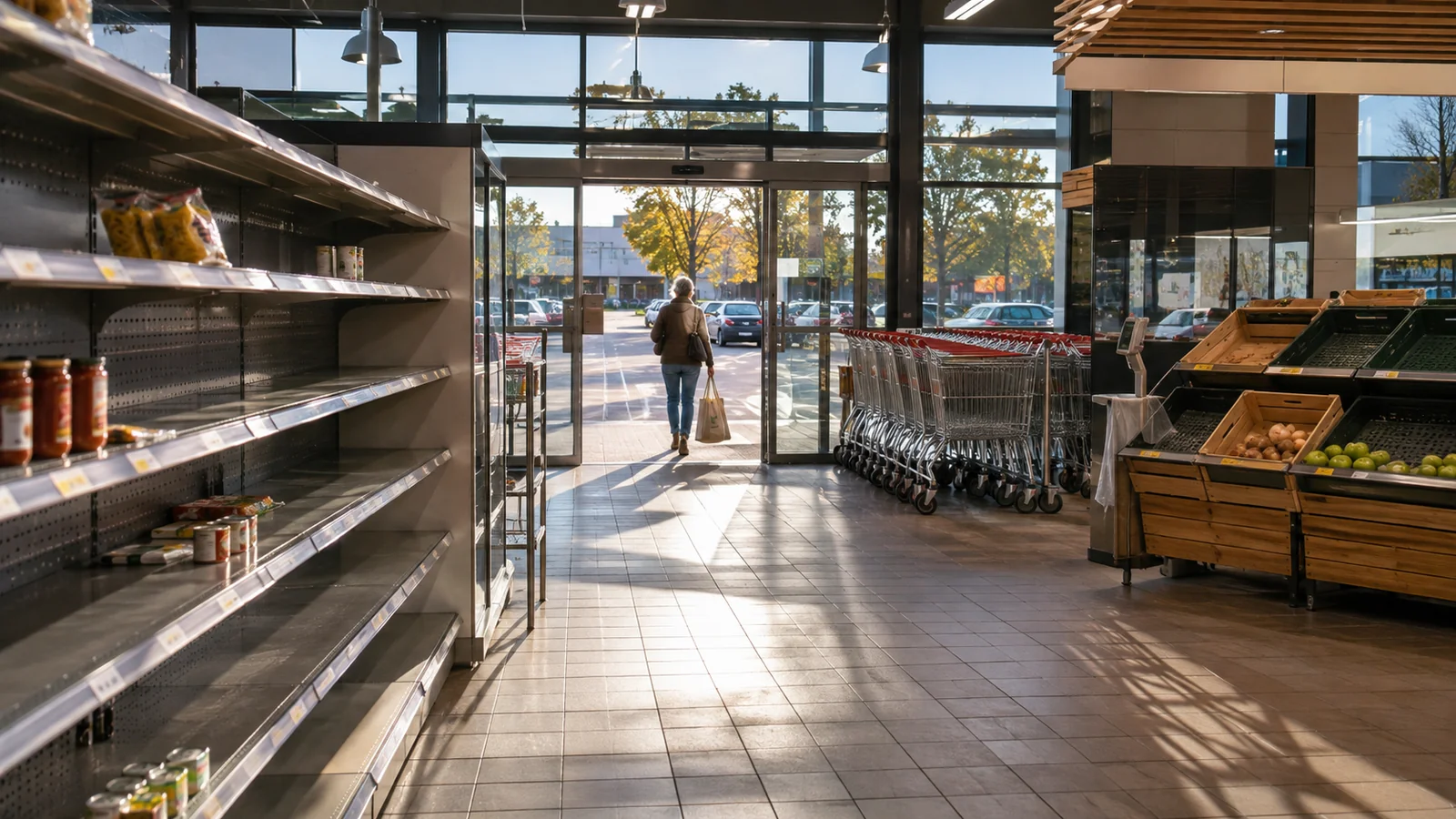
A context of shortage. An unprepared friend. A supermarket on the edge of chaos. And suddenly, a gun. This scenario explores a situation no one wants to live through — but that preparedness lets you anticipate with a clear head.
The scenario context
A major event has weakened supply chains. People feel the uncertainty. A friend — who hasn’t built up reserves or a preparedness plan — contacts you urgently. He begs you to go with him to the supermarket to secure a few essential supplies for himself and his young family.
You agree. When you arrive, it’s immediately obvious: the store is packed. The shelves are emptying fast. Faces are hardening. Tension is rising between people who all feel the same urgency — and the same fear of running out.
Your friend leaves your side briefly to grab an item. An argument breaks out in a nearby aisle. Three men try to intimidate your friend. The situation tips over: your friend pulls out a gun and shoots two of the three aggressors.
Chaos sets in. The police are on their way.
Editorial note: This scenario is fictional and built for educational purposes. Its aim is not to glorify violence, but to explore how decisions are made under extreme pressure in a crisis.
What this scenario reveals before the crisis even starts
Before analyzing how to react in the seconds after the shots, it is useful to identify the structural mistakes that led to this situation. Citizen preparedness starts well before the emergency.
No reserves
Your friend had no reserves. He found himself having to fight for basic resources at the worst possible moment — when everyone was doing the same thing. Basic food and water reserves avoid this type of situation entirely.
No plan
Going into a packed supermarket during a crisis without a precise plan, without a list, without an exit strategy and without assessing the risks means needlessly exposing yourself to situations that can deteriorate very quickly.
Splitting up
Separating from your partner in a high-tension environment is a common tactical mistake. It reduces your ability to support each other and exposes each person individually to threats that a group could have avoided or defused.
Managing emotions
Fear of scarcity drives irrational behaviour. Recognizing this mechanism — in yourself and in others — lets you act with more perspective in an environment where emotions dictate collective behaviour.
The first seconds after the shots
Your friend has just fired. Two people are on the ground. You are at the scene. The police are arriving. What is going through your mind, and what should you do?
Fundamental principle: in the seconds after a violent event, your absolute priority is your own immediate physical safety — then that of the people you are responsible for. Nothing else.
Assess the immediate threat
The third man is still there. Is he armed? Is he running away? Is he still a threat? Your first reading of the environment must answer this question. As long as you don’t know, you stay alert.
Get out of the area
A packed supermarket in a panic is an extremely dangerous environment. A fleeing crowd can be as dangerous as the initial threat — crushes, falls and mass panic cause serious injuries. Identifying secondary exits, avoiding the main flows and getting out calmly but quickly is a priority.
Do not intervene in the scene
The arrival of police at an active shooting scene is a critical moment. Anyone holding an object, making sudden movements or staying in the area may be perceived as a threat. Moving away from the scene, keeping your hands visible and following the instructions of emergency responders is the expected conduct.
Your friend: what is your responsibility?
This is one of the hardest questions in this scenario. Your friend has just used a gun. Depending on the circumstances, he may claim self-defence — or not. It is not for you to judge in the moment. Your role is not to shield him from a police investigation, but not to put yourself in danger by staying at the scene or trying to influence the situation.
In Quebec, as elsewhere in Canada, the use of a firearm in self-defence is governed by the Criminal Code. Assessing whether the response was proportionate is a matter for the courts, not for the people present at the scene. One point that is often overlooked: in Canada, civilians are not permitted to carry a firearm on their person for self-defence. Having a gun in a store is already a serious offence, regardless of the self-defence question. This scenario is therefore in no way a model of conduct: it shows how a decision made long before the crisis (arming oneself) turns an argument into a tragedy. Staying calm, not moving anything and cooperating with responders is the appropriate stance.
Table: each mistake and how to prevent it
| Mistake in the scenario | What would have prevented it |
|---|---|
| No reserves at home | Two weeks of water and food, built up in advance |
| Going out without a plan | Chosen time, short list, route, meeting point, fallback plan |
| Splitting up in the store | A simple rule: we stay together, we leave together |
| An argument escalating | Give up the item, walk away, never respond to intimidation |
| Carrying a gun | Illegal in Canada for a civilian, and a major aggravating factor |
| Staying at the scene | Get out, hands visible, follow police instructions |
What this scenario teaches about preparedness
Beyond managing the incident itself, this scenario illustrates several fundamental principles of citizen preparedness.
- Avoid high-risk situations — The best tactical decision would have been not to go to this supermarket at the height of the crisis. Having reserves at home makes that decision possible.
- Plan before going out — If a trip during a crisis is unavoidable, it must be prepared: chosen time, precise list, route, meeting point, fallback plan.
- Know your legal limits — Knowing what the law says about self-defence, carrying weapons and civilian intervention is not optional. It is part of responsible preparedness.
- Keep the group together — Never split up unnecessarily in a risky environment. Set simple rules for moving as a group before entering a potentially unstable place.
- Manage your own emotional reaction — Panic is contagious. The ability to stay calm in a chaotic environment is a skill that can be developed — notably through mentally simulating this type of scenario.
The central question: what would you do?
This scenario has no single answer. It depends on your position in the store, your relationship with your friend, your own preparedness, the layout of the premises and dozens of other variables.
What matters is having thought about it beforehand. Mentally simulating extreme situations isn’t anxiety — it is a preparedness tool. It helps short-circuit decision paralysis in moments when every second counts.
A few lines of thought to structure your personal analysis:
- Where exactly were you when the shots rang out?
- Did you identify the exits when you entered the store?
- What was your relationship of responsibility toward your friend?
- Were there other vulnerable people around you (children, older adults)?
- How would your own emotional state have influenced your judgment?
Frequently asked questions about this type of scenario
Is it realistic for such a situation to happen in Quebec?
Situations of extreme tension in stores during shortages have been documented in several contexts around the world — notably during major supply crises, natural disasters or periods of prolonged instability. Although Quebec is relatively stable, no region is immune to a rapid deterioration of the social fabric during a severe, sudden crisis. The probability remains low in ordinary times; it increases with the intensity and duration of the crisis.
What is the best way to avoid this type of situation?
The answer is simple in principle: don’t be in that supermarket. Keeping enough food and water reserves for several weeks completely avoids the need to go to a supply point at the height of a crisis. It is one of the most concrete benefits of minimal preparedness.
How can you help an unprepared friend without putting yourself in danger?
The best help you can give an unprepared friend comes beforehand: share your knowledge, encourage them to build their own reserves, recommend resources. During an active crisis, helping a friend get supplies in a hostile environment exposes you to risks that go beyond your own safety. Honestly weighing the service rendered against the risk taken is an adult, legitimate decision.
Is there a right answer to this scenario?
No. This type of scenario is designed to stimulate reflection, not to impose a single answer. The human, contextual and legal variables are too numerous for any single course of action to be universally correct. What matters is having thought about the fundamental principles — immediate safety, emotional management, the legal framework, group cohesion — before facing a real situation.
Key takeaway: the value of a crisis scenario lies not in the answer you give, but in the reflection it prompts. Each mental simulation builds a calmer, more structured and more effective response capacity for when a real situation arises.
Further reading
See building a food reserve from two weeks to 30 days, human behaviour in a crisis and reacting in a crisis: denial, freezing and mental training.