
In this article
How would you really react if the usual landmarks disappeared around you for days, or even weeks? It is an uncomfortable question, and that is exactly why it deserves to be asked, without drama, but without dodging it either. We plan water reserves, first aid kits and evacuation routes; we talk far less about what goes on in people’s heads, and around them, when ordinary structures falter.
This guide takes an honest look at the range of human reactions in a crisis, from the most common to the most extreme, then turns to a skill that modern comfort has greatly eroded: the ability to solve your own problems when you can’t buy the solution. The goal is not to predict your behaviour, but to think now, calmly, rather than at the moment everything tips over.
In brief
In brief. In the vast majority of disasters, mutual aid far outweighs disorder. In extreme, prolonged crises such as wars or state collapse, behaviour becomes much more varied, from remarkable solidarity to brutality. Nobody really knows how they will react: so you prepare by knowing your values and real resources, building bonds of trust, getting used to functioning despite discomfort and practising resourcefulness every day: repairing, substituting, learning by doing.
What is actually observed in disasters
Popular culture often imagines that a disaster turns people into a panicked, selfish mob. Decades of disaster sociology research show the opposite in most cases: after an earthquake, a flood, an ice storm or a major outage, the dominant behaviours are mutual aid, spontaneous organization and sharing. First help is almost always given by neighbours, passers-by and relatives, well before emergency services arrive. Widespread panic is rare; freezing and waiting are far more common.
This finding is reassuring, but it is not the whole story. Behaviour varies with the length of the crisis, the degree of disorganization, pre-existing inequalities and trust between people. The longer a crisis lasts and the more it deprives people of essentials, the wider the range of reactions becomes.
| Type of crisis | Examples | Dominant behaviours observed |
|---|---|---|
| Short and localized | A few days’ outage, a storm, local flooding | Mutual aid, neighbourhood solidarity, occasional tensions |
| Long but structured | 1998 ice storm, pandemic, post-disaster rebuilding | Strong solidarity at first, then fatigue and tension, need for psychological support |
| Extreme and prolonged | War, urban conflict, state collapse | A very wide range, from remarkable solidarity to predatory behaviour |
What extreme, prolonged crises reveal
Situations of prolonged civil collapse, wars, urban conflicts, the disintegration of the state, have been documented by witnesses, journalists, researchers and humanitarian organizations. These accounts converge on one finding: human behaviour in them is rarely what people expect, in either direction. There is no universal “survivor” profile.
By “extreme crisis”, we mean here a situation where essential services, security structures and social landmarks are interrupted for a long time, far beyond a 72-hour outage. In Quebec, such scenarios are very unlikely; studying them mainly helps us understand the human drivers that play out, on a smaller scale, in every crisis.
Five behaviours often described
These categories are neither exhaustive nor judgments. They are patterns that accounts of prolonged crises regularly bring to light.
- Keeping a low profile: many survivors of urban conflicts say they survived by avoiding attention: changing locations, avoiding certain streets, not displaying their resources. Often seen as unheroic, discretion turns out to be one of the most effective strategies where being visible is a risk. See protecting household information.
- Putting your skills to work for survival: people with very ordinary profiles, musicians, craftspeople, office workers, used their know-how in radically different contexts. Entertaining, negotiating, repairing, healing or producing something useful becomes a currency and a source of status.
- Making unexpected moral compromises: accounts often include decisions nobody would have considered in ordinary times, made in desperation when every option is bad. Judging them by everyday standards is an analytical mistake; above all they show the pressure hunger, fear and uncertainty put on judgment.
- Outwitting rather than confronting: some survived not through force, but through their ability to read a situation, defuse it, and deter by perception rather than confrontation. Adaptive intelligence often counts for more than gear.
- Revealing what the social framework held back: when social constraints weaken, some previously ordinary people adopt authoritarian or predatory behaviour. This is documented in studies of social disorganization: the absence of rules is not neutral.
Conversely, the same accounts are full of quiet acts of courage: neighbours hiding or feeding strangers, mutual aid networks forming, people sharing the little they have. Both realities often coexist in the same city, the same street, sometimes the same family. For the community dimension, see community rules in a crisis.
What this changes for preparedness
Knowing your circle realistically
Knowing how others will react matters as much as knowing how you will. The people you share a home, a neighbourhood or a trust network with are the first layer of safety, or of vulnerability. This reflection is not a call for suspicion, but for a realistic knowledge of existing relationships: who is reliable under pressure, who will need help, who might make decisions that put others at risk. Building those bonds before a crisis is one of the best forms of preparedness; see community resilience.
Being wary of your own projections
Most people have an image of themselves in a crisis that holds up poorly against the facts: we imagine ourselves brave, organized, efficient. Studies of acute stress show that real reactions depend on factors that are hard to predict: fatigue, hunger, sleep deprivation, fear for loved ones, isolation. People who thought they were strong falter; others who thought they were fragile reveal unsuspected resources. This is not a reason not to prepare, but to prepare differently, including the psychological dimension. See reacting in a crisis: denial, freezing and mental training.
Understanding group dynamics
In a lasting crisis, informal structures reorganize quickly: some people take authority, groups form around resources, unofficial hierarchies appear. Understanding these dynamics before they unfold lets you navigate them with discernment, and contribute constructively: a group that organizes with clear rules, shared tasks and attention to the most vulnerable gets through an ordeal much better.
Five concrete avenues for reflection
- Your non-negotiable valuesWhat is out of the question for you, whatever the situation?
- Your real resourcesSkills, relationships, adaptability, not just gear.
- Your circleWho is reliable under pressure? Who will need you?
- Discomfort tamedPhysical effort, exercises, simulations: functioning despite fear.
- Uncertainty acceptedPreparedness doesn’t eliminate it; it increases your ability to decide.
- Your non-negotiable values: not to promise yourself unrealistic behaviour, but to have clear landmarks before pressure blurs them.
- Your real resources: which skills, relationships and adaptive capacities could you truly mobilize in a degraded situation?
- The dynamics of your circle: honest answers, not idealized ones.
- Familiarity with stress: gradual exposure to controlled discomfort, demanding physical effort, stress management exercises, simulations, doesn’t make you immune to fear, but trains you to function despite it.
- Uncertainty as a given: preparedness doesn’t aim to eliminate uncertainty, but to reduce immediate dependence and decide better in degraded conditions.
Resourcefulness, a skill that comfort erodes
Our daily lives would seem magical to our great-grandparents: drinking water from the tap, heat at the turn of a thermostat, light with a flick, meals ready in minutes, and almost anything we want delivered the next day. This comfort is enormous progress. It has a quiet side effect, though: when almost every problem can be bought away, we lose the habit of solving it ourselves.
A trivial example: you are missing an ingredient for a recipe. The reflex is to go to the store. But if the store is not an option, during a storm, an outage or simply a voluntary challenge, you have to think: what substitute? What other way of doing it? It is this small mental muscle that makes the difference in a crisis, when the answer is no longer a thirty-minute drive away.
The good news is that resourcefulness is not innate. It can be trained, at any age, with simple steps.
1. Repair before replacing
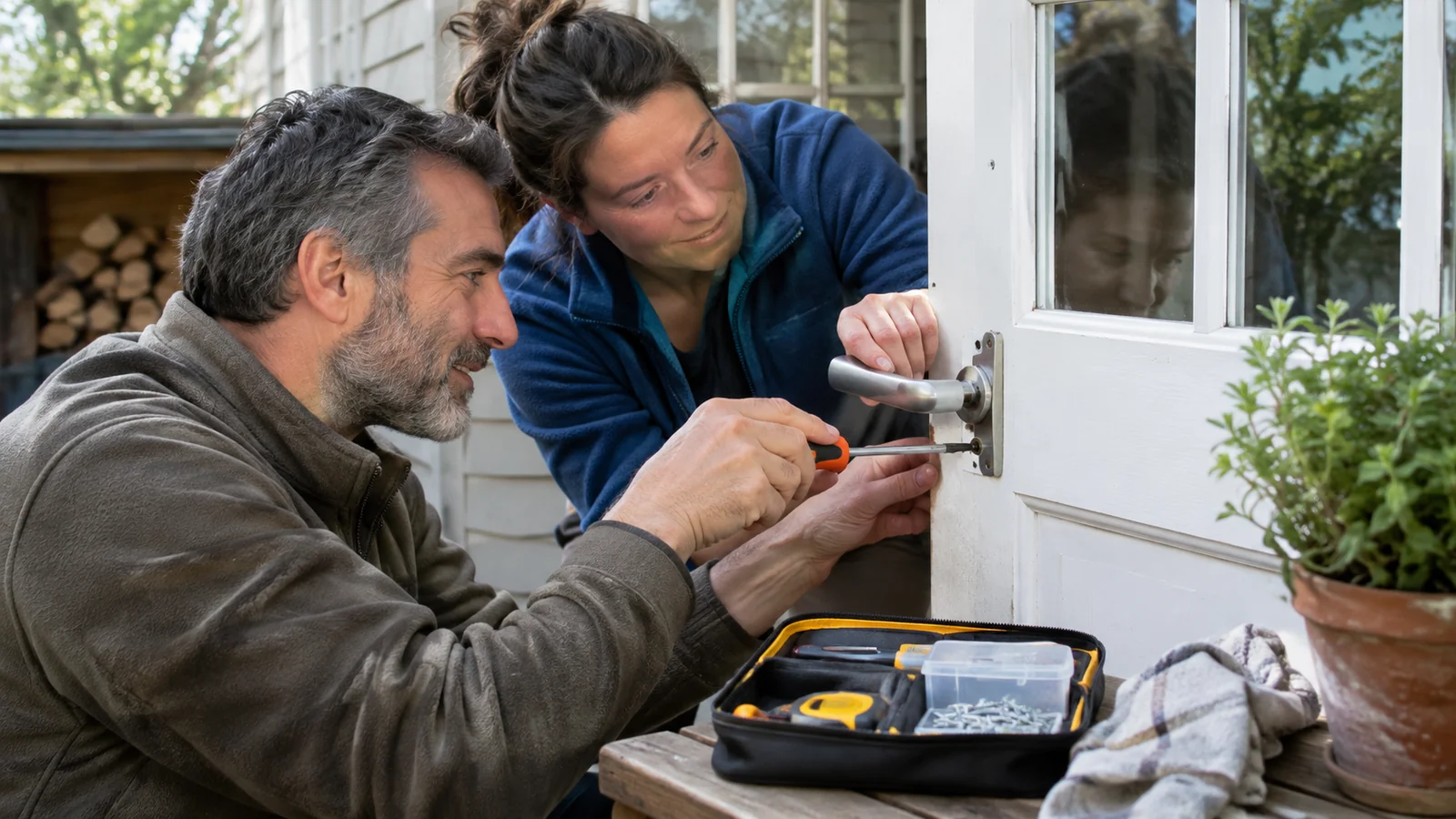
Before buying a replacement, figure out how to repair. Understand how the thing works. Learn a few basics: changing a tire, unclogging a drain, replacing a faucet washer, mending clothing, sharpening a knife, using basic tools. Every successful repair builds confidence for the next. Community repair cafés are an excellent place to learn.
2. Do, don’t just read
Videos and articles are useful, but a skill is only truly acquired by practising it, getting it wrong and trying again. You can watch hours of tutorials on gardening, food preservation or first aid: until you have done it, you won’t develop the practical judgment that lets you sense when something is wrong. Many self-sufficiency plans rest on actions never tried; the time to try them is now, not during the crisis.
3. Anticipate and prepare
Thinking ahead about likely situations helps you accept them faster when they happen, and have a plan B ready. That is the heart of preparedness: a rotating pantry, a family plan, a few tools and supplies to get through a loss of services. See essentials before scenarios.
4. Accept, plan, act
In a crisis, three steps keep coming back: accept reality instead of staying in denial, make a plan quickly, and act. If the plan doesn’t work, start over: accept, replan, move to plan B, then C. In her book on the psychology of disasters, journalist Amanda Ripley reports that several World Trade Center survivors described colleagues who, instead of evacuating, tidied their desks or finished a document: the situation was too enormous to be accepted immediately. The ability to recognize danger quickly made a major difference.
Challenges to practise
| Challenge | What it trains |
|---|---|
| A month without going back to the grocery store except for fresh food | Managing supplies, substitutions, meal planning |
| A weekend without electricity | Lighting, cooking, warmth, organization |
| Repairing one item a month instead of replacing it | Mechanical understanding, confidence |
| A full meal cooked only from your reserve | Knowing your pantry, rotation |
| A day without a smartphone | Navigation, memory, backup communication |
See also the 72-hour no-power, no-water challenge.
What you cannot know in advance
Nobody knows for certain how they will behave in a situation they have never experienced. People’s predictions about their own behaviour in an emergency are often wrong, in both directions. Post-traumatic stress specialists and humanitarian organizations regularly document this gap.
That is no reason to give up, but a reason to prepare with humility: develop a realistic awareness of your limits, build trust networks that don’t rest on you alone, and accept that you will need others as much as they will need you. Looking after your mental health is part of preparedness; see preparedness and mental health.
Reflection has value in itself
Asking yourself “how would I really react?” is not an exercise in fear, but in clear-sightedness. People who have been through serious crises often say it: those who had thought about certain scenarios in advance, even imperfectly, had an advantage in the first critical decisions. Not because they had the right answers, but because they had already asked themselves the right questions. Preparedness, in its deepest dimension, includes this inner work: not to become impervious to fear, but not to be entirely surprised by what adversity reveals, in yourself and around you.
Frequently asked questions
Do people panic in disasters?
Rarely. Research shows that mutual aid and spontaneous organization dominate in most disasters. Freezing and waiting are much more common than panic.
Can you know in advance how you will react?
Not with certainty. You can improve your odds, though, by reflecting on your values and resources, practising useful actions and getting used to functioning under moderate stress.
Should you be wary of your neighbours in a crisis?
No. Neighbours are the first source of help in almost every disaster. The point is to know them well beforehand, know who will need help and build trust.
How do you develop resourcefulness?
By repairing before replacing, learning practical skills, setting yourself concrete challenges (a weekend without power, a month without going back to the grocery store) and learning from your mistakes.
Can these reflections make you anxious?
Approached calmly, they tend to reduce anxiety, because the unexpected is scarier than what you have already thought about. If the topic causes significant distress, it helps to talk to someone close or a professional; in Quebec, Info-Social 811 is available day and night.