
In this article
- In brief
- What are we talking about?
- When institutional structures are no longer available
- Alone or in a community: two different realities
- Six key questions for a community
- What the law allows and does not allow
- The ethical weight of hard decisions
- What this thinking brings to preparedness
- Frequently asked questions
A WROL scenario, a situation without the rule of law, is one of the most complex situations to consider in citizen preparedness. It is not only about food or water: it is about human organization, shared rules and how a community can keep a working framework when ordinary institutions no longer respond.
Preparedness covers many practical areas: water, food, energy, first aid. One area is often left aside, though: what happens when the institutions that guarantee collective safety and justice are overwhelmed or absent? This article does not offer a ready-made code of conduct. It lays out the questions any community committed to resilience should examine, calmly, before it needs to, and it recalls what the law allows and what it does not.
In brief
In brief. When police and courts are temporarily overwhelmed, a group that depends on its members needs simple rules, known to everyone and agreed in advance. Six questions frame this thinking: who decides, which rules, how they are shared, how facts are established, what consequences apply and who carries them out. But no community replaces the law: mediation, making amends and temporary exclusion are possible; violence and summary “justice” remain crimes. As soon as the authorities can be reached, everything goes back to them.
What are we talking about?
WROL (Without Rule Of Law) describes a situation in which the usual legal, police and judicial structures have stopped working normally. It is not only the absence of police officers in the street: it is the temporary inability of the institutional framework to govern relations between people. The WROL scenario and its preparedness priorities describes the mechanisms in more detail.
The question is not reserved for the most extreme scenarios. Serious disruptions, such as a prolonged disaster or a local breakdown of public order, can create gaps of a few days or a few weeks during which communities must organize themselves while waiting for services to return.
When institutional structures are no longer available
In a prolonged crisis, the usual collective resources (police, courts, correctional services) can become unavailable or very limited. These services rely on considerable human, financial and logistical means, and they are often among the first to be redirected toward life-threatening emergencies.
In that context, local communities may find themselves handling situations that used to fall to the authorities: conflicts between people, theft, behaviour that endangers the group. This has been observed during wars, major natural disasters and economic collapses, on several continents.
The point is not to replace institutions or reject them. It is to understand what happens in the temporary space their absence creates, and to think about what a community can reasonably put in place to keep a minimum of cohesion and safety, within the law.
Alone or in a community: two different realities
The question of rules arises differently depending on whether you act alone or as a group.
| Isolated person or family | Community or group | |
|---|---|---|
| Decisions | Made according to your own values and resources, without a formal process | Require a decision-making method everyone accepts |
| Advantage | Speed, no consensus to reach | Shared tasks, mutual vigilance, mutual aid |
| Weakness | No collective safety net | Internal tensions as destructive as an outside threat |
| Main need | Personal plan and contact network | Simple rules, clear roles, conflict management |
It is in a community setting that thinking about rules matters most. A group without a minimal framework risks falling apart from the inside long before it is threatened from the outside. The principles of a resilient human network fully apply here.
Six key questions for a community
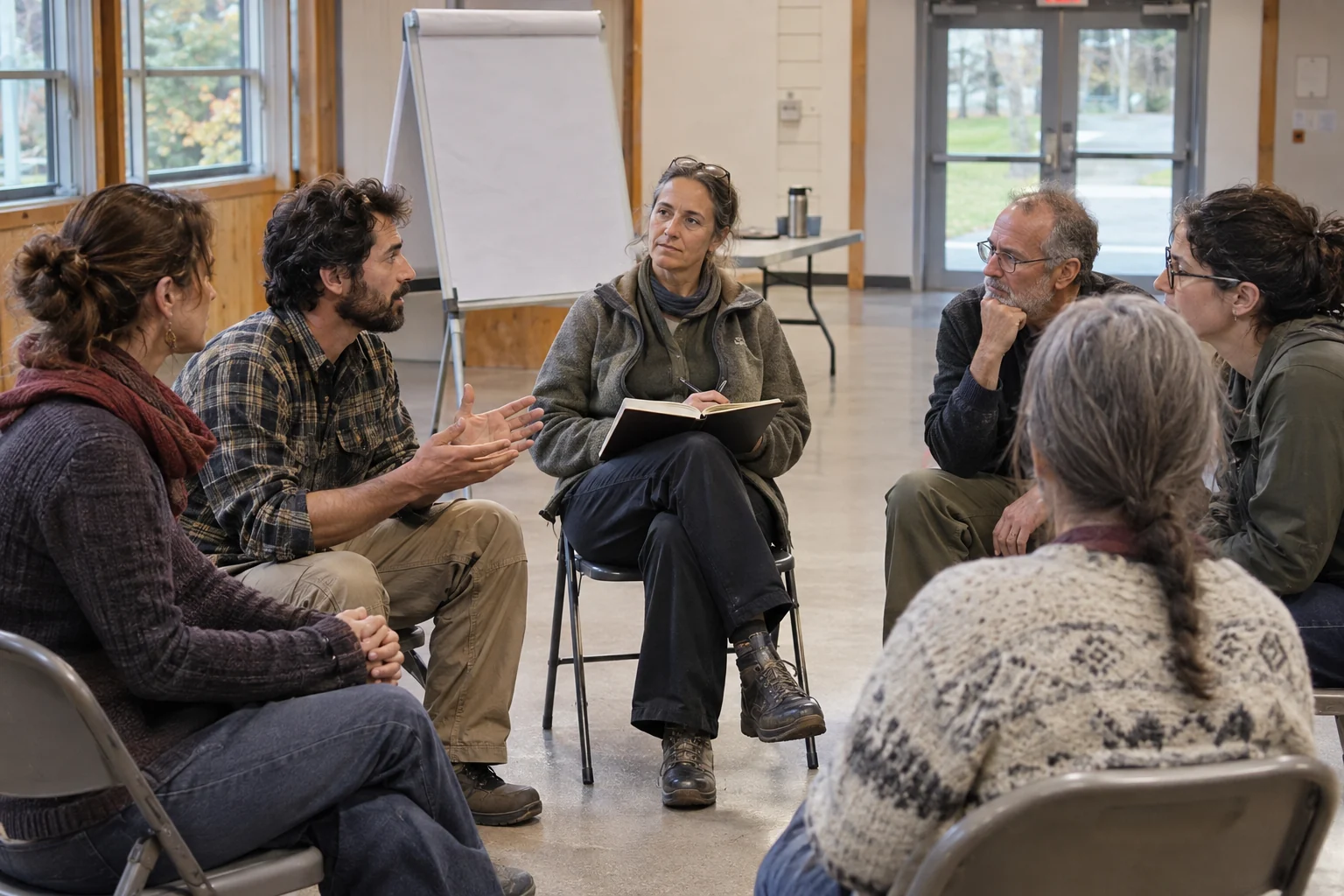
If a community has to manage its own cohesion temporarily, several questions arise. They deserve thought in advance, not to write a parallel criminal code, but to avoid improvising at moments of intense emotional pressure.
1. Who holds decision-making power?
Every functioning community needs some form of leadership. That leadership works better when it is shared, with several adults representing the group’s different interests, rather than concentrated in one person. The key is to define clearly the roles and the limits of that power before an internal crisis occurs. Leadership with vague responsibilities is vulnerable to abuse as well as paralysis.
2. Which rules does the community recognize?
The most basic rules concern harm to people and to shared property: theft, violence, behaviour that endangers collective safety. The simpler and more widely understood the rules are, the more likely they are to be respected. They must also remain compatible with the law: a group rule can never authorize what the law forbids.
3. How are the rules communicated?
A rule is only legitimate if it is known. Rules should be written down, posted, explained and understood by everyone, including newcomers. No one can be held responsible for a rule they did not know about: this basic principle of ordinary law remains relevant in an informal setting.
4. How are the facts established?
In a crisis, the temptation is to act fast. But an unfair decision made in haste can destroy a group’s cohesion as surely as an outside threat. A minimal process protects both the person concerned and the community against mistakes and score-settling:
- hear both sides;
- entrust the review to a few impartial people who are not involved in the conflict;
- examine the available information and write down what was said and decided.
5. What consequences should be planned?
Without courts or correctional services, the possible measures are limited, and that is a good thing. They must be proportionate, known in advance and compatible with the law. The most common are:
- mediation and making amends: apologies, returning property, work for the group’s benefit;
- restricted roles: removal of responsibilities or of access to certain shared resources;
- exclusion from the group, temporary or permanent, in serious cases;
- reporting to the authorities as soon as they can be reached, with the notes taken.
The restorative justice model, already practised in Quebec by alternative justice organizations, shows that a response based on repair and dialogue can preserve social ties better than a purely punitive sanction.
6. Who carries out the decisions?
It is better if the people who set the rules, those who reviewed the situation and those who carry out the decision are not the same. This separation of roles, even informal, reduces the risk of abuse and preserves the legitimacy of each step. It also protects everyone from a disproportionate psychological burden.
- Set the rulesThe whole group, in advance and in writing.
- Review the situationA few impartial people hear both sides.
- DecideA proportionate measure, provided for in the rules.
- Apply and recordOther people apply it; everything is written down for the authorities.
What the law allows and does not allow
A crisis does not suspend the Criminal Code. Even when services are overwhelmed, actions taken during the crisis can be examined afterwards.
- Citizen’s arrest is provided for in Canada (section 494 of the Criminal Code) under strict conditions: the person must be found committing an offence, the force used must be reasonable, and the person must be handed over to a peace officer without delay. In France, article 73 of the Code of Criminal Procedure sets a comparable framework for offences caught in the act.
- Self-defence must respond to a real threat and remain proportionate.
- Prolonged detention, punitive violence and any form of execution are crimes, whatever the circumstances. No gathering of neighbours can decide on a person’s life or physical integrity.
In practice, the strongest measure a community can legitimately take is to separate itself from a dangerous person and alert the authorities. For protecting your household within this framework, see protecting your family: personal safety and self-defence.
The ethical weight of hard decisions
Some situations can push a group under strain toward serious decisions. This territory deserves honest thought, precisely because it is uncomfortable. Any decision with heavy consequences should weigh on those who make it and on those who carry it out. That weight is not a weakness: it is a sign of an intact ethical conscience. A community that takes such decisions lightly has lost something essential.
The history of crises shows that groups that slide into summary “justice” often fall apart, and that score-settling leaves marks for years after things return to normal. Thinking about justice in a crisis is not pleasant. That is exactly why it deserves to be done calmly, before an emergency forces poorly prepared decisions.
What this thinking brings to preparedness
Thinking about community rules does not mean anticipating the collapse of civilization. It means recognizing that:
- institutional resources can be temporarily unavailable, even in moderate crises;
- communities that have thought about their rules before a crisis handle tension better than those that improvise;
- simple, known and accepted rules are sturdier than complex rules imposed under pressure;
- separating roles protects the group’s cohesion;
- any process, even a minimal one, is better than no framework in a high-tension situation.
In practical terms, if your preparedness group, your building or your street plans to cooperate in a crisis, a one-hour meeting to agree on a few rules and on how to settle disagreements is a useful resilience investment. To get started, see the basics of citizen preparedness.
Frequently asked questions
Is WROL realistic in Quebec or Canada?
A total and lasting collapse of institutions is very unlikely in the Canadian context. However, major disasters, prolonged crises or failures of essential infrastructure can leave services overwhelmed for several days or weeks. That is where thinking about community rules has practical value.
When should a community define its rules?
Before a crisis happens. Rules decided under pressure or in the heat of emotion are generally less balanced, less legitimate and less accepted than rules built calmly and collectively.
Do a group’s rules have legal value?
No. They can organize the internal life of a private group, but they never replace civil or criminal law. They cannot authorize anything the law forbids, and any serious incident must be reported to the authorities as soon as possible.
What should you do about a dangerous person if the police do not come?
Get people to safety, avoid confrontation, separate from the person, write down the facts and keep trying to reach emergency services. A citizen’s arrest is only possible under strict conditions, and the person must be handed over to the police without delay.