
In this article
- In brief
- What we know about violence in crises
- A personal safety plan
- During evacuation or in a collective shelter
- When the danger comes from within the group
- Defending yourself: prevention, escape and the law
- Keeping your head: the resource no one can take
- Where to get help
- Conclusion
- Frequently asked questions
When we picture a prolonged crisis, we think first about water, food and energy. We think less often about a risk that is nonetheless well documented: violence against women and girls increases during and after disasters. The subject is rarely discussed in citizen preparedness, even though it directly affects the safety of many families.
This article reviews what is known about these risks, without sensationalism, and offers practical ways to prepare: a personal safety plan, habits for collective shelters, vigilance within a group and sources of help. It is written for women and for those close to them, because everyone’s safety is everyone’s business.
If you are in danger right now. Call 911 in Canada, or 17 or 112 in France (or text 114). In Quebec, SOS violence conjugale answers day and night at 1-800-363-9010. In France, 3919 (Violences Femmes Info) is free and anonymous.
In brief
In brief. Humanitarian organizations observe a rise in gender-based violence during disasters, population displacement and lockdowns. The danger most often comes from people the victim knows, including within the household or group. Preparing means having a personal safety plan, keeping a trusted network, knowing where to get help and adopting a few simple habits in collective shelters. Mental resilience matters as much as gear.
What we know about violence in crises
You do not need to imagine a world without the rule of law to grasp the problem. Field observations from humanitarian work point the same way:
- Disasters amplify existing risks. The International Federation of Red Cross and Red Crescent Societies (IFRC) documented, in its report on gender-based violence in disasters, a rise in domestic and sexual violence after several major disasters.
- Lockdowns had the same effect. During the COVID-19 pandemic, UN Women spoke of a “shadow pandemic”: many countries reported more calls to domestic violence helplines.
- Collective shelters carry their own risks. Lack of privacy, poorly lit washrooms, crowding and stress: humanitarian guidelines recommend specific arrangements to protect women and children in camps and shelters.
- Attackers are most often known to the victim. In normal times as in crises, most sexual assaults are committed by someone the victim knows: a partner, former partner, relative or acquaintance. The danger does not mainly come from strangers.
To understand the local reality, you can look up police statistics for your area: the number of reported assaults is often higher than people expect, and many are never reported. The point is not to frighten, but to recall that personal safety is fully part of preparedness.
| Crisis situation | Increased risks | Useful preparation |
|---|---|---|
| Prolonged lockdown at home | Domestic violence, isolation, control over means of communication | Personal safety plan, code word with a trusted person, helpline numbers memorized |
| Evacuation and collective shelter | Assaults in poorly lit or isolated areas, crowding | Move in groups, headlamp, report any worrying behaviour to staff |
| Travel and journeys | Exposure in unfamiliar places, dependence on strangers | Shared route, charged means of communication, never accept conditional help |
| Group or prolonged mutual aid | Tension, alcohol, possessive or aggressive behaviour | Clear group rules, do not stay isolated, speak up early, leave the group if needed |
A personal safety plan
A safety plan is a tool recognized by victim support organizations. It is prepared in advance, ideally with a support worker, and can be adapted to crisis situations:
- A trusted network. Two or three people who know where you are and whom you can reach quickly. Agree on a code word that means “call for help”.
- Essential numbers. Write them on paper, not just in your phone: emergency services, a helpline, the nearest women’s shelter, a relative outside the region.
- Documents. Keep copies of your ID, health cards, prescriptions and your children’s documents in a safe place or with a trusted person.
- A small personal supply. Some cash, a charged phone or power bank, a change of clothes and your medication, ready to go.
- A place to go. Know where you could go: a relative, a women’s shelter, a municipal emergency shelter.
If you are already experiencing violence at home, the article Domestic violence during a crisis: safety and support explains the approach in detail, including digital safety and how those around you can help.
During evacuation or in a collective shelter
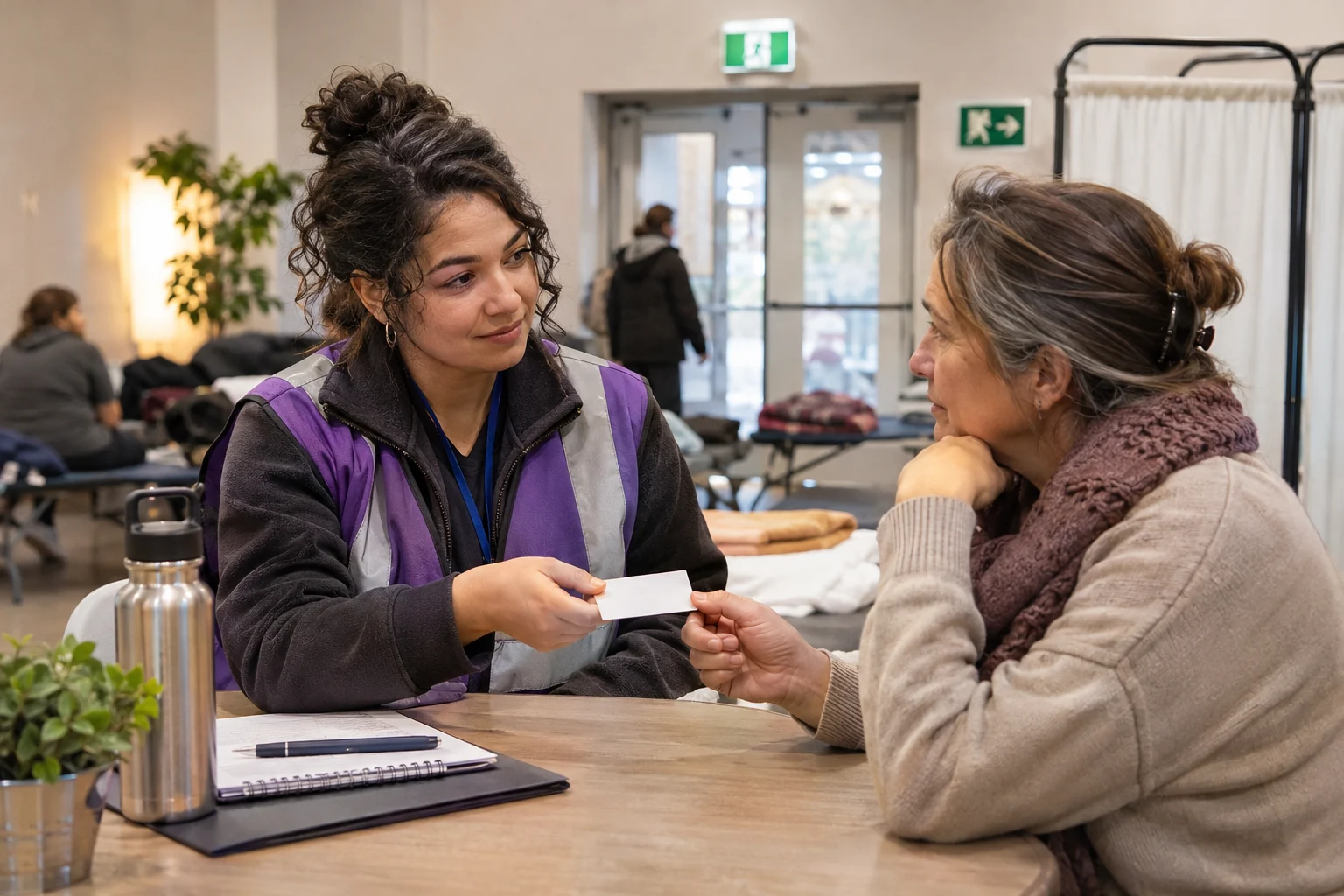
Emergency shelters are generally safe and supervised places. A few habits reduce the risks further:
- Stay with your family or a group of trusted people, especially at night.
- Go to washrooms and showers with others, with a headlamp.
- Keep your children in sight and agree on a meeting point inside the shelter.
- Identify the staff in charge and report any worrying behaviour without delay.
- Pack menstrual and personal hygiene products in your go bag, as they are often in short supply in the first days. See menstrual, reproductive and personal needs in emergencies.
When the danger comes from within the group
A prolonged survival situation creates dependencies: people rely on one another for water, food and safety. That interdependence can make it hard to push back against someone whose behaviour becomes possessive, unpredictable or aggressive, especially when alcohol is involved. A phrase like “if I can’t have you, no one can” is a serious warning sign.
- Do not stay alone with the person and do not keep the situation to yourself: tell other group members early.
- Set group rules from the start: no alcohol during watch shifts, respect for refusal, a procedure for conflicts.
- Plan a way out: know whom or where you could turn to if things get worse, even if it means leaving the group.
- Involve the authorities as soon as possible: even in the middle of a crisis, police, emergency services and support organizations usually keep operating, sometimes in reduced form.
These principles mirror those of a healthy mutual aid network: trust is built on clear rules and respect for everyone.
Defending yourself: prevention, escape and the law
Taking a self-defence course can build confidence and teach you how to react. Good programs focus first on prevention, reading situations, assertiveness and escape. The goal is to break free and reach a safe place, not to punish the attacker.
In Canada as in France, self-defence must remain necessary and proportionate to the threat. Taking the law into your own hands or retaliating remains illegal, including during a crisis. Defence sprays are prohibited for individuals in Canada and strictly regulated in France. For simple everyday habits, see preventing confrontations and asking for help.
Keeping your head: the resource no one can take
In the hardest situations, one thing remains yours: your thoughts. People who have been through extreme ordeals often describe how important it was to hold on to their inner “small voice”, their values and what connects them to others. Staying clear-headed, setting small goals, keeping hope and remembering why you are holding on are real strengths.
Survival may sometimes require going along temporarily to protect your life or your children’s, while waiting for a safe chance to get out or get help. There is no weakness in that. Afterwards, the psychological effects of an assault or a period of great danger deserve support: CAVACs in Quebec and victim support associations in France offer free help. See also preparedness and mental health: maintaining balance.
- Prepare your planTrusted network, code word, numbers written on paper, a place to go.
- Don’t stay isolatedMove in groups, especially at night and in shared spaces.
- Heed warning signsPossessiveness, threats, alcohol: speak up early and move away.
- Raise the alarmShelter staff, loved ones, police or helplines as soon as possible.
- Look after yourselfHold on to your mental anchors and seek support afterwards.
Where to get help
| Where | Resource | Contact |
|---|---|---|
| Canada | Emergency | 911 |
| Quebec | SOS violence conjugale (24/7, free, confidential) | 1-800-363-9010 |
| Quebec | Crime victims assistance centres (CAVAC) | 1-866-532-2822 |
| France | Emergency | 17 or 112, text 114 |
| France | Violences Femmes Info (free, anonymous) | 3919 |
These numbers can change: check them and write them down in your emergency kit. The preparedness review helps you spot what your plan is still missing.
Conclusion
Thinking about the risk of violence in a crisis is not giving in to fear. It is acknowledging a documented reality and preparing for it methodically, just as you would for water or energy. No manual can cover every eventuality, and decisions will always depend on the situation. But a safety plan, a trusted network and a few simple habits make a real difference. For the broader context of a prolonged breakdown, see also the WROL scenario and its preparedness priorities, and the overlooked strengths women bring to citizen preparedness.
Frequently asked questions
Does violence really increase during disasters?
Yes. Humanitarian organizations such as the IFRC and UN Women have documented a rise in gender-based violence during disasters, population displacement and lockdowns, notably during the COVID-19 pandemic.
What is a personal safety plan?
It is a set of measures prepared in advance: trusted people, a code word, emergency numbers, documents and belongings ready to go, a place to take refuge. Helplines such as SOS violence conjugale or 3919 can help you build one.
What should I do if someone in the group becomes threatening?
Do not stay alone with them, tell other group members quickly, move away and alert the authorities as soon as possible. Your safety comes before group cohesion.
Is a self-defence course useful?
Yes, especially one that focuses on prevention, assertiveness and escape. The goal is to break free and reach a safe place, within the legal limits of self-defence.