
In this article
- In short
- What is a tornado?
- The numbers in Canada and Québec
- In France: several dozen tornadoes a year
- Watch versus warning: what you need to know
- Signs that should make you act
- Where to take shelter
- Prepare your shelter and your family
- After the tornado
- Your kit for storm days
- Frequently asked questions
- Sources
Late in the afternoon of September 21, 2018, a tornado crossed the Ottawa River and tore through the Mont-Bleu area of Gatineau. Environment and Climate Change Canada rated it EF3, with winds of up to 265 km/h (165 mph). Six tornadoes were confirmed in eastern Ontario and Québec that day. Many residents described the same sequence: the sky went dark, there was a roar, and it was all over in minutes.
Canada is one of the countries with the most tornadoes in the world, and Québec is its second most active province. France also gets several dozen a year. A tornado leaves very little time to react, which is why everything has to be prepared ahead of time. This guide explains how tornadoes form, what recent numbers show, how to recognize the signs and where to take shelter, whether you are at home, in a car or outdoors.
In short
In short. Québec averages 10 to 11 tornadoes a year, mostly from May to August, and 21 were confirmed in 2024. Most have winds below 180 km/h (112 mph), but the strongest exceed 265 km/h (165 mph). The right reflex: at the first warning or the first sign, go to the basement or a small windowless room in the middle of the ground floor, protect your head and neck, and stay sheltered for at least 60 seconds after it passes. A car, a mobile home or a shed offers no protection.
What is a tornado?
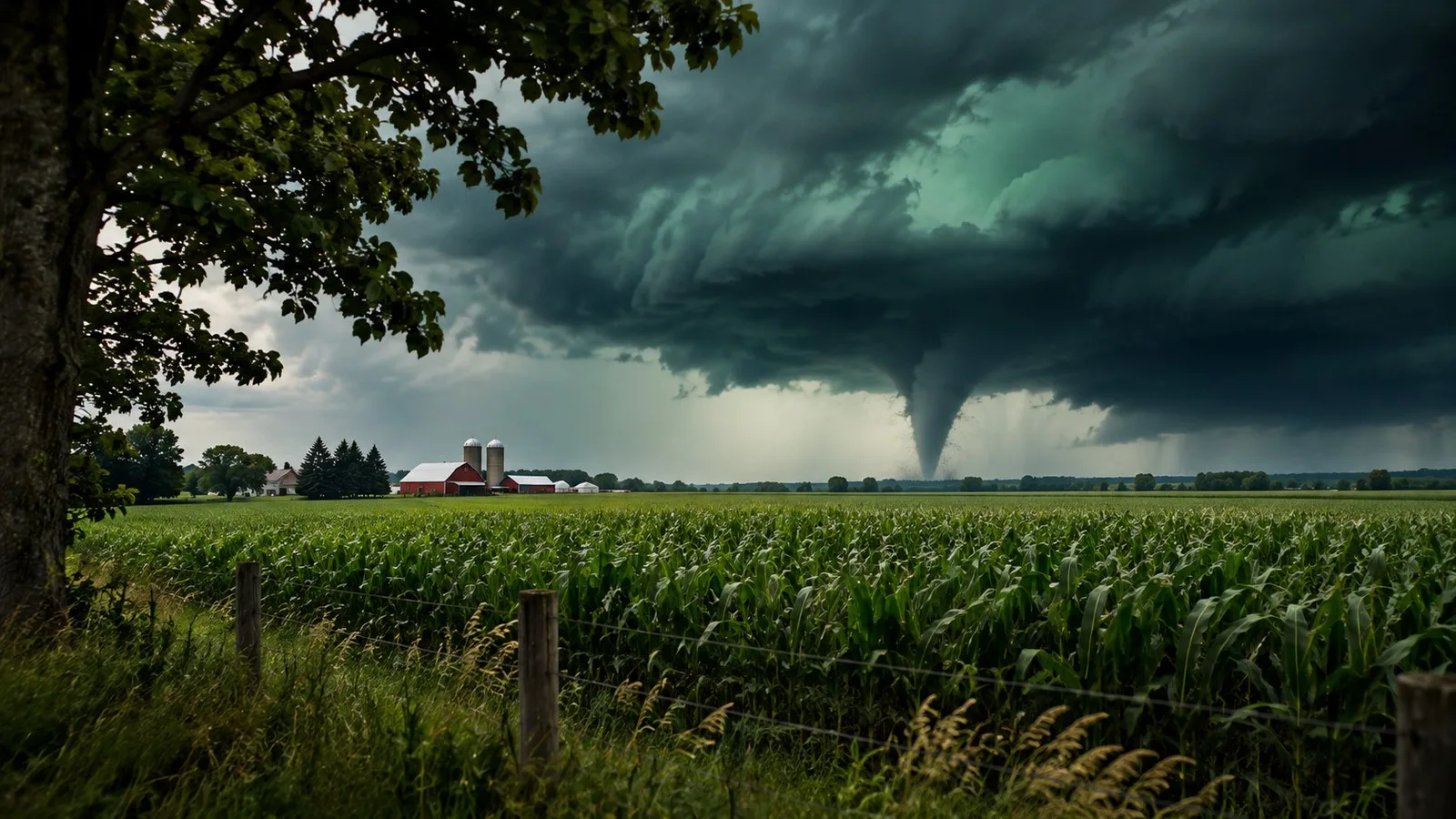
A tornado is a violently rotating column of air that extends from a thunderstorm cloud, the cumulonimbus, down to the ground. It forms in the most powerful storms, when warm, humid air near the ground meets winds that change direction and speed with height. The Québec government notes that a tornado can travel at up to 70 km/h (43 mph) and change course unpredictably.
Its passage is brief, often a few minutes, and narrow: the damage path can be only a few dozen metres wide. That is why you see striking images of one house flattened next to another almost untouched. In France, Keraunos, the French tornado and severe storm observatory, reports that tornado paths average 4 to 6 km (2.5 to 3.7 mi).
The Enhanced Fujita scale
Tornado winds are not measured directly: they are estimated from the damage. Since April 2013, Canada has used the Enhanced Fujita (EF) scale, which relies on 31 damage indicators, from houses to office towers to trees.
Estimated wind speed (km/h)
- EF090 to 130 km/h (56 to 81 mph)
- EF1135 to 175 km/h (84 to 109 mph)
- EF2180 to 220 km/h (112 to 137 mph)
- EF3225 to 265 km/h (140 to 165 mph)
- EF4270 to 310 km/h (168 to 193 mph)
- EF5315 km/h or more (196 mph or more)
Source: Environment and Climate Change Canada
According to Environment and Climate Change Canada, most tornadoes in the country have maximum winds below 180 km/h (112 mph), placing them in the EF0 or EF1 range. That is still enough to rip off roofs, overturn trailers and hurl debris that turns into projectiles.
The numbers in Canada and Québec
Western University’s Northern Tornadoes Project, which tracks and verifies Canadian tornadoes, confirmed 129 tornadoes in Canada in 2024. That was the second most active season on record, after the record of 131 tornadoes in 2022. The 2024 season was also the longest documented since at least 1980: 240 days, from March 16 to November 10, whereas an average season runs about six months, from mid-April to mid-September.
Québec recorded 21 tornadoes in 2024, four of them over water, making it the second most affected province after Ontario. MétéoMédia reports that the province averages 10 to 11 a year, and that since 2017 it has topped 30 tornadoes in a year three times. June 13, 2024 was the busiest day, with 10 tornadoes, including two near Senneterre in Abitibi.
Tornadoes per season
- 2022 (record)131
- 2024129
- Québec, 202421
- Québec, yearly average10 to 11
Sources: Northern Tornadoes Project, Western University; MétéoMédia
According to Public Safety Canada, tornadoes have been recorded in every province and territory, but they are most frequent in southern Alberta, Saskatchewan, Manitoba, Ontario, Québec and western New Brunswick.
Gatineau and Ottawa, September 21, 2018
Environment and Climate Change Canada’s preliminary statement lists six tornadoes that day:
- Kinburn and Dunrobin, Ontario, to Gatineau: EF3, winds up to 265 km/h (165 mph), many injuries, some of them serious.
- Arlington Woods to Greenboro, Ottawa: EF2, winds up to 220 km/h (137 mph).
- Calabogie to White Lake, Ontario: EF1, winds up to 175 km/h (109 mph).
- Three EF1 tornadoes in Québec: Val-des-Bois (13 km or 8 mi path), near the Baskatong Reservoir (10 km or 6 mi) and north of Otter Lake (3 km or 2 mi).
The event showed that a major tornado can hit a large urban area in Québec, not just the countryside.
In France: several dozen tornadoes a year
Météo-France notes that tornadoes, usually weak, occur every year in mainland France, but that no complete climatology exists. Keraunos estimates there are several dozen a year, mostly between May and October and in the second half of the day. The vast majority are weak, but violent tornadoes do occur: on August 24, 2026, an EF3 tornado hit Pomas, in the Aude department.
The count is imperfect, Keraunos points out, because weak tornadoes and those in sparsely populated areas often go unnoticed. France has no dedicated tornado warning: Météo-France’s map flags thunderstorms, and that is the one to watch.
Watch versus warning: what you need to know
Environment and Climate Change Canada uses two alert levels:
- Thunderstorm outlookUp to 36 hours ahead, a map shows the risk of severe storms. It is not an alert, but a cue to check your plan.
- Conditions are favourableConditions could produce severe thunderstorms or tornadoes. Keep an eye on the sky and on updates, and get your shelter ready.
- Tornado imminent or occurringA tornado is forming or has been observed. Take shelter immediately, without waiting to see it.
Source: Environment and Climate Change Canada
Severe thunderstorm and tornado warnings now use targeted polygons that cover only the threatened area. It is common to see a watch and a warning in effect for the same region at the same time. In Canada, the most serious warnings are sent to cell phones through the Alert Ready system. Keep your phone charged and the sound on during high-risk days.
You can follow current alerts on the PrépaCivile live watch, which shows Environment Canada warnings and Météo-France thunderstorm alerts.
Signs that should make you act
A warning does not always arrive in time. The Québec government and Public Safety Canada list the signs to recognize:
- a very dark sky, sometimes tinged green or yellow;
- frequent lightning and thunder, torrential rain or hail;
- a continuous roar or whistling sound, often compared to a train;
- a funnel-shaped cloud at the base of a thunderstorm cloud.
If you notice any of these signs, do not wait for confirmation: take shelter.
Where to take shelter
Advice from the Government of Québec and Public Safety Canada.
- Lowest, most centralBasement, otherwise a small windowless room on the ground floor: bathroom, hallway, closet. Under sturdy furniture, arms over head and neck.
- No elevatorsTake the stairs to a lower floor, into a hallway or interior room away from windows.
- Get outIt offers little protection: head to a sturdy building or shelter nearby without delay.
- Do not outrun itDo not try to outrun the tornado. Get to a building; otherwise pull over, set the parking brake, turn on hazard lights. Never under a bridge or overpass.
- Get lowWith no building nearby, lie face down in a ditch or low spot, hands over your head, away from trees and poles.
Sources: Government of Québec; Public Safety Canada
A few details that save lives:
- Do not open windows. The idea that you need to “equalize the pressure” is a myth; you lose seconds and expose yourself to flying glass.
- Avoid large roofs. Gyms, churches, barns and arenas have wide roofs that can collapse.
- Not under an overpass. Wind speeds up there and debris is funnelled through.
- Near power lines: if you are in a car and a line is within 10 m (33 ft) or has fallen on the vehicle, do not try to get out.
Prepare your shelter and your family
Preparation happens in spring, before storm season. A tornado often leaves only a few minutes: everyone needs to know where to go without thinking.
The shelter corner
Pick the safest spot in the house and keep it accessible: no heavy objects on shelves above it, a clear path, a headlamp hanging by the door. In a basement, the best place is the most underground side or under the stairs. Keep a small bag there with enough to last a few hours:
- a headlamp or flashlight for each person, and batteries;
- a whistle to signal where you are if you are trapped under debris;
- closed shoes and work gloves, to get out through glass and nails;
- a first aid kit;
- a battery or hand-crank radio and a charged power bank;
- water and copies of your important documents.
Run a drill
Once a year, run a family drill: someone shouts “Tornado!” and everyone reaches the shelter in under a minute. Children should know where to go even if you are not home. Also find out what the plan is at school, daycare and your workplace.
Around the house
Debris causes a large share of injuries. Before a high-risk day, bring in or tie down patio furniture, garbage bins, trampolines and toys. Have dead branches near the house trimmed. Take photos of your home and belongings for insurance purposes.
After the tornado
- Stay sheltered for at least 60 seconds after it passes: more gusts or a second tornado can follow.
- Go out carefully, in closed shoes and gloves. Watch for nails, glass and weakened structures.
- Stay at least 10 m (33 ft) away from any downed power line and call 911.
- If you smell gas, leave and call from outside.
- Check on your neighbours, especially older people and those living alone.
- Photograph the damage before cleaning up and contact your insurer.
- Follow local authority instructions, which may close off some areas.
A tornado is often followed by a long power outage in the affected area. The power outage fact sheet helps you get through several days.
Your kit for storm days
Frequently asked questions
When are tornadoes most common in Québec?
Mostly from May to August, in the afternoon and evening, on hot and humid days. But the 2024 season showed they can occur from March to November.
I have no basement. Where should I go?
To the smallest windowless room in the middle of the ground floor: a bathroom, closet or interior hallway. If you live in a mobile home, move to a sturdy building as soon as a watch is issued.
Can I outrun a tornado by car?
No. Authorities ask you not to try: a tornado can change direction, and roads can be blocked by debris or traffic. Get to a sturdy building or, failing that, pull over and protect yourself.
Is tornado damage insured?
In Canada, wind damage is generally covered by basic home insurance, but check your policy and deductibles. In France, tornadoes may fall under the storm coverage of your home insurance policy.
Disclaimer. This article is for public information and preparedness. It does not replace alerts from Environment and Climate Change Canada or Météo-France, or instructions from authorities. In an emergency, call 911 (Canada) or 112 (France).
Sources
- Government of Québec, Tornade : quoi faire avant, pendant et après (in French)
- Public Safety Canada, Tornadoes: how to prepare (in French)
- Environment and Climate Change Canada, Severe thunderstorms and tornadoes (in French) and Enhanced Fujita scale for wind damage
- Environment and Climate Change Canada, Six tornadoes confirmed in eastern Ontario and Québec, 2018 (in French)
- Western News, Northern Tornadoes Project: 2024 season
- MétéoMédia, Tornadoes in Québec: a more active season than thought (in French)
- Keraunos, Tornadoes in France; Météo-France, Wind, storms, tornadoes and cyclones (in French)
Go further: the Tornado fact sheet, the Power outage fact sheet, the emergency equipment builder and the live watch.