
In this article
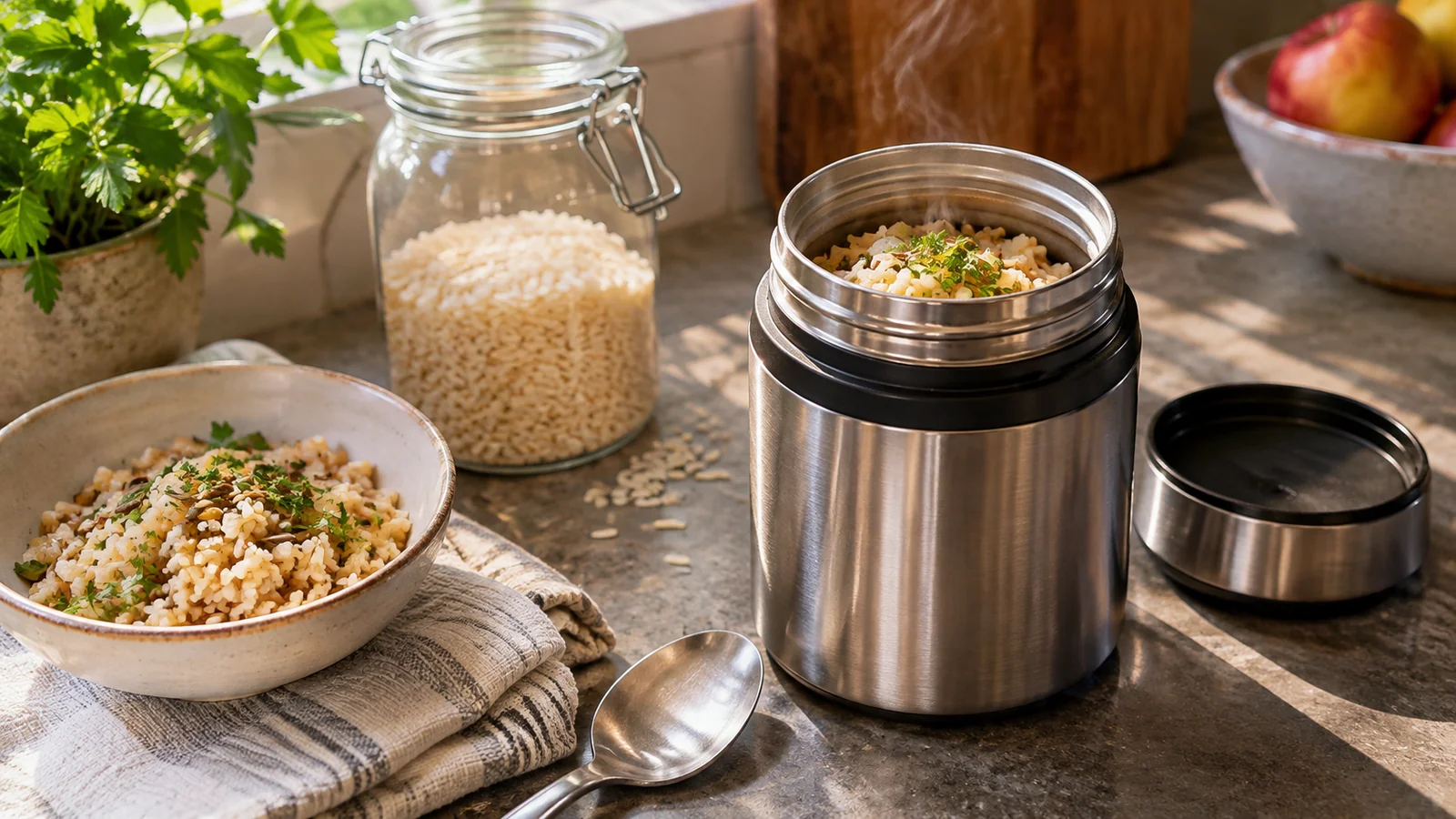
Looking for a way to cook without the power grid, with no fireplace or indoor cooking method? The insulated container at the back of your cupboard can do much more than keep coffee hot in a cold house or make homemade yogurt. If you can boil water and you have a good insulated bottle or food jar, you can prepare all kinds of food.
The method was popularized by sailors, because it uses far less fuel than cooking on a stove and reduces the risk of fire on board. It suits citizen preparedness just as well: if you are short on fuel, or don’t have an elaborate off-grid cooking setup, an insulated container can become a valuable ally. And even in normal times, a cooking method that uses less energy is always a good idea.
The principle is passive cooking, or the “haybox” method: you bring the food to a boil for a few minutes, then let it finish cooking in the heat held in by the insulation.
Which insulated container to use for cooking?
A cheap container won’t do. Many models keep a meal warm until lunch, but don’t hold enough heat to cook food, or can’t handle boiling water.
What to look for:
- a double-walled, vacuum-insulated stainless steel body, with no plastic or glass lining;
- a wide mouth, much easier to fill, empty and clean;
- a suitable capacity: about 0.7 L (24 oz) for one person, 1 to 1.2 L (34 to 40 oz) for a bigger meal, 2 L (68 oz) for a family;
- good stated heat retention, ideally checked with a test at home (see below).
A canning funnel makes filling easier and reduces the risk of burns, a long thin spatula helps get food out, and a bottle brush simplifies cleaning.
Testing your container
Before relying on a container, test it: preheat it, fill it with boiling water, close it and measure the water temperature with a kitchen thermometer after 4 hours, then after 8 hours. To cook safely, the water must stay above 60 °C (140 °F) for the entire planned cooking time.
The basics of insulated cooking
- PreheatFill with boiling water, close, wait 5 minutes, then empty.
- Pre-cookBring the food to a boil for a few minutes in a pot.
- Transfer while boilingPour everything in quickly, with the funnel, leaving 2.5 cm (1 in) of space.
- Close and waitDon’t open it during cooking: every opening lets heat escape.
- Check and serveThe food should be steaming; if not, reheat it before eating.
Start by preheating the container: pour in boiling water, close it and wait five minutes. Meanwhile, bring more water to a boil and do any pre-cooking needed. Then empty out the preheating water and keep it for another use, such as washing dishes or rinsing rice.
Add the boiling food and liquid, then close quickly. In very cold weather, you may need to restart the cooking halfway: pour the contents into a pot, bring back to a boil, and return them to the preheated container.
Don’t open the lid to check: you would let out the heat that is cooking the food.
Food safety
- Keep food above 60 °C (140 °F) throughout cooking and holding. Between 4 and 60 °C (40 and 140 °F), bacteria multiply quickly.
- For meat, poultry and fish, use pre-cooked, canned or freeze-dried food rather than raw, and bring everything to a boil before transferring.
- Dried red kidney beans must boil vigorously for at least 10 minutes to destroy a natural toxin; gentle cooking alone isn’t enough.
- Don’t let cooked food cool in the container for hours: eat it hot, or refrigerate it quickly.
- Wash the container and the lid seal thoroughly after each use.
Rice
Rice is one of the easiest foods to cook this way. Rinse it before cooking if you have enough water; the preheating water can be used for this.
- Instant rice: preheat the container, then add equal parts instant rice and boiling water. Leave about 2.5 cm (1 in) of space at the top for the rice to expand. Close: it is ready in 30 minutes and stays hot for several hours.
- White rice: in a pot, bring 250 ml (1 cup) of rice and 375 ml (1½ cups) of water to a boil and simmer for 5 minutes. Transfer to the preheated container, close and let stand 2 hours. If you plan to leave it more than 4 hours, reduce the water by 60 ml (¼ cup) so it doesn’t overcook.
- Brown rice: same method, with 5 minutes of simmering, then 4 to 5 hours of standing.
Soups
Chicken noodle soup
- Preheat the container.
- Bring 500 ml (2 cups) of chicken broth to a boil.
- Put 250 ml (1 cup) of dry noodles, 15 ml (1 tbsp) of dried minced onion, 5 ml (1 tsp) of garlic powder and 5 ml (1 tsp) of parsley in the container, plus canned or freeze-dried chicken if you like.
- Pour in the boiling broth, close and let stand about 4 hours.
Split pea soup
- Preheat the container for at least 5 minutes.
- In a pot, combine 250 ml (1 cup) of rinsed dried split peas, diced cooked ham (or freeze-dried), 30 ml (2 tbsp) of minced onion, 1 diced carrot (or 60 ml, ¼ cup, of dehydrated carrot), 2 bay leaves, 2.5 ml (½ tsp) of sage, 2.5 ml (½ tsp) of thyme, salt and pepper, with enough water to cover generously.
- Boil for 3 minutes, then pour into the container.
- Close and let stand 4 to 8 hours. Check that the soup is still steaming before serving; if not, reheat it.
Oatmeal
A simple breakfast, useful even once the power is back:
- Preheat the container.
- Add 125 ml (½ cup) of rolled oats, 125 ml (½ cup) of dried fruit, 5 ml (1 tsp) of cinnamon, 15 ml (1 tbsp) of brown sugar and a pinch of salt.
- Bring 250 ml (1 cup) of water or milk to a boil and pour it into the container.
- Close and let stand 30 minutes to an hour. Stir before serving.
Freeze-dried meals
An excellent way to prepare the freeze-dried meals in your reserve while using a minimum of fuel:
- Preheat the container.
- Read the package to find the amount of water needed, and bring it to a boil.
- Pour the contents of the pouch into the container, then the boiling water. Leave room for the food to expand as it rehydrates.
- Close and let stand about an hour.
Potatoes
- Preheat the container.
- Cut the potatoes into 2 to 3 cm (1 in) pieces and put them in a pot of water.
- Boil for 5 minutes, then pour everything into the container.
- Close and let stand 2 to 3 hours.
- Drain, or keep a little liquid for mashed potatoes. Season with butter powder, salt, pepper and parsley.
Dried legumes
If you have dried beans but don’t want to burn your precious fuel for hours, the insulated method cuts active cooking to about fifteen minutes.
- Preheat the container.
- Sort and rinse the beans, then boil them for 5 minutes in a pot of water. Pour beans and water into the container.
- Let stand 2 hours: the beans are now pre-soaked.
- Discard the water, put the beans in fresh water and boil vigorously for 10 minutes.
- Return to the preheated container, leaving room for them to expand, and let stand 3 hours. The beans should be tender; if not, continue with another boil.
Table: approximate cooking times
| Food | Boil before transfer | Standing time in the container |
|---|---|---|
| Instant rice | Water only | 30 min |
| White rice | 5 min | 2 h |
| Brown rice | 5 min | 4 to 5 h |
| Oatmeal | Liquid only | 30 to 60 min |
| Freeze-dried meal | Water only | About 1 h |
| Potato pieces | 5 min | 2 to 3 h |
| Split pea soup | 3 min | 4 to 8 h |
| Dried beans | 5 min, then 10 min | 2 h, then 3 h |
Practise before you need it
Insulated cooking takes a bit of a knack. First attempts may need extra cooking or adjustments to the amount of water. As with any preparedness skill, it is better to go through the trial-and-error phase in normal times, before depending on it in an emergency. Note your times and amounts: every container behaves a little differently.
Frequently asked questions
How much fuel does insulated cooking save?
A lot, especially for long-cooking foods such as legumes or brown rice: you heat for only a few minutes instead of 45 minutes to several hours. The exact saving depends on the food and the stove, but it easily adds up to tens of minutes of flame per meal.
Can you cook raw meat in an insulated container?
It isn’t recommended. The heat drops gradually, and raw meat could spend too long at a temperature that favours bacteria. Use meat that is pre-cooked, canned or freeze-dried.
Does a cooler or an insulated box work too?
Yes, that is the haybox principle: a pot brought to a boil, then placed in a well-insulated box (blankets, cushions, foam). The method works for larger quantities, with the same food safety rules.
Further reading
See portable stoves and cooking without electricity, bannock bread, storing dried beans and freeze-dried or dehydrated.