
In this article
- The tent: maximum protection, logistical trade-offs
- The tarp: versatility and lightness, with a real learning curve
- Comparing the two options for your situation
- Comparison table: tarp or tent
- What neither the tarp nor the tent replaces
- Points to watch before deciding
- Summary
- Frequently asked questions
- Further reading
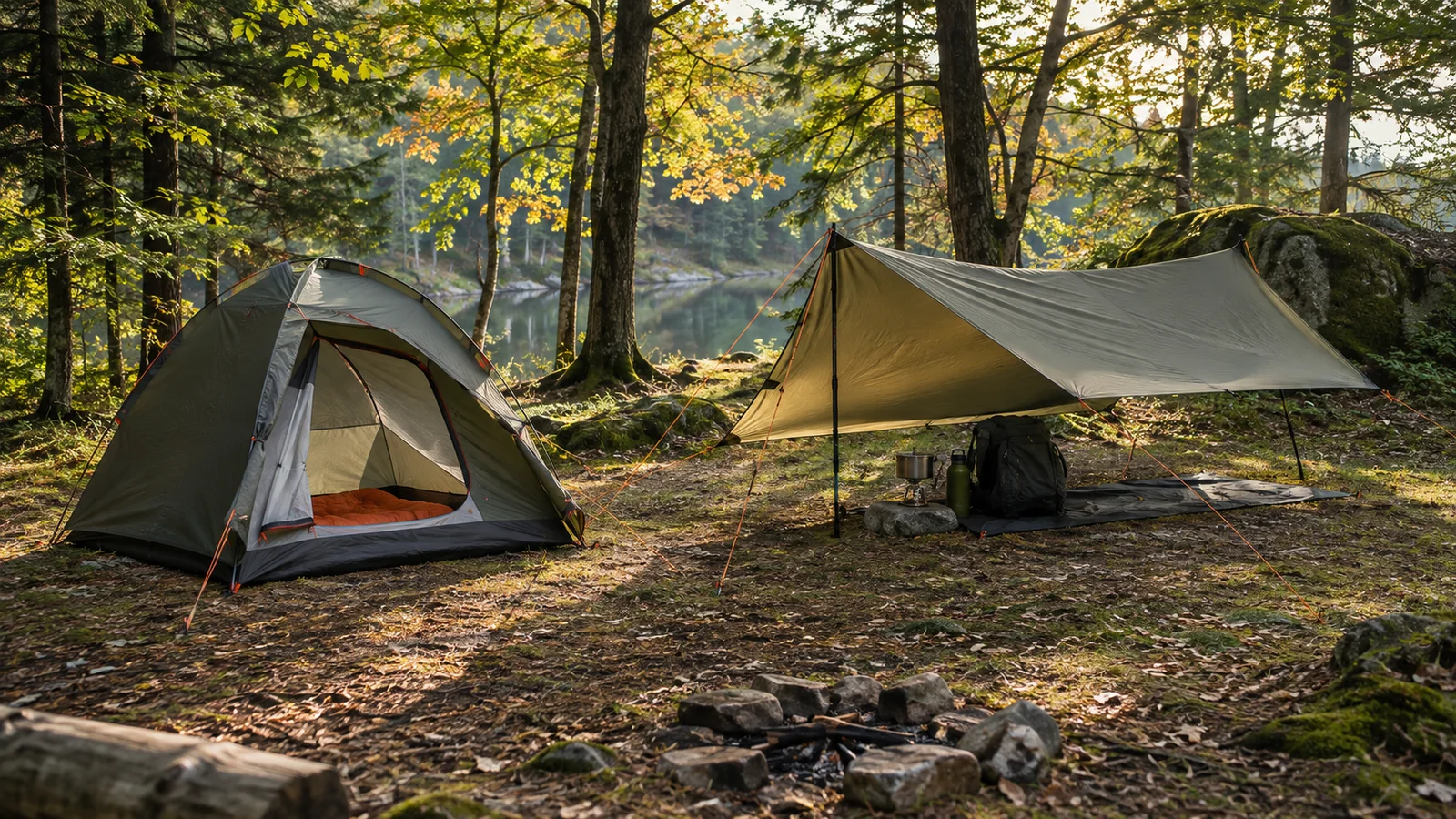
When putting together an evacuation bag, choosing your shelter is one of the most structuring decisions. Tarp or tent: both options have their supporters, real advantages and concrete limits. Neither is universally better. What matters is the fit between your choice, your skill level, your family situation and the scenarios you want to cover.
Shelter is generally among the basic priorities of any serious preparedness, alongside water, fire and food. In an emergency evacuation, having an effective shelter can make a decisive difference, especially against hypothermia, bad weather or prolonged exposure to cold. That is exactly where the tarp versus tent question takes on its full meaning.
This article is for people who have already built or started their evacuation bag and want to refine their choice of portable shelter. If your bag isn’t ready yet, first see how to choose an evacuation bag.
The tent: maximum protection, logistical trade-offs
A tent offers an enclosed, structured environment that is immediately usable. For someone not used to building improvised shelters, it is often the most reliable short-term option.
Advantages
- Complete, even protection: a quality waterproof tent protects on all sides — floor, walls and roof. An enclosed tent blocks the wind and keeps in some body heat; a high hydrostatic rating ensures it stays waterproof in sustained rain.
- Quick to pitch: a tent its user knows well can be set up in a few minutes, even in degraded conditions. A properly pitched tarp takes more time and extra gear.
- Protection from insects and some animals: a closed tent keeps insects and small animals out. It doesn’t protect you from a bear: in bear country, the rule remains to cook and store food away from the shelter (at least 50 m or 165 ft), hung or in a purpose-made container.
- Immediate comfort: the built-in floor, zipper and insect protection allow safer rest, especially for less experienced people or children.
Disadvantages
- Weight and bulk: even light tents remain bulkier and heavier than an equivalent tarp. In an evacuation bag where every kilogram counts, that is a significant factor.
- Single use: a tent does only one thing: shelter. It offers no versatility in a survival context.
- Cost: a tent really suited to outdoor conditions — resistant to rain, wind and low temperatures — is a significant investment. A low-end tent in an evacuation bag is often worse than a good tarp you know how to use.
- No fire nearby: tent materials are synthetic and flammable. You can’t use a fire to warm yourself from inside or right by the door.
The tarp: versatility and lightness, with a real learning curve
The tarp is often presented as the ultimate tool of the experienced practitioner. That reputation is deserved — provided you know how to use it. Its lightness and versatility make it gear of choice for self-reliant, trained people.
Advantages
- Light and compact: for solo use, a 2.1 m × 3 m (about 7 ft × 10 ft) tarp offers working protection while taking up little room in the bag. For two or more people, 3 m × 3.6 m (10 ft × 12 ft) is a reasonable starting point.
- Real versatility: a tarp can be used to collect rainwater, make an improvised stretcher, protect gear, signal, or serve as a windbreak for a cooking area. It is a rare multi-use tool when space is limited.
- Affordable: materials such as Tyvek or some reinforced polyethylene tarps are available at low cost. Some can even be salvaged for free from construction sites.
- Compatible with a fire: depending on the configuration, you can position a fire in front of the shelter to reflect heat inward, at a safe distance from the fabric and only where open fires are allowed (check fire bans from SOPFEU and your municipality) — an option that is impossible with a closed tent.
- Use with a hammock: a tarp can be pitched over a hammock to keep off the rain while staying off damp or cold ground.
Disadvantages
- No insulating floor: unless specially configured, a tarp doesn’t protect you from the ground. Damp or cold ground can draw away body heat quickly and promote hypothermia, especially if the sleeping bag is in direct contact with wet ground.
- Exposure to insects: an open shelter doesn’t protect from mosquitoes, ticks or other insects. In a Quebec summer, that is a comfort and health factor not to downplay.
- Significant learning curve: pitching a tarp properly in real conditions — uneven ground, rain, wind, nightfall — is a skill acquired through repeated practice. Watching online tutorials isn’t enough. A badly pitched tarp in degraded conditions can be dangerous.
Comparing the two options for your situation
The choice between tarp and tent depends on several personal and contextual variables. Here is a framework to guide your thinking.
Beginner profile
If you have never built a tarp shelter in real conditions, the tent remains the safest option. It is predictable, quick to pitch and protects effectively without advanced skills.
Intermediate or experienced profile
If you have practised several tarp configurations in varied conditions, the tarp becomes a serious option. It lightens the bag and frees up space for other essential gear.
Family context
With children or vulnerable people, the tent offers a more controlled environment. Sharing the load between adults sometimes makes it possible to carry both options — a tarp and a tent — to adapt to the scenario.
An example of a practical compromise: in a family where the adults share the load, carrying a tarp in one bag and a tent in the other offers real flexibility. If necessary, the heavier bag can be lightened or left behind, keeping the more compact option.
Comparison table: tarp or tent
| Criterion | Tent | Tarp |
|---|---|---|
| Weight and bulk | Heavier | Very low |
| Ground protection | Built-in floor | Must be added (pad, groundsheet, branches) |
| Insects | Protected | Exposed, unless you add a net |
| Pitching | Quick and predictable | Takes practice |
| Versatility | Single use | Shelter, rainwater, stretcher, gear protection |
| Fire nearby | Ruled out | Possible with distance and permission |
| Ideal profile | Beginners, families, children | Trained people, solo use |
What neither the tarp nor the tent replaces
Whatever gear you choose, knowledge remains the hardest resource to lose. A bag can be stolen, lost or damaged. Skills stay with you.
Learning to build a shelter with materials available in the environment — a branch shelter, a snow shelter, a log or leaf shelter — is an indispensable complement to any gear. Gear amplifies skills. It doesn’t replace them.
From this perspective, the tarp has an indirect advantage: learning to use it well forces you to understand the basic principles of shelter building — orientation, drainage, thermal insulation, wind resistance. That knowledge remains useful even without any gear.
To go deeper, see 11 survival shelter designs and the lean-to shelter.
Points to watch before deciding
- Don’t choose a tarp if you have never tested it in real conditions. A first use in a degraded situation, on a cold, rainy night, can quickly become dangerous.
- Don’t choose a cheap tent to save money. A tent that can’t stand up to rain or wind in real conditions is a false economy in an emergency.
- Take Quebec’s seasons and climate into account. Winter conditions radically change the equation: a well-positioned tarp can be very effective with a fire, but requires real mastery of the terrain and of ground insulation techniques.
- Consider the members of your group. Children, older adults, inexperienced people: their presence directly affects the right choice of shelter.
Summary
There is no universal answer to the tarp versus tent debate. The tarp offers more versatility, lightness and potential — for those who know how to use it. The tent offers immediate, predictable protection — especially valuable for beginners, families and emergencies without prior preparation. Either way, regular practice and knowledge of the terrain remain the best investments. Your gear should match your real level, not the one you hope to have on the day.
See also calculating the weight of your evacuation bag and the family evacuation bag.
Frequently asked questions
What size tarp for solo survival use?
For one person, a tarp of at least 2.1 m × 3 m (7 ft × 10 ft) is generally recommended as a starting point. Depending on the shelter configuration, a slightly larger surface can improve side protection and wind management. For two people, a 3 m × 3.6 m (10 ft × 12 ft) tarp offers more flexibility.
Can you use a Tyvek tarp for a survival shelter?
Tyvek is a light, waterproof material that can serve as an emergency shelter. It is often available at low cost or can be salvaged from construction sites. Its long-term durability is lower than that of a reinforced polyethylene or silicone-coated nylon tarp, however. For occasional or backup use, it works.
Is a light hiking tent suitable for the evacuation bag?
A quality light hiking tent — with a sufficient hydrostatic rating, taped seams and good wind resistance — can be perfectly suitable. The important thing is to check that it is really designed for varied outdoor conditions and not for fair-weather summer camping. Entry-level or light leisure tents are generally not suited to real emergency conditions.
Is it reasonable to carry both a tarp and a tent?
In a family where the load is shared among several people, yes. A tarp in one bag, a tent in another. That offers real flexibility depending on the scenario and makes it possible, if necessary, to lighten the load quickly by leaving the heavier item behind. Solo, the weight-to-benefit trade-off rarely justifies this combination.
Further reading
See choosing a site and practising outdoor shelter, the hammock in winter and cold-weather survival.