
In this article
During a major disaster, the dynamics of an area change quickly. Places that are usually unremarkable become hotspots of disorder, overload or structural danger. Identifying them in advance and building them into your travel plan is part of realistic, effective preparedness.
This content is not meant to feed general distrust or paint a catastrophic picture of society. It offers a pragmatic reading of dynamics observed during major crises, useful for planning your movements in an informed way.
In brief
In brief. After a disaster, seven types of places often concentrate overload or danger: hospitals (except in a genuine emergency), transport hubs, supermarkets, bridges, tunnels and flooded roads of uncertain condition, the surroundings of prisons, wilderness without preparation and areas of tension. The best way to avoid them is to need to travel less: supplies at home, first aid, alternative routes prepared in advance.
Why do some places become dangerous after a disaster?
A major disaster, whether an earthquake, a long infrastructure failure, major flooding or another disruptive event, quickly upsets the usual balance. Essential services are stretched far beyond their capacity. Available stock no longer matches demand. Flows of people converge on a few key points.
In this context, places that normally run in an orderly way can turn into zones of overcrowding, confusion or physical danger. Understanding these dynamics lets you plan safer routes and avoid being in the wrong place at the wrong time.
Basic principle. The aim is not to avoid all human contact or every institution, but to anticipate overload points so you do not add your own vulnerability to them, and to leave available resources to those who need them most.
The seven types of places to factor into your travel plan
The seven types of places below are not dangerous in every scenario. Their level of risk depends on the nature of the disaster, how long it lasts and the region affected. The goal is to recognize them and take them into account in your planning.
| Place | Main risk | Prepared alternative |
|---|---|---|
| Hospitals and health centres | Overload, long waits, exposure to infection | First aid and a kit at home; health information line |
| Airports, train stations, bus terminals | Crowds, suspended operations, uncertain information | Check service status before travelling |
| Supermarkets and distribution points | Rushes, tension, empty shelves | Food supply at home |
| Bridges, tunnels, flooded roads | Invisible damage, moving water | Alternative routes identified in advance |
| Surroundings of correctional facilities | Security uncertainties if systems fail | Routes that bypass them |
| Wilderness without preparation | Dehydration, hypothermia, injuries without care | A precise destination, equipment and skills |
| Areas of social tension | Crowd surges, confrontations | Move away calmly at the first signs |
1. Hospitals and health centres
In a major crisis, health facilities quickly become overwhelmed. Priorities are reassigned according to the severity of cases, which medical teams call triage. A moderate injury may then mean a very long wait, with no guarantee of quick care.
There is also a health risk: a hospital under pressure concentrates injured and sometimes contagious people, in conditions where usual protocols can be hard to maintain. Going to hospital for a non-urgent reason therefore offers few advantages and several real drawbacks.
Important: this never applies to a life-threatening emergency. For a serious injury, chest pain, difficulty breathing or loss of consciousness, call emergency services (911 in North America, 112 in Europe) or go to the emergency department. For a less serious problem, use health information lines where possible (811 in several Canadian provinces, 111 in the United Kingdom, or 116 117 in France to reach an on-call doctor, for example).
Worth considering. Developing basic first aid skills and putting together a kit suited to your household lets you handle many minor injuries without relying on hospitals right away. It also frees up resources for those who really need them. See our guide to organizing first aid.
2. Airports, train stations and transport hubs
Transport infrastructure quickly becomes a gathering point for people trying to leave an affected area. This concentration leads to congestion, tension and unpredictable stress-driven behaviour.
In many scenarios, regular operations at these facilities are suspended or severely disrupted. Heading to an airport or train station without reliable information on whether it is operating can waste precious time and needlessly expose you to crowds under pressure. Check service status with operators and authorities first, and follow official evacuation instructions, which sometimes include organized transport.
3. Supermarkets and food distribution points
A large part of the population does not have enough supplies to last several days without restocking. During prolonged disruption, food stores quickly become the first gathering point for unprepared people.
Stock runs out quickly and tension rises as shelves empty. In prolonged or very degraded situations, aggressive behaviour can appear, even though mutual aid remains the most common reaction. Trying to get supplies in that context is a poor trade-off, especially if you already have a supply at home.
Building a basic food supply in advance, even a modest one, is exactly what keeps you from having to go to these places at the worst moment. It is one of the simplest and most effective preparedness steps; our article on a short-term food supply explains how to start.
4. Bridges, tunnels and potentially weakened structures
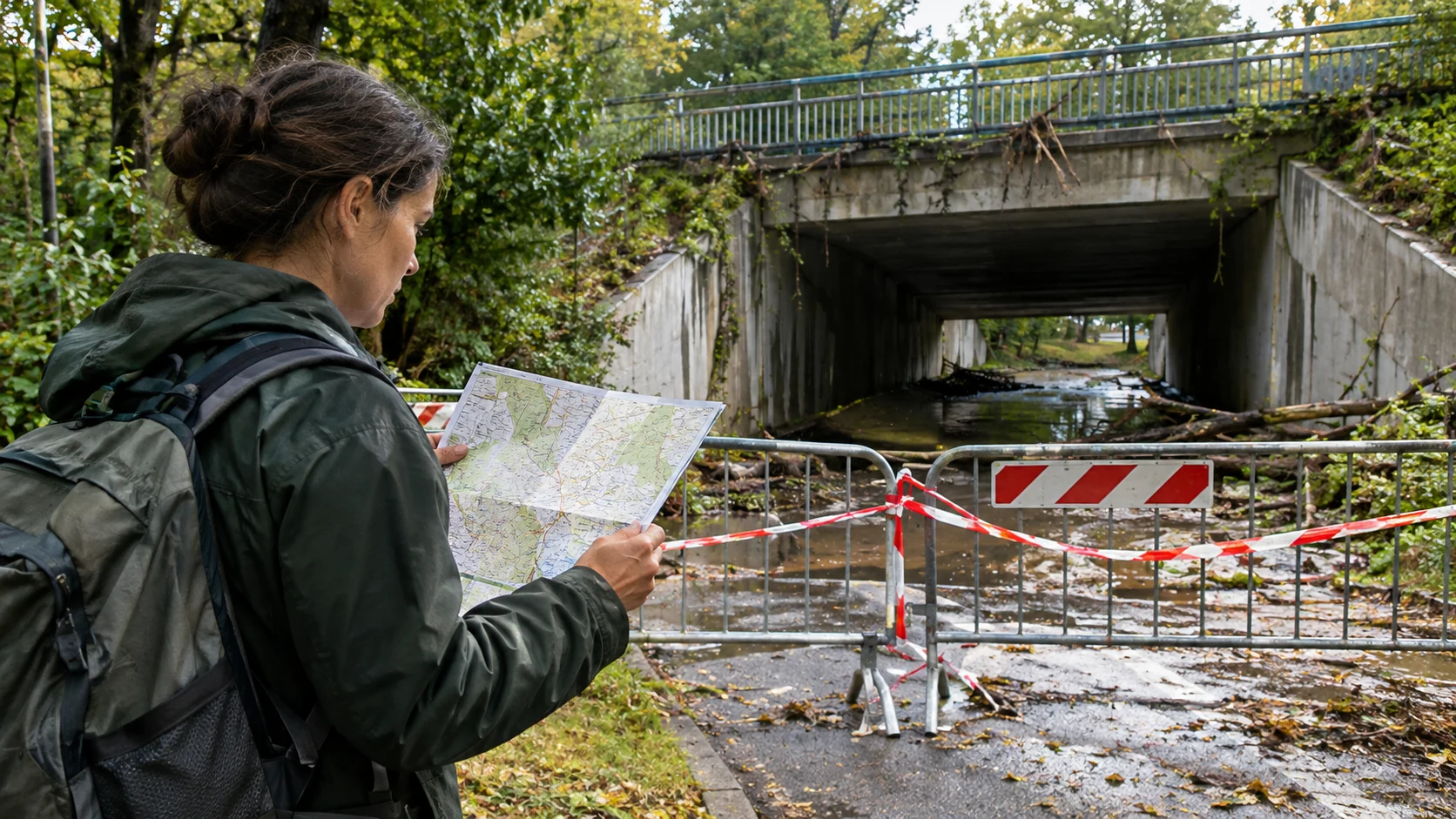
Some disasters, such as earthquakes, explosions, flash floods or ground subsidence, can compromise the integrity of infrastructure that looks intact. A bridge or tunnel can be damaged without it being visible. When in doubt, the prudent approach is to plan routes that avoid these structures until their condition has been confirmed, and to strictly respect closures ordered by the authorities.
The same applies to flooded roads: never cross a road covered by water, on foot or by car. According to public safety authorities, a few dozen centimetres of moving water is enough to knock a person over or carry away a vehicle, and the road surface may have been washed out underneath.
Practical tip. Identify several routes out of your home or workplace in advance, noting which ones cross bridges, tunnels or flood-prone areas. Plan at least one route that avoids them. Our guide to preparing an evacuation plan walks you through the process.
5. Correctional facilities and their surroundings
In a disaster serious enough to disrupt how institutions function, correctional facilities can face major difficulties: power outages, reduced staff, disrupted communications. In extreme cases, these difficulties can affect security systems, even though facilities have emergency plans.
Without assuming rare scenarios, it still makes sense to avoid their surroundings when planning your routes, just as you would avoid other risk areas, such as hazardous industrial sites in the event of a chemical accident.
6. The wilderness without adequate preparation
The idea of retreating to the woods during a disaster is intuitively appealing. In practice, surviving in the wild without solid preparation is much harder than popular imagination suggests. Basic needs, safe water, shelter, food and warmth, are hard to meet over time without suitable equipment and previously acquired skills. Risks pile up quickly: dehydration, hypothermia, injury with no way to treat it, dangerous wildlife depending on the region, not to mention wildfire season in many areas.
| What nature can offer | What nature demands |
|---|---|
| Distance from densely populated areas Possible natural resources (water, food) Calm and discretion | Skills that have been developed and practised Suitable equipment you know how to use A concrete plan, not a general direction A precise destination, not endless flight |
Heading into nature can remain an option in some scenarios, but only with a precise destination, sufficient resources and real skills. It is not a default plan. Our article on the seven pressures that undermine judgment in the wilderness explains what is at stake.
7. Areas of social tension and confrontational gatherings
Prolonged deprivation, fear or uncertainty can create significant tension. Gatherings that start out spontaneous or as protests can change quickly if collective frustration passes a certain threshold. These crowd dynamics are hard to anticipate when you are in the middle of them.
The prudent approach is to avoid these areas at the first signs of tension, without waiting for the situation to deteriorate. This implies no judgment about the motives of the people present: it is simply a reading of the physical risk linked to the density and emotional state of a group under pressure.
If you sense tension rising in a public space, stay calm, avoid drawing attention and leave gradually, without visible haste, moving towards the edges of the crowd rather than against its flow. Our article on getting around areas that feel unsafe offers more guidance.
Building these areas into your preparedness plan
The value of this analysis lies not in the list itself, but in what it means in practice for your preparedness.
| Action | What it changes |
|---|---|
| Plan your routes in advance | Identify several routes from your home and workplace, note those that pass through sensitive areas and plan alternatives. |
| Reduce your need to travel | Supplies of water, food and medication suited to your household directly reduce the need to go to risky areas in the first hours or days. |
| Develop basic skills | First aid, navigation, water treatment: these skills let you stay self-reliant longer and depend less on overloaded infrastructure. |
| Also identify useful resources | Community centres, schools that may become shelters, neighbourhood pharmacies, skilled neighbours. |
The key takeaway. Preparedness directly reduces exposure to risky areas. Someone with supplies, a well-thought-out evacuation plan and basic skills does not need to rush to the busiest places at the worst moment.
Frequently asked questions
Do these recommendations apply to every type of disaster?
Not uniformly. The nature of the disaster, how long it lasts and the region affected strongly influence the level of risk for each type of place. An earthquake, a long power outage or a flood do not create the same dynamics. The aim is to have an adaptable way of reading the situation, not a rigid list.
Should you avoid hospitals entirely if seriously injured?
No. A life-threatening injury or illness justifies calling emergency services or going to the emergency department, even when conditions are degraded. The recommendation concerns moderate injuries, when other basic care options are available. Judgment based on context remains essential.
How do I plan an evacuation route that avoids these areas?
Mark on a map the sensitive places along your usual routes: hospitals, large stores, bridges, flood-prone areas, correctional facilities. Then trace two or three alternative routes. Do this calmly, without waiting for an emergency.
Can the wilderness be a viable option in a disaster?
It can, under specific conditions: real skills developed in advance, suitable equipment, a precise destination and a concrete plan. Without these, heading into the wild adds significant risks to an already difficult situation. It is a last resort, not a default strategy.