
In this article
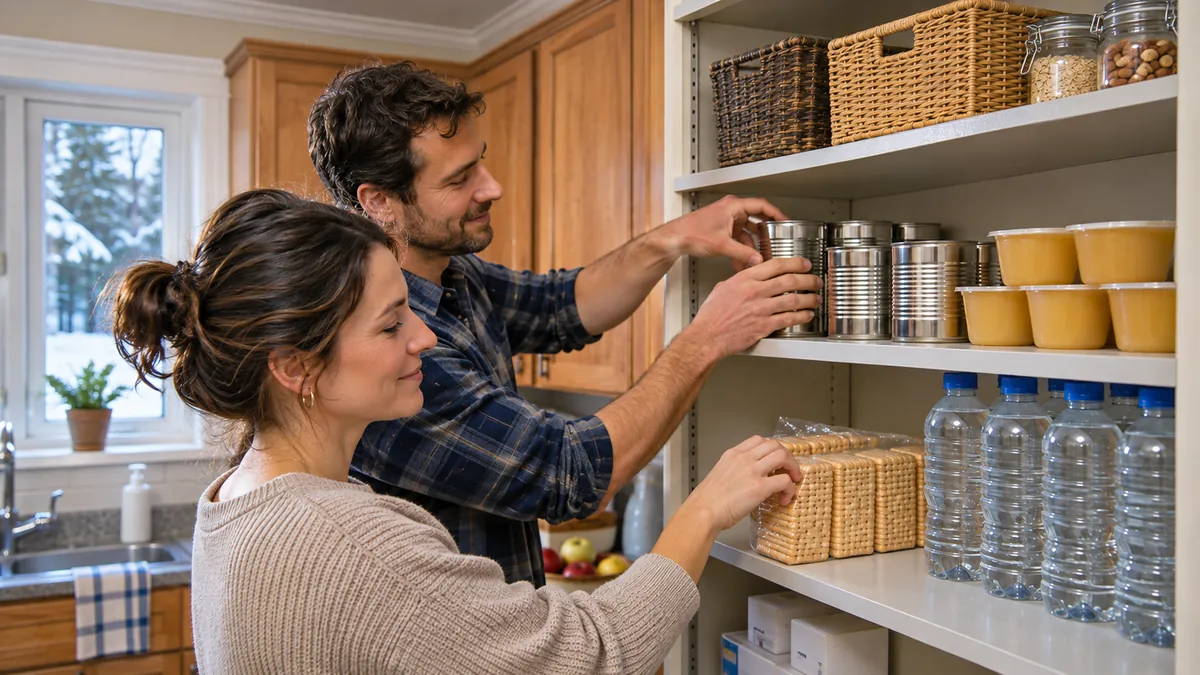
This first week of the preparedness program focuses on a food and water supply suited to your household. Start by taking stock of what you already have, consolidate a 72-hour goal, then consider a longer period according to your means. This guide helps you choose food your household actually eats, plan for a power outage and organize rotation.
At a glance
- Start from your usual meals: a supply nobody eats ends up in the garbage.
- Include some ready-to-eat meals: an outage can cut off both cooking and refrigeration.
- Water is part of the supply: 4 L per person per day (2 L for drinking, 2 L for food and hygiene).
You can start with one small action: choose a few meals your household really eats and check what you would need to prepare them during a service disruption.
A gradual, accessible approach
The 52-week preparedness program breaks this big topic down into manageable weekly steps. We start with the basics of preparing for common situations, then gradually move toward longer-term scenarios.
Each step suggests supplies to check and skills to develop. Adapt the pace to your budget and priorities: one week of this program may take longer in your situation.
Moving forward gradually lets you spread out purchases and test stock rotation. It makes organizing easier, without removing your household's financial constraints.
Adapting preparedness to your situation
Before you start, take a moment to think about the situations you could face:
- Job loss or an economic slowdown
- Natural hazards in your region (freezing rain, storms, floods, extreme heat)
- Local disruptions (prolonged outage, boil-water advisory, closed roads)
- Special medical or dietary needs of family members
This reflection will form the basis of your emergency plan and help you make the choices that best fit your situation.
Week 1: building the essentials
Prioritizing basic needs
First, check a 72-hour supply, the minimum recommended by the Government of Quebec and Public Safety Canada. If you then want to plan for 14 days, build a menu and calculate the corresponding needs: this duration is a personal goal, with no guarantee of self-sufficiency or comfort.
Water and food must remain usable throughout the situation you are planning for. The volume stored does not prove the water is drinkable, and a treatment device does not work for every type of contamination: follow local advisories.
A power outage can limit cooking and refrigeration. Include some meals that are ready to eat or need little preparation. Never use a device designed for outdoor use (camp stove, barbecue, generator) indoors: it produces carbon monoxide.
Approximate duration, in hours, if the doors stay closed
- Closed refrigerator 4 h
- Half-full freezer 24 h
- Full freezer 48 h
Source: Health Canada, "Food and drinking water safety in an emergency" (updated May 8, 2026, consulted November 10, 2026).
In other words, after a few hours without power, the contents of your refrigerator no longer count as part of your supply. Open the doors only when necessary, check temperatures with a thermometer, and do not put frozen food outside, even in winter: the sun can thaw it and animals can contaminate it. During a long outage, ask a relative or friend who has power whether they can keep your food.
Choosing suitable foods
Start from your household's usual meals, preferences and special needs. Check ingredients and allergens. A list of individual products is not, by itself, a nutritionally complete menu.
| Type of food | Examples | Without power? |
|---|---|---|
| Ready to eat | Canned tuna, salmon, chicken or legumes, peanut butter, crackers, fruit cups | Yes, no cooking or water needed |
| Little preparation | Canned soups or stews, cereal | Better heated; some soups need water to dilute |
| Need water, cooking and time | Dried lentils and beans, rice, pasta | Only with a safe way to cook and extra water |
Supply list for week 1
The following categories are examples to adapt. Quantities should come from your portions, the number of meals and the duration you choose; no number of jars or cans here guarantees two weeks of food. Organize your food supply with the calculator →
Food and water
Water: as a storage benchmark in Quebec and Canada, plan 2 L per person per day for drinking, plus 2 L for food preparation and hygiene; adjust for special needs and add water for pets separately. See Calculating an emergency water supply.
Peanut butter or another usual product suited to your household's allergies, in a quantity calculated from planned portions.
Drinks your household usually has, if they are useful for the menu; juice does not replace your water supply.
Ready-to-eat protein sources: for example canned tuna, salmon, chicken or legumes, according to your household's habits and needs.
Soups or stews: check the number of servings and how they are prepared; count the water needed when the product must be diluted.
Shelf-stable foods your household likes: cookies, cereal or other products suited to the menu and their storage conditions.
Lentils, beans or other legumes: distinguish ready-to-eat canned products from dried ones that need water, cooking and time.
Reserve water or container to be filled
Canada: packaged water. France: empty bottle to fill with drinking water. These two offers do not contain the same thing.

DATREX Poche à eau d'urgence pour catastrophe ou survie, 125 ml chacune
Visit on Amazon.ca — DATREX Emergency water bag for disaster or survival, 125 ml each
Peanut butter
Compare the format and storage conditions. Check the ingredients, allergens, dates and possible preparation needs; adjust the quantities to your home.

Kraft Beurre d'arachide lisse léger Pot de 2 kg
Visit on Amazon.ca — Kraft Light Smooth Peanut Butter 2 kg jar
Jardin BiO étic - Pur Beurre de Cacahuète 350g (L'emballage peut varier) (Lot de 4)
View on Amazon.co.uk — Garden BiO étic - Pure Peanut Butter 350g (Package may vary) (Set of 4)Fruit juice
Compare the format and storage conditions. Check the ingredients, allergens, dates and possible preparation needs; adjust the quantities to your home.

Rougemont Lot de 40 jus de fruits de 200 ml
Visit on Amazon.ca — Rougemont Set of 40 200 ml fruit juices
Teisseire Fruit Shoot au Jus de Pomme Sans Sucres Ajoutés 4x20cl
View on Amazon.co.uk — Teisseire Fruit Shoot with Apple Juice Without Sugars Added 4x20clCanned Chicken
Compare the format and storage conditions. Check the ingredients, allergens, dates and possible preparation needs; adjust the quantities to your home.

Kirkland Signature Poitrine de poulet - Emballée dans de l'eau - Morceau de qualité supérieure - 6 boîtes de 354 g
Visit on Amazon.ca — Kirkland Signature Chicken Breast - Packed in Water - Top Quality Piece - 6 cans of 354 g
Paul & Louise Poulet basquaise 285g - Prêt en 2 min - 100% viande origine France (Lot de 4)
View on Amazon.co.uk — Paul & Louise Basque Chicken 285g - Ready in 2 min - 100% meat origin France (Set of 4)Canned soup
Compare the format and storage conditions. Check the ingredients, allergens, dates and possible preparation needs; adjust the quantities to your home.

Campbell's Chunky Soup, Soupe au poulet et aux nouilles, canette de 476 ml (boîte de 8)
Visit on Amazon.ca — Campbell's Chunky Soup, Chicken and Noodle Soup, 476 ml Can (Box of 8))
Liebig Soupe légumes & vermicelles - Les 2 briques de 30cl
View on Amazon.co.uk — Liebig Soup vegetables & vermicelli - The 2 bricks of 30clCraquelins
Compare the format and storage conditions. Check the ingredients, allergens, dates and possible preparation needs; adjust the quantities to your home.


GERBLÉ – Biscuits Complets au Germe de Blé – Riches en fibres – Sans Huile de Palme – Nutri-Score B – 5 Sachets Individuels – 25 Biscuits – 210 g
View on Amazon.co.uk — GERBLÉ - Complete Biscuits with Wheat Germ - Rich in fibre - Palm Oil Free - Nutri-Score B - 5 Individual Bags - 25 Biscuits - 210 gCanned beans
Compare the format and storage conditions. Check the ingredients, allergens, dates and possible preparation needs; adjust the quantities to your home.

Earth's Choice - Haricots Cannellini biologiques, sans sel ajouté, 398 ml
Visit on Amazon.ca — Earth's Choice - Organic Cannellini Beans, No Salt Added, 398 ml
CASSEGRAIN - Haricots Blancs Préparés - Fermes & Savoureux - Sans Additif - Nutri-Score A - Emballage 100% Recyclable - Boîte de Conserve 400 g (Lot de 2)
View on Amazon.co.uk — CASSEGRAIN - Prepared White Beans - Farm & Tasty - No Additive - Nutri-Score A - 100% Recyclable Packaging - Canned Box 400 g (Set of 2)Equipment and special needs
A manual can opener.
A permanent marker, to date products when they come in.
Special needs: check infant products (ready-to-serve formula), hygiene items, glasses and medical equipment. Plan medications with the professionals involved, according to prescriptions; do not automatically add a medication or dietary supplement.
Pets: calculate food from the actual daily ration and the chosen duration. A "large container" does not correspond to a set number of days; also plan their water. For a dog, see Calculating emergency food supplies for your dog.
Manual Can Opener
Compare the format and storage conditions. Check the ingredients, allergens, dates and possible preparation needs; adjust the quantities to your home.

OXO Good Grips Good Grips Ouvre-boîtes Noir 19 cm
Visit on Amazon.ca — OXO Good Grips Good Grips Box opener Black 19 cm
OXO Good Grips Ouvre-boîte à poignée souple
View on Amazon.co.uk — OXO Good Grips Soft Handle Box OpenerRotation and label dates
A supply stays useful when you eat it and replace it: put new products at the back, use the oldest first, and write the purchase date with a marker. Health Canada also explains what the dates on packaging mean:
| Label | What it means |
|---|---|
| "Best before" | The end of the period during which an unopened product keeps its freshness, taste and nutritional value. It does not guarantee safety. It is not required on foods that keep for more than 90 days, such as many canned goods. |
| After "best before" | You can buy and eat the food, but it may have lost some freshness, flavour or texture. Once opened, its shelf life changes. |
| "Expiration date" | On infant formula, meal replacements and nutritional supplements. After this date, throw the product out. |
Never rely on smell, appearance or taste to judge whether food is safe. Throw out cans that are dented, bulging, punctured or leaking, and any food that has been in contact with floodwater. When in doubt, throw it out.
Actions to complete this week
Keep labels and note opening dates when useful. Organize rotation without replacing or extending the manufacturer's dates and instructions.
If you can afford it, keep a little cash in small bills, without compromising essential expenses; no single amount suits every household.
Draw up an emergency plan and name the types of situations you are preparing for (weather, natural disasters, economic or personal difficulties).
Choose an out-of-area contact who can coordinate news with your loved ones.
With the agreement of the people concerned, give this contact the useful details and agree on how news will be passed on.
Once these checks are done, you have a first foundation to build on. The next step is to take stock of and organize useful household tools. Week 2: taking inventory of your equipment →
Myths and facts
| Myth | Fact |
|---|---|
| "A supply means special survival rations." | An effective supply starts with the food your household already eats, simply in larger quantities and well organized. |
| "After the best-before date, it has to go." | According to Health Canada, an unopened food can still be eaten after this date, with less freshness or flavour. That is different from an "expiration date". |
| "In winter, I'll put the freezer contents outside." | Health Canada advises against it: the sun can thaw the food and animals can contaminate it. |
Frequently asked questions
Do I have to buy everything this week?
No. Start by taking stock of what you have, then add gradually, a few items with each grocery trip. The goal of week 1 is a first 72-hour stage, not a full pantry.
Is it worth it if I live near a grocery store?
Yes. During a storm, freezing rain or a widespread outage, stores may be closed or emptied, and roads difficult. A few days of supplies spare you from going out at the worst moment. See also Ice storms in Quebec: preparing for outages and household needs.
How do I work out quantities?
From your actual portions: number of people × number of meals × number of days. The food storage calculator does the math and accounts for the water needed for preparation.
Sources and benchmarks
References for Quebec and Canada. Sources consulted on November 10, 2026.
- Government of Quebec — How to prepare at home
- Health Canada — Food and drinking water safety in an emergency
- Health Canada — How to read food date labels and packaging
Put this reading into practice
Perform the action as you wish and then check the result. Your follow-up remains specific to this route.
52 weeks to strengthen your preparation; Week 1
Start the food reserve
Your action: Count the usual meals already available and choose a realistic first amount to complete gradually.
To check: The quantities correspond to the foyer; meals remain feasible with the means provided.
To do