
In this article
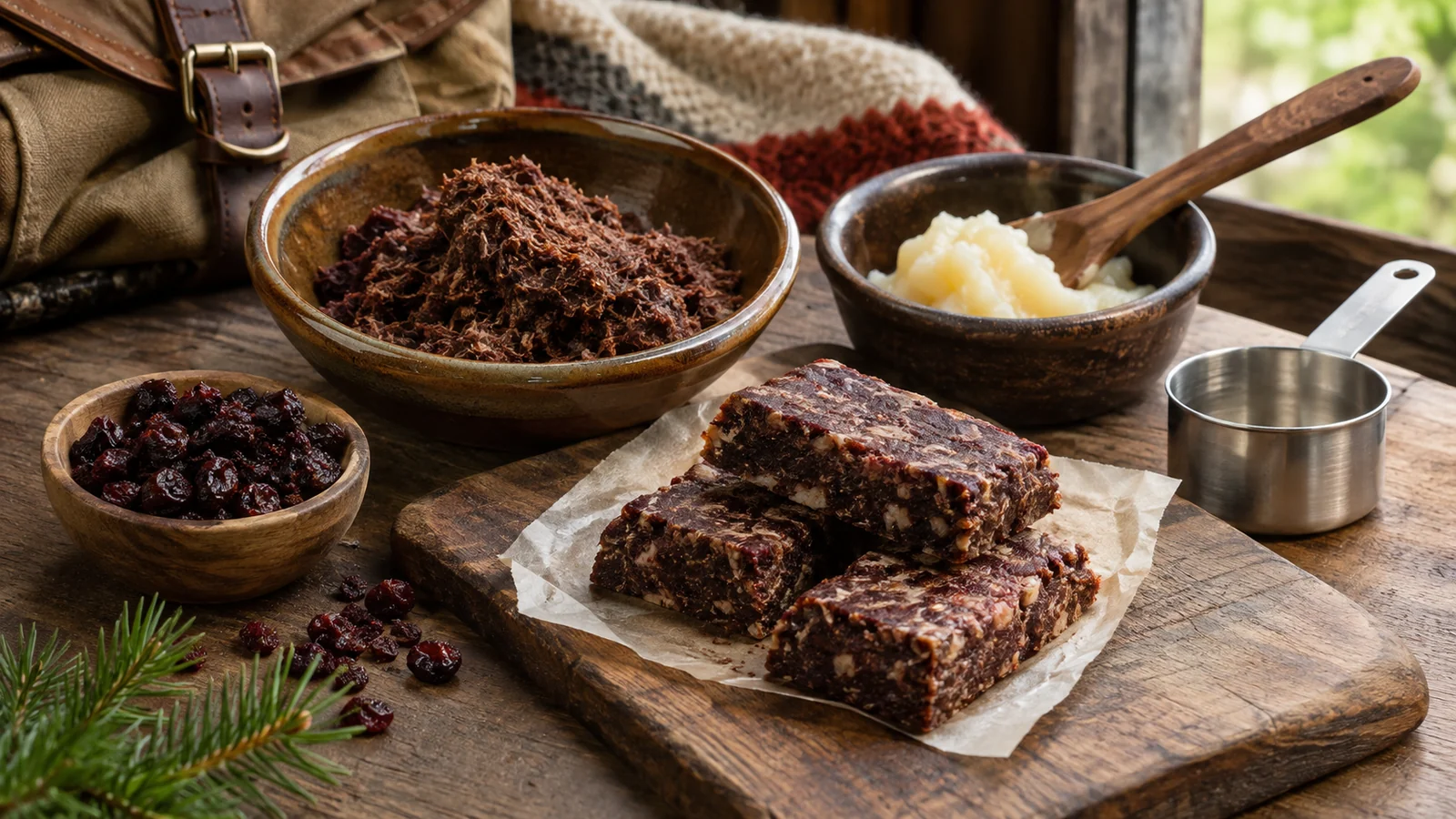
Pemmican is a portable, long-lasting, high-energy food developed by the Indigenous peoples of the North American Plains. It is made of lean dried meat, ground into a powder, then mixed with rendered fat. Dried, crushed berries such as saskatoons or blueberries are sometimes added.
Its great advantage is energy density: a few bites provide a substantial amount of calories and fat, which makes it a food of choice for long walks, physical work in the cold or an evacuation bag. It doesn’t replace a varied diet, but it fills the gap remarkably well.
An ancient, strategic food
The Plains nations, who moved with the seasons and the bison herds, relied on pemmican to get through periods when hunting was impossible. Later, pemmican became the staple of the fur-trade voyageurs: light, compact and nourishing, it let them cover long distances by canoe without depending on daily hunting. The Métis of the Prairies turned it into a real industry in the 19th century.
Properly prepared, pemmican keeps a long time before going rancid. The secret comes down to two points: perfectly dry meat, and well-rendered, strained fat. Residual moisture, and bits of meat left in the fat, are what make it spoil.
Food safety first
Home-dried meat carries a real risk if poorly prepared. Sun drying, as it was once done in the dry air of the Prairies, doesn’t reliably eliminate bacteria such as E. coli or Salmonella, especially in a humid climate like Quebec’s. Current recommendations are clear:
- heat the meat to an internal temperature of at least 71 °C (160 °F) before or after drying (in the oven or in a simmering liquid);
- then dry it at low temperature in a dehydrator or oven, around 60 to 70 °C (140 to 160 °F), until the meat snaps when bent;
- work with clean hands, surfaces and utensils, and keep raw meat refrigerated until you prepare it;
- for game, make sure of its origin and the hunting rules that apply, and apply the same pre-cooking.
Key point: if you have any doubt about a step, keep the pemmican in the refrigerator or freezer rather than at room temperature. A survival food that makes you sick is worse than no food at all.
Pemmican recipe
Ingredients
- Lean meat: traditionally bison, deer, elk or moose; beef works very well. Choose lean cuts, such as inside round or trimmed shoulder. Allow about 1 kg (2.2 lb) of raw meat to get 300 to 400 g (11 to 14 oz) of dried meat.
- Fat: beef suet, from your butcher. Kidney fat gives a firmer, more stable tallow, but any beef fat can be rendered.
- Optional extras: dried berries (blueberries, cranberries, saskatoons, cherries), chopped nuts, a little maple syrup or honey. Every moist or sweet addition shortens shelf life at room temperature.
Steps
- Prepare and cook the meatRemove all visible fat, slice thinly, heat to 71 °C (160 °F) internal.
- DryDehydrator or oven at 60 to 70 °C (140 to 160 °F), several hours, until the slices snap.
- GrindIn a food processor or blender, to a fibrous powder.
- Render the fatOver low heat for several hours, then strain out the bits.
- Mix the dry ingredientsPowdered meat and ground dried fruit, in a large bowl.
- Add the fatAbout one part fat to two parts meat, stirring.
- Shape and storeBars or balls, cool, dry, out of the light, in an airtight container.
1. Prepare and cook the meat
Remove all visible fat: it is what goes rancid first. To slice thinly, put the meat in the freezer for 1 to 2 hours; it then cuts into strips 3 to 5 mm (⅛ to ¼ in) thick. Then heat the slices to 71 °C (160 °F) internal, in the oven or by dipping them briefly in a simmering liquid, and drain them.
2. Dry the meat
Arrange the slices without overlapping on dehydrator trays, or directly on the oven rack with the door ajar, at the lowest possible temperature (ideally 60 to 70 °C, or 140 to 160 °F). Depending on thickness, allow 6 to 12 hours. The meat is ready when it snaps as you bend it: if the thick parts are still rubbery, keep drying. It must be brittle.
3. Grind the meat
Run the meat through a food processor until you get a fibrous powder. Without a processor, chop it as finely as possible, then finish in a blender or mortar.
4. Render the fat
Cut the suet into small pieces, removing any scraps of meat. Melt it over low heat, in a slow cooker, in the oven or in a cast-iron pan, for several hours, stirring occasionally. The fat is ready when it stops sizzling and the remaining bits are golden and crisp. Strain it through a fine sieve or clean cloth. Beware of burns: rendered fat is very hot and sticks to skin.
5. Mix the meat and extras
If you are using powdered dried fruit or other dry additions, mix them with the meat first, in a large bowl that leaves room for the fat.
6. Add the fat
Allow about one part fat to two parts meat, by weight. Slowly pour the hot fat over the meat while stirring, until the mixture holds together when pressed. If it is still crumbly, add a little fat; if it is too greasy, add a little powdered meat. Moist additions, such as syrup, go in at this stage, in small amounts.
7. Shape and store
Spread the mixture in a dish and let it set before cutting it into bars or squares, or roll it into small balls. Wrap each portion in waxed paper, then in an airtight container or sealed bag. Store cool, dry and out of the light. In the refrigerator or freezer, shelf life is much longer.
Table: storing pemmican
| Version | Cool, dry pantry | Refrigerator | Freezer |
|---|---|---|---|
| Meat and fat only, well prepared | A few weeks to a few months | Several months | A year or more |
| With dried fruit | A few weeks | A few months | A year |
| With nuts, syrup or peanut butter | Not recommended | A few weeks | Several months |
These times are a guide only: heat, humidity and the quality of drying change them. A rancid smell, a bitter taste or the slightest mould mean the product must be thrown out.
How to eat it
Pemmican is eaten as is, in small bites chewed slowly. It isn’t a food you wolf down, but it is surprisingly filling: fat is digested slowly and provides steady energy for hours. You can also crumble it into hot water to make a thick stew, the voyageurs’ “rubbaboo”, often enriched with flour or potatoes.
Because it is very high in fat and low in carbohydrates and fibre, it goes well with starchy foods, fruit or vegetables. People who need to limit saturated fat, or who have gallbladder problems, should eat it in moderation.
Place in a food reserve
Pemmican is a good addition to a reserve or an evacuation bag: it gets you through a day too busy to cook a meal, or keeps you going when conditions get difficult. Make a small batch first, taste it, check how it keeps over time, and rotate it like the rest of your reserves.
Frequently asked questions
Can you dry meat in the sun the way it used to be done?
It isn’t recommended. Sun drying depends heavily on air humidity and temperature, and doesn’t guarantee that dangerous bacteria are eliminated. Pre-cooking to 71 °C (160 °F) followed by drying in the oven or a dehydrator is much safer.
Which fat should you use?
Beef tallow is the standard: firm at room temperature, it keeps better than soft fats. Avoid liquid vegetable oils and butter, which go rancid faster and don’t give a pemmican that holds together.
Is pemmican a complete meal?
No. It provides plenty of energy, protein and fat, but little carbohydrate, fibre and vitamin C. For prolonged use, it must be supplemented with other foods.
Can you replace homemade pemmican with a commercial product?
Yes. Commercial pemmican and dried meat bars exist, made under controlled conditions. Check the label for the best-before date and storage conditions.
Further reading
See bannock bread, storing dried foods and building a food reserve.