
In this article
- Why moving without a purpose is a risk in itself
- Before leaving: the questions to ask
- Planning alternate routes
- Identifying risk zones by crisis phase
- Movement as a two-way exchange of information
- Adapting your behaviour to the environment
- Travelling by vehicle
- Crossing a tense area, on foot or by car
- Leaving a place that has become dangerous quickly
- Practical points of vigilance
- Frequently asked questions
- Further reading
In a serious crisis, every trip becomes a decision in its own right. Knowing when to stay, when to go, which way to go and how to do it without drawing attention can make a concrete difference. This guide brings together the principles of purposeful movement in degraded conditions: planning routes, reading risk zones, preparing your vehicle, crossing a tense area, leaving a place that has become dangerous and reaching somewhere safe, always within the law and the instructions of the authorities.
Why moving without a purpose is a risk in itself
In a crisis — a major natural disaster, a prolonged infrastructure outage or civil unrest — the natural tendency is to want to go and see what is happening. That curiosity, while understandable, can become a real risk factor.
Going out with no clear purpose to “see what’s going on” needlessly exposes you to uncontrolled situations, uses up resources (energy, time, fuel) and clogs the roads emergency services need.
Basic principle: any trip in degraded conditions should serve a specific intention. If you can’t clearly name the reason for going out, that is generally a signal to stay put.
This doesn’t mean being paralyzed. Some situations require action: reaching a vulnerable relative, getting to a shelter, following an evacuation order, picking up an essential medication. The aim is to tell useful movement from impulsive movement.
Before leaving: the questions to ask
- Why? What specific need does this trip meet, and can it be met another way (phone, neighbour, delivery, waiting)?
- Where? What is the exact destination, and what is the plan if it is unreachable?
- Which way? What is the main route, and the backup route?
- When? By day rather than at night, outside the peak of panic, after a weather episode ends?
- With whom? Alone or with others, and who knows you are leaving?
- With what? Water, a snack, a light, a charged phone, a power bank, a paper map, suitable clothing.
- Is the risk worth the reward? If the gain is small and the risk high, stay.
Planning alternate routes
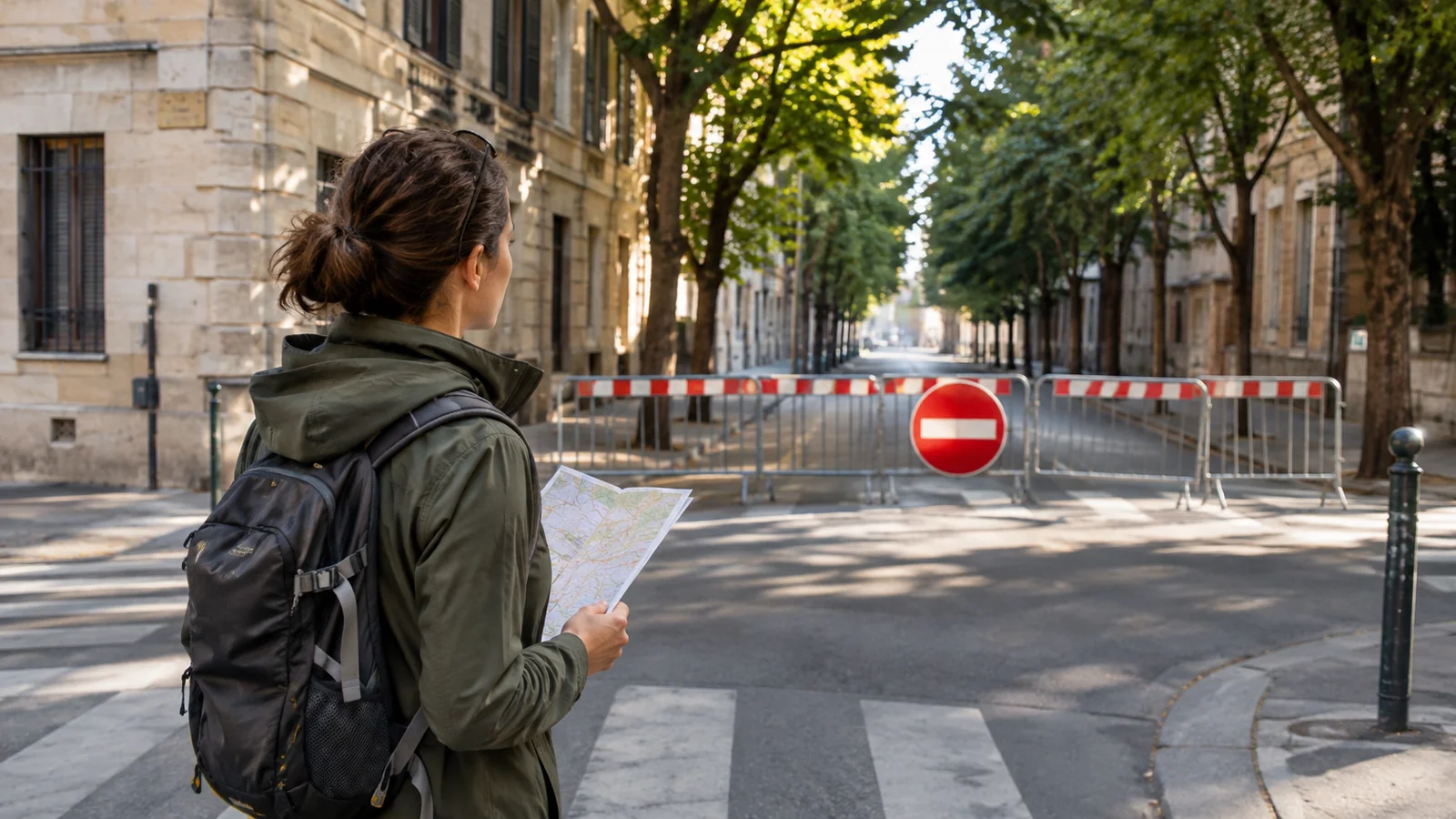
In an urban crisis, the usual routes can quickly become unusable, saturated or dangerous. Thinking about alternate routes in advance is one of the most concrete and least costly preparations a citizen can make.
The point isn’t to map every possible situation perfectly — that’s unrealistic — but to develop an adaptable way of moving:
- know several routes between your usual points (home, family, work, school, meeting point);
- identify ways that avoid major arteries, main intersections and places where crowds gather spontaneously;
- know the local geographic constraints: rivers, railways, industrial zones, limited access points;
- identify resources along the way in advance: community centres, arenas, schools that often serve as shelters, police and fire stations, hospitals;
- expect that some routes considered safe in normal times may change status depending on circumstances.
A planned route is never final. Its real value is to give you a basis for thinking, not a guaranteed road. The ability to adapt your route quickly to what you observe is at least as important as the initial planning.
For residents of large cities — such as Montreal, whose island layout creates particular constraints around bridges and tunnels — this advance geographic thinking is all the more relevant. A PACE plan (primary, alternate, contingency, emergency) applied to routes forces you to plan at least two ways across every unavoidable crossing point.
Identifying risk zones by crisis phase
Every city has areas of tension in normal times. In a crisis, these tensions shift in a way that is broadly predictable, even if the details are impossible to anticipate.
Initial phase
Places tied to immediate resources concentrate tension: gas stations, pharmacies, grocery stores, ATMs. They quickly attract many stressed people, which increases the risk of conflict and crowd crushes.
Later phases
Over time, immediately accessible resources run out. Shopping centres and large public buildings may become distribution centres, shelters or checkpoints run by the authorities, which changes who goes there.
Transit infrastructure — bridges, tunnels, interchanges — deserves special attention. In the initial phase, they can be points of massive congestion. Later, they may be closed for inspection or controlled by the authorities.
These examples aren’t predictions: they illustrate a general logic. Every crisis, every city, every neighbourhood has its own dynamics. What matters is developing a way of reasoning, not memorizing a fixed list.
Movement as a two-way exchange of information
Moving during a crisis means both gathering information and giving it off. This principle is often underestimated.
What you observe
- Is the way clear or blocked (trees, power lines, water, debris)?
- Are there signs of activity in nearby buildings (sounds, lights, smoke)?
- Does the atmosphere seem calm, organized or tense?
- What clues show the general state of the area (open businesses, municipal services present, traffic)?
What you show
- How you move (confident, hesitant, hurried).
- Your visible gear and how much of it there appears to be.
- Valuables in plain sight.
- The number of people in your group.
- Your likely destination.
Key principle: the goal isn’t to become invisible, but to limit the information you give off without meaning to. The less you attract the attention of an unknown observer, the less of a target you are.
Adapting your behaviour to the environment
| Zone | What you observe | Appropriate behaviour |
|---|---|---|
| Neutral | Calm human presence, visible services | Move naturally, limit signs of wealth or gear, stay courteous |
| Uncertain | Unknown or ambiguous presence, little activity | Observe before committing, stay on lit public roads, keep a fallback option |
| Tense or hostile | Crowd, shouting, improvised roadblock, violence | Turn back early, detour widely, never intervene, report to 911 once safe |
In most situations, the most effective stance is that of someone who doesn’t draw attention: not over-equipped, not hesitant, not provocative. This “low profile” stance must stay consistent with the environment: a hiking pack goes unnoticed on a trail, less so in front of an office building.
On weapons: in Canada, civilians cannot carry a weapon on their person for self-defence, and a crisis doesn’t change that rule. Beyond the law, a visible or concealed weapon turns a simple altercation into a potential tragedy. Safety while moving relies on avoidance, distance and de-escalation, not confrontation.
Travelling by vehicle
- Prepare the vehicle before you need it: tank at least half full at all times, tires suited to the season, emergency kit, phone charger, paper map.
- Doors locked, windows up in tense or congested areas; valuables out of sight, in the trunk.
- Keep space: leave enough distance from the vehicle ahead to be able to manoeuvre and pull out of the line.
- Dark traffic lights: treat every intersection as an all-way stop.
- Don’t stop for an improvised roadblock set up by strangers: turn around calmly when possible and report it to 911. On the other hand, always stop at police roadblocks and follow instructions.
- Downed power lines, water on the road: never drive through. A line on the ground is considered live, and 30 cm (1 ft) of moving water is enough to carry away a vehicle.
Crossing a tense area, on foot or by car
- Avoid it if you canA 30-minute detour beats a risky 5-minute crossing.
- Plan the crossingWay in, way out, fallback point, crossing in daylight.
- Blend inOrdinary clothing, no conspicuous gear, no visible valuables.
- Keep movingWalk or drive at a steady pace, without lingering or stopping to chat.
- Keep your distanceGo around crowds, don’t respond to any provocation.
- Take stock afterwardsOnce safe, let someone know and report any danger to 911.
Weighing risk and reward
Before crossing an uncertain area, ask the question simply: what do I gain, and what do I risk? Saving 20 minutes doesn’t justify passing close to an agitated crowd. Reaching a child alone at home may justify a longer detour, but rarely direct risk-taking.
Keeping valuables out of sight
Phone put away when not in use, jewellery removed, money split among several pockets, bag carried in front in a crowd. If someone demands your belongings, hand them over: no object is worth an injury.
Leaving a place that has become dangerous quickly
Some situations require leaving fast: a fire in the building, a gas leak, a crowd turning violent, an alert requiring evacuation. Two phases follow one another, and they call for different reflexes.
- Getting out: the brief, decisive act. It requires knowing your exits in advance, not going back for your belongings, and following the instructions of staff or responders.
- Reaching a safe place: the phase that follows. It requires calm, endurance, navigation and actively seeking help: loved ones, neighbours, a shelter, emergency services.
Core principle: the goal is never confrontation. It is to reach a safe zone as efficiently as possible while exposing yourself as little as possible.
Resources that help
- Phone: keep it charged, share your location with a trusted person, and use texts on a saturated network. A power bank is often worth more than any gadget.
- Cash: a small reserve in mixed denominations remains useful when payment terminals and ATMs are down.
- Clothing: a warm layer, a rain jacket and good shoes in your everyday bag make all the difference if you have to walk.
- Battery-free navigation: a paper map of the region, and the ability to orient yourself by the sun and major landmarks (river, mountain, highway).
- Contact: as soon as possible, reach a loved one or an agreed contact point, then emergency services if needed. Prolonged isolation makes every risk worse.
Abroad
When travelling, a crisis can strike far from anything familiar. Sign up for the Registration of Canadians Abroad service before leaving, keep a digital and a paper copy of your passport, and note the contact details of the embassy or consulate. In an emergency, Global Affairs Canada’s Emergency Watch and Response Centre answers day and night at +1 613 996 8885 (collect calls accepted in many countries). Always follow the instructions of local authorities and the embassy.
Practical points of vigilance
- Don’t confuse preparedness with perfectionism. It is impossible to anticipate every variable of a real crisis. The goal is to reduce blind spots, not eliminate uncertainty.
- Decision fatigue is a real risk. Under prolonged stress, the ability to assess a situation deteriorates. Decisions made in advance reduce the mental load when it is highest.
- Alone or in a group is not the same strategy. A group is more visible but better able to handle the unexpected, especially with simple rules: we stay together, and we agree on a meeting point if separated.
- Communication with loved ones is a safety factor. Knowing where each household member should go, and having a meeting plan set in advance, reduces unplanned trips in the critical first hours.
Frequently asked questions
Should you stay home or leave during a crisis?
In most situations, staying home with supplies is the safest option, unless the authorities order an evacuation or the home becomes dangerous (flooding, fire, no heat in extreme cold). A trip is justified by a specific need, not by worry.
How do you avoid drawing attention while moving?
Ordinary clothing, discreet gear, valuables out of sight, a confident gait and a route that avoids crowds. A “low profile” isn’t a disguise: it simply means not standing out in the environment you are passing through.
What should you do if you come across an improvised roadblock?
Don’t approach it, turn around calmly if there is still time, and take the backup route. Once safe, report the roadblock to 911. If the roadblock is held by police or emergency services, stop and follow instructions.
Can you cross private land or a railway to save time?
No. A railway is dangerous and off-limits; private land exposes you to confrontation and legal action. Detours on public roads remain the solution.
Further reading
See preparing an evacuation plan, a disrupted journey home, the get home bag scenario, knowing your neighbourhood to move more safely and the grey man: limits and risks.