
In this article
Freezing eggs is one of the simplest ways to keep a supply without resorting to powdered eggs. Properly frozen, eggs behave almost like freshly cracked eggs once thawed, provided you follow a few steps. Here is what to freeze, how, for how long, and how to use them safely afterwards.
At a glance
- Freeze raw eggs, out of the shell: whole and beaten, or whites and yolks separately (yolks with a little salt or sugar).
- At −18°C (0°F), aim to use them within 12 months for good quality.
- Thaw in the fridge and cook thoroughly: freezing does not kill germs.
Raw or cooked: what can you freeze?
Raw eggs: recommended
Freezing raw eggs gives the best results. Thawed, they behave like freshly cracked eggs in taste, texture and cooking. This is the method to favour for all-purpose use.
Cooked eggs: with care
Possible, but cooked whites turn rubbery once thawed. Cooked yolks freeze well: for hard-boiled eggs, freeze only the yolks.
Never freeze eggs in the shell
The water in an egg expands as it freezes and can crack the shell. When thawed, the contents leak through the cracks, and a cracked shell lets bacteria in. Always crack the eggs and freeze only the liquid.
Freezing whole eggs
Crack each egg separately into a small clean bowl (to catch a bad one), then gently mix white and yolk without beating in air.
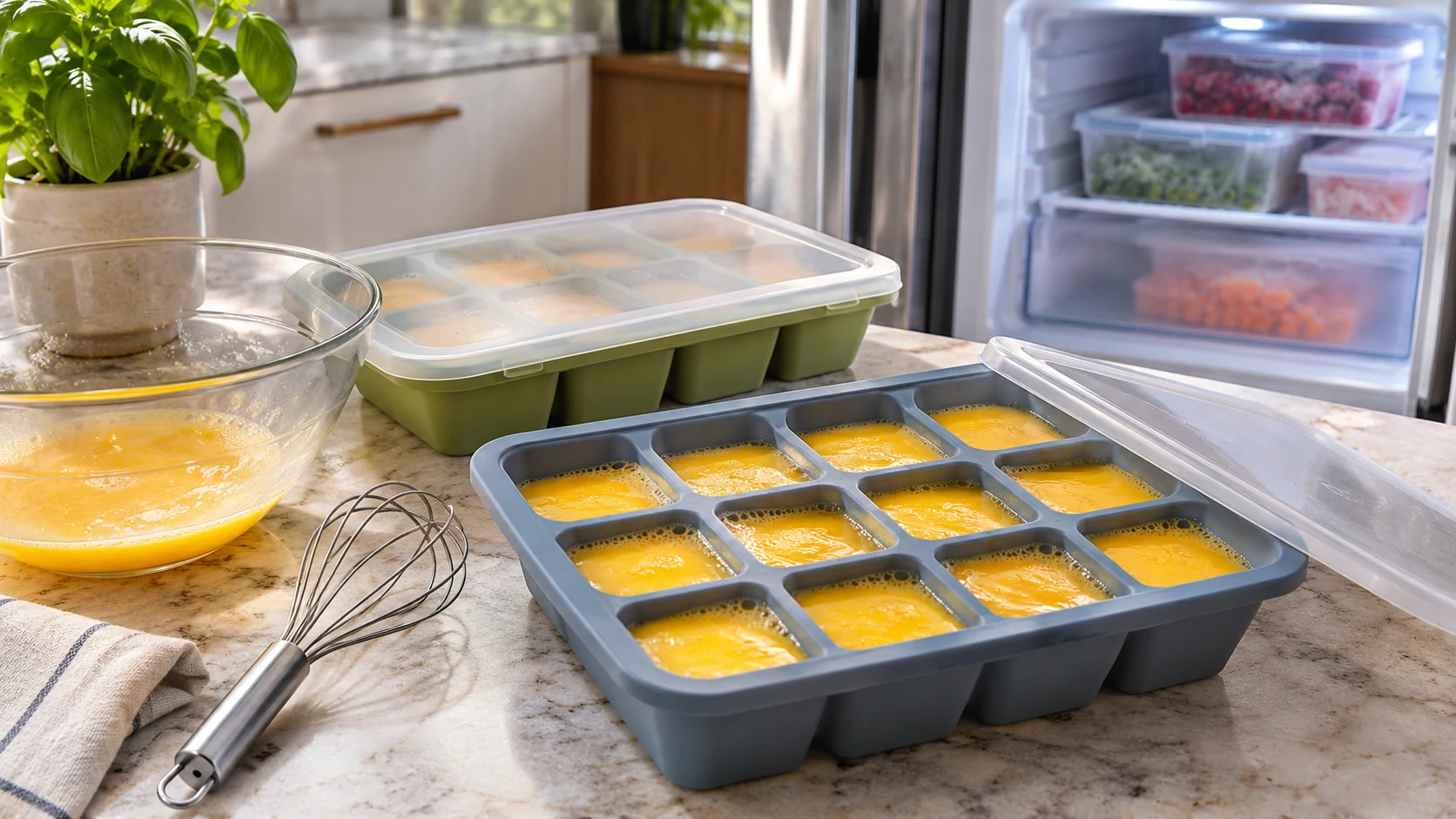
Pour into portions in a freezer-safe container, leaving room for expansion.
Freeze until solid.
Pop them out and transfer to airtight freezer bags: you will save a lot of space.
Label each bag with the number of eggs and the date.
Handy containers: ideally, freeze each egg separately so you can take out exactly the number you need. Flexible containers make it easy to pop them out: large ice cube trays, silicone muffin moulds, small airtight containers.
Freezing eggs in bulk
For large quantities, freezing each egg separately is not always practical. Bulk freezing is faster, but a container must be thawed all at once: size it to your usual needs. If two or three eggs are usually enough, do not put more than half a dozen eggs per container.
Crack the eggs into a bowl or blender.
Mix until smooth.
Divide into containers of the size you need, label (number of eggs, date) and freeze.
Freezing whites or yolks separately
If your recipes call for separate whites or yolks, separate them before freezing: it cannot be done once the egg is thawed.
Whites: no preparation
Raw whites freeze very well as is. Pour them into an ice cube tray and freeze: one standard cube is roughly one white.
Yolks: with a little salt or sugar
Untreated, yolks turn gel-like. Mix them, then for 4 yolks add about 0.5 mL (⅛ tsp) of salt or 7 mL (1½ tsp) of sugar. Salt suits savoury dishes, sugar desserts: note it on the label.
Storage time
For good quality, use frozen eggs within 12 months. Kept constantly at −18°C (0°F) or below, they remain safe beyond that, but their taste and cooking properties gradually decline.
Point to watch: a home freezer's temperature changes every time it is opened, especially near the door. Store the eggs at the back, label each container and follow the "first in, first out" rule. See Food stock rotation: ten practical rules.
What about a power outage? Keep the freezer closed: according to the US Department of Agriculture (USDA), a full freezer holds its temperature for about 48 hours, and about 24 hours if it is half full. To decide what to keep or throw out afterwards, see Power outage: checking the food in your fridge. It is also why the freezer should not be your only supply.
Thawing and using
In the fridge: the recommended method
Move the container to the fridge the day before. Slow thawing in the cold, at 4°C (40°F) or less, preserves quality and limits bacterial risk. It is the method to use for every purpose.
In cold water, if you are in a hurry
Put the sealed container in cold water, keep the water cold and cook the eggs as soon as they are thawed. Never thaw eggs in hot water or on the counter.
Use thawed eggs in thoroughly cooked dishes. For lightly cooked or raw recipes (mayonnaise, mousse), use pasteurized eggs instead: freezing does not kill germs. For whites to whip, thaw them in the fridge and take out only the amount you need.
Measurement equivalents
For eggs mixed before freezing:
| To replace | Use |
|---|---|
| 1 whole egg (large) | 45 mL (3 tbsp) of thawed egg |
| 1 yolk | 15 mL (1 tbsp) of thawed yolk |
| 1 white | 30 mL (2 tbsp) of thawed white |
In Quebec / In France
In Quebec and Canada: graded eggs sold in grocery stores are washed and must stay refrigerated. Buy them chilled, with clean, intact shells, and freeze them well before the "best before" date.
In France: eggs are not washed and are often sold at room temperature; once you have refrigerated them at home, keep them cold. The freezing method is the same.
Frequently asked questions
Can thawed eggs be refrozen?
Best avoided: quality declines and each thaw gives germs a chance to multiply. Freeze small portions so you only thaw what you need. Once cooked in a dish, eggs can be frozen again as a prepared meal.
Can frozen eggs replace powdered eggs in an emergency supply?
Not entirely. Frozen eggs depend on electricity; commercial powdered eggs keep without refrigeration, for the time stated by the manufacturer. The two complement each other: frozen eggs for everyday use, powder for the long-term supply.
How can I tell if frozen eggs are still good?
Check the date on the label and that the freezer has stayed at −18°C. After thawing, throw out any egg with an unusual smell. Ice crystals or a slightly different texture affect quality, not safety.
Read next
Food stock rotation
The "first in, first out" rule applied to food supplies, including frozen eggs.
Foods that need no refrigeration
To complement the freezer with a supply that does not depend on electricity.
Sources and verification references
Local instructions and product instructions take precedence for your situation. References consulted for this update:
Equipment to compare for your needs
Some links below are affiliate links: we may receive a commission at no additional cost to you. Products are examples by function, to choose according to your needs; buying the entire selection is unnecessary.