
In this article
- In brief
- Extreme heat and heat waves: what exactly are we talking about?
- What the numbers say
- Who is most vulnerable?
- Your home: your first piece of protective equipment
- Drinking, eating, dressing: the right habits
- Recognising heat stroke and responding
- Heat wave plus power outage: the scenario to prepare for
- A check-in network: the most effective measure
- Pets and heat
- Your pre-summer preparation checklist
- Frequently asked questions
- Sources
Heat makes no noise and leaves no visible damage. No torn-off roofs, no flooded streets: just days that drag on, nights that no longer cool down and homes that turn into ovens. That is exactly what makes it dangerous. During the 2018 heat wave in Montréal, 66 people died, and the vast majority of them died at home, without anyone noticing in time.
This guide covers the whole picture: what “extreme heat” and “canicule” actually mean in Québec and France, what the numbers say, who is most vulnerable, how to turn your home into a refuge, how to recognise heat stroke, and what to plan for if a heat wave comes with a power outage.
In brief
In brief. In Québec, extreme heat generally means daytime highs of 31 to 33 °C (88 to 91 °F) with nights staying above 16 to 20 °C (61 to 68 °F) for three days. Deaths mostly happen at home, among older, ill or isolated people. The three life-saving habits: keep your home closed and shaded during the day, spend at least two hours a day somewhere cool or air-conditioned, and check on vulnerable people every day.
Extreme heat and heat waves: what exactly are we talking about?
The words differ from one country to another, but the idea is the same: heat that lasts long enough, day and night, that the body can no longer recover.
In Québec
According to the Government of Québec, the extreme heat threshold varies by region. In general it means temperatures of 31 to 33 °C during the day and 16 to 20 °C at night, for three consecutive days. These thresholds come from public health research: for the island of Montréal, the reference indicator is a high of 33 °C (91 °F) combined with a low of 20 °C (68 °F), the point at which mortality rises sharply.
Environment and Climate Change Canada issues a heat warning when, for at least one hour, a temperature of 30 °C (86 °F) or more with a humidex of 40 or more is forecast, or a temperature of 40 °C (104 °F) or more.
The humidex combines temperature and humidity to express how hot it feels. Here is the official scale:
Humidex value
- 20 to 29: little discomfort20-29
- 30 to 39: some discomfort30-39
- 40 to 45: great discomfort, avoid exertion40-45
- Above 45: danger, heat stroke possible46 +
Source: Environment and Climate Change Canada
In France
In France, Météo-France includes heat in its weather warning map, department by department, using four colours. For a heat wave, yellow means a heat peak, orange means a heat wave (canicule) and red means an extreme heat wave. Municipalities also keep a register of vulnerable people who wish to be contacted during these episodes.
In both countries one point always comes up: hot nights are what kill. When the temperature no longer drops at night, the body does not recover, especially in a poorly insulated home that stores heat.
What the numbers say
Montréal, summer 2018
The summer 2018 heat wave caused 66 deaths in Montréal, according to the regional public health department. The profile of the victims is telling:
- 72% had a chronic disease;
- 66% were 65 or older;
- 25% had a schizophrenic disorder and 18% had an alcohol or addiction problem;
- 66% lived in an urban heat island;
- 80% died at home.
Montréal public health also stressed that low income and social isolation are major risk factors. During that episode, Urgences-santé received about 1,200 calls a day, 200 more than normal.
France: from 2003 to today
The August 2003 heat wave remains the benchmark: Inserm estimated the excess mortality at 14,802 deaths. The warning system has since been overhauled, but heat still kills every summer:
Number of deaths
- August 2003 (excess deaths)14,802
- Summer 2023over 5,000
- Summer 2024over 3,700
Sources: Inserm (2003), Santé publique France via vie-publique.fr (2023, 2024)
The review of summer 2023, the fourth hottest summer since 1900, shows the scale of the problem: four heat waves, 68 departments affected (73% of the population of mainland France), about 20,000 emergency visits for heat-related conditions and 10,600 hospitalisations. More than 5,000 deaths were attributable to heat over the whole summer, or 3% of total mortality, including more than 1,500 during heat wave episodes. Three deaths out of four involved people aged 75 and over. Eleven fatal workplace accidents possibly linked to heat were also recorded, mostly in construction.
These numbers show one thing: heat kills less spectacularly than insidiously. It worsens existing illnesses, dehydrates, exhausts, and strikes first those who cannot protect themselves.
Who is most vulnerable?
The Government of Québec identifies several higher-risk groups. If you recognise yourself, or think of someone close to you, your preparation should benefit them first:
- children under 5 and older adults;
- people losing autonomy or living alone;
- people with a chronic disease or a serious mental health condition;
- people with an alcohol or drug problem;
- people working outdoors or in hot environments (construction, agriculture, foundries, bakeries);
- people taking medications that can worsen the effects of heat;
- pregnant women;
- people without access to a cool or air-conditioned place.
Several factors make an episode more dangerous: high humidity, little or no wind, heat that arrives early in the season or after a cool spell, several days without relief, and hot nights. Cities are generally hotter than rural areas because of heat islands.
If you take prescription medication, ask your pharmacist before summer whether it increases your sensitivity to heat or dehydration. It is a two-minute question that can make all the difference.
Your home: your first piece of protective equipment
Since most deaths happen at home, preparation starts at home. The goal is simple: keep heat out during the day and let it out at night.
During the day: close and shade
- Close windows, curtains and blinds as soon as the sun hits the glass. Outdoor blinds, awnings and reflective films work better than indoor curtains because they stop heat before it gets through the window.
- Limit appliances that produce heat: oven, dryer, dishwasher, incandescent lighting. Cook early in the morning or switch to cold meals.
- Find the coolest room in your home (often the basement or a north-facing room) and make it your fallback room.
At night: ventilate
- Open windows when the outside air is cooler than the inside air, ideally creating a cross-draft between two sides of the home.
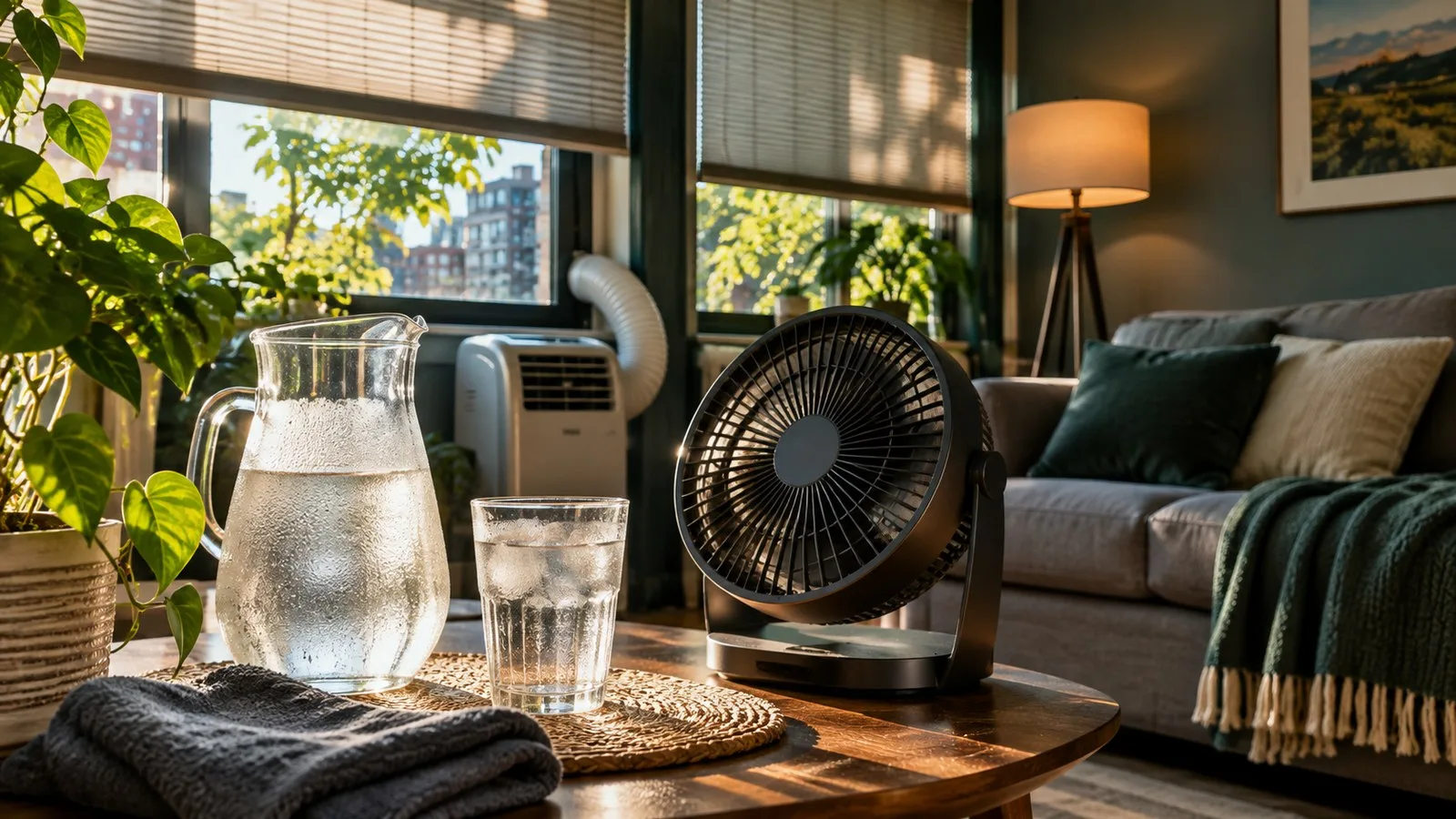
- A floor fan helps move the air. Keep in mind, however, that a fan moves air without cooling it: when it is very hot indoors, it does not replace a cool or air-conditioned place.
The backup: a cool place two hours a day
Québec public health recommends spending at least two hours a day in an air-conditioned or cool place. Identify those places around you now: libraries, shopping centres, community centres, cooling sites opened by your municipality. Note their opening hours and how to get there without a car.
Drinking, eating, dressing: the right habits
- Drink water before you feel thirsty. Thirst is a late signal, especially in older adults. Limit alcohol, which worsens dehydration.
- Store water ahead of time. The Government of Canada recommends about 4 litres (about 1 US gallon) per person per day in an emergency kit, for at least 72 hours. During a heat wave this supply really matters if water is cut off or you cannot go out.
- Dress light: loose, light-coloured clothing and a wide-brimmed hat outdoors.
- Shift your effort: physical activity before 11 a.m. or after 6 p.m. for adults; before 10 a.m. or after 4 p.m. for children.
- Cool your body: lukewarm showers or baths, a damp cloth on the neck and wrists.
Recognising heat stroke and responding
Heat stroke is the most serious effect of heat. It can come on suddenly and cause death very quickly if untreated. The signs, according to the Government of Québec:
- body temperature above 39.5 °C (103.1 °F) taken orally, or above 40 °C (104 °F) rectally;
- hot, dry, red skin, or on the contrary pale, cold skin;
- dizziness, confused speech, aggressive or unusual behaviour, general malaise.
Other symptoms should raise concern and call for close monitoring: headache, muscle cramps, swelling of the hands, feet or ankles, heat rash, unusual fatigue, nausea or vomiting, signs of dehydration.
Based on Government of Québec guidance.
- Warning signsMove the person somewhere cool, have them drink, sponge them down. Call Info-Santé 811 for an assessment.
- Symptoms that persist or worsenSee a doctor within two hours.
- Life-threatening emergencyDifficulty breathing, convulsions, confusion, agitation or loss of consciousness: call 911 immediately.
Source: Government of Québec
In France, call 15 (SAMU) or 112 in an emergency, and 0 800 06 66 66 for the free “Canicule” information line that the health authorities can activate during the summer.
In children, a fever above 38.5 °C (101.3 °F) rectally or 38 °C (100.4 °F) orally calls for action. And one absolute rule: never leave a child or an animal alone in a car, not even for a few minutes, not even with the windows cracked.
Heat wave plus power outage: the scenario to prepare for
A heat wave drives electricity demand up. A power outage can therefore happen at exactly the wrong time: no air conditioner, no fan, no refrigerator. That is the scenario that turns an unpleasant episode into a dangerous one. Prepare for it:
- Keep ice packs and frozen water bottles in the freezer: they cool a cooler and, once melted, become drinking water.
- A hard-sided cooler protects temperature-sensitive medication and food during an outage.
- Power banks and a solar charger keep your phone working so you can follow instructions and call for help.
- A hand-crank radio gives access to bulletins even without a network or electricity.
- A backup place to stay: an air-conditioned relative, a public place, a cool cottage. Decide beforehand, not during.
If you depend on an electric medical device (oxygen concentrator, dialysis machine, refrigerated medication), talk to your doctor and your electricity provider before summer: some offer priority registration.
A check-in network: the most effective measure
Four deaths out of five happened at home in Montréal in 2018, often among people living alone. The most effective measure cannot be bought: it is one phone call a day.
- Make a list of people to call during a heat wave: older parents, neighbours who live alone, friends who are ill.
- Agree on a daily check-in (call or visit) and a backup person if you are away yourself.
- Teach them the signs of heat stroke, and make sure they have water, a cool place and a way to reach 911.
- In France, every town hall keeps a heat wave register: people aged 65 and over, people with disabilities and isolated people or people under treatment can sign up to be contacted during a heat wave.
Pets and heat
Dogs tolerate heat poorly, especially short-nosed breeds and older animals. Walk them early in the morning or late in the evening, avoid scorching asphalt, always leave fresh water available and never leave them in a vehicle. A collapsible bowl lets them drink during outings.
Your pre-summer preparation checklist
- PrepareBlinds or reflective film, cool places identified, call list, water supply, medication reviewed with your pharmacist.
- ProtectHome closed by day and ventilated at night, two hours a day somewhere cool, drink regularly, daily call to loved ones.
- RecoverKeep drinking, watch vulnerable people for a few days, note what was missing for next time.
Frequently asked questions
Is a fan enough during a heat wave?
It helps move the air and makes heat more bearable, but it does not cool the air. When it is very hot indoors, you also need to spend time somewhere cool or air-conditioned and cool your body (lukewarm shower, damp cloth).
How much water should a family store?
The Government of Canada recommends about 4 litres per person per day, for at least 72 hours. For a family of four, that is about 48 litres (13 US gallons). Add water for pets.
Why are hot nights so dangerous?
Because the body recovers at night. When the temperature no longer drops, fatigue and dehydration build up day after day, especially in older or ill people. That is why warning thresholds take overnight lows into account.
Who should I call if in doubt?
In Québec: Info-Santé 811 for an assessment, 911 in an emergency. In France: 15 or 112 in an emergency, and 0 800 06 66 66 when the “Canicule” line is active.
Disclaimer. This article is meant for public information and preparedness. It does not replace advice from a health professional or instructions from the authorities. In a serious medical situation, call 911 (Canada) or 15 or 112 (France).
Sources
- Government of Québec, Extreme heat: what to do before, during and after (in French)
- Government of Québec, Health effects of oppressive and extreme heat (in French)
- INSPQ, Meteorological indicators and thresholds for heat wave warning systems in Québec (in French)
- Environment and Climate Change Canada, How to use the humidex
- Global News, 66 Montrealers died from extreme heat during 2018 heat wave
- French government, Heat waves; Service-public.fr, heat wave register (in French)
- Vie-publique.fr, Summer 2023 heat wave: over 5,000 deaths and Summer 2024: over 3,700 deaths (in French)
- Inserm, Excess mortality during the August 2003 heat wave (in French)
- Government of Canada, Emergency kits
Go further: the Heat wave hazard guide, the water storage calculator and PrépaCivile Watch to follow heat warnings live.