
In this article
- In brief
- From “grey man” to grey neighbour
- A thought-provoking account
- Before a crisis: don’t draw attention
- During a crisis: staying discreet when everyone is watching
- Discretion and mutual aid: finding the balance
- If someone knocks at your door
- What about weapons?
- In practice: the grey neighbour’s habits
- Frequently asked questions
The “grey man” concept is well known in preparedness circles: blend into the crowd, avoid drawing attention through your clothing, gestures or behaviour. It is usually applied to moving around in public. But what about your home, your supplies and your relationships with neighbours once a crisis has set in?
This article applies the idea to the household: how to stay discreet about your preparedness without cutting yourself off from your community, and how to balance protecting your family with helping others. Discretion is not an end in itself: its main purpose is to avoid unnecessary tension.
In brief
In brief. Being a “grey neighbour” means not turning your preparedness into a topic of conversation or a show: discreet deliveries, supplies stored out of sight, light and cooking smells kept in check during a prolonged outage. But research shows that mutual aid prevails in disasters: discretion works best when combined with active involvement in the neighbourhood, sharing skills and information rather than showing off supplies.
From “grey man” to grey neighbour
The grey man principle is simple: dress, move and act so you do not stand out. The idea first circulated mainly in the United States, among people who did not want to attract attention in public. It later broadened into a general strategy for avoiding becoming a target for ill-intentioned people. The basics of this everyday approach are covered in the article on everyday discretion and the grey man approach.
Applied to the household, the question becomes: what do your neighbours know about your supplies, your equipment and your level of preparedness? And what would happen if, in the middle of a prolonged crisis, that information became important to people who lack everything?
A thought-provoking account
A reader once wrote to us after reading an account widely shared on preparedness forums. The author, who said he had lived through a civil war, described what he called “survival hatred”: people angry at a neighbour because he had prepared without warning them, to the point of turning on him and his property, even after he had shared some of his supplies. Phrases like “he could have warned us” or “he must have stolen all that” summed up the resentment.
The story made our reader hesitate. He had been thinking of organizing his community’s resources ahead of any crisis. Would being known as “the prepared one” make him a target?
This kind of account needs context. It is an anecdote from a war situation, not a general observation. Disaster sociology, especially the work of Enrico Quarantelli and the Disaster Research Center at the University of Delaware, shows instead that mutual aid, not violence, is the most common response after a disaster. During Quebec’s 1998 ice storm, it was solidarity between neighbours that people remembered. Resentment exists, but it is the exception.
The lesson, then, is not to distrust everyone. It is to avoid putting your preparedness on display, and to favour organized mutual aid over improvised generosity under pressure.
Before a crisis: don’t draw attention
Discretion starts long before any crisis. The less people know about your supplies and equipment, your preparations or your views on the subject, the less they will think of you if something happens. That is the core of household OPSEC: protecting information about your family.
- Deliveries. A growing stockpile gets noticed. Have large orders delivered when few neighbours are around, or pick them up in store.
- Bulk purchases. A pack of toilet paper surprises no one; 20 kg (about 45 lb) bags of rice or several buckets of freeze-dried food unloaded at the front door are another matter. Unload in the garage or out of sight.
- Storage. Keep supplies in a closed space (basement, closet, garage) and spread them out rather than keeping everything in one place.
- Appearance. Camouflage clothing or visible tactical gear in daily life draws attention. Keep that kind of clothing for hunting or outdoor activities, where it goes unnoticed.
- Conversations. Talking about preparedness in general is useful; detailing what is in your basement is not, including on social media.
To go further, the article on privacy and a low profile in everyday life offers more practical examples of making a home less of a target.
During a crisis: staying discreet when everyone is watching
This is the hardest part. In a prolonged crisis, people have more time and attention for what is around them. Neighbours eventually talk, share information and compare situations. The timeline varies with the crisis: an earthquake destroys quickly and then gives way to rebuilding, while an economic collapse, a pandemic or a large-scale power failure sets in more slowly.
| What gets noticed | Why | How to stay discreet |
|---|---|---|
| Light at night | A lit house in a dark neighbourhood signals a power source | Black out windows (blackout curtains, film or heavy black plastic sheeting), use low-intensity lamps in an inside room |
| Generator noise | It carries a long way | Limit running hours, place it outside well away from openings (carbon monoxide risk), favour batteries and solar |
| Cooking smells | The smell of food carries far when people are hungry | Cook simply, heat water for freeze-dried meals, never use a camp stove or barbecue indoors |
| Comings and goings | Frequent trips arouse curiosity | Combine outings, keep a routine similar to your neighbours’ |
In a neighbourhood without power, a lit house can give the impression that you have resources others lack. Keeping your electricity invisible from the street avoids unnecessary questions, while still letting you charge batteries or run a fan or radio.
Over time, some people will probably notice that your family is coping better. Discretion does not make that reality disappear; it mainly keeps you from advertising it and lets you choose how and when you share.
Discretion and mutual aid: finding the balance
There is something to be said for charity, and something else for self-protection. The two are not necessarily at odds. In the long run, the best protection is often to be known as a useful neighbour rather than a neighbour with lots of supplies.
- Share skills rather than supplies. Knowing how to purify water, give first aid or repair a device helps others without revealing what you own.
- Go through collective structures. Contributing to a food bank, a shelter or a neighbourhood mutual aid group lets you help without making your home the area’s depot.
- Build the network before the crisis. Encouraging every household to prepare is the best way to keep everyone from turning to you. The human network is what makes a neighbourhood strong.
- Set aside a share to give. Some people deliberately keep a small supply meant for sharing (water, canned food, blankets), separate from the family’s own.
So our reader was right to want to organize his community now. What matters is doing it in a way that encourages everyone to prepare, rather than becoming the only source of supplies.
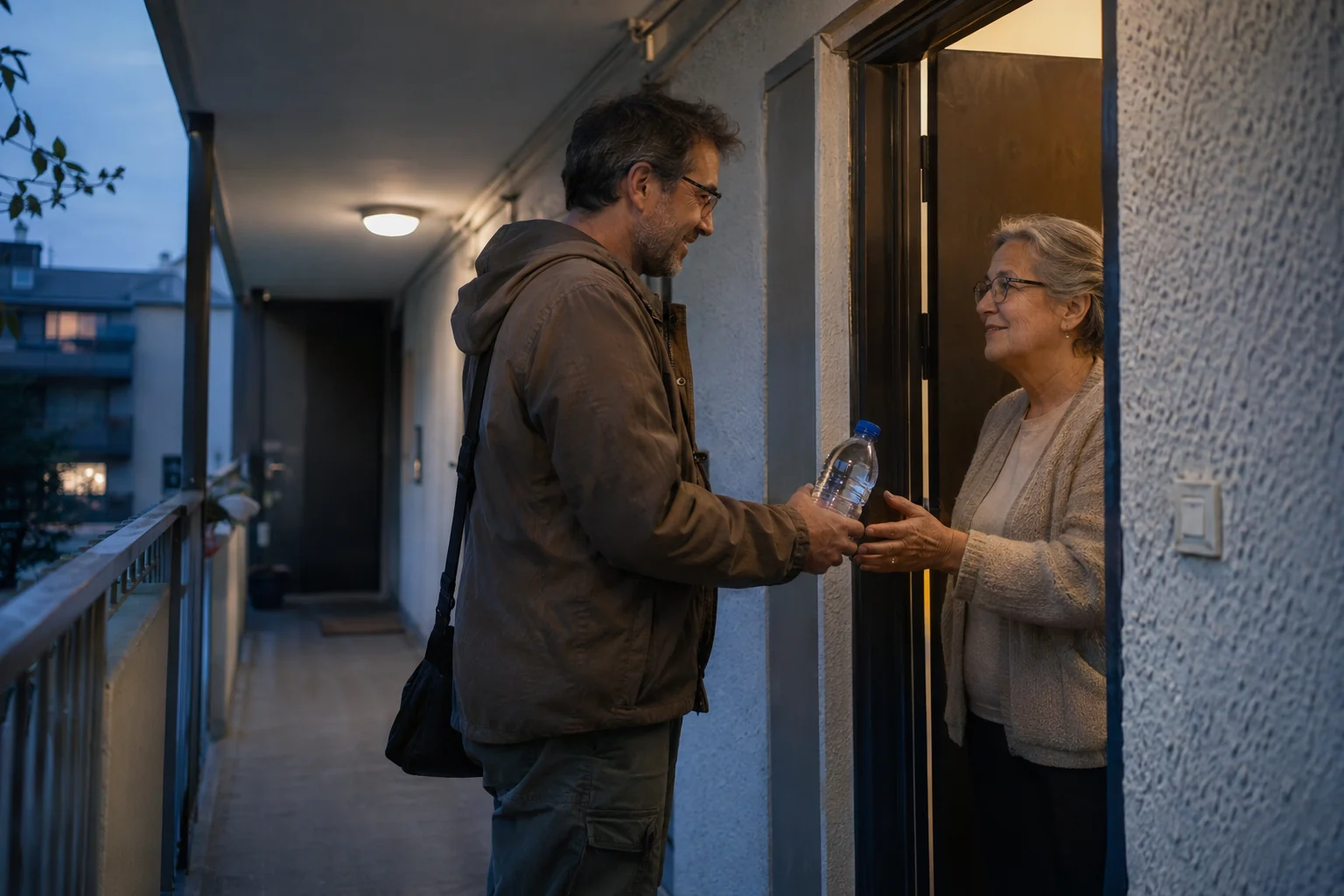
If someone knocks at your door
Even if you are very discreet, someone may one day knock at your door asking for help. It is better to have thought it through as a family beforehand:
- Decide in advance what you are willing to share and who answers the door.
- Talk without opening wide: a door held by a security chain, or a conversation through a window, lets you hear the request safely.
- Point to official resources: shelters, municipal distribution points, community organizations. Keep their contact details handy.
- Give modestly from the supply set aside for that purpose, without showing people around the house.
- If threatened, do not negotiate: step back, lock up and call 911 (17 or 112 in France).
What about weapons?
Some people imagine walking around armed and wearing ballistic protection if things got bad enough. That is precisely the opposite of the grey neighbour approach: visible gear draws attention, can worry neighbours and escalate a situation. In Canada, owning, transporting and using firearms is strictly regulated under the Firearms Act, and personal protection is almost never an accepted reason to carry a firearm in public. In France, carrying weapons is also heavily restricted. A household’s safety rests first on discretion, coordination with neighbours and the ability to avoid confrontation. See also protecting your family: personal safety and self-defence.
In practice: the grey neighbour’s habits
- Keep your inventory to yourselfTalk about preparedness, yes; detail your supplies, no.
- Store out of sightDeliveries, bulk purchases and supplies kept away from prying eyes.
- Control light, noise and smellsBlack out windows, limit the generator, cook simply and safely.
- Help through the communityShare skills, support mutual aid structures, keep a supply to give.
- Prepare your answer at the doorDecide as a family, point to official help, avoid any confrontation.
Practising the grey neighbour approach at home can delay, or even completely prevent, confrontations. That is probably its main benefit. To take stock of your own preparedness, try the preparedness review.
Frequently asked questions
Isn’t being discreet selfish?
No, as long as you do not confuse discretion with isolation. You can stay discreet about your supplies while actively helping through your skills, your time or a supply set aside for sharing.
Should you hide your preparedness from extended family or friends?
Not necessarily. Encouraging loved ones to prepare is a good idea. The point is not to share the details of your supplies beyond your circle of trust.
How can you have light at night during an outage without being noticed?
Use low-intensity or red-light lamps in an inside room, and black out windows with opaque curtains or heavy black plastic. Never use combustion heating or lighting without proper ventilation.
What if a neighbour becomes insistent or threatening?
Do not negotiate under pressure. Get to safety, lock up and contact emergency services. In less tense situations, point the person toward municipal and community resources.